About Innovation Hub
 Global Content Pulse (Webinars)


 Global Production Financing
(Webinars)
Global Production Financing
(Webinars)  LeaderSpeak Podcast
  Global Entertainment Digest (Newsletter)
  About Vitrina
 About VIQI
 Our Story
 Our Solutions 🔥
 Film+TV Projects Tracker 🚀
 Case Studies
 Our Profile
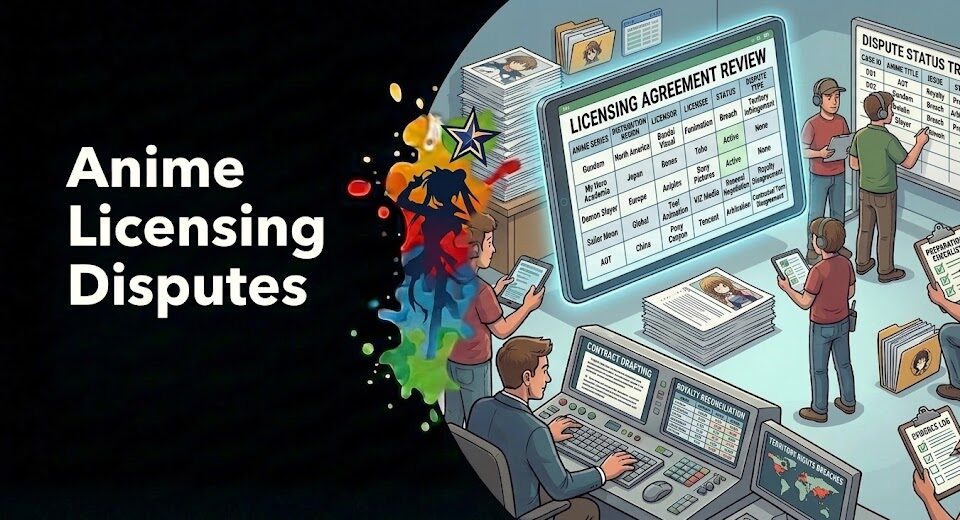
One day your favorite series is streaming. The next day it’s gone—and nobody’s explaining why. If you’ve followed anime long enough, you’ve lived this. Licensing disputes and rights conflicts are among the least-reported but most disruptive forces in anime distribution, and when they detonate, they don’t just inconvenience fans. They strand catalogs in legal limbo, wipe distributors off the map, and reshape the entire competitive landscape for years afterward.
The cases in this article are real. The damage was real. And the structural vulnerabilities they exposed—fractured production committee ownership, short-term license windows, opaque territorial splits—are still very much present in the market today. Whether you’re a distribution professional tracking deal risk, an acquisition lead building a slate, or a fan trying to understand why a title vanished, these disputes tell you more about how anime licensing actually works than any overview guide ever could.
Here’s what happened. And—more usefully—here’s what each case teaches the industry about structuring deals that don’t collapse under their own weight.
Table of Contents
- Why Anime Licensing Disputes Are Structurally Inevitable
- Geneon USA’s 2007 Collapse and the Funimation Rescue
- ADV Films vs. Sojitz: When a Rights Holder Pulls the Catalog
- 4Kids Entertainment’s Bankruptcy and the IP Fallout
- Bandai Entertainment’s 2012 Shutdown: When Licenses Outlive Companies
- The Funimation–Crunchyroll Merger and the 2022–2023 Title Purge
- Territorial Geo-Blocking: The Ongoing Rights Conflict Nobody Talks About
- What These Disputes Teach Licensing Professionals
- Frequently Asked Questions
- Conclusion
Ask VIQI: Which Anime Titles Have Active Rights Conflicts or Expired Licenses?
VIQI is Vitrina’s AI assistant—trained on 1.6 million titles, 360,000 companies, and 5 million entertainment professionals. Use it to surface rights holder histories, deal timelines, and distribution gaps before you commit to an acquisition.
✓ Included with 200 free credits | ✓ No credit card needed
Why Anime Licensing Disputes Are Structurally Inevitable
Before we get into the cases, you need the structural backdrop—because these disputes aren’t random failures. They’re the predictable output of how anime rights are held, split, and traded.
Japan’s production committee system—seisaku iinkai—means any given anime title is co-owned by 4 to 12 companies simultaneously. The animation studio, the manga publisher, the music label, the toy manufacturer, the broadcasting network—all of them hold a stake in the IP and must agree before international rights can be sold, renewed, or reassigned. When one committee member undergoes a corporate restructuring, gets acquired, or simply refuses to agree to a renewal, the entire international licensing structure for that title can freeze. The overseas distributor—who negotiated in good faith—suddenly can’t renew a deal that all parties want renewed, because one committee member won’t respond.
Layer onto that the fact that Western anime licenses are short. Standard streaming terms run 2 to 3 years. Home video licenses average 3 to 7 years. When terms expire and re-licensing negotiations stall—over price, territory, format, or committee disagreement—titles vanish from platforms, sometimes permanently. That’s not a malicious act. It’s the mechanical consequence of time-limited rights in a fragmented ownership structure.
And then there are the distributor-side collapses—companies that held licenses for dozens or hundreds of titles and simply ceased to exist. That’s where it gets genuinely messy. Our comprehensive guide to anime licensing and distribution strategy covers how professionals structure deals to avoid these outcomes. But first—let’s look at what happens when they don’t.
Geneon USA’s 2007 Collapse and the Funimation Rescue
Geneon Entertainment USA was, for most of the 2000s, one of the most respected anime distributors in North America. It held licenses to high-profile titles including Hellsing, Black Lagoon, Haibane Renmei, Rozen Maiden, and Trigun—a catalog that any distributor today would consider premium. In August 2007, Geneon USA abruptly announced it was ceasing distribution operations in North America.
The parent company—Geneon Entertainment, a subsidiary of Pioneer Corporation—had been retreating from the North American market for months. Declining DVD sales, a collapsing retail environment, and the rising cost of localization had made the North American operation financially unviable. The shutdown was immediate. Roughly 90 titles sat in licensing limbo: some mid-release, some with incomplete dub productions, some with manufacturing already underway.
What saved the catalog—at least partially—was a distribution agreement between Geneon USA and Funimation Entertainment, announced just weeks after the shutdown. Funimation didn’t acquire Geneon’s licenses outright. Instead, it became the distribution agent for a substantial portion of the catalog, handling physical releases and retail while Geneon technically retained the rights. It was a creative workaround that kept titles on shelves, but the split ownership structure created its own complications: certain titles eventually fell back into limbo when even that arrangement expired, and the Japanese rights holders had to be re-approached individually for each renewal.
The dispute lesson: Even a large, well-regarded distributor can collapse with 90+ active licenses mid-cycle. When it does, the titles don’t automatically find a new home. Each rights holder must individually agree to reassignment or re-licensing, and the process can take months to years. Fans waited over a decade to see some Geneon titles fully re-released with proper dubs. Distribution company stability is a genuine due-diligence variable—not an afterthought.

Your AI Assistant, Agent, and Analyst for the Business of Entertainment
VIQI AI helps you plan content acquisitions, raise production financing, and find and connect with the right partners worldwide.
- Find active co-producers and financiers for scripted projects
- Find equity and gap financing companies in North America
- Find top film financiers in Europe
- Find production houses that can co-produce or finance unscripted series
- I am looking for production partners for a YA drama set in Brazil
- I am looking for producers with proven track record in mid-budget features
- I am looking for Turkish distributors with successful international sales
- I am looking for OTT platforms actively acquiring finished series for the LATAM region
- I am seeking localization companies offer subtitling services in multiple Asian languages
- I am seeking partners in animation production for children's content
- I am seeking USA based post-production companies with sound facilities
- I am seeking VFX partners to composite background images and AI generated content
- Show me recent drama projects available for pre-buy
- Show me Japanese Anime Distributors
- Show me true-crime buyers from Asia
- Show me documentary pre-buyers
- List the top commissioners at the BBC
- List the post-production and VFX decision-makers at Netflix
- List the development leaders at Sony Pictures
- List the scripted programming heads at HBO
- Who is backing animation projects in Europe right now
- Who is Netflix’s top production partners for Sports Docs
- Who is Commissioning factual content in the NORDICS
- Who is acquiring unscripted formats for the North American market
ADV Films vs. Sojitz: When a Rights Holder Pulls the Catalog
The ADV Films situation is one of the most instructive licensing disputes in anime industry history—and one of the messiest.
ADV Films, based in Houston, was for years the dominant force in North American anime licensing. By the mid-2000s it held rights to hundreds of titles including Evangelion, Ghost in the Shell: Stand Alone Complex, Full Metal Panic!, Azumanga Daioh, and Air. The company had aggressively licensed at a pace and price level that required continuous strong DVD sales to sustain. When the DVD market started compressing around 2006–2008, the financial strain hit ADV hard.
But the critical rupture wasn’t a simple business failure—it was a rights-holder dispute. Sojitz Corporation, a Japanese general trading company that had co-financed a large portion of ADV’s licensing deals, exercised its contractual right to reclaim a substantial block of the licensed titles. The exact mechanism involved Sojitz’s ownership stake in a co-venture with ADV. When the relationship broke down, Sojitz effectively pulled roughly 30 high-profile titles from ADV’s catalog—including several that were mid-release—and transferred them to newly formed distribution entities.
The fallout was extraordinary. ADV essentially dissolved itself and reincorporated its assets across several new companies—Sentai Filmworks, Section23 Films, and Switchblade Pictures—to continue operating without the Sojitz-linked titles. Meanwhile, the titles Sojitz reclaimed landed at a different distributor entirely. Fans watching mid-series releases suddenly found themselves holding volume 3 of a series that would be completed by a company they’d never heard of, at a different price point, with different packaging.
The dispute lesson: Co-financing agreements with Japanese trading companies are not passive arrangements. If a rights-holder partner has contractual reclamation triggers embedded in a co-venture structure, those triggers can be pulled—legally, suddenly, and with no obligation to complete your release slate first. Any co-financed licensing deal needs legal review that addresses what happens to in-progress releases if the arrangement terminates mid-cycle.
Track Rights Holder Histories Before You Sign
Trusted by Netflix, Warner Bros, and Paramount. Vitrina’s platform covers 400,000+ projects and 140,000+ companies—de-risk your acquisitions by surfacing distributor track records, rights transfer histories, and ownership structures before you commit.
✓ 200 free credits | ✓ No credit card required | ✓ Cancel anytime
4Kids Entertainment’s Bankruptcy and the IP Fallout
No licensing dispute in American anime history was more publicly catastrophic than the collapse of 4Kids Entertainment—and arguably none did more reputational damage to a licensor in the eyes of Japanese rights holders.
4Kids held the North American licensing rights to Yu-Gi-Oh!, Pokémon (shared with The Pokémon Company), One Piece (for several years), and a large children’s programming slate. The company filed for Chapter 11 bankruptcy protection in April 2011, citing a dispute with TV Tokyo and Nihon Ad Systems over royalty payments and contract terms related to the Yu-Gi-Oh! license—a dispute that had escalated into a lawsuit the previous year.
The core allegation from the Japanese rights holders was that 4Kids had underpaid royalties—specifically, that 4Kids had failed to properly account for and remit sub-licensing revenue from the Yu-Gi-Oh! property. 4Kids disputed the figures. But the litigation—combined with weakening revenues from its children’s programming block—made the company’s financial position untenable. When it filed for bankruptcy, its licenses became assets in the estate, subject to court approval for any sale or reassignment.
The bankruptcy proceedings stretched into 2012. Japanese rights holders, who were simultaneously creditors and the ultimate owners of the IP, found themselves in the unfamiliar position of navigating US bankruptcy court. 4K Media—a new entity formed to manage the Yu-Gi-Oh! rights specifically—was eventually created by Konami to extract the property from the bankruptcy estate and continue its exploitation under direct Japanese oversight. The One Piece license had already reverted earlier, eventually finding a long-term home at Funimation.
The dispute lesson: Royalty accounting disputes are among the most common triggers for licensing relationship breakdown—and among the hardest to resolve quickly. Japanese rights holders who feel underpaid don’t just renegotiate. They terminate, litigate, and in extreme cases reclaim the IP through bankruptcy proceedings. Meticulous revenue reporting and transparent royalty accounting aren’t just administrative obligations. They’re the single most important relationship-maintenance tool a Western licensee has.
Bandai Entertainment’s 2012 Shutdown: When Licenses Outlive Companies
In January 2012, Bandai Entertainment—the North American arm of Bandai Namco Holdings—announced it would cease new physical media releases and significantly scale back operations. The company held licenses to flagship titles including Gundam (multiple series), Code Geass, The Melancholy of Haruhi Suzumiya, Lucky Star, and Gurren Lagann.
Unlike Geneon’s sudden shutdown, Bandai’s was strategic—a calculated exit from a physical media business that no longer made financial sense, rather than an emergency collapse. But the licensing consequences were nearly identical. Titles went into a grey zone where they remained technically licensed but weren’t being actively distributed. Reprints stopped. Out-of-print physical releases commanded steep secondary market prices. And the digital rights situation was murky enough that streaming platforms couldn’t move freely on titles still under Bandai’s held licenses.
The resolution was gradual rather than dramatic. Right Stuf (later acquired by Crunchyroll) eventually acquired some Bandai catalog titles. Others were re-licensed by Funimation. A handful of titles—particularly specific Gundam series—sat in limited availability for years while Sunrise (the production studio, a Bandai subsidiary) and various rights holders navigated re-licensing negotiations in what was itself a complex intra-corporate ownership structure.
The dispute lesson: A parent company’s decision to exit a market doesn’t automatically free up the licenses. Rights held by a subsidiary remain encumbered until formally reassigned or expired, even if the holding company has no commercial interest in exercising them. Fans and competing distributors both lose access during the limbo period—and that limbo can last years. Our full breakdown of anime home video distribution rights covers how these encumbrances are structured within physical license agreements.
The Funimation–Crunchyroll Merger and the 2022–2023 Title Purge
The most significant anime licensing disruption of the modern streaming era wasn’t a legal dispute in the traditional sense. It was a corporate merger—but its effects on content availability were indistinguishable from a licensing war.
Sony Pictures Television acquired Crunchyroll from AT&T’s WarnerMedia in 2021 for approximately $1.175 billion. Sony already owned Funimation. The intention—consolidating both platforms under a single Crunchyroll brand—was announced publicly. But what nobody fully anticipated was the volume of title removals that would follow as the two platforms’ overlapping license portfolios were rationalized.
Between 2022 and early 2023, hundreds of titles were pulled from Funimation’s streaming catalog as Sony migrated users and content to Crunchyroll. The removals weren’t arbitrary—they followed a logic of license deduplication and non-renewal of agreements that only made sense for one platform, not two. But to subscribers, the experience was a rolling wave of content disappearance. As reported by Variety, the consolidation displaced a significant portion of mid-tier and catalog anime off active streaming platforms entirely—either into Crunchyroll’s catalog or, for titles that weren’t prioritized in the migration, into a distribution gap that independent operators are still filling today.
Simultaneously, VRV—the Crunchyroll-adjacent bundle platform that had aggregated Crunchyroll, HiDive, and other anime services—was shut down in January 2023. HiDive, operated by Sentai Filmworks (since rebranded as HIDIVE, acquired by AMC Networks), had to be separated from the bundle and repositioned as a standalone competitor. The migration created real subscriber confusion—and real gaps in license continuity for titles that had been available on VRV through sub-licensing arrangements that no longer existed after the shutdown.
The dispute lesson: Corporate M&A is a licensing event. When two major anime streaming platforms merge, every overlapping license in both catalogs becomes a potential casualty of consolidation economics. Japanese rights holders don’t automatically benefit—they often find themselves re-negotiating from scratch with a merged entity that has different pricing leverage and content priorities than either predecessor. And competing distributors who built their supply assumptions around the old landscape need to reassess from the ground up. See our strategic breakdown of top anime distributors for how the post-merger landscape has restructured.
Territorial Geo-Blocking: The Ongoing Rights Conflict Nobody Talks About
Not all anime licensing disputes end up in a courtroom or a bankruptcy filing. The most pervasive form of rights conflict in modern anime distribution is quieter—and affects more fans globally than any single distributor collapse ever did. It’s territorial geo-blocking.
When a Japanese rights holder licenses a title to Crunchyroll for North America, to Wakanim (now Crunchyroll Europe) for France and Germany, and to a separate platform for Southeast Asia, the result is a fractured global availability map that looks nothing like the borderless internet fans actually use. A title available the day of broadcast in the US might be unavailable in Poland for 18 months. A series streaming on Crunchyroll in Australia might be unavailable in New Zealand because the ANZ territorial split assigned New Zealand rights to a different—or as yet unlicensed—holder.
These aren’t disputes in the legal sense. But they’re rights conflicts in the commercial sense—cases where the fragmentation of territorial rights across multiple licensees creates systematic access failures. The Fragmentation Paradox that drives margin erosion across the broader entertainment supply chain is particularly acute in anime, where production committees may split international rights into 15 to 25 separate territorial packages, each negotiated on a different timeline with a different licensee at a different price.
The practical consequence is a global fanbase that knows exactly what’s available in other territories and resents the gap. When Demon Slayer episodes air in Japan and immediately stream in North America but are unavailable in South Africa or the Philippines because those territorial licenses haven’t been placed, the rights conflict is invisible in the legal sense—but the commercial cost to Japanese rights holders in piracy and goodwill is measurable and real.
The dispute lesson: Territorial rights fragmentation isn’t a compliance issue—it’s a market intelligence problem. Rights holders who can’t quickly identify which territories are unlicensed for a given title are leaving revenue on the table and creating audience frustration that drives piracy. Distribution professionals who can map territorial gaps rapidly—and approach rights holders with specific, executable proposals for those gaps—have a genuine commercial edge over competitors who wait for rights holders to come to them.
What These Disputes Teach Licensing Professionals
Taken together, these cases point to the same set of structural vulnerabilities—and the same set of contractual safeguards that professional licensees use to de-risk their positions.
Clear reversion and assignment language is non-negotiable. Every licensing agreement should specify—precisely—what happens to in-progress releases if the licensee undergoes a change of control, insolvency, or operational shutdown. The Geneon case demonstrated that a “distribution agreement with an expiring licensee” is not the same as “a license in your hands.” The ADV/Sojitz case showed that co-financing provisions can include reclamation triggers that override the operational relationship entirely. These scenarios should be contractually addressed before ink dries, not litigated after crisis hits.
Royalty accounting systems matter as much as acquisition strategy. The 4Kids collapse was, at its core, a revenue accounting dispute. A transparent, auditable royalty reporting system that both parties can verify—and that reports on time, every quarter—removes the primary litigation trigger in most distributor-rights holder relationships. Many of the disputes in this article could have been avoided or resolved earlier with better financial infrastructure on the licensee side.
Monitor M&A activity as a licensing risk signal. The Funimation-Crunchyroll merger was publicly announced in 2021. Distribution professionals who tracked that event and modeled its implications for overlapping catalog rights had 12 to 18 months to position themselves ahead of the title purge that followed. Corporate M&A in the streaming sector is now a routine licensing event—and the operators who treat it as an intelligence signal rather than background noise consistently find themselves acquiring catalog rights that others didn’t see coming onto the market.
Distributor financial health is an acquisition due-diligence variable. Before licensing content from a sub-licensor, or before acquiring a title whose rights are held by a distributor, check that distributor’s financial position. Geneon’s problems were visible to attentive observers before the shutdown. ADV’s strains were known in the industry before the Sojitz break. A distributor with contracting revenues, significant debt, or parent-company restructuring activity is a rights-in-limbo risk—regardless of how many impressive titles are on their current slate.
Need Rights Intelligence Before Your Next Anime Acquisition?
Vitrina Concierge makes warm introductions directly to the rights holders and decision-makers relevant to your acquisition targets—not a list, a real conversation with a vetted counterparty.
- Korean animation studio → Netflix Adult Animation (week one)
- LA producer → Netflix UK, Fifth Season, Fox Entertainment (48 hours)
- Middle Eastern studio → Legendary Pictures (direct access)
Frequently Asked Questions
What causes anime licensing disputes most commonly?
The most common triggers are expired license windows with failed renewal negotiations, royalty payment disputes between Western licensees and Japanese rights holders, distributor insolvency that leaves licenses stranded in bankruptcy estates, and corporate M&A that creates overlapping or conflicting license ownership. Japan’s production committee system—where 4 to 12 companies may co-own a single IP—adds a structural layer of complexity that makes any renewal or reassignment dependent on unanimous committee agreement.
Why do anime titles get removed from streaming platforms without warning?
Almost always because a license term expired and wasn’t renewed in time, or because a corporate event—a merger, a distributor shutdown, or a rights holder reclamation—forced the title off-platform. Streaming platforms are legally obligated to remove content when they no longer hold valid licenses, regardless of when or how the license lapsed. The “no warning” aspect often reflects the distributor’s contractual inability to disclose pending non-renewals while negotiations are ongoing. By the time the deal formally fails, the removal is immediate.
What happened to the anime titles Geneon USA licensed when it shut down?
Funimation became the distribution agent for a substantial portion of the catalog through a post-shutdown agreement, handling physical releases while Geneon technically retained the rights. When that arrangement also expired, titles entered a second licensing cycle where Japanese rights holders had to individually re-engage with new licensees. Some titles—including Hellsing and Black Lagoon—were eventually re-licensed successfully. Others sat unavailable for years. The process underscored that distribution agreements and license ownership are two different instruments, and losing one doesn’t automatically transfer the other.
How did the 4Kids bankruptcy affect anime licensing relationships with Japan?
It damaged them substantially. Japanese rights holders—particularly TV Tokyo and Nihon Ad Systems—were forced to navigate US bankruptcy court as creditors to recover their IP and unpaid royalties. The experience reinforced Japanese rights holders’ preference for licensing to financially stable, verifiable partners rather than maximizing upfront MG commitments from companies whose financial resilience was unclear. Post-4Kids, royalty accounting audits became more common in Japanese licensors’ standard contract requirements. Konami created a dedicated entity—4K Media—specifically to remove Yu-Gi-Oh! from the bankruptcy estate and manage it under direct Japanese oversight.
How does a licensing dispute get resolved when a distributor goes bankrupt?
Anime licenses held by a bankrupt distributor become assets in the bankruptcy estate, subject to court oversight. Three common outcomes: (1) The license is sold to another distributor as part of an asset sale, with the Japanese rights holder’s consent required for assignment; (2) The license expires during proceedings, reverting cleanly to the rights holder for re-licensing; (3) The rights holder successfully argues in court that the license should revert immediately due to breach of contract—typically the most favorable outcome for Japanese IP owners. The timeline for any of these paths typically runs 6 to 24 months from bankruptcy filing to resolution.
What did the Funimation–Crunchyroll merger mean for anime licensing disputes and rights conflicts?
The merger concentrated anime streaming rights in North America and Europe under Sony’s Crunchyroll umbrella to a degree the industry hadn’t seen before. Titles that had been licensed separately to Funimation and Crunchyroll became redundant entries in a merged catalog, leading to selective non-renewals—what fans experienced as the 2022–2023 title purge. For the broader market, the merger created a rights vacuum in the catalog and mid-tier segment that independent operators have been actively filling. VRV’s shutdown in January 2023 added additional disruption by collapsing a bundle model that had given multiple smaller platforms shared access to Crunchyroll’s library.
Can fans do anything when an anime licensing dispute causes a title to disappear?
Practically, no—not in the short term. But physical ownership of a legitimately licensed release protects access regardless of what happens to streaming agreements. Owning a Blu-ray or DVD of a title insulates you from every streaming expiry, platform shutdown, or geo-blocking change that affects digital access. From an industry perspective, fan demand is genuinely tracked by Japanese rights holders when they’re evaluating re-licensing—persistent social media campaigns and measurable streaming demand (even from unofficial sources) are factors that rights holders account for when deciding whether to push through a re-licensing deal for a title with a troubled history.
Conclusion: Disputes Are the X-Ray of How Licensing Actually Works
Every case in this article is a failure mode—but also a working diagram of the structural mechanics that make anime licensing so much more complex than it appears from the outside. Production committee fragmentation, short license windows, co-financing provisions with embedded reclamation rights, royalty accountability gaps, and M&A-driven catalog reshuffling: these aren’t edge cases. They’re standard-issue features of the market, active in thousands of deals right now.
Key Takeaways:
- Geneon USA (2007): Distributor collapse with 90+ active titles proved that distribution agreements and license ownership are two separate instruments—losing one doesn’t transfer the other.
- ADV Films vs. Sojitz: Co-financing provisions can include contractual reclamation triggers that override operational relationships—and can fire mid-release-cycle without warning.
- 4Kids Entertainment: Royalty accounting disputes are among the most common licensing relationship killers—and can push Japanese rights holders into US bankruptcy court as creditors.
- Funimation–Crunchyroll merger: Corporate M&A is a licensing event. The 2022–2023 title purge was predictable 18 months in advance for operators tracking the deal’s catalog implications.
- Territorial geo-blocking: The most pervasive form of rights conflict isn’t a legal dispute—it’s a data deficit. Rights holders and distributors who can map unlicensed territorial gaps in real time close deals faster and lose less revenue to piracy.
De-Risk Your Next Anime Acquisition With Real-Time Rights Intelligence
Trusted by Netflix, Warner Bros, Paramount, and Google TV. Track 400,000+ projects. Access 3 million verified executives. Ask VIQI strategic questions about distributor histories, rights conflicts, and territorial gaps.
✓ 200 free credits | ✓ No credit card required | ✓ Cancel anytime
Need direct introductions to anime rights holders? Explore Concierge Service →
Find Film+TV Projects, Partners, and Deals – Fast.
VIQI matches you with the right financiers, producers, streamers, and buyers – globally.
Producers Seeking Financing, Co-Pros, or Pre-Buys?
Vitrina Concierge helps producers reach the right financiers, commissioners, distributors, and co-production partners — with precision outreach, not cold pitching.
Join Industry Briefings Trusted by Leaders

Books, Novels & Comics Adaptations: Global Trends
Books, webtoons, and manga driving the next global screen hits. Discover how in this webinar.

Micro-Dramas & Mobile-First Storytelling
Micro-dramas are building real audiences and revenue. Understand the platforms, buyers, and economics behind the growth.

Navigating Global Content Licensing Trends
How global content licensing is shifting beyond flat fees to flexible, deal-driven models.