IHUB
IHUB
 Private Briefings (Webinars)


 LeaderSpeak Podcast
  Global Entertainment Digest (Newsletter)
  Premium Lists
 Membership Benefits
 About Vitrina
 Our Story
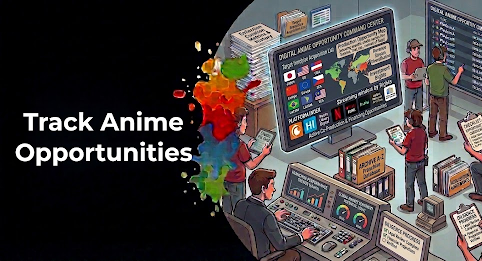
Vitrina is the anime industry’s real-time supply-chain intelligence platform. It gives buyers, distributors, and rights teams visibility into which titles are available, which platforms hold rights by territory, and which producers are actively seeking distribution partners — replacing annual festival contacts and email chains with structured, searchable intelligence updated continuously across 150+ countries and 140,000+ tracked companies.
Japan’s anime market generated $25.1 billion in 2024, with overseas revenue now accounting for 56% of that total and growing at 26% year-over-year. For buyers, distributors, and rights teams operating in this market, the volume of activity has outpaced the intelligence infrastructure most teams are using to track it.
Most acquisition teams still rely on festival contacts, email chains with Tokyo agents, and annual attendance at AnimeJapan or TIFFCOM. This guide explains where those methods fall short, how Vitrina addresses each gap, and how to integrate anime intelligence into your existing acquisition workflow.
Key Takeaways
- Japan’s anime overseas revenue grew 26% in 2024 — creating more acquisition opportunities than traditional scouting methods can track at scale
- Vitrina maps title availability, platform rights by territory, and active seller mandates — updated continuously, not once a year at a market event
- Acquisition teams using structured intelligence platforms identify viable targets months earlier than teams relying on festival networks alone
- VIQI AI lets acquisition teams query the full supply-chain database in plain language: “Which anime titles have open SVOD rights in Southeast Asia for Q3 2026?”
- Vitrina covers the full supply chain: rights holders, studios, producers, distributors, and sub-licensors across the global anime ecosystem
- Concierge support is available for teams that need active shortlisting, RFI dispatch, and targeted introductions — not just raw platform access
Table of Contents
- The Intelligence Problem in Anime Rights Acquisition
- How Vitrina Addresses Each Gap
- Vitrina vs. Traditional Research Methods
- Who Uses Vitrina for Anime Intelligence
- Vitrina’s Three Core Products for Anime Teams
- How Vitrina Fits Into Your Acquisition Workflow
- Getting Started With Vitrina
- Frequently Asked Questions
Replace annual market contacts with real-time anime rights intelligence — title availability, territory rights, and seller mandates, continuously updated.
The Intelligence Problem in Anime Rights Acquisition
The anime rights market has three structural intelligence gaps that manual research and market attendance cannot fill at scale.
Gap 1 — You Don’t Know What’s Available Until It’s Already Gone
The most commercially significant anime titles are committed 12-18 months before Japanese broadcast — at the production committee stage, before public announcements, before market showcases, before trade press coverage. By the time a title appears at AnimeJapan or is listed in a market catalog, the window for first-look negotiation has already closed for the most competitive buyers.
Teams that discover titles through public announcements are systematically competing against buyers who discovered them earlier. The information gap is the competitive gap.
Gap 2 — Rights Availability Is Opaque by Default
Even when a buyer knows a title exists, knowing which rights are genuinely available in which territories requires either direct outreach to the Japanese sales agent — which takes time and relationships — or attendance at the specific market session where the rights holder is present. For buyers managing pipelines of 50-200 titles across multiple territories and windows, this is an unscalable research burden.
Production committee structures compound the problem: the entity offering a title may hold streaming rights but not dub rights. Another committee member may control FAST rights. A prior licensee’s exclusivity may still be running in your primary territory. None of this is visible without direct engagement, and direct engagement takes weeks per title at minimum.
Gap 3 — Comparable Deal Intelligence Is Practically Unavailable
What did a comparable title trade at in the last 18 months? What exclusivity window did the buyer negotiate? Which markets did the deal cover? This intelligence — which would allow buyers to price offers correctly and avoid overpaying — is almost entirely absent from public sources. Acquisition teams either rely on institutional memory from previous deals or on the sales agent’s asking price, which is structured to maximize the licensor’s return.
How Vitrina Addresses Each Gap
Vitrina is a global film and TV supply chain intelligence platform that maps relationships, production activity, and market positioning across 300,000+ active companies worldwide. For anime acquisition teams, the platform operates across three specific use cases that directly address the intelligence gaps above.
Production Pipeline Tracking
Vitrina’s production tracking surfaces anime titles at the pre-production and early production stage — before public announcements, before market catalogs, before most buyers have heard of the show. For acquisition teams who want to identify titles during the 12-18 month pre-broadcast window when negotiating leverage is highest and prices are most favorable, this is the starting point.
The platform maps production committee relationships — which studio is producing, which broadcaster is attached, which music label is involved, which international sales agent has historically handled the committee’s international rights — giving buyers a clear picture of who to contact, not just what to track.
Rights Holder and Sales Agent Mapping
For every title in its database, Vitrina maps the rights holder network: who holds which rights, in which territories, and which sales agents and distributors have existing relationships with those rights holders. For an acquisition team preparing for AnimeJapan or TIFFCOM, this means arriving with a prioritized list of meetings based on actual rights availability — not a general networking agenda.
The platform’s relationship graph shows which international platforms have existing licensing relationships with specific production committees or sales agents. This tells a buyer whether a target title is likely already spoken for with a competitor — and which titles have open territory availability that represents a genuine acquisition opportunity.
For a deeper look at how territory restrictions affect the value of anime rights deals, see: Anime Regional Rights: How Windowing and Territory Restrictions Affect Value
Market Intelligence for Deal Benchmarking
Vitrina’s supply chain data includes deal activity signals — which platforms are acquiring in which markets, which territory clusters are seeing increased competition, and how acquisition patterns have shifted across recent market cycles. This intelligence doesn’t replace legal deal records, but it gives acquisition teams the market context to price offers more accurately and to identify territories where competition is lower relative to demand.
For Southeast Asia specifically — where the anime streaming market is valued at $1.26 billion and growing at 8.4% CAGR toward $2.60 billion by 2033 (IMARC Group, 2024) — Vitrina’s regional supplier and buyer mapping identifies which platforms are actively acquiring, which territories are underserved, and which rights holders are actively seeking new regional partners.
Southeast Asia’s anime streaming market is valued at $1.26 billion and projected to grow at 8.4% CAGR to reach $2.60 billion by 2033 (IMARC Group, 2024). For acquisition teams building regional distribution strategies, this growth trajectory — combined with Vitrina’s mapping of active buyers and available rights across Indonesian, Thai, Philippine, Malaysian, and Singaporean markets — represents a quantifiable opportunity window for early-mover positioning.
See What Vitrina Can Do for Your Team
From simulcast tracking to library due diligence — Vitrina gives anime acquisition teams the intelligence layer the market has always needed.
- ✓ Title availability and rights status across 150+ territories
- ✓ Active seller mandates updated continuously — not just at TIFFCOM
- ✓ Platform rights holdings with holdback expiry intelligence
Vitrina vs. Traditional Research Methods
Understanding where Vitrina fits requires understanding why traditional research methods fail at scale. The four approaches most acquisition teams currently use — trade publications, market attendance, IMDbPro/Luminate, and cold outreach — each have structural limitations that compound as market velocity increases.
| Method | What It Tells You | What It Misses | Timing |
|---|---|---|---|
| Trade press (Variety, Deadline) | Announced deals, market headlines | Pre-announcement activity; projects that never get press | Downstream — news = deal already done |
| Festival / market attendance | What sellers want to show; structured pitch meetings | Titles not yet in a sales campaign; emerging markets; 51 weeks of activity between events | 2-4 times per year |
| IMDbPro / Luminate | Credits, past performance, completed projects | Active pre-production pipeline; real-time rights status; who’s actually acquiring right now | Static; self-reported; updated infrequently |
| Cold outreach to Tokyo agents | Direct rights availability for specific titles | Competitive activity; comparable deal benchmarks; multi-title pipeline view | Weeks per title; relationship-dependent |
| Vitrina | Production pipeline, rights holder network, buyer mandates, territory availability | Nothing — built to surface what the others miss | Continuously updated; pre-announcement |
The Bloomberg Terminal for Film & TV
Vitrina’s positioning as the “Bloomberg Terminal for the film and TV industry” reflects how acquisition executives describe its core value: real-time market intelligence that replaces reactive, relationship-dependent research with structured, continuous data coverage across the global supply chain.
Who Uses Vitrina for Anime Intelligence?
Vitrina serves three distinct user groups across the anime supply chain, each with different intelligence needs.
Content Acquisition Teams at Streaming Platforms
For SVOD and AVOD platforms building anime catalogs, Vitrina’s primary value is pre-market title identification and rights holder mapping. Acquisition teams use the platform to build their market meeting agenda — knowing before they land in Tokyo which production committees have available titles in their target territories and budget range, and which sales agents to prioritize based on the committee relationships they manage.
Netflix reports that more than 50% of its global subscriber base watches anime (Netflix Newsroom, 2025). For platforms building toward that level of catalog depth, identifying the right titles at the right stage of production — before competitors do — is a direct competitive advantage.
International Sales Agents and Distributors
For sales agents representing Japanese production committees internationally, Vitrina provides buyer intelligence — who is actively acquiring in which territories, which platforms have existing catalog gaps in specific genres or markets, and which buyers have the acquisition budget and strategic focus to close a deal on a given title type.
This is the sell-side equivalent of the acquisition team’s buy-side research. Sales agents who arrive at market with a prioritized list of qualified buyers — buyers whose acquisition patterns align with the title they’re selling — close deals faster and at better terms than agents who rely on general market attendance and inbound inquiries.
Rights Teams at Studios and Production Companies
For studios and production companies managing existing anime libraries, Vitrina’s territory availability mapping helps identify markets where rights are underutilized — territories where existing licensees’ exclusivity windows have expired, FAST rights are available but haven’t been placed, or sublicensing opportunities exist that the current distribution structure isn’t capturing.
Japan’s government has set a target of tripling overseas content sales to approximately $131 billion by 2033 (Variety, 2025). For production companies participating in that growth trajectory, systematic rights territory management — knowing exactly what’s available, what’s committed, and what’s expiring — is a revenue optimization function that Vitrina’s data directly supports.
JETRO facilitated 220 business talks between 69 international buyer companies from 28 countries and Japanese content providers at AnimeJapan 2024. The volume of structured business matching activity at a single market event reflects both the depth of global demand for Japanese anime rights and the extent to which that demand currently exceeds the capacity of informal relationship networks to facilitate efficiently.
Vitrina’s Three Core Products for Anime Teams
Vitrina’s anime intelligence capabilities are delivered through three integrated products, each designed for a specific point in the acquisition workflow.
Project Tracker
Pre-announcement title intelligence and rights mapping
Vitrina’s Project Tracker surfaces anime titles during the 12-18 month pre-broadcast window — when prices are lowest and competition is minimal. For each title, the platform maps production committee structure, studio attachments, broadcaster commitments, international sales agent relationships, and territory rights availability. Updated continuously, not at market intervals.
VIQI AI
Natural language queries across the full supply chain
VIQI is Vitrina’s AI query interface — ask it in plain language: “Which anime titles have open SVOD rights in Southeast Asia for the Fall 2026 season?” or “Find production committees actively seeking co-production partners for action titles.” VIQI searches 300,000+ companies and 1.6 million+ active titles and returns verified intelligence in seconds.
Vitrina Concierge
Verified introductions to rights holders and buyers
For senior executives who need a direct introduction to the right production committee or sales agent — not a database to search. Concierge combines Vitrina’s intelligence platform with human research and outreach, delivering verified introductions to the specific counterpart for each deal. Built for executives whose time is better spent negotiating than researching.
How Does Vitrina Fit Into Your Acquisition Workflow?
Vitrina is not a replacement for market attendance, agent relationships, or legal due diligence. It is a pre-research and qualification layer that makes all of those activities more efficient.
Before Market (3-4 Weeks Before AnimeJapan, TIFFCOM, or MIP)
An acquisition team uses Vitrina to build a prioritized title watchlist and a structured meeting agenda. The watchlist identifies titles at the pre-production stage that match the platform’s genre criteria, territory needs, and budget range. The meeting agenda maps each target title to the rights holder and sales agent who control the relevant rights, so every meeting has a specific commercial purpose — not just a networking objective.
During Market
At market, Vitrina’s relationship data surfaces second-order connections — the Japanese sales agent managing a target title also represents three other titles in the buyer’s watchlist, making a broader conversation more efficient. The platform’s buyer intelligence identifies which competitors are actively pursuing the same rights, giving the acquisition team real-time context for how aggressively to move on priority titles.
After Market
Post-market, Vitrina’s rights availability tracking monitors expiring exclusivity windows on titles the team was unable to acquire during the initial market cycle. A title locked with Crunchyroll for North America in a 24-month exclusive deal signed in 2023 has an availability window opening in 2025 — Vitrina surfaces that expiry in time for the acquisition team to approach the licensor before competitors do.
Between Markets (the 51 Weeks That Aren’t AnimeJapan)
This is where Vitrina delivers the most differentiated value. The global anime rights market moves continuously — new production committees form, sales agents take on new titles, exclusivity windows expire, FAST rights open up. Teams relying on annual market cycles miss 51 weeks of deal flow. Vitrina’s continuous tracking means the acquisition pipeline is always live, not just during the 2-3 weeks of major market events.
For a detailed look at how anime simulcast deals are structured across key territories, see: How Anime Simulcast Deals Are Structured Across Japan, the US, and Southeast Asia
Your Annual Market Trip Can’t Keep Up
The global anime rights market moves 365 days a year — AnimeJapan and TIFFCOM are highlights, not the full picture.
Vitrina continuously tracks title releases, rights changes, new seller mandates, and platform acquisitions across Japan and 60+ markets — giving your team the intelligence cadence the market now demands.
Getting Started With Vitrina for Anime Intelligence
Vitrina offers three access points depending on team size, workflow, and use case. All three are available from day one with no credit card required for initial access.
Option 1
Self-Serve Platform Access
For acquisition teams who want direct access to Vitrina’s production tracking, rights holder mapping, and territory intelligence. Start with a search on your current target titles — seeing the platform’s production committee mapping, rights holder network, and buyer relationship graph for titles you already know provides an immediate benchmark for Vitrina’s coverage and depth.
Option 2
VIQI AI
For teams who want to query the supply chain without learning a new interface. Ask VIQI a question about your specific acquisition scenario — open rights in a territory, active mandates in a genre, production committees seeking co-production partners — and get structured intelligence back in seconds.
Option 3
Vitrina Concierge
For senior acquisition executives and rights teams who need introductions, not just data. Concierge handles the research, qualification, and outreach — delivering a shortlist of verified counterparts for each deal scenario, with active relationship management from a dedicated team member.
Start Acquiring Anime Rights With Better Intelligence.
Vitrina’s anime platform is built for the speed and complexity of the global rights market. Join the acquisition teams already using Vitrina to move faster, target better, and close more deals.
No credit card required · Free tier available · Premium plans from day one
Frequently Asked Questions
Does Vitrina cover both major franchise titles and smaller independent anime productions?
Yes. Vitrina’s database covers 140,000+ active film and TV suppliers globally, including major Japanese animation studios, mid-tier production companies, and independent studios producing seasonal anime. The platform’s production tracking covers titles across the full budget and profile spectrum — from major franchise sequels to new IP from emerging studios that represent early acquisition opportunities before they attract mainstream attention.
How current is Vitrina’s production data?
Vitrina’s data is updated continuously through its supply chain tracking system, which monitors production activity signals across the global film and TV market. For anime specifically, the platform tracks production committee formation, studio attachments, broadcaster commitments, and international sales agent relationships — all signals that surface title availability before public announcements.
Can Vitrina help identify anime rights opportunities in Southeast Asia specifically?
Yes. Southeast Asia’s anime market is valued at $1.26 billion and projected to reach $2.60 billion by 2033 (IMARC Group, 2024), with paid streaming accounts across the region exceeding 61 million in 2025. Vitrina’s regional supplier and buyer mapping identifies active acquirers, available rights, and existing distribution relationships across Indonesian, Thai, Philippine, Malaysian, and Singaporean markets.
Is Vitrina useful for rights holders and sales agents, or only for buyers?
Both. Buyers use Vitrina to identify titles, map rights holders, and qualify acquisition opportunities. Rights holders and sales agents use the platform’s buyer intelligence to identify which platforms are actively acquiring in their titles’ key territories, which buyers have catalog gaps that match the content they’re representing, and how to prioritize outreach before and during market events.
How does Vitrina compare to attending market events directly?
Market attendance and Vitrina work best together. Market events create relationship context and enable real-time deal conversations. Vitrina provides the pre-market research layer that makes those conversations more targeted and productive — arriving with a specific title watchlist, qualified meeting agenda, and rights availability data transforms a general networking event into a structured acquisition sprint.
How does VIQI AI work for anime acquisition?
VIQI is Vitrina’s natural language query interface. Instead of navigating a database, you ask VIQI a direct question: “Which production committees are actively seeking international co-production partners for action anime?” or “Which platforms hold SVOD rights to a specific title in Southeast Asia and when do those rights expire?” VIQI searches Vitrina’s full supply-chain database and returns verified, structured intelligence.
What is Vitrina Concierge and when should I use it?
Vitrina Concierge is a premium, human-backed service for acquisition executives who need direct introductions rather than self-serve data access. Concierge assigns a dedicated team member who researches your specific deal scenario, identifies and qualifies counterparts, and makes a verified introduction on your behalf. Best suited for senior executives managing high-value deal scenarios where relationship context matters more than database access.
What intelligence gaps does Vitrina solve that IMDbPro and Luminate don’t?
IMDbPro and Luminate show you what already happened — completed productions, released titles, past deal announcements. Vitrina shows you what’s happening — titles in pre-production 12-18 months before broadcast, active acquisition mandates in real time, rights availability before titles go to market. The difference is the difference between reading the news and having a source.
Intelligence Is the Acquisition Advantage
The global anime rights market is growing faster than the informal information networks most acquisition teams rely on. JETRO facilitated 220 business talks between 69 international buyers and Japanese content providers at a single 2024 market event — a number that reflects the volume of deal activity happening in this market and the extent to which structured market access is now a prerequisite for participating effectively.
Teams that identify the right titles earliest, understand rights availability most accurately, and arrive at negotiation with the most complete market context consistently close better deals. Vitrina provides that intelligence layer — across production pipeline tracking, rights holder mapping, buyer intelligence, and territory availability monitoring — for the anime market and the broader global film and TV supply chain.
For acquisition teams ready to go deeper, start with these resources:
- Anime Licensing for Streamers and Buyers: The Complete Executive Guide
- Anime Regional Rights: How Windowing and Territory Restrictions Affect Value
About the Author

Sandeep Nikanke
An analyst exploring the entertainment supply chain — from how media is made to how it reaches your screen. At Vitrina, Sandeep maps global acquisition workflows, rights structures, and platform strategies to help content buyers and distribution teams make faster, better-informed decisions.