About Innovation Hub
 Global Content Pulse (Webinars)


 Global Production Financing
(Webinars)
Global Production Financing
(Webinars)  LeaderSpeak Podcast
  Global Entertainment Digest (Newsletter)
  About Vitrina
 About VIQI
 Our Story
 Our Solutions 🔥
 Film+TV Projects Tracker 🚀
 Case Studies
 Our Profile
Not every film financing company in the United States is the right fit for your project. That sounds obvious—but most producers still approach the market backwards, pitching to whoever will take a meeting instead of matching their capital stack needs to the right financing model first. The result? Wasted months, diluted deals, and sometimes a greenlight that never arrives.
Here’s the reality of the US film finance market in 2026: commercial banks have retreated. City National Bank—once Hollywood’s go-to entertainment lender—lost its strategic focus and created what Joshua Harris, President of Peachtree Media Partners, describes as “an enormous gap in the marketplace.” Private capital has moved in to fill it. But private capital isn’t monolithic. Gap lenders, equity funds, slate investors, and hybrid models each operate on fundamentally different risk logic—and the terms they offer reflect that.
This guide maps the top US film financing companies by type, vetting criteria, and the specific project profiles they’re built to serve. It’s not a pitch deck. It’s a strategist’s tool—so you walk into your first call knowing exactly what the other side of the table needs to say yes.
💡 Vitrina Analyst Note
Our analysts note that City National Bank’s retreat left a real void in US production lending that private lenders like Peachtree and BondIt have filled on different terms. From what we track on Vitrina, projects closing in 2026 are genre films with cast attached and sixty to eighty percent of budget confirmed before gap financing.
Table of Contents
- The US Film Finance Market in 2026: What Changed
- The Four Financing Types You Need to Understand
- Top US Film Financing Companies: The Strategist’s Shortlist
- How to Vet a Film Financing Partner Before You Sign
- Building the Right Capital Stack for Your Project
- Financing Company Comparison at a Glance
- FAQ
- Conclusion
Ask VIQI: Which Film Financing Companies Are Actively Investing in Your Genre and Budget Range?
VIQI is Vitrina’s AI assistant—trained on 1.6 million titles, 360,000 companies, and 5 million entertainment professionals. Ask it which US film financiers are actively closing deals in your genre, budget tier, and production stage right now.
✓ Included with 200 free credits | ✓ No credit card needed
The US Film Finance Market in 2026: What Changed
The US film finance ecosystem has been reconfigured—not gradually, but in three sharp lurches: the 2008 credit crisis, the 2020 COVID production shutdown, and the 2023–2024 streaming contraction. Each one thinned the herd of available lenders and reshaped who’s still at the table.
Commercial banks retreated. City National Bank—once the cornerstone of Hollywood production lending—scaled back its entertainment focus after being acquired by RBC. As Joshua Harris of Peachtree Media Partners noted in a Vitrina LeaderSpeak interview: “City National lost their strategic focus… that created an enormous gap in the marketplace.” Comerica and JP Morgan still operate entertainment divisions, but their risk appetite has narrowed to larger, well-packaged projects with verified pre-sales and completion bonds.
Private capital moved in. The gap left by commercial banks has been filled by private lenders, family offices, and specialist film finance companies operating on different—often more flexible—terms. But “flexible” doesn’t mean “forgiving.” Private capital charges for the risk it’s taking. Gap loans typically carry upfront fees of 7–15% plus interest at prime plus 3–8%. All-in costs on an 18-month gap loan can reach 22% of the principal. You need to factor that into your recoupment model before you sign anything.
Streaming contraction changed what gets funded. The 2023–2024 slowdown in streamer commissioning compressed demand for content—which reduced pre-sale values and made gap financing harder to justify. The projects that are closing deals in 2026? Genre films with clear commercial DNA: action, thriller, horror. Low-cost, high-concept. Proven producers, A-list or B-list cast, completion bond attached. That’s the packaging formula that’s actually moving money right now.

Your AI Assistant, Agent, and Analyst for the Business of Entertainment
VIQI AI helps you plan content acquisitions, raise production financing, and find and connect with the right partners worldwide.
- Find active co-producers and financiers for scripted projects
- Find equity and gap financing companies in North America
- Find top film financiers in Europe
- Find production houses that can co-produce or finance unscripted series
- I am looking for production partners for a YA drama set in Brazil
- I am looking for producers with proven track record in mid-budget features
- I am looking for Turkish distributors with successful international sales
- I am looking for OTT platforms actively acquiring finished series for the LATAM region
- I am seeking localization companies offer subtitling services in multiple Asian languages
- I am seeking partners in animation production for children's content
- I am seeking USA based post-production companies with sound facilities
- I am seeking VFX partners to composite background images and AI generated content
- Show me recent drama projects available for pre-buy
- Show me Japanese Anime Distributors
- Show me true-crime buyers from Asia
- Show me documentary pre-buyers
- List the top commissioners at the BBC
- List the post-production and VFX decision-makers at Netflix
- List the development leaders at Sony Pictures
- List the scripted programming heads at HBO
- Who is backing animation projects in Europe right now
- Who is Netflix’s top production partners for Sports Docs
- Who is Commissioning factual content in the NORDICS
- Who is acquiring unscripted formats for the North American market
The Four Financing Types You Need to Understand First
Before you approach a single financier, you need to know which financing model you actually need. These aren’t interchangeable—each occupies a different position in your capital stack and comes with different obligations.
1. Production Loans (Senior Debt)
Entertainment banks—Comerica, JP Morgan—provide production loans secured against confirmed financing instruments: pre-sale contracts, tax credit commitments, equity agreements. This is first-position senior debt. It recoups before gap financing, before equity, before anyone else. The cost is lower (prime + 1–3%), but the eligibility bar is high. You need a solid package before any bank considers you.
2. Gap / Mezzanine Financing
Gap financing bridges the shortfall between your confirmed sources and your total budget—typically covering 10–30% of the production budget, secured against unsold foreign territories. It’s mezzanine in the waterfall: repays after senior debt, before equity. The risk profile is higher, and so is the cost. A completion bond is mandatory. No gap lender touches an unbonded production.
3. Equity Investment
Equity investors take an ownership stake in the project—or the company—in exchange for capital. They sit at the bottom of the recoupment waterfall, which means they get paid last. That’s the highest-risk position, which is why equity targets the highest returns. Project equity typically covers 20–40% of a production budget. Slate equity (investing across a portfolio of films) diversifies that risk. A24’s model—company equity that participates across all productions—is the most sophisticated version of this structure.
4. Hybrid / Multi-Instrument Financing
The most sophisticated US film financiers combine instruments. A company might offer a production loan against pre-sales, gap financing against unsold territories, and equity participation in the upside—all from the same partner. Peachtree Media Partners’ model is a version of this: debt-first, with the structural capability to advance against territories before distribution agreements are executed. That’s a hybrid that preserves producer creative control while accessing capital at multiple leverage points.
Top US Film Financing Companies: The Strategist’s Shortlist
Each company below is evaluated by financing model, deal size, project requirements, and what genuinely differentiates them for the producer or executive doing due diligence.
1. Peachtree Media Partners
Peachtree Media Partners is a private film finance lender—not an equity investor—backed by Peachtree Group, a major private equity firm with deep real estate roots. That distinction matters. As Joshua Harris explains: “We’re not investing in film and TV. We lend in film and TV. We take a collateral position against the film IP.” Their unique structural advantage is lending against the future value of territories before distribution agreements are executed—something traditional banks won’t do.
Peachtree targets projects in the $5M–$50M range, requires a completion guarantee from a bonded company (Film Finances, Unifi, Media Guarantors, or Patterson James), and sources pipeline primarily through agency relationships with WME, UTA, and CAA. Their model preserves producer creative control while advancing capital at a stage of production where most lenders require more certainty. Sister company Gramercy Park Media handles production.
Best for: Packaged independent films ($5M–$50M) with agency representation, completion bond secured, and key cast attached. Producers who want to maintain creative upside while accessing structured debt.
2. BondIt Media Capital
BondIt Media Capital was co-founded by Matthew Helderman following the 2008 credit crisis—specifically to fill the void left when traditional banks pulled back from independent content financing. BondIt has become one of the most active independent film finance companies in the US, deploying capital across production loans, bridge financing, and gap structures for independent films and TV.
What makes BondIt strategically interesting is their comfort with the post-streamer financing environment. Where many lenders tightened criteria after the 2023 contraction, BondIt has maintained deal flow by adapting their collateral assessment—including SVOD rights and ancillary revenue streams—to reflect how content actually gets monetized in 2026. They operate across features, docs, and unscripted, with a particular depth in the mid-budget independent space.
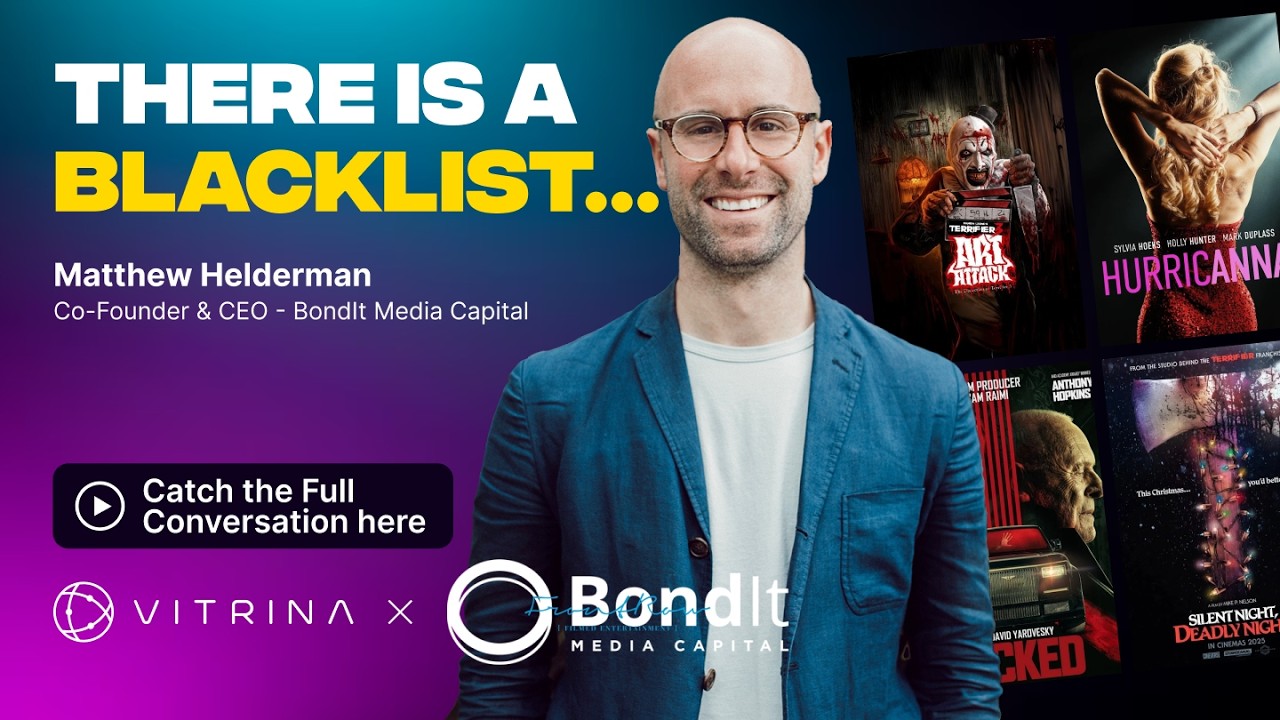
Matthew Helderman (Co-founder & CEO, BondIt Media Capital) discusses the post-streamer financing landscape and how private capital is navigating the new content economy:
Best for: Mid-budget independent features and TV ($1M–$20M), projects needing bridge financing against tax credits or pre-sales, productions that need a lender with genuine understanding of multi-platform revenue structures.
3. Comerica Bank — Entertainment Division
Comerica Bank is one of the few commercial banks that has maintained a dedicated entertainment lending practice through the industry’s turbulence. Based in Los Angeles, their entertainment division provides production loans, revolving credit facilities, and financing against tax incentives for both film and television. Their rates are the most competitive available for qualifying projects—but the eligibility threshold is correspondingly high.
Comerica requires fully packaged projects: confirmed equity, verified pre-sale contracts, approved tax incentives, and completion bond in place. They’re not a development finance solution. But if you’re at greenlight with your capital stack mostly assembled and need to draw a production loan against confirmed instruments, Comerica’s low-cost senior debt is hard to beat. Their entertainment team has decades of collective experience in film finance structures—which means the due diligence process is rigorous but efficient.
Best for: Well-packaged productions ($5M+) at greenlight stage with confirmed financing instruments. Not suitable for early-stage deals or projects without a full package.
4. JP Morgan — Entertainment Finance
JP Morgan’s entertainment finance division operates at the higher end of the market—primarily studio-affiliated productions, major streamer originals, and large-budget independent films. Their involvement in a deal signals institutional credibility that affects downstream financing conversations. But they’re not writing production loans for sub-$15M independent films. That’s not their mandate.
Where JP Morgan adds strategic value is in tax credit financing and slate deals—providing liquidity against multiple projects across a production company’s slate. If you’re building a company infrastructure rather than financing a single film, JP Morgan’s institutional relationships and multi-project facility structures are worth pursuing. But come to the table with a track record and a finance attorney who knows how entertainment bank facilities actually work.
Best for: Production companies and studios building multi-project slate facilities ($15M+), tax credit monetization, productions with major distributor or streamer attachments.
Track Every Active Film Financing Deal—Before It Hits the Trades
Trusted by Netflix, Warner Bros, and Paramount. Join 140,000+ entertainment companies tracking the global supply chain—including which US financiers are actively closing deals in your genre and budget range right now.
✓ 200 free credits | ✓ No credit card required | ✓ Full platform access
5. FilmNation Entertainment
FilmNation Entertainment operates a hybrid model: international sales, co-production, and equity financing—all from the same company. Founded in 2008 by Glen Basner, FilmNation has backed films like Arrival, The Imitation Game, Knives Out, and Promising Young Woman. Their equity participation is typically project-specific, tied to sales rights in key territories—which means their investment thesis is simultaneously a financing decision and a distribution strategy.
That alignment of incentives is FilmNation’s structural advantage for producers. They’re not a passive equity investor waiting for recoupment—they’re a sales agent with skin in the game on international performance. When FilmNation attaches to your project, they’re actively motivated to sell it. The flip side: their equity participation comes with territory holdbacks, and those holdbacks reduce your own upside in the markets they sell.
Best for: Awards-contender films and prestige independent features with strong international appeal. Projects where the producer values a finance-plus-sales partner over a pure lender.
6. Black Bear Pictures
Black Bear Pictures—and its international sales arm Black Bear International—operates a similar hybrid model to FilmNation but with more aggressive genre focus and a stronger appetite for mid-budget commercial films. They provide equity, foreign sales, and in some structures, gap financing coordination. Joshua Harris’s Peachtree interview specifically called out Black Bear as one of the reputable sales agencies whose attachment signals bankability to lenders.
That signal matters. When a gap lender or equity investor sees Black Bear attached as sales agent, it tells them someone with real market relationships has assessed the project’s commercial viability. That de-risking function—separate from the capital Black Bear directly provides—has a measurable impact on a project’s ability to close the rest of its financing stack.
Best for: Commercial genre films ($5M–$25M) seeking both financing and a credible foreign sales partnership. Action, thriller, and elevated genre where international pre-sales are the primary collateral strategy.
7. A24
A24 is the model everyone cites and almost no one gets to use for their project. But understanding A24’s financing structure is valuable for any serious producer because it represents the most evolved version of the equity-plus-distribution model in independent film. A24 is not a traditional financier—they’re a studio that takes company-level equity positions and maintains full creative and distribution control over their slate.
What Andrea Scarso of IPR VC (a firm that has co-invested alongside A24) observed in a Vitrina LeaderSpeak interview is instructive: A24’s edge isn’t just financial—”it’s the innovation in how they connect with their audience, the marketing, the promotion.” Their P&A model has redefined what indie marketing looks like. That said, submitting a project to A24 hoping they’ll finance it is a strategy with near-zero conversion rate unless you come through an established relationship or an agent who already has one. The Fragmentation Paradox applies here too: you need a warm introduction, not a cold submission.
Best for: Distinctive auteur-driven films with a clear audience identity. Not a traditional financing route—requires prior relationship or strong agency packaging.
8. Creative Wealth Media Finance
Creative Wealth Media Finance is one of the more active independent film finance companies in the US mid-market—providing production loans, gap financing, and bridge facilities specifically for independent productions. Their focus on the $2M–$20M range makes them accessible to producers who can’t meet the eligibility thresholds of Comerica or JP Morgan but need more institutional structure than a pure private lender.
Creative Wealth’s value is speed and specialization. They understand independent film collateral structures—foreign pre-sales, US tax credits, completion bonds—in a way that many private lenders don’t. And they don’t require the fully assembled package that entertainment banks demand before talking. They’ll engage earlier in the process, which matters when you’re in the 6–8 week window before a production deal starts to unravel.
Best for: Independent films in the $2M–$20M range that need a lender willing to engage before the full package is locked. Genre and commercial fare with identifiable collateral.
9. Participant
Participant (formerly Participant Media) is the most distinctive equity investor in the US market—impact-focused, financing films with social change ambitions alongside commercial potential. Their portfolio includes Spotlight, Roma, An Inconvenient Truth, and Green Book. Participant doesn’t just write equity checks—they bring documentary distribution infrastructure, social impact campaign resources, and educational marketing programs that create revenue streams other equity investors can’t replicate.
But here’s the vetting reality: Participant’s investment thesis is narrow. They’re not financing genre films, action franchises, or pure entertainment slates. If your project has a genuine social impact dimension—environmental, civil rights, health, education—and can demonstrate commercial viability alongside mission alignment, Participant is the right call. If it doesn’t, you’re wasting both your time and theirs.
Best for: Impact-driven films with demonstrable social significance and commercial distribution potential. Projects where the cause marketing dimension adds measurable audience reach beyond traditional P&A.
10. Myriad Pictures
Myriad Pictures, founded by Kirk D’Amico, operates as an international sales company and independent financier with particular strength in co-production financing and European market access. Their financing model typically combines equity participation with foreign sales representation—similar to FilmNation and Black Bear—but with a more globally distributed production approach that suits projects with inherently international subject matter.
Myriad’s strategic edge is their European co-production network. For US-based producers whose projects have strong cross-Atlantic commercial potential—or who want to access European incentive programs alongside US financing—Myriad’s ability to structure deals that span multiple jurisdictions is genuinely useful. They’re not the right call for domestic-focused genre films. But internationally compelling narratives? Myriad has the connections to build a multi-territory capital stack that pure US lenders can’t construct.
Best for: Internationally appealing stories where co-production financing with European partners accelerates the capital stack. Projects seeking combined US equity and foreign pre-sales from the same partner.
How to Vet a Film Financing Partner Before You Sign
The financing pitch runs both directions. Yes—you’re pitching your project. But you should also be vetting the company you’re about to enter a multi-year financial relationship with. Here’s the framework that matters:
Verify their deal history—not their press releases. Ask for 3–5 specific films they’ve financed in the last 24 months, at a comparable budget range. Then verify independently—through IMDbPro, Deadline deal reports, or direct industry contacts. A company that’s slow to provide specific credits, or whose credits don’t appear in any verifiable record, is a company you should walk away from before the first term sheet.
Understand their capital source. Gap lenders and private equity firms backed by institutional capital—pension funds, family offices, insurance companies—operate with more stability and predictability than firms sourcing deals from individual HNW investors who can change their mind. Ask directly: “Where does your capital come from?” The answer tells you how reliable the funding actually is when you’re six weeks from production start and your capital stack needs to close.
Map their position in your waterfall. Before signing anything, you need to understand exactly where a financier sits in your recoupment waterfall—and whether that position conflicts with any other financing you’ve already secured. Conflicts in the inter-party agreement are the most common cause of production financing falling apart at the last stage. Your entertainment attorney should red-line the waterfall before you’re anywhere near a signature.
Check their completion bond requirements. All serious gap lenders require a completion bond from an approved bonding company—Film Finances, Unifi, Media Guarantors, or Patterson James. If a so-called “gap lender” is willing to advance without a completion bond, that tells you something about how they’re actually pricing risk. As Joshua Harris put it: the completion bond addresses “the biggest single risk in moviemaking”—delivering a finished product. Without it, no reputable lender will touch a production.
For a deeper framework on evaluating financing partners—including the due diligence steps that protect producers from deals that look good in a pitch and collapse in execution—Vitrina’s guide to de-risking film financing covers the full process. And the best film financing companies to know in 2025 provides additional context on the broader global landscape.
Building the Right Capital Stack for Your Project
The capital stack isn’t assembled by finding one investor who covers everything. It’s built layer by layer—and each layer has to be compatible with the layers above and below it. Here’s what a workable $10M independent film capital stack actually looks like in 2026:
Equity (20–30% of budget / $2M–$3M): This is the highest-risk, most expensive capital. Raise it from investors who understand the risk profile—family offices, HNW individuals with entertainment interest, or a film fund like IPR VC or similar. Don’t raise equity from people who’ve never invested in film before without giving them a thorough education on waterfall position and realistic timelines. Misaligned expectations on equity are how producer-investor relationships collapse post-delivery.
Pre-sales and distribution advances (30–45% of budget / $3M–$4.5M): This is your collateral engine. A reputable international sales agent—Black Bear, FilmNation, WME—goes to territory buyers with your package and generates minimum guarantee commitments that can be discounted against a production loan. The quality of your sales agent and the commercial strength of your package determines what percentage of your budget you can close from pre-sales. Genre and cast are the two primary levers.
Tax incentives (15–20% of budget / $1.5M–$2M): US states like New Jersey (extended through 2039), Georgia, and California (limited but available) offer meaningful rebates. If you can route production through a high-incentive jurisdiction, you can either bank against the approved incentive through a rebate loan or use the incentive as confirmed soft money that reduces the gap you need to fill. This decision needs to be made before you lock your shooting location—not after.
Gap financing (10–15% of budget / $1M–$1.5M): This is what Peachtree, BondIt, and Creative Wealth Media Finance are providing—the bridge between your confirmed instruments and your total budget. At 10–15% of a $10M film, you’re targeting a $1M–$1.5M gap loan. The all-in cost at 22% effective annual rate means you’re paying $220K–$330K for that capital over an 18-month period. Factor that into your recoupment model before you decide whether closing the gap through debt is cheaper than giving up more equity. For a comprehensive breakdown of how these layers interact, Vitrina’s guide to decoding the film capital stack is the most complete resource available.
US Film Financing Companies: Comparison at a Glance
Need Direct Introductions to US Film Financiers? We’ll Make Them.
Vitrina Concierge is your Virtual Agent. We don’t give you a list—we make warm introductions directly to decision-makers actively seeking your type of content.
- LA producer → Netflix UK, Fifth Season, Fox Entertainment (48 hours)
- Independent filmmaker → Legendary Pictures (direct access)
- Studio partner → Warner Bros, Paramount, Google TV
Frequently Asked Questions
What is the difference between a film finance lender and an equity investor?
A film finance lender provides debt—a loan secured against collateral (pre-sales, tax credits, IP rights) that must be repaid with interest regardless of how the film performs. They sit higher in the recoupment waterfall and take less risk. An equity investor provides capital in exchange for an ownership stake and profit participation—but only gets paid after all debt is repaid. Higher waterfall position for lenders means lower risk; lower position for equity means higher potential return but also higher loss exposure. Peachtree Media Partners and BondIt are lenders. A24 and Participant take equity positions.
Why did City National Bank pull back from Hollywood film financing?
After being acquired by RBC (Royal Bank of Canada), City National Bank shifted its strategic priorities away from entertainment lending. As Joshua Harris of Peachtree Media Partners described it: “City National lost their strategic focus… that created an enormous gap in the marketplace.” The retreat of commercial banks from Hollywood lending has been a broader trend since 2008, accelerated by the 2020 production shutdown and the 2023–2024 streaming contraction. Private capital firms like Peachtree and BondIt have moved into the space that City National and similar institutions vacated.
What does a typical US independent film capital stack look like?
A typical $10M independent film capital stack in 2026 looks like: equity (20–30% / $2M–$3M), international pre-sales discounted against a production loan (30–45% / $3M–$4.5M), US state tax incentives (15–20% / $1.5M–$2M), and gap financing for the remainder (10–15% / $1M–$1.5M). Each layer must be compatible with the others in the inter-party agreement. The gap loan closes last and is the hardest to secure—requiring a completion bond, confirmed pre-sales 1.5–2x the loan amount, and a reputable sales agent already attached.
Is a completion bond required for all US film financing?
A completion bond is mandatory for any production using gap financing or production loans from institutional lenders. It’s an insurance policy from a third-party bond company—Film Finances, Unifi, Media Guarantors, or Patterson James—that guarantees the film will be delivered on time and on budget. Costs typically add 3–6% to the production budget. Without a completion bond, no serious gap lender will advance capital. According to Joshua Harris, the completion guarantee addresses “the biggest single risk in moviemaking”—non-delivery—making it the foundation of any lender’s due diligence.
What is gap financing and how much does it cost?
Gap financing is a mezzanine debt loan secured against a film’s unsold territorial distribution rights—typically covering 10–30% of the production budget. It bridges the shortfall between confirmed financing and total budget. The cost is significant: upfront fees of 7–15% of the loan amount, plus interest at prime plus 3–8%. On an 18-month $1.5M gap loan, the all-in cost can reach approximately $330,000—an effective rate of around 22%. That cost must be factored into your recoupment model. Most gap lenders require your foreign sales agent to provide estimates showing 1.5–2x the loan amount in unsold territory value.
How do I find film financing companies actively investing in my genre?
The most efficient approach combines market intelligence with warm introductions. Vitrina’s platform tracks 400,000+ active projects and can surface which US financiers are actively closing deals in your specific genre and budget range—before those deals appear in the trades. Vitrina Concierge makes direct introductions to decision-makers at qualifying financing companies. Producers using Concierge have connected with Netflix UK, Fifth Season, and Fox Entertainment within 48 hours—the same speed and relationship logic applies to connecting with the right US film finance company for your project.
What projects does A24 finance?
A24 finances and distributes distinctive films with strong audience identity—typically auteur-driven, genre-defying, or culturally resonant projects. Their portfolio includes Everything Everywhere All at Once, Midsommar, Lady Bird, Hereditary, and Moonlight. A24 is not a traditional financing route—they function as a studio with full equity and distribution control. Access requires either an established agent relationship (CAA, WME, or UTA) or a prior working relationship with their acquisitions team. Cold submissions don’t result in financing. Warm introductions through representation do.
What types of projects are easiest to finance in the US market right now?
In 2026, the easiest projects to finance in the US independent market are genre films with strong international pre-sale appeal: action, thriller, and horror at $5M–$25M with A-list or B-list cast attached. Low-cost, high-concept is the operative phrase. Projects with domestic-focused subject matter, comedy without international stars, or first-time producer teams face significantly higher hurdles. A completion bond, a reputable sales agent already attached, and 60–80% of the budget confirmed before approaching gap lenders is the realistic preparation standard.
Conclusion: Match the Money to the Model—Before the First Meeting
The US film financing landscape in 2026 rewards preparation. Not just a good script, not just a commercial package—but a producer who walks into a financing conversation knowing exactly which instrument they need, which waterfall position they’re offering, and which financier’s risk model aligns with their project profile. That’s not hustle. That’s strategy.
Key Takeaways:
- Commercial banks have retreated: City National’s pullback created a void that private lenders—Peachtree, BondIt, Creative Wealth Media—have filled. But private capital prices its risk: gap loan all-in costs can reach 22% of principal over 18 months.
- Know your financing type first: Senior debt (Comerica, JP Morgan), gap/mezzanine (Peachtree, BondIt), equity (FilmNation, A24, Participant), and hybrid models (Black Bear, Myriad) serve fundamentally different project needs at different capital stack positions.
- Completion bonds are non-negotiable: Film Finances, Unifi, Media Guarantors—a bond from one of these companies is a mandatory prerequisite for any institutional gap lender. Budget 3–6% of production costs for it.
- Packaging drives access: The projects closing financing in 2026 are genre films with agency representation (WME, CAA, UTA), A/B-list cast, a reputable sales agent, and 60–80% of budget confirmed. That’s the baseline—not the goal.
- Vetting goes both directions: Verify deal history, understand the financier’s capital source, map their waterfall position against your other instruments, and have an entertainment attorney review every inter-party agreement before you sign anything.
The producers who close the best deals don’t necessarily have the best projects. They have the best intelligence—knowing which financier is actively looking, which instrument fits their stack, and which introduction opens the right door. That’s the advantage Vitrina is built to deliver.
Find the Right US Film Financier for Your Project—Before the Trades Do
Trusted by Netflix, Warner Bros, Paramount, and Google TV. Track 400,000+ projects. Access 3 million verified executives. Close financing faster with Vitrina’s intelligence platform.
✓ 200 free credits | ✓ No credit card required | ✓ Cancel anytime
Need direct introductions to US film financiers? Explore Concierge Service →
Find Film+TV Projects, Partners, and Deals – Fast.
VIQI matches you with the right financiers, producers, streamers, and buyers – globally.
Producers Seeking Financing, Co-Pros, or Pre-Buys?
Vitrina Concierge helps producers reach the right financiers, commissioners, distributors, and co-production partners — with precision outreach, not cold pitching.
Join Industry Briefings Trusted by Leaders

Micro-Dramas & Mobile-First Storytelling
Micro-dramas are building real audiences and revenue. Understand the platforms, buyers, and economics behind the growth.

Navigating Global Content Licensing Trends
How global content licensing is shifting beyond flat fees to flexible, deal-driven models.
Film & TV Production Financing: 2026 Trends
Production financing conditions are changing quickly. Understanding where money is moving and what buyers are backing is key to getting projects approved and funded in 2026.
Unreleased Film+TV Projects: Opportunities & Showcase
A curated view of unreleased Film and TV projects open for financing and collaboration