About Innovation Hub
 Global Content Pulse (Webinars)


 Global Production Financing
(Webinars)
Global Production Financing
(Webinars)  LeaderSpeak Podcast
  Global Entertainment Digest (Newsletter)
  About Vitrina
 About VIQI
 Our Story
 Our Solutions 🔥
 Film+TV Projects Tracker 🚀
 Case Studies
 Our Profile

Here’s the uncomfortable truth about movie content financing ROI: most producers leave 15–20% of their budget on the table before a single frame rolls. Not because they don’t have financing. Because they don’t have the right financing structure—and in 2026, that gap costs more than ever.
The market’s changed. Phil Hunt, Founder and CEO of Head Gear Films—the company that’s financed 550+ movies and holds the record as the most highly credited producers in UK history since 1906—said it plainly in his October 2025 Vitrina LeaderSpeak interview: the industry has become “much, much harder in terms of getting movies off the ground and getting movies sold.” Post-COVID production excess met a streaming correction, and the result is a financing environment that punishes the unprepared.
But here’s what’s also true: the producers who understand how to engineer their capital stack—stacking incentives, timing presales, structuring gap debt intelligently, and tapping Sovereign Content Hubs like Saudi Arabia and the UAE—aren’t just surviving this crunch. They’re widening their margin while competitors scramble. This guide breaks down the seven strategies driving content financing ROI in 2026 so you can do the same.
Table of Contents
- Engineer Your Capital Stack Before You Develop
- Weaponize Incentive Stacking for 35–50% Budget Coverage
- Time Your Presales to Protect Backend Revenue
- Use Gap Financing as Precision Debt—Not a Last Resort
- Access Sovereign Content Hubs Before Your Competition Does
- Structure Equity to Accelerate Recoupment
- De-Risk Your Supply Chain with Real-Time Intelligence
- FAQ
- Conclusion
Ask VIQI: What’s the Optimal Capital Stack for My Project Budget and Genre?
VIQI is Vitrina’s AI assistant—trained on 1.6 million titles, 360,000 companies, and 5 million entertainment professionals. Ask about financing structures, territory values, or lender requirements for your exact project type.
✓ Included with 200 free credits | ✓ No credit card needed
1. Engineer Your Capital Stack Before You Develop
Most producers approach financing reactively—packaging the project, then chasing money. The producers generating the strongest movie content financing ROI in 2026 flip that sequence entirely. They architect the capital stack during development, not after.
A well-engineered capital stack for a $10M feature typically breaks down like this:
The sequence matters as much as the percentages. Tax incentives reduce your effective budget first—lowering the amount you need to raise from every other source. Territory presales, structured as MG contracts and discounted by entertainment banks at 70–90% of face value, become your primary debt collateral. Equity fills the middle. Gap closes the last 10–15%.
For more depth on structuring the debt layer in this stack, our complete guide to gap financing in film breaks down every cost, collateral requirement, and lender expectation you’ll need to navigate in the current market.
Stop Guessing Who’s Financing. Get Targeted Outreach.
Stop searching and start getting funded. We identify the exact decision-makers currently backing projects like yours, turning raw data into risk-aligned capital partnerships.
Major Studios
Scouting early stage projects, IP, and Regional partners for global studio pipelines.
IP Owners & Leads
Connecting creative leads with qualified financiers and major streaming platforms.
Streamers
Securing high-value pre-buy content and discovering early-stage global IP for platforms.
Indie Producers
Bridging the gap for indie filmmakers to reach executive production partners and capital.
Global Financing Ecosystems
Mapping complex markets and pairing projects with disciplined, risk-aligned capital across global territories worldwide.
2. Weaponize Incentive Stacking for 35–50% Budget Coverage
Single-jurisdiction incentive thinking is 2019. The producers protecting their EBITDA in 2026 are stacking rebates across two or three jurisdictions—and the numbers are genuinely compelling. Consider what’s available right now:
- Abu Dhabi: Up to 50% cash rebate on qualifying spend—one of the highest rates globally, increased in 2024.
- Saudi Arabia: 40% cash rebate via Vision 2030 Film Fund, backed by $1 billion in film and TV infrastructure capital.
- UK: 25% base rebate, rising to 29.25% for VFX-heavy productions as of April 2025—with 40% business rate relief for film studios extended to 2034.
- Greece: 40% cash rebate with €105M allocated for 2025, application window reopened January 1.
- Czech Republic: 35% for animation and digital, cap nearly tripled to $19M effective January 2025.
But stacking only works when you’ve mapped your qualified production expenditure (QPE) against each jurisdiction’s criteria before you shoot a frame. Structuring post-production VFX in the UK alongside location services in Abu Dhabi—both on a single project—isn’t uncommon. It does require that your legal team has the inter-party agreements locked and your spend tracking is airtight from day one.
The hidden cost is the audit risk. As we explored in our analysis of stacking incentives across two jurisdictions, dual-jurisdiction structures require meticulous documentation—or the back-end recoupment you planned around simply won’t materialize.
Find the Financiers Backing Your Genre
Stop searching and start getting funded. We identify the exact decision-makers currently backing projects like yours, turning raw data into risk-aligned capital partnerships.
3. Time Your Presales to Protect Backend Revenue
Here’s the tension every serious producer navigates: presales reduce your financing risk but surrender upside. Sell too many territories before production and you’ve handed your backend to distributors at below-market prices. Sell too few and you can’t close the budget gap.
The smart play—increasingly used by independent producers working with specialist lenders—is to presell anchor territories (Germany, Japan, Australia) for bank collateral while holding domestic and streaming rights open. Joshua Harris, President and Managing Partner of Peachtree Media Partners, laid this out clearly: his firm will advance against the projected value of unsold territories before a distribution agreement is executed. That means a producer can pre-sell enough to satisfy the bank, retain the high-value domestic upside, and use Peachtree’s advance to bridge the difference.
“We will take the value of certain territories before a distribution agreement is executed and advance that to production.
— Joshua Harris, President & Managing Partner, Peachtree Media Partners
This approach preserves recoupment acceleration—your IRR differential versus a fully presold project can exceed 200–300 basis points on a 24-month window when you retain the territories that move post-festival. Timing is everything. Pre-sell for financing security, hold back for valuation upside.
Track Financiers Actively Seeking Your Content Type—Before They Close Their Slates
Trusted by Netflix, Warner Bros, and Paramount. Join 140,000+ companies tracking the global entertainment supply chain in real time.
✓ 200 free credits | ✓ No credit card required | ✓ Full platform access
4. Use Gap Financing as Precision Debt—Not a Last Resort
Gap financing is a mezzanine debt instrument that sits senior to equity in the recoupment waterfall and is secured against a film’s unsold territorial distribution rights. It typically covers 10–30% of a production budget—but most producers only reach for it when everything else has failed. That’s backwards thinking.
Used with precision, gap financing preserves your equity position while closing the last funding tranche without surrendering additional territory rights or diluting ownership. The effective cost—typically 8–15% annually, plus 1–2% origination fees and $15–25K in legal—is knowable and plannable. Factor it into your ROI model upfront rather than discovering it mid-production.
Phil Hunt’s Head Gear Films has structured gap financing across 550+ productions since 2002—more films annually than most studios. His current read on the market is instructive: lenders are selective, completion bonds are non-negotiable, and name talent remains the critical variable. A-list attachment can compress your gap rate from 15% down to 8–10%, which on a $2M gap loan represents $100–140K in annual interest savings.
Phil Hunt (Founder & CEO, Head Gear Films) breaks down gap financing mechanics and the current financing landscape in this episode of Vitrina LeaderSpeak:

Three things disqualify projects from gap financing that you can control before approaching lenders: a gap exceeding 30% of budget (signals a weak package), absence of a completion bond (non-starter), and no reputable sales agent attached (lenders won’t issue sales estimates without one). Don’t pitch for gap until all three are resolved.
5. Access Sovereign Content Hubs Before Your Competition Does
The rise of Sovereign Content Hubs—government-backed production centers in Saudi Arabia, UAE, Qatar, South Korea, and India—represents the most underutilized financing opportunity in the current market. These aren’t vanity projects. They’re strategic capital deployment by governments with long-term content ambitions.
Saudi Arabia’s Vision 2030 doesn’t just offer a 40% cash rebate. It backs an entire infrastructure build: new soundstages in Riyadh, crew training programs, streamlined cultural clearance processes. The UAE’s Abu Dhabi film office moved its top rebate to 50%—while offering 0% tax on qualified projects through its free zone structure for up to 50 years. These numbers don’t exist in Western markets.
But the opportunity window is closing faster than the trades are reporting. According to Variety, the MENA region’s production investment grew significantly through 2024-2025 as sovereign funds moved from commitment to active deployment. The producers who’ve established relationships 6–12 months ahead of their production windows are the ones accessing this capital. Those who show up at market without existing contact networks are often 2–3 quarters behind the decision cycle.
The Fragmentation Paradox applies here acutely—600,000+ companies operate across the global film and TV supply chain, but the sovereign hub ecosystem adds thousands more verified production entities that most Western producers have never encountered. Without real-time intelligence on which companies have government backing, current capacity, and active deal flow, you’re navigating this space blind.
6. Structure Equity to Accelerate Recoupment
Equity investors in film and TV come in more shapes than most producers recognize. Andrea Scarso, Managing Partner of IPR VC—a Helsinki-founded fund management company that’s been connecting capital markets with the creative industry for over a decade—makes a point that gets lost in most equity conversations: “When you hit a successful IP, the upside can be greater than the overall risk you’re taking on a portfolio.” That’s the equity pitch that institutional investors actually respond to. Not single-project risk. Portfolio exposure across a slate.
IPR VC raises from institutional investors, family offices, and insurance companies—then takes equity positions in projects, not companies. That distinction matters for your ROI modeling. When you’re negotiating equity terms, you want investors who understand they’re buying a portfolio position, not punting on a single title. It changes how they price risk, how they structure waterfall rights, and—critically—how patient they are about recoupment timelines.
Recoupment acceleration through optimized capital stacks can compress typical 24–36 month recovery windows to 12–18 months—a 50% improvement that materially improves the IRR you can offer equity partners. The mechanism: incentive stacking reduces effective budget (lowers breakeven), presale optimization front-loads cash (accelerates recovery), and smart gap structure keeps equity’s waterfall position clean.
As reported by Screen International, equity availability for mid-budget independent film tightened considerably through 2024–2025 as institutional capital rationalized exposure following the streaming correction. That makes it more important than ever to pitch equity with precise IRR modeling—not narrative excitement.
7. De-Risk Your Supply Chain with Real-Time Intelligence
Your financing structure is only as strong as your execution chain. And this is where the Fragmentation Paradox silently destroys ROI: producers overpay for services by 15–20% because they’re operating on anecdotal vendor knowledge, relationships from the last production, and 6-month-old trade data. They don’t know the market. They know their network.
On a $10M production with 40% of budget allocated to services—VFX, post-production, equipment, location services—that’s $600,000 of margin leaking through information asymmetry. That’s your gap financing tranche, wasted.
Vitrina resolves the Fragmentation Paradox by mapping real-time capabilities across 140,000+ active film and TV suppliers globally. When you’re sourcing VFX for a project shooting in the UK with post in Greece, you can surface verified vendors with current capacity, hero project portfolios, and market-benchmarked pricing—in days rather than the 3–6 months traditional relationship-sourcing requires. A LA-based producer using Vitrina Concierge connected with Netflix UK, Fifth Season, and Fox Entertainment in 48 hours. That’s the Insider Advantage operating at scale.
But it’s not only vendor sourcing. Real-time deal tracking through Vitrina’s platform lets you see which financiers are actively closing deals in your content category—before it appears in the trades. That intelligence changes how you sequence your financing conversations and when you enter the market. Showing up 6 weeks ahead of a funding window you didn’t know existed is the difference between a competitive conversation and a closed door.
For producers actively seeking co-production partners to strengthen their financing structure, our guide to co-production partnerships in entertainment maps out how to leverage verified intelligence in that search.
Need Financiers for Your Project? We’ll Find Them.
Vitrina Concierge is your Virtual Agent. We don’t give you a list—we make warm introductions directly to decision-makers actively seeking your type of content.
- Korean animation studio → Netflix Adult Animation (week one)
- LA producer → Netflix UK, Fifth Season, Fox Entertainment (48 hours)
- Middle Eastern studio → Legendary Pictures (direct access)
Frequently Asked Questions
What is movie content financing ROI and how is it measured?
Movie content financing ROI measures the financial return generated per dollar of financing capital deployed across a production. It’s calculated by dividing net revenue (after all recoupment obligations) by total financing cost (debt interest, equity dilution, incentive administration). A well-structured $10M film with 25% incentive coverage, optimized presales, and gap financing at 10% should target an IRR of 15–25% for equity investors over a 24-month window.
What’s the difference between gap financing and equity in a film capital stack?
Gap financing is debt—it sits senior to equity in the recoupment waterfall and is secured against unsold territory distribution rights. It costs 8–15% annually and must be repaid before equity investors see returns. Equity takes the riskiest position (last out) but participates in upside. The distinction matters for ROI: debt is predictable and tax-efficient; equity is participation-based. Most optimized capital stacks use both, with gap covering 10–15% and equity covering 20–40%.
How much can incentive stacking reduce my effective production budget?
Done correctly, incentive stacking across two jurisdictions can reduce your effective budget by 35–50%. For example, combining Abu Dhabi’s 50% rebate on location spend with the UK’s 29.25% VFX rebate on post-production costs can cover substantial portions of both above-the-line and below-the-line expenses. The key is structuring your spend tracking from day one and ensuring each jurisdiction’s qualified expenditure (QPE) is cleanly segregated for audit purposes.
When should I approach a gap lender for movie content financing?
Approach gap lenders after you’ve secured at least 60–70% of your budget through other sources. You’ll need: a reputable sales agent with territory estimates, presale contracts covering at least 50% of budget, a completion bond commitment letter, and clean chain of title. Gap lenders typically fund 4–8 weeks from application when documentation is complete. Don’t approach before these elements are in place—incomplete packages lead to rejections that affect future relationships with that lender.
What are Sovereign Content Hubs and how do they improve content financing ROI?
Sovereign Content Hubs are government-backed production centers—primarily in MENA (Saudi Arabia, UAE, Qatar) and APAC (South Korea, India)—that offer among the world’s highest cash rebates (40–50%) combined with government infrastructure investment and streamlined access to local crews and facilities. They improve content financing ROI by dramatically reducing effective budget through rebates that Western markets can’t match, while opening distribution channels into fast-growing regional audiences.
How do presales affect movie content financing ROI?
Presales are a double-edged tool for ROI optimization. They de-risk financing by providing MG contracts that banks accept as collateral (at 70–90% of face value), reducing your equity requirement. But they limit upside by committing territory revenue at pre-completion prices. The optimal approach: presell enough anchor territories (typically Germany, Japan, Australia) to satisfy your production lender’s LTV requirements, while holding domestic and key streaming rights open for post-completion valuation—potentially at 2–4x pre-production MG values.
Why does supply chain intelligence matter for content financing ROI?
The Fragmentation Paradox—600,000+ companies operating in opaque silos—causes 15–20% margin leakage on services spend through information asymmetry. On a $10M production with 40% services budget, that’s $600K in preventable cost. Real-time supply chain intelligence (verified vendor capabilities, market-benchmarked pricing, current capacity) eliminates that overpayment and compresses deal timelines from 3–6 months to 2–4 weeks. Protecting that margin directly flows back to content financing ROI.
How long does it take to recoup a well-structured film investment in 2026?
Typical recoupment runs 24–36 months from delivery for a mid-budget independent film under standard financing structures. But recoupment acceleration through optimized capital stacks—incentive stacking reducing effective budget, strategic presales front-loading cash recovery, smart gap structure keeping the waterfall clean—can compress this to 12–18 months. That 50% improvement in timeline translates directly to improved IRR for equity investors and faster slate reinvestment for producers.
Conclusion: ROI Doesn’t Happen at the Box Office—It’s Engineered Before Production
The producers winning in 2026’s tighter financing market aren’t finding magic capital sources. They’re engineering superior capital stacks—stacking incentives intelligently, timing presales to preserve backend, using gap financing as precision debt, and leveraging Sovereign Hub rebates that Western markets can’t match. They’re also protecting the 15–20% margin that the Fragmentation Paradox silently destroys through supply chain opacity.
Key Takeaways:
- Capital Stack Architecture: Design your financing structure during development—tax incentives first, presales second, equity third, gap to close. Sequence determines your effective cost of capital.
- Incentive Stacking: Dual-jurisdiction structures can deliver 35–50% effective budget reduction. Abu Dhabi (50%), Saudi (40%), UK VFX (29.25%), and Greece (40%) are the 2026 leaders.
- Presale Timing: Pre-sell anchor territories for bank collateral; hold domestic and streaming rights for post-completion valuation at 2–4x pre-production prices.
- Gap Financing Precision: Use gap as intentional mezzanine debt (10–15% of budget at 8–15% APR), not emergency funding. Approach lenders with 60–70% already secured.
- Sovereign Hub Access: Establish relationships with MENA and APAC government film offices 6–12 months before your production window—not at market.
- Supply Chain Intelligence: Real-time vendor intelligence eliminates the 15–20% margin leakage from the Fragmentation Paradox—protecting $600K+ on a $10M production.
Start Tracking the Financing Deals Closing Right Now
Trusted by Netflix, Warner Bros, and Paramount. Join 140,000+ companies on Vitrina to track real-time deal flow, financier activity, and supply chain intelligence across 400,000+ active projects.
✓ 200 free credits | ✓ No credit card required | ✓ Cancel anytime
Need direct introductions to financiers? Explore Concierge Service →
Find Film+TV Projects, Partners, and Deals – Fast.
VIQI matches you with the right financiers, producers, streamers, and buyers – globally.
Producers Seeking Financing & Partnerships?
Book Your Free Concierge Outreach Consultation
(To know more about Vitrina Concierge Outreach Solutions click here)
Join Industry Briefings Trusted by Leaders
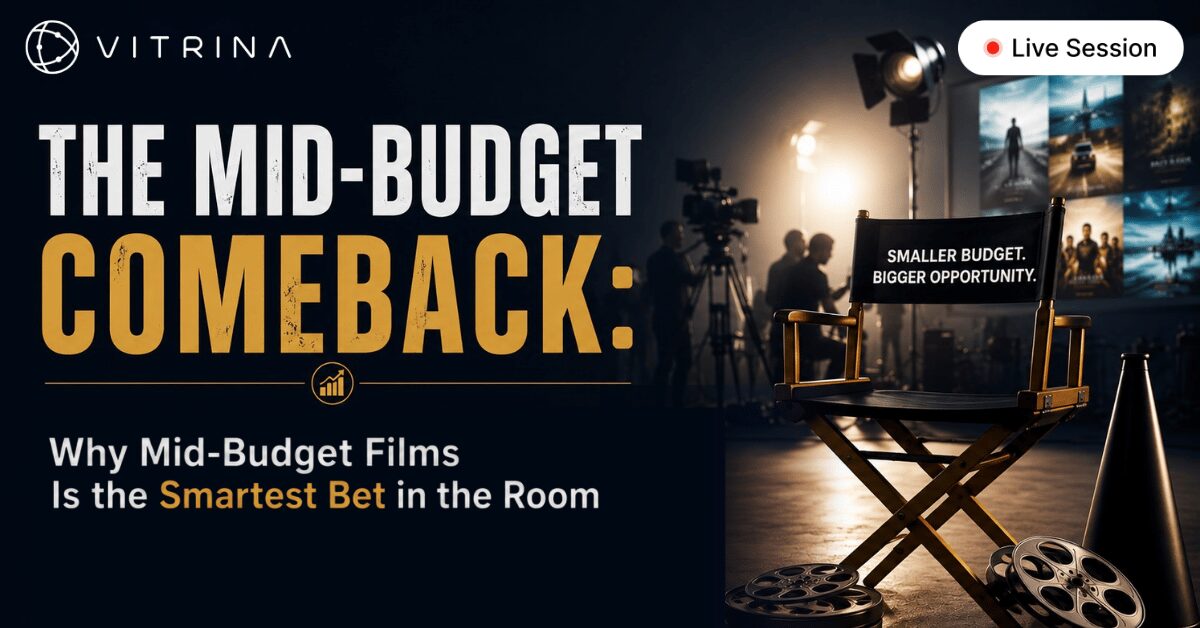
The Mid-Budget Comeback: Why Mid-Budget Films Is the Smartest Bet in the Room
Mid-budget films are attracting new capital. See why this segment is becoming one of the strongest bets in Film today.
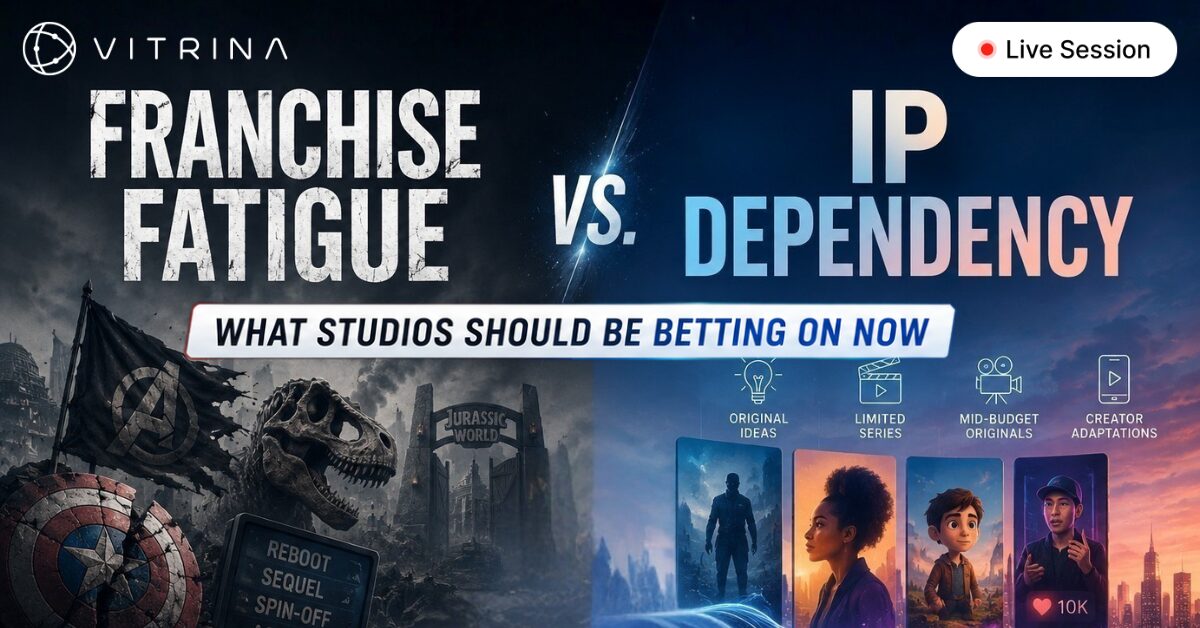
Franchise Fatigue vs. IP Dependency: What Studios Should Be Betting On Now
s franchise performance softens, where will the next generation of valuable IP come from? Join the briefing.

Unscripted Is Eating the World: The Multi-Billion Reality and Format Boom
Unscripted is the new prestige — inside the $19.8B global format boom reshaping how streaming platforms compete.

How Co-Productions and Regional IP Are Reshaping Global Drama
As global drama evolves, which stories travel, which stay local, and how are they getting financed?