About Innovation Hub
 Global Content Pulse (Webinars)


 Global Production Financing
(Webinars)
Global Production Financing
(Webinars)  LeaderSpeak Podcast
  Global Entertainment Digest (Newsletter)
  About Vitrina
 About VIQI
 Our Story
 Our Solutions 🔥
 Film+TV Projects Tracker 🚀
 Case Studies
 Our Profile
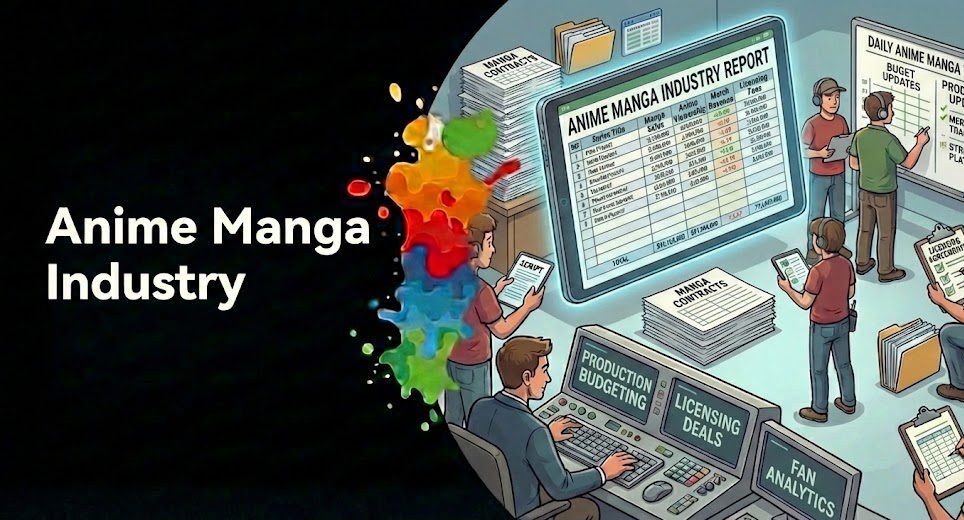
Here’s the thing about the anime manga industry: it’s no longer a niche. It’s a $30+ billion global content machine — and the executives who aren’t paying attention are already behind. From Netflix dropping record anime licensing budgets to South Korean studios muscling into what was once Japan’s exclusive domain, the supply chain dynamics have shifted dramatically. If you’re acquiring, financing, or distributing animation-adjacent content heading into 2026, you need to understand what’s actually driving the market — not what trade headlines say six weeks after the fact.
This isn’t a primer. We’re assuming you already know what a cour is, why Toei Animation and MAPPA occupy different rungs on the production hierarchy, and how streaming exclusivity reshapes IP valuation. What we’re unpacking here are the structural shifts — the deals being done now, the financing models being tested, and where the Fragmentation Paradox™ is quietly eating 15–20% of margin for operators who haven’t solved their intelligence gap yet.
Track Anime Licensing Deals Before They Hit the Trades
Trusted by Netflix, Warner Bros, and Paramount. Join 140,000+ companies tracking global entertainment supply chain intelligence — including anime and animation markets.
✓ 200 free credits | ✓ No credit card required | ✓ Full platform access
Where the Anime Manga Market Actually Stands in 2026
The global anime market crossed $30 billion in annual revenues — and the trajectory isn’t slowing. But here’s what that number doesn’t tell you: the growth is unevenly distributed, and the capital is pooling in places traditional distribution relationships don’t easily reach.
According to Variety, streaming platforms now account for more than 40% of all anime content consumption globally — a figure that was closer to 22% just four years ago. That acceleration isn’t accidental. It’s the direct result of platform bidding wars for exclusive streaming rights to established IP, particularly shonen franchises with existing international fanbases. Netflix alone has committed to producing or co-producing more than 40 original anime titles as part of its ongoing Japan-centric strategy, a push that’s reshaping how Japanese studios structure their financing arrangements.
But the market expansion isn’t just Japan’s story anymore. South Korean animation studios — building off the K-drama infrastructure that’s proven so effective internationally — are beginning to produce anime-adjacent content at competitive price points. And in Southeast Asia, government-backed production centers are actively recruiting Japanese animation talent to establish regional production capacity. This is the Sovereign Content Hubs™ dynamic playing out in real-time: capital shifting from the Hollywood/Japan axis toward regional powerhouses with more aggressive incentive structures.
For our deep-dive on how anime studios are reshaping global entertainment supply chains, including the structural shifts driving studio consolidation, see that analysis in full.

Your AI Assistant, Agent, and Analyst for the Business of Entertainment
VIQI AI helps you plan content acquisitions, raise production financing, and find and connect with the right partners worldwide.
- Find active co-producers and financiers for scripted projects
- Find equity and gap financing companies in North America
- Find top film financiers in Europe
- Find production houses that can co-produce or finance unscripted series
- I am looking for production partners for a YA drama set in Brazil
- I am looking for producers with proven track record in mid-budget features
- I am looking for Turkish distributors with successful international sales
- I am looking for OTT platforms actively acquiring finished series for the LATAM region
- I am seeking localization companies offer subtitling services in multiple Asian languages
- I am seeking partners in animation production for children's content
- I am seeking USA based post-production companies with sound facilities
- I am seeking VFX partners to composite background images and AI generated content
- Show me recent drama projects available for pre-buy
- Show me Japanese Anime Distributors
- Show me true-crime buyers from Asia
- Show me documentary pre-buyers
- List the top commissioners at the BBC
- List the post-production and VFX decision-makers at Netflix
- List the development leaders at Sony Pictures
- List the scripted programming heads at HBO
- Who is backing animation projects in Europe right now
- Who is Netflix’s top production partners for Sports Docs
- Who is Commissioning factual content in the NORDICS
- Who is acquiring unscripted formats for the North American market
7 Structural Trends Every Acquisition Executive Needs to Know
1. The Streaming Exclusivity Arms Race Is Compressing Licensing Windows
Platform competition for top-tier anime IP — think established manga adaptations with proven reader bases above 5 million volumes sold — has driven MG structures to levels that make some broadcasters genuinely uncomfortable. Crunchyroll, post-Sony merger, and Netflix are effectively in a duopoly for premium anime licensing outside Japan. But the exclusivity clauses they’re demanding — often 5-7 years across all SVOD windows — are squeezing out smaller regional platforms that used to build audiences on second-window rights.
And here’s the real consequence: it’s pushing Japan’s mid-tier studios toward direct streaming deals before they’ve fully packaged the underlying IP. Some producers are entering platform agreements before completing their capital stack. That’s a risk profile that traditional completion bond insurers haven’t fully priced in yet.
2. Japan’s 50% Production Incentive Is Still Underutilized by Foreign Producers
Japan offers a 50% cash rebate on qualifying production expenditures incurred in Japan — the highest incentive rate of any major production nation. But the practical utilization by non-Japanese producers sits well below what the structure theoretically allows. Why? Language barriers in the application process, unfamiliarity with which expenditure categories qualify, and the relationship-dependent nature of accessing verified local vendors at competitive prices.
This is a margin story. If you’re co-producing anime content with a Japanese studio, leaving 30-50% of available incentive value unclaimed because your team doesn’t have verified intelligence on qualifying spend categories is the definition of EBITDA erosion that doesn’t have to happen. The capital is sitting there. You just need the infrastructure to capture it.
3. Manga IP Acquisition Is Moving Faster Than Production Infrastructure Can Support
Right now, the gap between manga IP being acquired and anime adaptation capacity is widening. Production studios — particularly the top-tier houses like MAPPA, Bones, and Ufotable — are booked well into 2027 for premium projects. That’s forcing IP holders to either wait in queue or work with mid-tier studios whose quality consistency is less proven.
But there’s a more interesting dynamic emerging: the rise of hybrid production models. Japanese studios are increasingly subcontracting animation work to Korean studios like Production I.G Korea, and to Indian animation houses — primarily for key-frame breakdown, in-betweening, and composite work that doesn’t require the creative oversight of principal animation. This isn’t new. What’s new is the volume, the quality control frameworks being applied, and the transparency (or lack of it) in how these arrangements get structured.
4. AI Tools Are Entering the Anime Pipeline — With Complicated IP Implications
The Authorized AI™ question is hitting anime production harder than almost any other content vertical. Animation’s reliance on visual style consistency — maintaining character design across hundreds of episodes — makes it theoretically ideal for AI assistance in in-betweening and frame generation. Several studios are quietly piloting tools. But the IP exposure question hasn’t been resolved.
Here’s what keeps completion bond underwriters awake: if AI-generated frames in an anime series are later challenged on IP grounds, what does that do to the chain of title? Can the content be insured? Can it be distributed in jurisdictions with strict IP transparency requirements? These aren’t hypothetical questions. They’re questions that will determine whether deals close in 2026 or get stuck in legal review for months.
Jayakumar P, CEO at Toonz Media Group, discussed the trajectory of AI integration in animation workflows — including how studios are navigating the transition while protecting creative control. The full conversation is worth your time:
Jayakumar P (CEO, Toonz Media Group) on AI tools, market expansion, and the future of animation production:

5. Merchandising Revenue Is Back — and It’s Changing How Deals Get Structured
Anime’s merchandise ecosystem never really went away — but the global retail channels for anime merchandise have matured dramatically. Direct-to-consumer merchandise tied to streaming releases is now a material revenue line in deal models. Demon Slayer generated more in merchandise revenue globally than its theatrical box office. That number matters when you’re structuring a licensing deal or co-production arrangement.
The implication? Streaming platforms are increasingly insisting on merchandise participation clauses in licensing agreements. And IP holders — particularly the publishing companies that own the underlying manga — are pushing back hard. How that tension resolves itself will define the economic architecture of the next generation of anime licensing deals.
6. MENA and LATAM Are Emerging Anime Consumer Markets — Not Just Distribution Stops
If you’re still thinking about the Middle East and Latin America as secondary markets for anime content, you’re six weeks behind. Both regions have seen year-over-year anime viewership growth exceeding 35% on streaming platforms. Saudi Arabia’s Vision 2030 investments are beginning to fund original animation that draws explicitly from anime visual language — targeting both domestic and export markets simultaneously.
And in Brazil, where manga publishing has maintained strong retail sales even as the rest of the global print market declines, the connection between manga readership and streaming consumption creates a vertically integrated audience that’s genuinely valuable. Platforms that haven’t yet established dedicated anime acquisition strategies for MENA and LATAM are leaving subscriber growth on the table.
Connect With Verified Anime Studios in 48 Hours
Netflix UK sourced verified production partners through Vitrina in 48 hours. Join 140,000+ companies — studios, streamers, distributors — using Vitrina to close deals faster.
✓ 200 free credits | ✓ No credit card required | ✓ Access 400,000+ active projects
7. The Fragmentation Problem Is Getting Worse Before It Gets Better
Here’s the structural problem no one is talking about clearly enough: the anime production supply chain involves hundreds of specialized vendors — keyframe animators, compositors, dubbing houses, merchandise licensees, sub-distributors — operating in a system with almost zero verified intelligence infrastructure. Most relationships are still built through personal connections and introductions. That’s the Fragmentation Paradox™ in its purest form.
The cost? Producers working without real-time intelligence on vendor capabilities and pricing are routinely absorbing 15–20% unnecessary cost through markup structures built on information asymmetry. When your total production budget for a 12-episode anime cour is $8–12 million, that’s a material number. It’s the difference between recoupment at three years and recoupment at five.
The Real Challenges Facing Anime Producers and Distributors Right Now
You can’t talk about the anime manga industry trends without being honest about the structural headwinds. And there are several worth mapping clearly.
Animator overwork and talent pipeline fragility remains the industry’s most uncomfortable truth. Japan’s animation workforce is operating at capacity limits that aren’t sustainable. Studios like MAPPA have been publicly criticized for scheduling practices that risk the health of their animation teams — and that criticism is beginning to affect how overseas partners approach co-production discussions. Any deal structure that doesn’t build realistic production timelines around verified capacity isn’t a deal structure. It’s wishful thinking.
Then there’s the distribution revenue concentration risk. When two platforms — Crunchyroll and Netflix — control the majority of international anime streaming distribution, IP holders are negotiating from a weaker position than the market’s health might suggest. That’s the kind of structural dynamic that changes when alternative distribution channels — Amazon Prime, Disney+, regional FAST networks — make more aggressive anime acquisition plays. But right now, the leverage sits firmly with the platforms.
And then there’s the financing structure mismatch. Traditional film financing models — pre-sales, gap financing, equity tranches — don’t map cleanly onto anime production cycles. A series that runs for 4 cours over 18 months doesn’t fit the same recoupment model as a 90-minute feature. Yet many producers are still trying to force-fit traditional structures onto episodic animation, which creates real cash flow problems in months 8 through 12 of production.
For a framework on how content professionals are navigating anime licensing and distribution at scale, including the deal structures that are actually working in 2026, that resource covers the mechanics in depth.
Where the Strategic Opportunities Are: A CFO-Level View
So where does the smart money actually go in the anime manga industry heading into 2026? Let’s be specific.
Mid-tier manga IP is undervalued. The market has focused intensely on proven franchises — the top 50 manga series by volume — while ignoring the tier just below: manga series with 2–4 million volumes sold that have passionate reader communities but haven’t yet been adapted. These represent better ROI than competing in the auction for a rights package that five other platforms are already bidding on. The data exists to identify these opportunities systematically. But you need real-time intelligence infrastructure to act on it before it hits the public deal pipeline.
Co-production structures between Japanese and Korean studios are generating better production efficiency than either market achieves independently. Korean studios bring cost-competitive execution on secondary animation work; Japanese studios contribute IP relationships and creative direction. The deal architecture is still being figured out — particularly around IP ownership splits and credit structures — but the production partnerships that get this right are producing premium content at margins that make the deal math genuinely attractive.
Weaponized distribution™ of anime library content is a real strategy right now. If you hold rights to a catalog of completed anime series — even content that’s 5–10 years old — the FAST channel and free AVOD market for anime content is genuinely monetizable in a way it wasn’t two years ago. As reported by The Hollywood Reporter, AVOD platforms have aggressively expanded their anime library acquisitions in 2025, with Tubi and Pluto TV both running dedicated anime channels reaching audiences that can’t justify premium subscription costs.
And finally: dubbing infrastructure is a competitive advantage, not just a localization cost. Producers who’ve invested in high-quality English, Spanish, and Portuguese dubs of their anime catalog are seeing materially higher engagement metrics and lower churn on streaming platforms compared to subtitle-only releases. With AI dubbing tools improving rapidly — and services like DeepDub and Papercup capable of delivering emotionally consistent character voices across multiple languages — the cost curve on quality dubbing is moving in the right direction fast.
How Vitrina Accelerates Anime Industry Deal-Making
The intelligence gap in the anime supply chain is real — and it’s costing operators margin they don’t need to lose. Vitrina’s platform maps 140,000+ verified companies across the global entertainment supply chain, including anime studios, animation vendors, dubbing houses, and distribution partners — filterable by capability, territory, and current capacity status.
That means when you’re looking for a verified mid-tier Japanese studio with available production slots in Q3 2026, or an Indian animation vendor with demonstrated anime-style capability at competitive price points, you’re not relying on a cold email list or a colleague’s five-year-old contact. You’re looking at real-time intelligence on who’s active, what they’re capable of, and what they cost.
Netflix UK identified and engaged a verified production partner through Vitrina in 48 hours. That’s the Insider Advantage in practice — not a marketing promise. For executives tracking the competitive anime streaming platform landscape and trying to move faster than the standard deal timeline, that intelligence gap is the difference between winning the rights and reading about someone else winning them in the trades.
Ask VIQI — Your Anime Market Intelligence Assistant
Want to know which anime studios have production capacity right now? Which platforms are actively acquiring in MENA? Ask VIQI — Vitrina’s AI-powered market intelligence tool trained on the global entertainment supply chain.
✓ 200 free credits | ✓ No commitment required | ✓ Trusted by 140,000+ companies
What This Means for Your 2026 Anime Strategy
The anime manga industry in 2026 rewards operators with real-time intelligence, deal-ready relationships, and financing structures built for episodic content cycles — not theatrical models. The market is growing, the capital is moving, and the supply chain is fragmenting further, not consolidating. That’s actually an advantage if you have the infrastructure to navigate it. But it’s a margin leak if you don’t.
The executives who’ll close the best deals in the next 18 months aren’t necessarily the ones with the biggest acquisition budgets. They’re the ones who know — before everyone else — where the production capacity is, which IP is undervalued, and which platform is actively building its anime slate. That’s an intelligence problem. And it’s solvable.
Key Takeaways
- Market size & trajectory: The global anime market exceeds $30 billion, with streaming accounting for 40%+ of consumption — a figure that’s nearly doubled in four years.
- Japan’s 50% incentive is underutilized: Foreign co-producers are leaving substantial capital on the table by not fully capturing Japan’s film rebate structures.
- Production capacity is constrained: Top studios are booked into 2027 — hybrid Japan/Korea/India production models are the practical workaround for quality-conscious producers who can’t wait.
- The Fragmentation Paradox™ costs 15–20% margin: Operators without real-time vendor intelligence infrastructure are paying a preventable tax on every deal they close.
- Mid-tier manga IP is the smart acquisition target: Series with 2–4 million volumes sold offer better ROI than competing in auction environments for proven top-tier franchises.
Frequently Asked Questions: Anime Manga Industry
How large is the anime manga industry in 2026?
The global anime manga industry exceeds $30 billion annually as of 2026, driven by streaming platform expansion, merchandise licensing, and theatrical releases. Streaming now accounts for more than 40% of all anime content consumption globally, up from approximately 22% four years ago.
Which streaming platforms are most active in anime licensing?
Crunchyroll (post-Sony merger) and Netflix dominate international anime licensing outside Japan, with Netflix committed to 40+ original anime titles. Amazon Prime Video and Disney+ are making more aggressive plays, while regional platforms in MENA and LATAM are actively building anime content libraries to serve rapidly growing viewer bases.
What are the biggest challenges in the anime production supply chain?
The three most significant challenges are: animator workforce capacity constraints in Japan, with top studios booked into 2027; distribution revenue concentration among a small number of platforms, weakening IP holder negotiating leverage; and financing structure mismatch between traditional film financing models and anime’s episodic production cycle requirements.
How is AI changing anime production in 2026?
AI tools are being piloted for in-betweening, frame generation, and dubbing localization in anime production. However, the Authorized AI™ question — ensuring clean chain of title for AI-assisted content — remains unresolved for many productions. Studios using AI without verified IP clearance frameworks face completion bond insurability risks and potential distribution blockers in certain jurisdictions.
What manga IP acquisition strategy makes sense for 2026?
Mid-tier manga IP — series with 2–4 million volumes sold and established reader communities but not yet adapted to animation — offers the best ROI in the current market. Top-tier franchise rights are priced at auction-level premiums that are increasingly difficult to justify. The key is identifying undervalued properties before they enter competitive bidding environments, which requires real-time market intelligence rather than reactive trade coverage.
How does Japan’s production tax incentive affect anime co-productions?
Japan offers a 50% cash rebate on qualifying in-country production spend — the highest rate of any major production nation. But foreign co-producers routinely fail to fully capture this incentive due to language barriers in the application process and lack of verified intelligence on qualifying expenditure categories. Proper incentive optimization on a standard anime cour budget can represent material EBITDA improvement.
What role do emerging markets like MENA and LATAM play in the anime industry?
MENA and LATAM have shifted from secondary distribution territories to primary growth markets for anime content. Both regions have seen viewership growth exceeding 35% year-over-year on streaming platforms. Saudi Arabia is investing directly in anime-influenced original animation through Vision 2030 funds, and Brazil’s strong manga retail market creates a vertically integrated audience that drives premium streaming conversion at above-average rates.
De-Risk Your Next Anime Deal with Verified Intelligence
Stop relying on six-week-old trade coverage and relationship networks that haven’t been updated since your last MIPCOM. Vitrina’s 140,000+ verified companies give you real-time intelligence on anime studios, co-production partners, and distribution networks — before the deal hits the public pipeline.
✓ 200 free credits | ✓ No credit card required | ✓ Cancel anytime
Find Film+TV Projects, Partners, and Deals – Fast.
VIQI matches you with the right financiers, producers, streamers, and buyers – globally.
Producers Seeking Financing & Partnerships?
Book Your Free Concierge Outreach Consultation
(To know more about Vitrina Concierge Outreach Solutions click here)
Join Industry Briefings Trusted by Leaders

The Mid-Budget Comeback: Why Mid-Budget Films Is the Smartest Bet in the Room
Mid-budget films are attracting new capital. See why this segment is becoming one of the strongest bets in Film today.
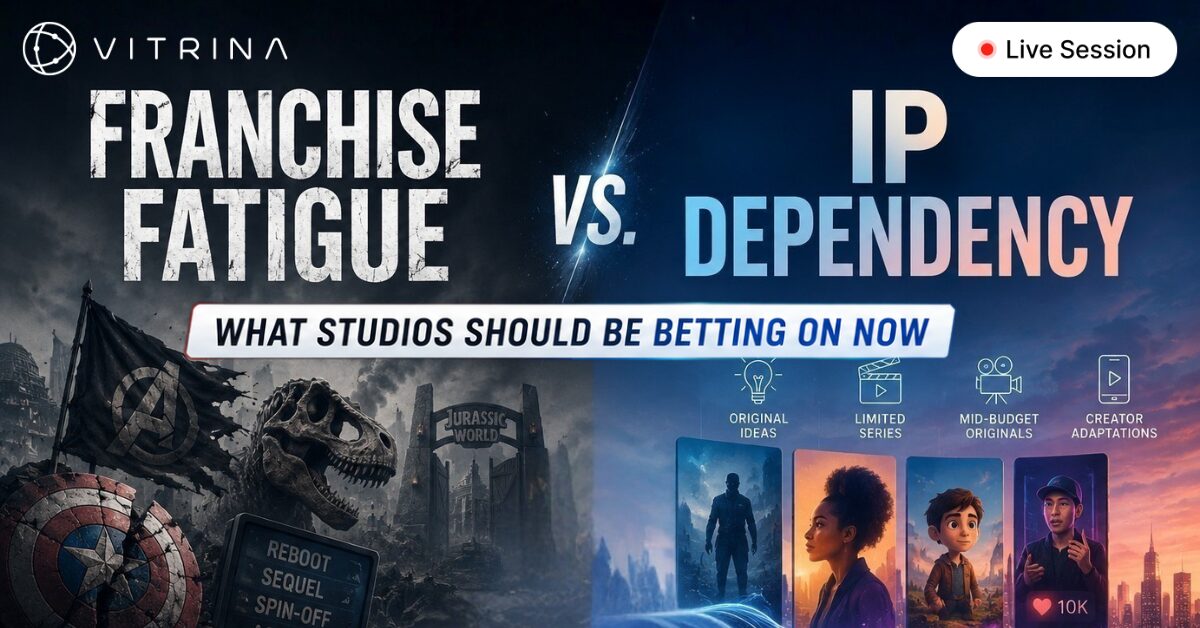
Franchise Fatigue vs. IP Dependency: What Studios Should Be Betting On Now
s franchise performance softens, where will the next generation of valuable IP come from? Join the briefing.

Unscripted Is Eating the World: The Multi-Billion Reality and Format Boom
Unscripted is the new prestige — inside the $19.8B global format boom reshaping how streaming platforms compete.

How Co-Productions and Regional IP Are Reshaping Global Drama
As global drama evolves, which stories travel, which stay local, and how are they getting financed?