Turkey’s production houses have quietly rewritten the rules of global content. While Hollywood debates slate sizes and streaming economics, Istanbul’s dizi machine keeps cranking out drama that reaches 150+ countries—dubbed, subtitled, and voraciously consumed from Latin America to the Gulf. That’s not an accident. It’s the result of decades of craft, competitive budgets, and a storytelling tradition that translates across cultures with startling ease.
If you’re sourcing co-production partners, scouting service providers, or simply trying to understand where Turkish content gets made, you need to know who’s actually building this ecosystem. This guide cuts straight to the companies that matter—the ones with the infrastructure, the track record, and the global relationships to deliver.
💡 Vitrina Analyst Note
Our analysts note that Turkey exports more television content than any country except the United States, with Turkish dizi reaching over 150 countries and OSN reporting strong performance across their 23 MENA territories. From what we track on Vitrina, the production houses closing international deals are those integrating distribution with production, not just creative output.
In This Guide
Discover Verified Turkish Production Companies Now
Join 140,000+ entertainment professionals using Vitrina to track, filter, and connect with production houses across Turkey—before a project hits the trades.
Why Turkey’s Production Ecosystem Matters Right Now
Here’s the thing about Turkey—it’s not “emerging.” It’s arrived. The country exports more television content than any nation except the United States, and Turkish drama has become a genuine sovereign content hub for MENA, Eastern Europe, Latin America, and beyond. Platforms like Netflix, Amazon Prime Video, and regional giants like OSN actively license Turkish titles because the ROI is simply hard to argue with.
Rolla Karam, Senior Vice President of Content Acquisition at OSN (Orbit Showtime Network), put it plainly in a Vitrina LeaderSpeak interview: “Turkish content does amazingly well for our audience.” OSN—covering 23 countries across MENA—dubs Turkish dizi into Syrian colloquial Arabic, giving shows a second life with audiences that have adopted them as their own. That’s not niche demand. That’s structural.
But knowing that Turkey matters is the easy part. Knowing which companies to call, and why, is where most international buyers and co-producers get stuck. The Fragmentation Paradox is real here—Istanbul has hundreds of production entities, and the ones with real capability aren’t always the loudest names in the room.
Let’s fix that.
Top 10 Production Houses in Turkey for Global Entertainment Needs
1. Ay Yapım
Ay Yapım is arguably the most export-driven production house in Turkey. Founded by Kerem Çatay, the company is behind Çukur, Bir Zamanlar Çukurova, and several titles that have landed on Netflix globally. Their output consistently features high production value—cinematic visuals, complex character arcs, and the kind of episode-to-episode tension that keeps audiences in 60+ countries coming back.
What sets Ay Yapım apart is their international distribution discipline. They don’t just produce—they actively manage rights, work with international sales agents, and structure deals that work across multiple territory models. If your brief involves acquiring Turkish content with proven export credentials, Ay Yapım belongs at the top of your list.
2. OGM Pictures
OGM Pictures, led by Onur Güvenatam, has become one of Turkey’s most ambitious production companies for streaming originals. Their co-production track record includes a partnership with Fremantle on the Turkish adaptation of My Brilliant Friend—Elena Ferrante’s beloved Neapolitan novel series—demonstrating they can operate at a European prestige-drama level. Netflix has also commissioned original content through OGM, which tells you everything about where their capability sits.
For co-production executives looking to bridge Turkish creative talent with international IP, OGM Pictures is the clearest proof-of-concept in the market.
3. Inter Medya
Inter Medya wears two hats—and wears both well. As a production and distribution company, they produce original Turkish content and simultaneously distribute it across 150+ countries. That vertical integration gives them a strategic edge that pure-play producers can’t match: they understand how a show needs to be packaged before a single frame is shot because they’re the ones selling it afterward.
Inter Medya has also entered the vertical drama space—the short-form, mobile-first content format that’s reshaping consumption in MENA and Asia. According to Vitrina’s coverage of the company’s recent moves, this isn’t a pivot so much as a deliberate expansion of their format portfolio to capture next-generation audiences.
4. Gold Film
Gold Film is one of Turkey’s longest-running production houses, with decades of domestic broadcast history behind them. They’ve produced some of the most-watched primetime series on Kanal D and Show TV, which means their understanding of what Turkish audiences actually want is deep and empirically tested.
For international buyers looking to license content with proven domestic ratings—not just festival buzz—Gold Film’s catalog deserves serious attention. Their shows travel particularly well in the Balkans and MENA, where the cultural resonance of their storytelling lands hard.
5. Tims&B Productions
Tims&B Productions is the company behind Diriliş: Ertuğrul—the historical epic that became a global phenomenon, particularly across Muslim-majority markets. The show reportedly reached 1 billion views on Pakistan’s TRT Ertugrul YouTube channel alone. That’s not a hit. That’s a cultural event.
Tims&B has since doubled down on historical and epic content, recognizing the underserved demand for prestige drama rooted in Turkic and Islamic heritage. If your acquisition brief touches faith-based content, historical epics, or MENA/South Asia audience development, this is the production house that has proven it can deliver at scale.
6. MF Yapım
MF Yapım operates across drama, comedy, and entertainment formats—giving them unusual versatility in a production landscape that tends to specialize. They’ve worked extensively with Turkey’s major free-to-air broadcasters and understand the domestic commissioning ecosystem from the inside out.
But it’s their format adaptation work that opens international doors. Turkish producers who understand how to localize foreign formats—and reverse-export Turkish formats outward—are increasingly valuable to global content networks. MF Yapım sits squarely in that capability zone.
Track Turkish Production Activity in Real Time
Netflix, Warner Bros, and 140,000+ entertainment companies use Vitrina to track who’s producing what—before a deal closes. Start with 200 free credits and explore Turkey’s full production landscape today.
7. 01 Yapım
01 Yapım has built a reputation around high-concept dramas with strong female-driven narratives—a storytelling niche that travels exceptionally well to Latin American and European markets where female viewership anchors primetime. Their production quality punches above Turkey’s typical budget-per-minute average, and their talent relationships with A-list Turkish actors are a genuine asset for presales.
And presales matter here—because securing MGs from key territories before production starts is exactly how disciplined international co-producers de-risk their capital stack. Turkish drama, when packaged well, can close presale contracts across MENA, Eastern Europe, and Latin America simultaneously.
8. Karga Seven Pictures
Karga Seven Pictures occupies a distinctive position—they specialize in documentary and factual entertainment, giving them a profile that’s genuinely underrepresented in Turkey’s production landscape. While the dizi machine dominates headlines, global demand for authentic documentary content from non-Western markets is accelerating. Platforms are hungry for it.
For buyers and distributors looking to diversify beyond scripted drama, Karga Seven’s catalog offers access to Turkey’s factual production ecosystem. Their output has reached international broadcasters, making them a rare bridge between Turkish documentary talent and global commissioning demand.
9. Medyapım
Medyapım is one of Turkey’s highest-volume production companies, known for long-running primetime series with massive domestic audiences. Volume in Turkish television means something specific: these aren’t 6-episode prestige seasons. We’re talking 40+ episode runs per season, which requires logistics, crew depth, and operational infrastructure that most production companies simply don’t have.
That operational scale is exactly why Medyapım is a credible service production partner for international projects that need Istanbul as a base. They know how to keep a machine running, which is a capability that’s harder to find—and more valuable—than it sounds.
10. BKM (Beşiktaş Kültür Merkezi)
BKM built its name in comedy—and comedy is where Turkey’s domestic box office and television market have historically been hardest to crack from outside. But their evolution into broader drama and streaming content signals a company that understands where the commercial gravity is shifting.
BKM’s value for international partners is partly about access to Turkish comedy talent, but increasingly about their understanding of format—the kind of structural DNA that makes a show adaptable to other markets. That’s an underutilized angle in Turkey’s export story, and BKM is one of the companies positioned to develop it.
What Makes Turkish Production Houses Genuinely Different
Turkish production doesn’t just replicate Western formats with a local accent. It does something more interesting—it synthesizes storytelling traditions from multiple cultures simultaneously. Turkey sits at the crossroads of European, Middle Eastern, and Central Asian narrative traditions, and the best Turkish producers know how to activate all three registers in a single series.
The result? A cultural elasticity that very few other national cinemas can match. A Turkish drama can air on MBC in Saudi Arabia, Antena 3 in Spain, Kanal D in Turkey, and a Netflix global feed simultaneously—each audience finding something that feels made for them.
Cost structure matters too. Turkish production houses deliver cinematic production quality—outdoor locations, period costumes, large casts—at a cost-per-episode that would be structurally impossible in the UK, US, or Western Europe. That’s not cheap-and-cheerful. That’s a genuine competitive advantage that savvy buyers and co-producers are actively weaponizing.
As reported by Deadline, international acquisitions of Turkish content have increased substantially year-over-year, with streaming platforms accelerating their investment in the format. And according to Variety, Turkish dizi now reaches audiences in over 150 countries—second only to American content by territory count.
Your AI Assistant, Agent, and Analyst for the Business of Entertainment
VIQI AI helps you plan content acquisitions, raise production financing, and find and connect with the right partners worldwide.
- Find active co-producers and financiers for scripted projects
- Find equity and gap financing companies in North America
- Find top film financiers in Europe
- Find production houses that can co-produce or finance unscripted series
- I am looking for production partners for a YA drama set in Brazil
- I am looking for producers with proven track record in mid-budget features
- I am looking for Turkish distributors with successful international sales
- I am looking for OTT platforms actively acquiring finished series for the LATAM region
- I am seeking localization companies offer subtitling services in multiple Asian languages
- I am seeking partners in animation production for children's content
- I am seeking USA based post-production companies with sound facilities
- I am seeking VFX partners to composite background images and AI generated content
- Show me recent drama projects available for pre-buy
- Show me Japanese Anime Distributors
- Show me true-crime buyers from Asia
- Show me documentary pre-buyers
- List the top commissioners at the BBC
- List the post-production and VFX decision-makers at Netflix
- List the development leaders at Sony Pictures
- List the scripted programming heads at HBO
- Who is backing animation projects in Europe right now
- Who is Netflix’s top production partners for Sports Docs
- Who is Commissioning factual content in the NORDICS
- Who is acquiring unscripted formats for the North American market
How to Actually Work With Turkish Producers
Here’s where a lot of international buyers stumble—they approach Turkish production houses the same way they’d approach a UK independent, and then wonder why deals move slowly. The production culture is different. Relationships precede transactions. Trust is built in the room, not over email.
A few things that experienced co-production executives know going in:
Creative control is non-negotiable. Turkish producers are deeply protective of their creative vision. Co-production structures that require significant format modification or script approval rights often stall before heads of terms are signed. Come in with a collaborative posture, not a development-by-committee approach.
Rights structures need early clarity. The most common friction point in Turkish co-productions involves digital rights, particularly for streaming platforms. Establish SVOD, AVOD, and linear rights parameters in term sheets—don’t leave them for delivery negotiations. You’ll save 6 weeks of back-and-forth.
Speed is a feature, not an accident. Turkish production pipelines move fast. A series that would take 18 months to develop and greenlight in the US can be in production within weeks once a commissioning decision is made. But that speed requires you to be equally decisive. Decision paralysis is the fastest way to lose a slot.
For deeper guidance on structuring international partnerships, our international co-production strategy guide walks through the financing and rights structures that work across markets like Turkey.
Find Your Turkish Co-Production Partner in 48 Hours
Vitrina’s Concierge service connects you directly with verified Turkish production houses matched to your project’s genre, budget, and rights structure. No cold outreach. No wasted calls.
The Streaming Era and What It’s Doing to Turkish Dizi
Streaming hasn’t killed the dizi format. But it has restructured it. The traditional Turkish model—long episodes, high volume, broadcast-driven—is coexisting with a newer streaming-native format that’s shorter, season-based, and optimized for binge consumption rather than nightly appointment viewing.
Netflix Turkey has been active in commissioning local originals—series like Şahsiyet and The Protector demonstrated that Turkish storytelling could compete on quality metrics with any global Netflix production. Those commissions validated the ecosystem for other international platforms that were watching closely.
But there’s a newer format gaining momentum: vertical drama. Short-form, mobile-first storytelling—where each episode runs under 5 minutes and narrative hooks land hard within 30 seconds. Rolla Karam of OSN visited Istanbul specifically to evaluate a Turkish vertical drama production house, noting the production energy and investment involved. The economics don’t yet justify licensing fees at scale, she acknowledged—but the format is real, the production quality is high, and the audience appetite is there.
Inter Medya’s recent move into vertical drama signals that Turkey’s most sophisticated producers see this not as a threat to the dizi format but as a parallel distribution channel worth developing. The companies that figure out the monetization model first will have a significant first-mover advantage.
Co-Production Opportunities: Where Turkey Fits in the Global Capital Stack
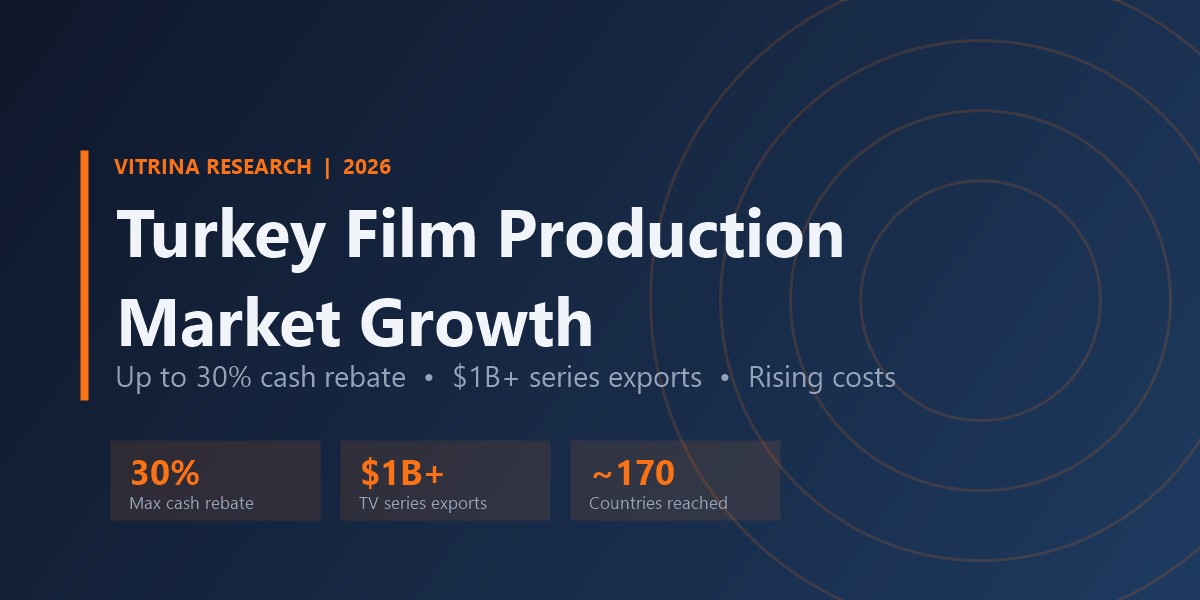
Let’s be direct about the financing reality. Turkey doesn’t offer the kind of government-backed incentive packages you’d find in Saudi Arabia (40% cash rebate) or Abu Dhabi (up to 50%). It’s not structured as a sovereign content hub in the Vision 2030 sense. But that’s not why you go to Turkey.
You go to Turkey for creative IP, established production infrastructure, crew depth, and built-in distribution relationships across MENA and Europe. The cost efficiency is structural—not incentive-driven—which actually makes it more reliable across budget cycles. You’re not building a capital stack around a tax rebate that could be revised next fiscal year. You’re building around genuine production economics.
Co-production treaties between Turkey and several European nations provide additional access pathways—particularly relevant for producers seeking to qualify content for European co-production fund support while maintaining Turkish creative leadership. Understanding how to structure multi-territory financing deals with Turkish partners requires knowing which companies have the financial sophistication to operate inside those frameworks.
And that’s the Fragmentation Paradox problem in miniature. Not every production house in Istanbul can handle international co-production agreements. The ones on this list can. But there are hundreds of others that can’t—and the difference isn’t always visible from the outside without verified intelligence.
Frequently Asked Questions About Turkish Production Houses
What makes Turkish production houses competitive globally?
Turkish production houses combine cinematic production quality with cost structures that are significantly below US, UK, or Western European equivalents. They also bring established international distribution relationships—particularly across MENA, Latin America, and Eastern Europe—and a storytelling tradition that translates culturally across diverse markets. Turkish dizi now reaches audiences in over 150 countries, which reflects both the creative quality and the active export infrastructure behind it.
Which Turkish production houses work with international streaming platforms?
Several Turkish production houses have active streaming relationships. Ay Yapım and OGM Pictures have both worked with Netflix on original commissions. Inter Medya distributes Turkish content to streaming platforms across 150+ countries. Tims&B Productions created content that reached global audiences through digital platforms, including Diriliş: Ertuğrul on YouTube. As the streaming ecosystem continues to commission locally, more Turkish producers are actively developing platform-native projects.
How do Turkish production houses handle international co-productions?
The most internationally experienced Turkish production houses—particularly Ay Yapım, OGM Pictures, and Inter Medya—are structured to handle multi-territory co-production agreements, rights negotiations, and international distribution. They work with international sales agents and understand presale mechanics. However, co-production structures require clear early agreement on creative control, rights windows, and digital platform terms. Coming in with well-prepared term sheet frameworks significantly accelerates deal timelines.
Why does Turkish content perform so well in MENA markets?
Turkish drama resonates in MENA for multiple reasons: cultural proximity, shared historical references, and narrative themes around family, honor, and social dynamics that translate across Arab-majority audiences. OSN—which covers 23 MENA countries—dubs Turkish content into Syrian colloquial Arabic, giving it a second audience layer. Rolla Karam, SVP Content Acquisition at OSN, has noted that Turkish content performs “amazingly well” for their subscriber base. Regional platforms across Saudi Arabia, Egypt, and the GCC continue to actively acquire Turkish titles.
What types of content do Turkish production houses specialize in?
The dominant format is scripted drama—often in the dizi format, with long episode counts and strong romantic or family-driven narratives. But the landscape is diversifying. Historical epics (Tims&B), prestige co-productions (OGM Pictures), factual and documentary (Karga Seven), comedy formats (BKM), and now vertical short-form drama (Inter Medya) are all active verticals. Turkish production houses increasingly operate across multiple content types rather than specializing narrowly.
How do I find and vet Turkish production houses for a specific project?
The challenge is separating the companies with genuine international capability from the hundreds of smaller production entities that operate primarily in domestic Turkish television. Verified intelligence platforms like Vitrina allow you to filter production companies by genre, track record, international distribution history, and active project status. For high-stakes partnerships, Vitrina’s Concierge service matches you directly with pre-vetted production houses whose capabilities align with your project’s specific requirements.
What is the typical cost structure for Turkish co-productions?
Turkish production economics vary significantly by genre and format. Broadcast dizi series can be produced at a cost-per-episode considerably below Western European equivalents while maintaining high visual quality. Streaming originals typically carry higher per-episode budgets to meet platform technical and creative requirements. Turkey doesn’t offer government cash rebates at the level of Saudi Arabia or UAE, so budget planning should be based on genuine production economics rather than incentive-driven modeling. This structural cost competitiveness tends to be more reliable across multi-year projects.
Is Turkey considered a sovereign content hub?
Turkey has many characteristics of an established content hub—significant export volume, production infrastructure, crew depth, and international distribution relationships. But it differs from Vitrina’s Sovereign Content Hub framework in one key respect: it’s not primarily government-backed investment driving the ecosystem. Turkey’s production industry is commercially driven, which gives it different risk and reward characteristics than government-backed hubs like Saudi Arabia or UAE. This makes it a complementary partner rather than a competitive alternative to those sovereign hub markets.
Conclusion: Turkey’s Production Ecosystem Is Ready. Are You?
Turkey’s production houses aren’t waiting to be discovered. The industry has been exporting content for decades, building relationships with broadcasters and platforms in 150+ countries, and quietly positioning Istanbul as one of the world’s most capable and cost-competitive production destinations. The question isn’t whether Turkey’s production ecosystem is ready for global partners. It’s whether your sourcing and due diligence process is sophisticated enough to identify the right partners within it.
But the Fragmentation Paradox cuts both ways here—the depth of Turkey’s production landscape is a feature, not a bug. There’s genuine diversity of capability: from prestige streaming originals at OGM Pictures to high-volume broadcast production at Medyapım, from distribution-integrated deal-making at Inter Medya to epic historical drama at Tims&B. Your job is matching the right company to the right project. That’s where verified intelligence stops being nice-to-have and starts being operationally essential.
Key Takeaways:
- Scale and reach: Turkish content reaches 150+ countries—second only to American content by territory count, making Turkey’s production houses uniquely positioned for global distribution deals.
- Proven MENA demand: Platforms like OSN (23 MENA countries) report that Turkish content “does amazingly well”—meaning your licensing economics on Turkish titles in MENA are structurally supported by proven subscriber appetite.
- Streaming evolution: Companies like OGM Pictures (working with Fremantle and Netflix) and Inter Medya (entering vertical drama) signal that Turkey’s production houses are actively adapting to platform-native content requirements.
- Cost competitiveness without incentive dependency: Turkey’s production economics are structurally competitive—not rebate-driven—which makes them more reliable across multi-year projects than government incentive-dependent markets.
- Relationship-first culture: Successful international co-productions in Turkey start with trust-building, clear early rights frameworks, and decisiveness. Companies that come prepared move faster and close better deals.
Start Connecting With Turkish Production Houses Today
Join 140,000+ entertainment professionals who use Vitrina to track Turkish production activity, discover co-production partners, and secure content deals—faster. Start with 200 free credits. No credit card required.