IHUB
IHUB
 Private Briefings (Webinars)


 LeaderSpeak Podcast
  Global Entertainment Digest (Newsletter)
  Premium Lists
 Membership Benefits
 About Vitrina
 Our Story
By Vitrina Research Team | Published: October 13, 2026 | 10 min read
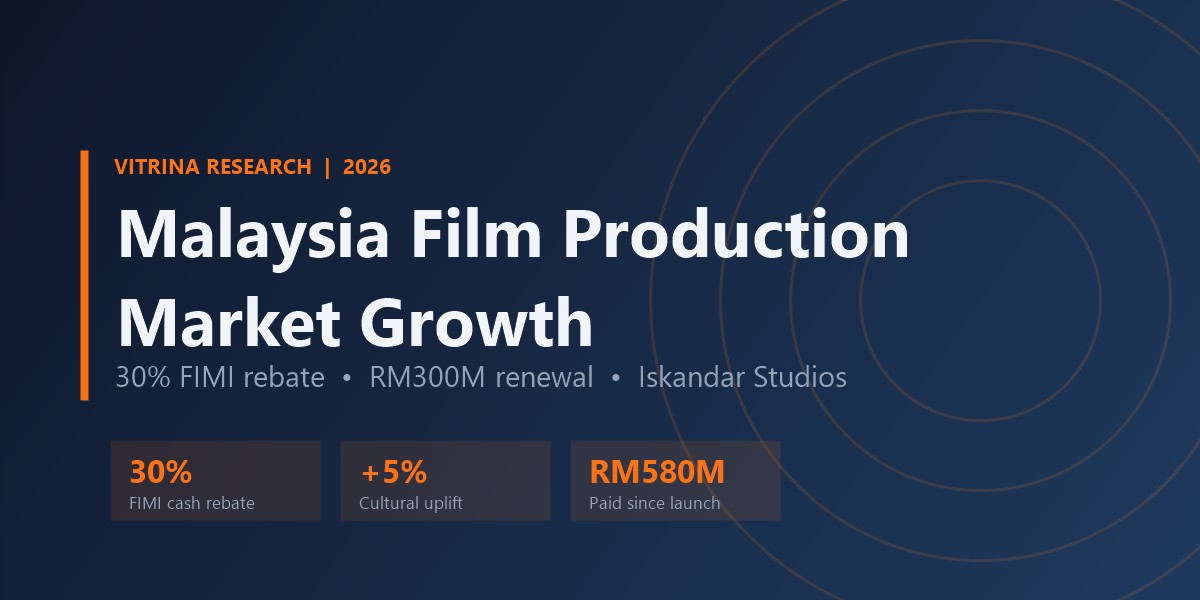
Malaysia film production market growth has a long-term funding commitment behind it. In March 2026, the National Film Development Corporation (FINAS) extended its Film in Malaysia Incentive (FIMI) for another five years with a renewed RM300 million (about US$76 million) allocation, plus a separate RM300 million budget for audiovisual infrastructure, according to Deadline. For producers, financiers, and streaming executives, Malaysia is positioning itself as a stable Southeast Asian production hub with a 30% cash rebate and studio capacity on Singapore’s doorstep.
The pipeline is growing. In September 2026, Malaysia’s Economy Minister announced Malaysia-Australia and Malaysia-South Korea production slates expected to bring about US$22 million (RM92 million) of international film and TV work into the country over two years, as reported by The Star. Over 13 years, FIMI has paid around RM580 million in rebates to 243 projects. The question for international producers is how to use that incentive alongside Malaysia’s studios, crews, and location variety.
Key Takeaways
- FIMI offers a 30% cash rebate on qualifying Malaysian production expenditure, with an additional 5% for projects that pass a cultural test.
- FINAS extended FIMI for five years in March 2026 with a RM300 million (about US$76 million) allocation, plus RM300 million for audiovisual infrastructure.
- FIMI has paid around RM580 million (about US$147 million) in rebates to 243 projects over 13 years.
- Iskandar Malaysia Studios in Johor has hosted more than 100 productions worth a combined RM1.2 billion since opening in 2014.
- New Malaysia-Australia and Malaysia-South Korea slates worth about US$22 million signal growing co-production activity tied to the Johor-Singapore Special Economic Zone.
Why Malaysia Is Emerging as a Southeast Asian Production Hub
Malaysia has hosted international productions for decades. “Entrapment” used Kuala Lumpur’s Petronas Towers, “Anna and the King” was filmed in Malaysia, and “Crazy Rich Asians” filmed scenes in Kuala Lumpur, Penang, and Langkawi. Netflix’s “Marco Polo” was among the first major series to use the Johor studio complex now known as Iskandar Malaysia Studios.
Malaysia film production market growth now rests on three factors. First, a long-running cash rebate that has just been funded for another five years, giving financiers confidence it will be paid. Second, purpose-built studio infrastructure in Johor, a short drive from Singapore’s airport and financial services. Third, diverse locations, from modern cities and colonial towns to rainforests, islands, and beaches, within a single country.
For producers and financiers, the question is whether the 30% rebate, crew depth, and studio availability fit their budget and schedule. The table below summarizes the essentials.
| Metric | Detail | Source |
|---|---|---|
| Cash rebate rate | 30% of qualifying Malaysian production expenditure | FINAS |
| Cultural uplift | Additional 5% for projects passing a cultural test | FINAS |
| FIMI allocation | RM300 million (about US$76M), extended for five years in 2026 | Deadline, March 2026 |
| Infrastructure budget | Separate RM300 million for audiovisual infrastructure | Deadline, March 2026 |
| Track record | Around RM580 million paid to 243 projects over 13 years | FINAS |
How Big Is Malaysia’s Film Production Market?
FIMI’s payout record is the clearest measure of Malaysia film production market growth: roughly RM580 million in rebates to 243 projects over 13 years, which, at a 30% rate, implies close to RM2 billion of qualifying local spend. Iskandar Malaysia Studios alone reports more than 100 productions with a combined value of RM1.2 billion since 2014, from China, the United States, Singapore, and Malaysia. The renewed RM300 million allocation, matched by RM300 million for infrastructure, signals the government’s intention to grow that base further.
Malaysia’s 2026 Production Investment Commitments (RM million)
Source: FINAS via Deadline (March 2026); Ministry of Economy via The Star (September 2026)
The 30% FIMI Cash Rebate
FIMI returns 30% of qualifying Malaysian production expenditure to both local and international productions, with an additional 5% for projects that pass a cultural test, bringing the maximum to 35%. It is administered by FINAS and covers feature films, TV series, documentaries, animation, and post-production work. Minimum qualifying spend thresholds apply and differ by type of activity, so producers should confirm current figures with FINAS at budgeting stage. Producers comparing the region can benchmark FIMI against Vitrina’s guide to the Thailand film incentive rebate.
The 2026 Renewal and Infrastructure Budget
The March 2026 renewal, announced at Hong Kong’s Filmart, extends FIMI for five years with a RM300 million allocation. A separate RM300 million budget is set aside for audiovisual infrastructure over the same period. Together, they give producers planning multi-season series or slate deals a longer and more secure horizon.
Studio and Crew Infrastructure
Iskandar Malaysia Studios in Johor is the country’s flagship facility, with soundstages, backlot space, and production offices built for international work. It has announced plans to add standing sets such as aircraft cabins, cockpits, prisons, trains, courtrooms, and traditional Malay villages. Kuala Lumpur and the Klang Valley hold much of the crew base, equipment rental, and post-production. Producers sourcing finishing work locally can compare options in Vitrina’s directory of top VFX companies in Malaysia.
Why International Producers Are Choosing Malaysia Now
The September 2026 slate announcements show where growth is heading. Led by Malaysia’s OMG Studios, a US$10 million Malaysia-Australia film and TV slate with Sandpiper Entertainment and a US$12 million Malaysia-South Korea feature film slate with Greenfish Studio are expected to bring about US$22 million of work into the country over two years. Economy Minister Akmal Nasrullah Mohd Nasir said the collaboration “will create opportunities for Malaysian talent, vendors, studios.”
The government is also linking production to wider economic policy. The Johor-Singapore Special Economic Zone is being promoted as a hub for international content, virtual production, and creative technology, with Iskandar Malaysia Studios at its center. The minister has encouraged the industry to move beyond servicing other countries’ productions toward owning intellectual property that can be licensed internationally.
The rebate economics underpin the momentum. A 30% rate, with a cultural uplift to 35%, competes well with other Southeast Asian programs, while Malaysian crew and accommodation costs remain lower than in many Western markets. The five-year renewal reduces the risk that the incentive will disappear mid-project.
VITRINA INTELLIGENCE
Who’s Actually Producing in Malaysia Right Now?
Trade headlines show you the slate deals. VIQI shows you the verified studios, service vendors, and financiers behind them — searchable by capability, budget tier, and deal activity across 159,223 companies, instead of chasing referrals.
How Producers Access Malaysia’s Incentives and Local Partners
Accessing FIMI is a structured process managed by FINAS, and producers who engage early avoid delays.
Applying for the FIMI Cash Rebate
International producers typically apply through a Malaysian production services company registered with FINAS. The application is filed before production with the budget, schedule, and details needed for any cultural test. After production, the producer submits audited qualifying spend, and the rebate is paid following review, so it should be cash-flowed during the shoot. Producers should keep detailed records of local vendors, payroll, and invoices from day one, because the audit tests each claimed cost against the approved budget. A local accountant familiar with FINAS requirements helps avoid delays at the payment stage.
Structuring Co-Productions and Local Partnerships
The 2026 Australia and South Korea slates show how co-production structures are developing, with a Malaysian lead company partnering foreign producers on multi-title deals. Choosing a local partner with FINAS experience, crew relationships, and studio access is the most important early decision. A strong partner can also advise on which costs qualify for the rebate, how to structure the cultural test to secure the extra 5%, and how to schedule work around Malaysia’s seasons and public holidays. Vitrina’s directory of top production houses in Malaysia is a practical starting point.
What Are the Core Challenges in Producing in Malaysia?
Malaysia film production market growth comes with two practical constraints.
Crew Depth for Large Productions
Malaysia’s crew base is experienced in local and regional production, but very large international projects may need to import heads of department and specialists. When several big productions are active at once, experienced crew can become stretched. Productions with large crews should identify key local department heads early and plan training or mentoring roles that strengthen the local workforce, which can also support the cultural test.
Climate, Logistics, and Approvals
Tropical heat, humidity, and monsoon rains affect exterior schedules, especially on the east coast during the northeast monsoon. Filming permits, location approvals, and content guidelines also need to be planned in advance with FINAS and local authorities.
Which Regions Within Malaysia Are Attracting the Most Production?
Production activity is concentrated in three areas.
Johor and Iskandar Puteri: Studios and the Special Economic Zone
Johor hosts Iskandar Malaysia Studios and sits next to Singapore, making it the natural base for stage-heavy international productions and for projects using the Johor-Singapore Special Economic Zone.
Kuala Lumpur and the Klang Valley: Crews and Urban Locations
Kuala Lumpur offers a modern skyline, varied urban locations, and most of the country’s crews, equipment, and post-production companies.
Penang, Langkawi, and Borneo: Heritage Towns, Islands, and Rainforest
Penang’s colonial George Town, Langkawi’s beaches and islands, and the rainforests of Sabah and Sarawak on Borneo provide period, tropical, and jungle settings. These locations require more travel planning, but they give productions landscapes that are hard to find elsewhere in the region.
What Makes a Production a Good Fit for Malaysia?
Malaysia film production market growth does not benefit every project equally, and fit should be tested early.
Budget Tier and Rebate Efficiency
Mid-budget features, series, and regional co-productions that can place most of their spend in Malaysia benefit most from the 30% rebate. Projects that pass the cultural test gain the extra 5%. Regional co-productions with partners in Australia, South Korea, or elsewhere in Asia can combine FIMI with incentives in partner countries, provided each territory’s spend rules are respected.
Genre and Location Fit
Action, adventure, period drama, and stories set across Southeast Asia make strong use of Malaysia’s cities, colonial towns, and rainforests. Stage-heavy projects can use Iskandar Malaysia Studios and its planned standing sets. Productions that need to double for other Asian cities can also use Kuala Lumpur’s varied architecture and Johor’s proximity to Singapore.
How Malaysian Service Vendors and Studios Are Getting Discovered by International Productions
As incentives and slate deals grow, international producers face a discoverability gap. There is no central, verified view of which Malaysian service companies, equipment houses, and post facilities have FINAS experience and capacity for a given project. Most introductions still run through markets such as Filmart, the film commission, and referrals.
For Malaysian production companies and vendors, being visible to international producers and platform sourcing teams is a growing business development advantage, particularly as the government pushes toward co-production and IP ownership.
VITRINA INTELLIGENCE
Invisible to the Producers Looking at Malaysia?
International interest in Malaysia is growing, and most of it still moves through referrals. List your studio, equipment house, or service company on Vitrina and get found by the producers actively sourcing Malaysian partners.
How Vitrina Helps Producers and Financiers Navigate the Malaysian Market
Acting on Malaysia film production market growth requires knowing who is actively producing, which service companies can manage FIMI applications, and which co-producers and financiers are building regional slates. That intelligence has historically been scattered across trade coverage, market catalogs, and personal networks. VIQI, Vitrina’s M&E intelligence platform, consolidates it into a searchable database of 159,223 verified companies worldwide.
Producers and financiers use VIQI to identify Malaysian production companies, studios, and vendors by capability, budget tier, and deal activity, cutting partner research from weeks to hours. Film agencies use it to understand which producers are evaluating their territory.
For Malaysian studios and vendors, a VIQI listing puts their credits and capabilities in front of the international producers and streaming teams evaluating the market.
VITRINA INTELLIGENCE
Still Finding Malaysian Partners by Cold Email?
See how producers and financiers use VIQI to go from weeks of cold outreach to a focused, hours-long search — verified studios, vendors, and co-production partners across 159,223 companies.
Conclusion
Malaysia film production market growth is backed by sustained public investment. A 30% cash rebate renewed for five years, a matching infrastructure budget, a studio complex with more than 100 productions to its name, and new international slates give the country a strong case as a Southeast Asian production hub.
The opportunity comes with conditions. Producers and financiers need to plan for post-audit payment, crew capacity, and tropical weather. Malaysian studios and vendors are well placed to win more international work, if buyers can find them.
For producers and acquisition executives, the practical challenge is intelligence: who is producing in Malaysia, who holds verified local capacity, and who is structuring incentive-backed deals. That is the gap VIQI is built to close. Start your search for Malaysian production partners today.
Frequently Asked Questions
What is the cash rebate for filming in Malaysia?
Malaysia’s Film in Malaysia Incentive (FIMI) offers a 30% cash rebate on qualifying Malaysian production expenditure, with an additional 5% for projects that pass a cultural test. It is administered by FINAS and was extended for five years in March 2026 with a RM300 million allocation.
What is driving Malaysia film production market growth in 2026?
The five-year FIMI renewal, a separate RM300 million infrastructure budget, Iskandar Malaysia Studios’ growing production record, and new Malaysia-Australia and Malaysia-South Korea slates worth about US$22 million.
How much has FIMI paid out so far?
FINAS reports that FIMI has paid around RM580 million (about US$147 million) in rebates to 243 projects over 13 years.
What are the biggest challenges of producing in Malaysia?
Crew depth for very large productions, tropical weather and monsoon seasons, and the need to plan permits and approvals in advance are the main practical challenges. The rebate is also paid after audit, so it must be cash-flowed.
How can Malaysian studios and vendors get discovered by international productions?
Many Malaysian production companies and vendors still rely on markets, the film agency, and referrals. Listing on an M&E intelligence platform like Vitrina’s VIQI puts verified credits and capabilities in front of producers and streaming platforms sourcing partners for Malaysian shoots.
About the Author
Vitrina Research Team
The Vitrina Research Team produces intelligence-led analysis on media and entertainment industry structure, deal activity, and market trends. Our research draws on VIQI’s proprietary dataset of 159,223 M&E companies worldwide.