IHUB
IHUB
 Private Briefings (Webinars)


 LeaderSpeak Podcast
  Global Entertainment Digest (Newsletter)
  Premium Lists
 Membership Benefits
 About Vitrina
 Our Story
By Vitrina Research Team | Published: October 13, 2026 | 10 min read
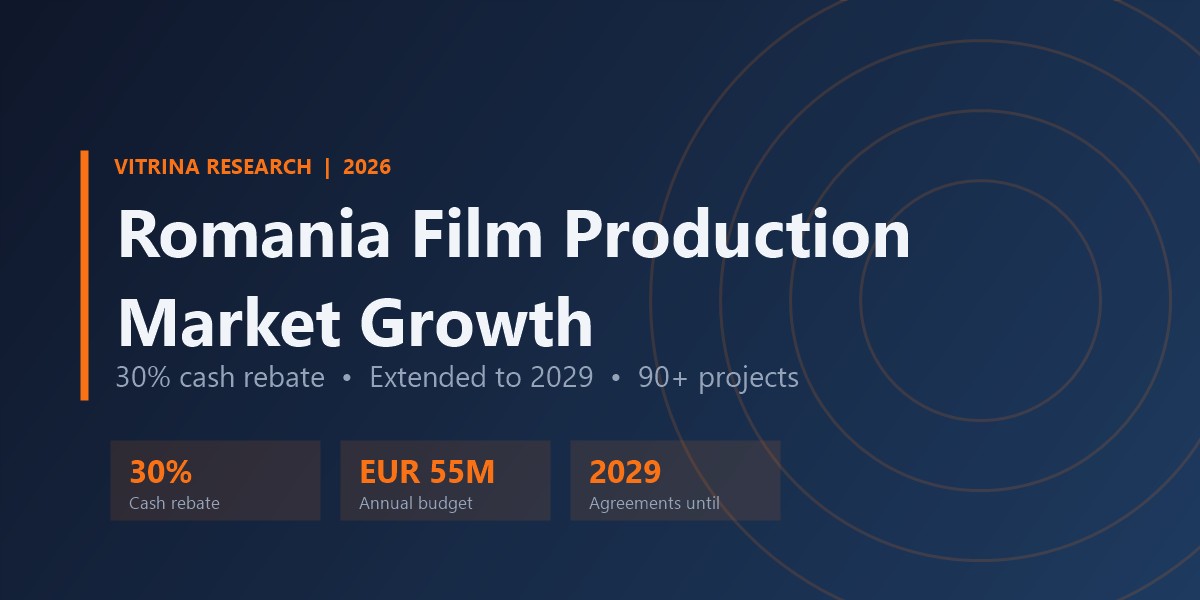
Romania film production market growth is back on the agenda after a difficult few years. In June 2026, the government approved a three-year extension of its revamped 30% cash rebate, allowing financing agreements to be signed through the end of 2029 with payments running to 2031, according to Variety. For producers, financiers, and studio executives, the country that hosted Netflix’s “Wednesday” is trying to turn a stop-start incentive history into a predictable, bankable production offer.
The recovery is measurable. Since the rebate relaunched in 2024 after a two-year pause caused by unpaid claims, Romania has drawn more than 90 projects representing an estimated €110 million in planned local spend, according to the Office for Film and Cultural Investments (OFIC). The scheme carries an annual budget cap of €55 million, a minimum local spend of €100,000, and a per-project cap of €10 million, as reported by Screen at the relaunch. The question for international producers is whether Romania’s renewed stability can win back the larger productions that moved to neighboring markets during the pause.
Key Takeaways
- Romania’s cash rebate returns 30% of eligible local spend, with a €100,000 minimum, a €10 million per-project cap, and a €55 million annual budget.
- A June 2026 extension allows financing agreements through the end of 2029, with payments running through 2031.
- Since the 2024 relaunch, more than 90 projects have been approved, representing about €110 million in planned local spend (OFIC).
- The original scheme offered 35%, rising to 45% for projects promoting Romania, but it was suspended over unpaid claims; the relaunched version trades a lower rate for reliability.
- Netflix’s “Wednesday” season one, shot near Bucharest, showed what Romanian studios and crews can deliver, and studio operators report rising international interest in 2026.
Why Romania Is Re-Emerging as an Eastern European Production Hub
Romania has a long record as a cost-effective production base. Large studio lots around Bucharest have hosted Hollywood features, television series, and European co-productions for decades, supported by experienced crews, craft departments, and construction teams. The country’s own filmmakers built an international reputation through the Romanian New Wave, with festival winners that gave the local industry creative credibility abroad.
Romania film production market growth stalled when the original cash rebate, launched in 2018 at 35% and up to 45% for projects that promoted the country, ran into a backlog of unpaid claims and was suspended. International producers need certainty that a rebate will be paid on time, and many moved projects to Hungary, the Czech Republic, and Bulgaria. The relaunched scheme is designed to fix that trust problem first, accepting a lower headline rate in exchange for a funded, time-bound program.
For producers and financiers, the practical question is now whether the 30% rate, the annual cap, and Romania’s studio and crew depth line up for a specific project. The table below summarizes the essentials.
| Metric | Detail | Source |
|---|---|---|
| Cash rebate rate | 30% of eligible expenditure incurred in Romania | OFIC / Variety |
| Minimum local spend | €100,000 per project | Screen, 2024 relaunch |
| Per-project cap | €10 million | Screen, 2024 relaunch |
| Annual budget | €55 million | Variety, June 2026 |
| Scheme term | Agreements through end of 2029; payments through 2031 | Variety, June 2026 |
How Big Is Romania’s Film Production Market?
Romania’s domestic box office is modest, so the market is defined largely by inbound international and co-production spend. OFIC’s figure of more than 90 approved projects and about €110 million in planned local spend since 2024 is the clearest current measure of Romania film production market growth. With an annual cap of €55 million, the scheme’s capacity is larger than its early uptake, which leaves room for more and bigger projects as confidence returns.
Romania Cash Rebate: Original vs Relaunched Scheme
Source: OFIC; Screen; Variety. The 2018 scheme was suspended over unpaid claims before its 2024 relaunch.
The 30% Cash Rebate Program
The relaunched rebate returns 30% of eligible expenditure incurred in Romania. It is administered by the Office for Film and Cultural Investments (OFIC). Eligible formats include feature films, documentaries, TV and web series, and animation. Projects must reach a minimum of €100,000 in local spend, and the rebate is capped at €10 million per project. The key structural change is funding discipline: an annual budget cap of €55 million and a defined term are meant to ensure that approved projects are actually paid. Producers comparing Romania with regional peers can benchmark it against Vitrina’s guide to the Hungary film tax rebate.
The 2026 Extension
The June 2026 extension, announced during the Transilvania International Film Festival, gives producers a longer planning horizon. Financing agreements can be signed through the end of 2029, and payments can run through 2031. That matters for high-end series and multi-season projects, which need confidence that the incentive will still exist when later seasons go into production.
Studio and Crew Infrastructure
Bucharest and its surroundings hold most of Romania’s production infrastructure, including Castel Film Studios and the large studio lot at Buftea, which was used by “Wednesday.” These facilities offer soundstages, standing sets, backlots, and in-house construction and craft departments. Romania’s crew base, trained on decades of international service work, remains one of its strongest selling points. Producers looking for local animation partners can explore Vitrina’s directory of top animation studios in Romania.
Why International Producers Are Returning to Romania Now
Netflix’s “Wednesday” was the most visible proof of Romania’s capacity. Tim Burton’s series shot its first season near Bucharest, using local studios and locations to recreate an American boarding school, and its success generated screen tourism interest in the country. It showed that a Romanian base could deliver a global, high-end streaming series.
Industry sentiment has improved alongside the rebate. Castel Film Studios’ head of production, Bogdan Moncea, has said interest from international clients has started to return, with discussions about new projects increasing significantly since the beginning of 2026. The extension removes one of the biggest objections producers raised during the pause: uncertainty about whether the program would continue.
The rebate economics are the mechanism behind the recovery. A 30% rate is competitive with several regional programs, and Romania’s cost base for crews, construction, and accommodation remains attractive. Producers weighing the region often compare it with Vitrina’s analysis of the Czech Republic film incentive, where a different rate and cap structure gives a useful benchmark.
VITRINA INTELLIGENCE
Who’s Actually Producing in Romania Right Now?
Trade headlines show you the “Wednesday” shoot. VIQI shows you the verified studios, service vendors, and financiers behind Romanian production — searchable by capability, budget tier, and deal activity across 159,223 companies, instead of chasing referrals.
How Producers Access Romania’s Incentives and Local Partners
Accessing the rebate is a formal application process, and producers who prepare documentation early avoid the delays that frustrated earlier applicants.
Applying for the Cash Rebate
Applications go to OFIC before production, supported by a budget showing eligible Romanian spend, the production schedule, and the agreement with the local production company. After approval, the producer signs a financing agreement, shoots, and submits audited spend for payment. Because the rebate is paid after audit, it has to be cash-flowed or financed during production. Producers should also keep detailed records of local suppliers, payroll, and invoices from day one, because the audit will test each eligible cost against the approved budget, and missing paperwork is the most common cause of reduced or delayed payments in rebate systems across the region.
Structuring Co-Productions and Local Partnerships
Most international productions work through an experienced Romanian service company or co-producer that handles crew, permits, and the rebate paperwork. As an EU member and Eurimages participant, Romania also gives European co-productions access to additional public funding. Rebate timing, co-production equity, and gap financing should be modeled together from the start. A local partner with recent OFIC experience can also advise on which costs qualify, how to schedule spending against the annual budget, and how to structure agreements so the rebate can be used as collateral with lenders.
What Are the Core Challenges in Producing in Romania?
Romania film production market growth depends on rebuilding confidence, and two issues still come up in producer discussions.
Payment Reliability and Annual Caps
The suspension of the original scheme left a lasting impression, so financiers will watch closely to see that claims under the relaunched scheme are paid on time. The €55 million annual cap also limits how much can be committed in any one year, so large productions should engage OFIC early to confirm that funds are available for their schedule.
Competition from Neighboring Markets
Hungary, the Czech Republic, and other regional markets used Romania’s pause to win projects and expand their studio capacity. Romania now has to compete against established alternatives with long, uninterrupted payment records, so price and crew quality alone may not be enough without visible proof of reliability.
Which Regions Within Romania Are Attracting the Most Production?
Production activity concentrates in three areas.
Bucharest and Buftea: Studios and Crews
The capital and nearby Buftea hold the main studio complexes, equipment houses, and most crews. They are the natural base for production offices and stage work.
Transylvania: Castles, Medieval Towns, and Mountains
Transylvania offers castles, fortified churches, and medieval towns such as Sibiu, Brașov, and Sighișoara, along with the Carpathian Mountains. It suits period, fantasy, and horror projects, and it is also home to the Transilvania International Film Festival in Cluj-Napoca.
The Danube Delta and Black Sea Coast
The Danube Delta’s wetlands and the Black Sea coast offer unusual natural landscapes for adventure, nature, and coastal stories, though logistics are more demanding than around Bucharest. Productions working there usually plan for boat access, longer travel days, and seasonal weather, which makes careful scheduling essential.
What Makes a Production a Good Fit for Romania?
Not every project captures the same value from Romania, and fit should be tested early.
Budget Tier and Rebate Efficiency
Mid-budget features and high-end series that can place most of their spend locally benefit most, since the €10 million cap limits the effective rate for very large productions. Projects with long shoots and heavy construction gain from Romania’s lower labor and material costs. Series with several seasons also benefit from the extension to 2029, since later seasons can be planned under the same rules rather than relying on a scheme that might lapse.
Genre and Location Fit
Period dramas, fantasy, horror, and gothic stories make strong use of Romania’s castles, old towns, and forests. Productions that need to double for other European or American settings can also rely on the Bucharest studios’ standing sets and backlots.
How Romanian Service Vendors and Studios Are Getting Discovered by International Productions
The relaunch creates a discoverability challenge. International producers returning to Romania, or considering it for the first time, have no central way to see which service companies, equipment houses, and post facilities are active and equipped for their budget and genre. Many relationships lapsed during the rebate pause.
For Romanian studios and vendors, this is a business development priority. Producers and platform sourcing teams researching the market are looking for verified partners, and being visible to them, instead of relying on old referral networks, is now a real competitive advantage.
VITRINA INTELLIGENCE
Invisible to the Producers Returning to Romania?
International interest in Romania is picking up again, and most of it still moves through referrals. List your studio, equipment house, or service company on Vitrina and get found by the producers actively sourcing Romanian partners.
How Vitrina Helps Producers and Financiers Navigate the Romanian Market
Acting on Romania film production market growth requires knowing which studios and service companies are active, which have recently delivered rebate-backed productions, and which financiers and co-producers are working in the market. That intelligence has historically been scattered across trade coverage, festival catalogs, and personal networks. VIQI, Vitrina’s M&E intelligence platform, consolidates it into a searchable database of 159,223 verified companies worldwide.
Producers and financiers use VIQI to identify Romanian production companies, studios, and vendors by capability, budget tier, and deal activity, cutting partner research from weeks to hours. Film offices use it to understand which producers are evaluating their territory.
For Romanian studios and vendors, a VIQI listing puts their credits and capabilities in front of the international producers and streaming teams now looking at the market again.
VITRINA INTELLIGENCE
Still Finding Romanian Partners by Cold Email?
See how producers and financiers use VIQI to go from weeks of cold outreach to a focused, hours-long search — verified studios, vendors, and co-production partners across 159,223 companies.
Conclusion
Romania film production market growth is a recovery story with a clear path forward. A funded 30% cash rebate, a three-year extension, experienced crews, and studio lots proven by “Wednesday” give the country a credible case to win back international work.
The opportunity comes with conditions. Producers and financiers need to plan around the annual cap and post-audit payment, and Romania must keep paying claims on time to rebuild trust. Romanian studios and vendors are well placed to benefit, if international buyers can find them.
For producers and acquisition executives, the practical challenge is intelligence: who is producing in Romania, who holds verified local capacity, and who is structuring rebate-backed deals. That is the gap VIQI is built to close. Start your search for Romanian production partners today.
Frequently Asked Questions
What is the cash rebate for filming in Romania?
Romania offers a 30% cash rebate on eligible expenditure incurred in the country, administered by the Office for Film and Cultural Investments (OFIC). Projects need at least €100,000 in local spend, the rebate is capped at €10 million per project, and the program has an annual budget of €55 million.
What is driving Romania film production market growth in 2026?
The relaunch of the cash rebate in 2024, a June 2026 extension allowing agreements through 2029, more than 90 approved projects worth about €110 million in planned spend, and renewed international interest following Netflix’s “Wednesday.”
Why was Romania’s cash rebate suspended?
The original 2018 scheme, which offered 35% and up to 45% for projects promoting Romania, built up a backlog of unpaid claims and was paused. Most of those debts have since been paid, and the relaunched scheme uses a lower rate with a fixed annual budget.
What are the biggest challenges of producing in Romania?
Rebuilding confidence in payment reliability and competing with neighboring markets that expanded during Romania’s pause are the main challenges. Producers should also plan for the annual budget cap and post-audit payment timing.
How can Romanian studios and vendors get discovered by international productions?
Many Romanian studios and vendors still rely on referrals and festival networks. Listing on an M&E intelligence platform like Vitrina’s VIQI puts verified credits and capabilities in front of producers and streaming platforms sourcing partners for Romanian shoots.
About the Author
Vitrina Research Team
The Vitrina Research Team produces intelligence-led analysis on media and entertainment industry structure, deal activity, and market trends. Our research draws on VIQI’s proprietary dataset of 159,223 M&E companies worldwide.