IHUB
IHUB
 Private Briefings (Webinars)


 LeaderSpeak Podcast
  Global Entertainment Digest (Newsletter)
  Premium Lists
 Membership Benefits
 About Vitrina
 Our Story
Sourcing an AV vendor for a concert, award show, or branded activation? Vitrina maps 300,000+ entertainment supply-chain companies so you can vet AV event partners before you sign.
An awards telecast that loses its live feed mid-broadcast, a festival main stage where the LED wall drops out during a headline set, a branded activation where the sound system can’t cover the crowd — these are not corporate-conference AV problems. They are entertainment production problems, and they get solved (or created) by the audio visual event company a producer, brand, or rights holder chooses to hire. This guide is written for the people who commission that vendor: producers, brand and experiential marketing teams, and rights holders evaluating AV partners for concerts, festivals, televised award shows, and branded entertainment activations — not for someone booking AV for a sales kickoff.
Key Takeaways
- Audio visual event companies supply the technical stagecraft — staging/rigging, LED walls, broadcast-grade audio, lighting design, and live-streaming integration — for entertainment formats like concerts, festivals, award shows, and brand activations.
- They differ from generic corporate AV integrators in rigging complexity, LED scale, broadcast-grade signal chains, and insurance carried — and they differ from full live entertainment production companies, which own the overall show while often subcontracting AV vendors for specific technical scopes.
- Evaluation criteria that matter for entertainment work: format-specific technical capability, insurance and risk profile, a verifiable track record at comparable scale, and the ability to integrate with a broadcast or streaming delivery chain.
- Trade bodies like ESTA (US) and PLASA (UK) publish the ANSI E1.x rigging standards that serious AV vendors reference in their safety documentation.
- Vitrina’s supply-chain intelligence platform tracks 300,000+ companies and 5 million+ professionals (as of 2026) across the entertainment supply chain, including AV and technical-production vendors, so sourcing teams can shortlist and vet partners with verified track records instead of cold searches.
Table of Contents
- What Are Audio Visual Event Companies in the Entertainment Industry?
- How Is an Entertainment AV Event Company Different From a Generic Corporate AV Integrator?
- How Does an AV Event Company Differ From a Full Live Entertainment Production Company?
- What Service Categories Should You Expect From an AV Event Company?
- Which Entertainment Formats Rely Most Heavily on Specialized AV Vendors?
- How Do You Evaluate an AV Event Company Before Signing?
- How Should You Structure an RFP for an Entertainment AV Vendor?
- What Drives the Cost of Entertainment AV Production?
- Why Does Insurance and Technical Risk Matter More for Entertainment AV Than Corporate AV?
- What Do Real Entertainment AV Deployments Look Like?
- What Common Mistakes Do Producers and Brands Make When Sourcing AV Vendors?
- How Does Vitrina Help You Source and Vet Entertainment AV Event Companies?
- What Are Frequently Asked Questions About Audio Visual Event Companies?
What Are Audio Visual Event Companies in the Entertainment Industry?
Audio visual event companies are the technical-service vendors that design, build, and operate the staging, LED, audio, lighting, and streaming systems that make a live entertainment moment physically happen — distinct from the production company that conceives and runs the overall show. In the entertainment context, an AV event company is hired for a defined technical scope: it might supply and rig the LED wall for a festival main stage, run the broadcast audio mix for a televised award show, or build the lighting rig for an arena tour leg. It is a specialist subcontractor or direct vendor, not the creative or executive producer of the event. For a rights holder or brand, understanding this distinction up front changes who you put on a shortlist and what you ask them to quote.
How Is an Entertainment AV Event Company Different From a Generic Corporate AV Integrator?
An entertainment-focused AV event company is built around touring-grade rigging, large-format LED and video walls, broadcast-grade audio and RF coordination, and crews who can execute a show-critical cue-to-cue — while a generic corporate AV integrator is optimized for a single ballroom, a projector and screen, a lectern mic, and a one-day teardown. The two categories overlap on paper (both sell “AV services”) but the equipment classes, crew disciplines, and failure tolerances are not the same. A corporate AV integrator that mostly does conference rooms and hotel ballrooms is rarely the right partner for a concert, festival stage, or televised entertainment format, even if its sales page says “events.”
| Dimension | Entertainment-Focused AV Event Company | Generic Corporate AV Integrator |
|---|---|---|
| Typical formats | Concerts, festivals, award shows, branded entertainment activations | Conferences, sales meetings, trade show booths |
| Rigging | Motorized/manual chain hoists, truss spans, ANSI E1.4-class rigging plans | Minimal or none; static mounts |
| LED/video | Large-format outdoor-rated LED walls, media servers, video control | Projector-and-screen or single confidence monitor |
| Audio | Line-array PA, broadcast mix feeds, RF coordination for wireless mics/in-ears | Podium mic and house speakers |
| Streaming/broadcast integration | Direct integration with OB trucks, streaming encoders, multi-camera switching | Basic webcast or single-camera Zoom feed |
| Insurance profile | High-limit general liability, often with rigging/aerial-lift endorsements | Standard commercial GL |
The practical consequence of this table is a sourcing filter, not a value judgment: a corporate AV integrator can be excellent at what it does and still be the wrong vendor for a concert stage or a televised award show, because its inventory, crew certifications, and insurance were never built for overhead rigging or outdoor-scale LED. The same logic that separates a completion-bond-backed film financier from an ordinary lender applies here — see how completion bonds work for a parallel example of category-specific risk instruments that generalist providers simply do not carry. When a vendor’s proposal doesn’t reference truss spans, rigging plans, or a broadcast-grade signal chain, that is usually a sign the company’s core business sits in the corporate-event category rather than entertainment production, regardless of how the pitch is worded. This matters most at the RFP stage, before a contract is signed and before a producer discovers — often on load-in day — that the vendor’s crew has never rigged a truss span over a live audience.
Before you send an RFP to an AV vendor, see their actual credit history — not just their pitch deck.
How Does an AV Event Company Differ From a Full Live Entertainment Production Company?
A full live entertainment production company owns the entire show — creative direction, tour or event management, and overall vendor coordination — and typically subcontracts one or more AV event companies to execute specific technical scopes like rigging, LED, audio, or lighting. An AV event company, by contrast, is usually engaged for a defined deliverable inside someone else’s production plan. Vitrina’s companion guide, Live Entertainment Production Companies: 2026 Sourcing Guide, covers how to source and vet the production companies that run touring, broadcast live events, and immersive experiential shows end to end. This article is narrower on purpose: it’s about the AV vendor layer underneath that production umbrella — the companies you’d add to a technical-scope RFP even when a production company is already attached to the project.
| Dimension | AV Event Company | Live Entertainment Production Company |
|---|---|---|
| Contract role | Technical-scope vendor (staging, LED, audio, lighting, streaming) | Overall show owner/executive producer |
| Reports to | Production company, brand, or rights holder directly | Rights holder, promoter, or brand |
| Typical deliverable | A rigged, tested, operated technical system for one event or tour leg | The entire produced show, including creative and vendor management |
| When you’d hire directly | You already have a production plan and need a specific technical scope filled | You need someone to run the whole event or tour from concept to teardown |
In practice the two categories often sit in the same room during a production meeting: the live entertainment production company runs the show-level schedule and budget, while the AV event company reports its technical progress into that plan. Producers sourcing directly for a technical scope — say, LED and lighting for a branded activation with no separate production company attached — should still ask an AV vendor how it typically integrates with a production management team, since even a pure technical vendor needs to slot into someone’s overall run-of-show.
What Service Categories Should You Expect From an AV Event Company?
A capable entertainment AV event company should be able to speak fluently to five core categories: staging and rigging, LED/video walls, broadcast-grade audio, lighting design, and live-streaming or broadcast integration — and most vendors specialize in two or three rather than claiming mastery of all five. When you send an RFP, ask each vendor to name which of these categories they self-perform with in-house crew versus which they subcontract, because that materially changes your risk and coordination burden.
| Service Category | What It Covers | Format Examples | Key Question to Ask |
|---|---|---|---|
| Staging & rigging | Stage decks, truss, motorized/manual hoists, load calculations | Festival main stages, arena tours, award-show sets | Who is your certified rigger of record? |
| LED walls / video | Panel supply, video processing, media servers, control | Concert backdrops, festival stages, activation backdrops | What panel pitch and brightness do you stock for outdoor use? |
| Broadcast-grade audio | Line-array PA, broadcast mix feeds, RF/wireless coordination | Concerts, award shows, televised activations | Can you deliver an isolated broadcast mix separate from house PA? |
| Lighting design | Fixture supply, rigging, programming, operation | Concerts, festivals, award shows, immersive activations | Do you design in-house or license a third-party designer’s plot? |
| Live-streaming/broadcast integration | Camera packages, OB truck or encoder integration, multi-camera switching | Televised award shows, livestreamed festivals, hybrid activations | Have you fed a network OB truck or streaming platform directly before? |
Staging and rigging is the category with the least room for error: a load calculation mistake or an uncertified rigger creates a safety incident, not just a bad show. LED and video is where most of a producer’s visual budget concentrates for concerts and activations, and the category has moved quickly toward finer pixel pitches and higher brightness for outdoor daylight visibility, which means a vendor’s inventory age matters as much as its brand name. Broadcast-grade audio is easy to underestimate because a system that sounds fine to a live crowd can still fail a broadcast mix engineer who needs an isolated, clean feed separate from house reinforcement. Lighting design increasingly overlaps with the video category as designers program moving lights and LED content together from the same console, so ask whether a vendor’s lighting and video teams actually coordinate or work in silos. Live-streaming and broadcast integration is the newest core category and the one where the vendor pool is genuinely narrow — plenty of companies can run a webcam feed, far fewer have fed a network OB truck or handled multi-camera switching for a televised entertainment format.
Which Entertainment Formats Rely Most Heavily on Specialized AV Vendors?
Four entertainment formats create the highest AV stakes and the narrowest vendor pool: concerts and festivals, televised award shows, branded entertainment activations, and immersive/experiential entertainment marketing — each format has its own failure modes and its own subset of AV vendors who genuinely operate at that scale. A vendor who is excellent at corporate product launches is not automatically qualified for any of these four.
- Concerts and festivals: Outdoor-rated LED, weatherproofed rigging, and PA systems that cover tens of thousands of people across an open field are a different engineering problem than an indoor ballroom.
- Televised award shows: AV has to satisfy two audiences at once — the room and the broadcast feed — which means a separate broadcast-grade mix, camera-friendly lighting, and redundant signal paths.
- Branded entertainment activations: A brand’s on-site AV has to survive extended daily run times, public foot traffic, and often integrate with talent appearances or livestreamed segments. Brands that also work directly with talent management agencies for these appearances typically loop the AV vendor in on the talent rider early, since stage-plot and power requirements from a performer’s rider directly shape the AV build.
- Immersive/experiential entertainment marketing: Projection mapping, spatial audio, and interactive LED installations require vendors with dedicated experiential AV divisions, not just event-rental inventory.
These four formats also tend to compress timelines in ways generic corporate events don’t: a festival’s main-stage AV has to be fully operational for a fixed set-change window between artists, an award show’s technical rehearsal is often a single pass before the live broadcast, and a branded activation frequently has to be camera-ready the moment doors open to the public. An AV vendor whose crew hasn’t worked under that kind of compressed, no-second-take schedule is a real operational risk, even if its equipment list looks identical to a vendor who has.
How Do You Evaluate an AV Event Company Before Signing?
Evaluate an entertainment AV vendor on four fronts: technical capability matched to your specific format, insurance and risk profile, a verifiable track record at comparable scale, and the ability to integrate cleanly with your broadcast or streaming delivery chain — and request references from events of similar size, not just a highlight reel. A vendor’s website portfolio will show its best day; your job is to find out what a typical day and a bad day look like.
- Technical capability for the format: Ask for the exact equipment inventory (panel model, PA line-array model, console type) they intend to bring, not a generic capabilities list.
- Insurance and risk: Request a certificate of insurance naming your production as additional insured, and confirm rigging/aerial-lift endorsements are included, not just standard general liability.
- Track record at comparable scale: A vendor that has only done 500-capacity club shows is not automatically ready for a 20,000-seat arena tour leg or a network-televised award show, regardless of how the pitch reads.
- Broadcast/streaming integration: If your event will be filmed or streamed, confirm the vendor has previously fed a network OB truck, streaming encoder, or multi-camera switch — not just run house sound and lights.
It’s worth treating references the same way you’d treat any other vendor diligence: call the reference, ask specifically about the format and scale of the referenced event (not just “were they good to work with”), and ask what, if anything, went wrong on site. A vendor with a long client list but no references willing to speak to comparable-scale entertainment work is a signal worth taking seriously, especially for a first-time engagement on a high-visibility show like a televised award show or a major brand activation.
Stop vetting AV vendors from a static PDF portfolio. See verified project history across 1.6 million+ titles.
How Should You Structure an RFP for an Entertainment AV Vendor?
An entertainment AV RFP should specify the format and scale of the event, the exact technical scopes you need filled, the venue or site conditions, broadcast/streaming requirements, and your insurance minimums up front — vague RFPs are the single biggest reason producers receive quotes that can’t be compared against each other. Because AV event companies specialize by category, an RFP that simply asks “what can you do for our show” invites every vendor to answer from their own strongest category, which makes bids impossible to compare on a like-for-like basis.
- Name the format explicitly: A concert, a televised award show, and a branded activation each imply different technical requirements, so state which one you’re running rather than describing it generically as “an event.”
- Break the scope into named categories: List staging/rigging, LED/video, audio, lighting, and streaming integration as separate line items so vendors quote against the categories they actually self-perform, rather than bundling an unclear all-in number.
- Disclose venue and site conditions early: Rigging points, power availability, outdoor weather exposure, and load-in/load-out windows change equipment selection and crew size, and withholding them until after a quote is submitted produces change orders later.
- State broadcast or streaming requirements as a hard requirement, not a nice-to-have: If the event will be filmed or streamed, say so in the RFP itself so vendors without that capability can self-select out instead of submitting a quote they can’t actually fulfill.
- Set insurance minimums in the RFP, not the contract: Stating your required general liability limits and additional-insured language up front filters out underinsured vendors before you’ve invested time comparing their bids.
What Drives the Cost of Entertainment AV Production?
Entertainment AV costs are driven primarily by scale (audience size and venue footprint), technical complexity (rigging height, LED resolution and quantity, number of broadcast camera positions), and rental duration — not by a fixed day rate, which is why two events of similar attendance can carry very different AV budgets. There is no single published, verifiable industry-wide price benchmark for entertainment AV production that would hold across formats, regions, and vendor tiers, so this section describes the drivers qualitatively rather than citing a specific figure.
- Scale: A festival main stage serving tens of thousands of attendees requires substantially more LED surface area, PA coverage, and rigging capacity than a theater-scale award show, and cost scales with that footprint.
- Technical complexity: Higher rigging heights, finer LED pixel pitch for close-viewing distances, additional broadcast camera positions, and redundant signal paths all add cost independent of audience size.
- Rental duration and load-in/load-out: Multi-day festivals and touring productions amortize setup costs differently than a single-night award show, where the full rigging and LED build has to be justified by one night of use.
- Crew and labor: Entertainment AV work often requires certified riggers, broadcast engineers, and specialized programmers whose day rates reflect scarcity in the specific skill, not just general labor costs.
Because there isn’t a reliable public benchmark, the most useful sourcing practice is comparing multiple structured RFP responses against each other for the same defined scope, rather than anchoring to an industry-average number that may not reflect your format, region, or vendor tier.
Why Does Insurance and Technical Risk Matter More for Entertainment AV Than Corporate AV?
Entertainment AV work involves overhead rigging, large structures exposed to weather, and crowds that can number in the tens of thousands, so the liability exposure — and the insurance a serious vendor needs to carry — is materially higher than a hotel-ballroom AV job. Industry safety standards for the rigging side of this work are published as part of the ANSI E1 series developed through the Entertainment Services and Technology Association’s (ESTA) ANSI-accredited Technical Standards Program, which has operated since 1994 (ESTA, tsp.esta.org). In the UK, the Professional Lighting and Sound Association (PLASA) has separately developed rigging credentials, including the UK National Rigging Certificate launched in 2007 (PLASA, plasa.org). ESTA and PLASA briefly merged in 2010 and demerged in 2015, so treat them as two distinct organizations today rather than a single body.
On the insurance side, industry insurance brokers commonly describe $1,000,000 per-occurrence and $1,000,000 products-completed-operations as a typical minimum for staging and rigging general liability policies, with large-scale events sometimes requiring combined single limits well above that (industry insurance-broker guidance, 2025–2026). These figures are contractual and venue-driven norms rather than a codified legal standard, so always confirm the specific limits your venue, broadcaster, or insurer requires rather than assuming a single number applies everywhere.
Risk management for entertainment AV also extends beyond the insurance certificate itself. Ask a vendor how it documents rigging inspections before doors open, who on their crew holds a recognized rigging certification, and how they handle weather contingencies for an outdoor concert or festival stage — wind-load limits on truss and LED structures are a real operational constraint, not a formality. A vendor that can answer these questions specifically, with named procedures and named certifications, is demonstrating exactly the kind of operational maturity that separates an entertainment-grade AV company from a vendor that has simply expanded its corporate-event business into “events” more broadly.
What Do Real Entertainment AV Deployments Look Like?
Trade press coverage of recent major entertainment events shows multiple AV vendors typically working side by side on a single show, each covering a different technical category — rigging, LED, lighting, and effects are rarely all handled by one company. These are useful reference points for what a comparable-scale technical vendor stack actually looks like.
- Chase & Status arena tour (2025): TPi Magazine reported PRG supplying video and rigging, Lights Control Rigging handling lighting design and execution, BPM SFX running lasers and pyrotechnics on a grandMA3 console, and Ox Event House building the set, with ROE Vanish V8T LED panels on MoveKet automation (TPi Magazine, July 2025).
- Coachella main stage (2025): PRG supplied lighting and video for the festival’s main stage, including 1,180 tiles of ROE Carbon CB8 LED in its proprietary SpaceFrame rigging system with Disguise media servers, while GLP supplied what it described as its largest-ever Coachella lighting deployment (PRG.com; GLP, germanlightproducts.com, 2025).
- Super Bowl LIX halftime show (2025): PRG’s own press materials describe supplying roughly 60,000 feet of fiber optic cable and more than 700 lighting fixtures, including 48 Elation Proteus Radius units and proprietary followspot systems, plus camera packages integrated into the broadcast’s auxiliary control room (PRG.com, February 2025).
- TPi Awards (2025 and 2026): Robe Lighting served as production lighting supplier both years at Evolution London, deploying roughly 250 moving LED fixtures in 2025 in front of more than 1,850 industry attendees, and over 300 fixtures for the 25th-anniversary show in 2026, with video content by Observatory (Live Design Online; TPi Magazine, 2025–2026).
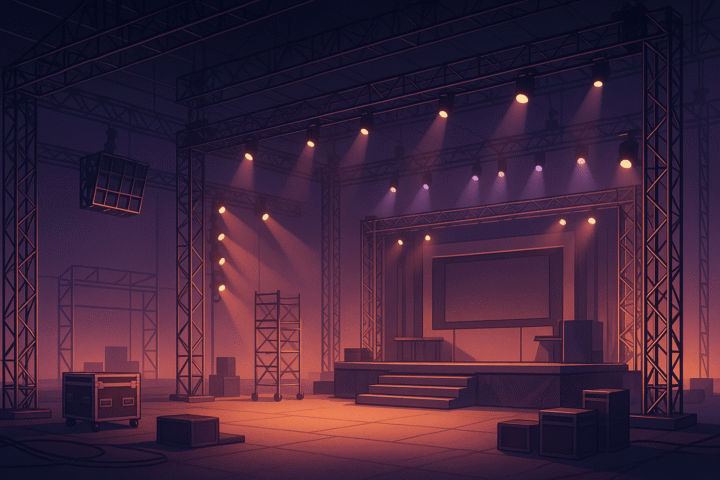
The consistent pattern: no single AV event company owns rigging, LED, audio, lighting, and effects for a major entertainment show. Producers and brands sourcing AV partners should expect to assemble a small vendor stack, then confirm each company’s scope, insurance, and prior work at that specific format and scale — not assume one generalist vendor covers everything end to end.
This also explains why some of the same vendor names recur across very different formats: a company like PRG shows up in trade press coverage of both a music festival main stage — the same festival circuit covered by music production companies sourcing guides and a televised halftime show because its rigging, video, and lighting divisions can scale across formats, while a smaller regional AV company might do excellent work at club and theater scale without ever bidding on stadium-scale jobs. For context on how full production companies (not just the AV layer) are evaluated across the US market, see this guide to top production houses in the Americas. Neither is a red flag on its own — the point for a producer or brand is to match the vendor’s demonstrated scale to the show you’re actually building, using trade press coverage, references, and verified project history rather than a vendor’s own claims about capacity.
What Common Mistakes Do Producers and Brands Make When Sourcing AV Vendors?
The most common sourcing mistake is treating “AV company” as a single undifferentiated category and requesting quotes from corporate-event integrators for an entertainment-scale job, which produces mismatched bids, underinsured vendors, and last-minute subcontracting the client never approved and never had a chance to vet. Several related mistakes tend to follow from that first one once a project is already underway.
- Confusing a reseller with the operator: Some vendors quote work they intend to subcontract to a third party without disclosing it, which means the producer never actually vets the crew that shows up on site.
- Skipping the insurance verification step: A vendor’s marketing claims about capability mean nothing if their certificate of insurance doesn’t name your production as additional insured or exclude rigging/aerial-lift work.
- Ignoring broadcast requirements until late: If an event will be filmed or streamed, AV vendors need to be selected with that requirement from day one — retrofitting a broadcast-grade audio feed after house AV is already locked in is expensive and sometimes impossible.
- Comparing bids that were scoped differently: When an RFP doesn’t break out staging, LED, audio, lighting, and streaming as separate line items, vendors quote against different assumptions, and the resulting bids look comparable on price but aren’t actually comparable on scope.
- Assuming a big-name vendor automatically fits the format: A company known for touring-scale arena work may not be the right fit for a tightly budgeted branded activation, and vice versa; track record has to be matched to your specific format and scale, not just brand recognition.
How Does Vitrina Help You Source and Vet Entertainment AV Event Companies?
Vitrina is a supply-chain intelligence platform for the entertainment industry that maps 300,000+ companies, 1.6 million+ titles, and 5 million+ professionals across 100+ countries (as of 2026), giving producers, brands, and rights holders a verified way to shortlist and vet AV event vendors instead of relying on cold web searches or a single vendor’s own pitch deck. For AV sourcing specifically, that means being able to see a vendor’s prior project history, connected personnel, and category focus (rigging, LED, audio, lighting, or streaming integration) in one place, and cross-reference it against comparable-scale entertainment work rather than a generic “events” claim.
Vitrina also tracks the broader entertainment supply chain around AV sourcing decisions — see Entertainment Industry Overview: Structure, Economics & How Money Flows for how AV and production spend fits into the wider industry, and Media and Entertainment Companies: The Complete Industry Landscape for how vendor categories map across the sector. If your AV sourcing sits inside a larger production or brand deal, Entertainment Deal Negotiation: A Practical Playbook Across Deal Types covers how vendor and production contracts typically get structured. Platform data on relationship mapping (30 million+ relationships as of 2026) and tracked annual spend ($200 billion+ as of 2026) is what lets sourcing teams see which AV vendors have actually worked together before, rather than guessing from a proposal alone. If your AV sourcing sits alongside broader talent or on-site staffing decisions for the same event, Top Talent Management Companies in MENA is one regional example of how Vitrina structures vendor and talent directories that a production team can cross-reference against its AV shortlist.
Vendor Sourcing, Verified
Find and vet your next AV event partner on Vitrina
Search 300,000+ entertainment supply-chain companies, see verified project history, and shortlist AV vendors who’ve actually delivered at your event’s scale.
What Are Frequently Asked Questions About Audio Visual Event Companies?
What is an audio visual event company in the entertainment industry?
An audio visual event company is a technical-service vendor that supplies and operates staging/rigging, LED walls, sound systems, lighting, or live-streaming integration for a live entertainment event, typically working within a scope defined by a producer, brand, or rights holder rather than owning the overall show.
How is an AV event company different from a corporate AV integrator?
An entertainment-focused AV event company carries touring-grade rigging, large-format LED, broadcast-grade audio, and crews used to show-critical cue-to-cue execution, while a generic corporate AV integrator is typically built around single-room conference and meeting setups with lighter equipment and lower insurance limits.
How is an AV event company different from a live entertainment production company?
A live entertainment production company owns the entire show — creative direction and overall vendor coordination — and often subcontracts one or more AV event companies for specific technical scopes such as rigging, LED, audio, or lighting; the AV company is the technical vendor, not the show’s overall producer.
What insurance should an entertainment AV vendor carry?
At minimum, confirm a certificate of insurance naming your production as additional insured with rigging and aerial-lift endorsements included; industry brokers commonly cite $1,000,000 per-occurrence general liability as a typical baseline for staging and rigging work, though large-scale events can require combined limits well above that, and requirements vary by venue and broadcaster.
What questions should I ask an AV vendor before signing a contract?
Ask for the exact equipment they intend to bring (not a generic capabilities list), whether they self-perform or subcontract each scope, references from events of comparable scale and format, and whether they have previously integrated with a broadcast OB truck or streaming platform if your event will be filmed.
Do AV event companies handle live-streaming and broadcast integration?
Some do and some don’t — broadcast-grade streaming integration (feeding an OB truck, running multi-camera switching, or delivering an isolated broadcast audio mix) is a specialized capability that not every AV vendor carries, so confirm it directly rather than assuming it’s included in a standard AV quote.
How does Vitrina help source AV event companies?
Vitrina’s supply-chain intelligence platform lets producers, brands, and rights holders search verified company and project data across the entertainment supply chain — including AV and technical-production vendors — to build a shortlist backed by track record rather than a cold search or a single vendor’s own pitch.
Can one AV event company handle staging, LED, audio, lighting, and streaming for the same show?
Some larger AV event companies self-perform multiple categories, but trade press coverage of major entertainment events consistently shows productions assembling a stack of two to four specialized vendors rather than relying on one company for every category, so ask each vendor directly which scopes they self-perform versus subcontract before assuming full-service coverage.