IHUB
IHUB
 Private Briefings (Webinars)


 LeaderSpeak Podcast
  Global Entertainment Digest (Newsletter)
  Premium Lists
 Membership Benefits
 About Vitrina
 Our Story
Sourcing mobile production capacity for a live broadcast? Vitrina maps 300,000+ verified companies across the entertainment supply chain — as of 2026.
Video Production Trucks 2026: Buyer’s Guide for Broadcasters
A single Super Bowl broadcast now requires 15 mobile production units and 29 broadcast trailers working across seven venues for 14 different customers (TV Technology, Broadcast Now, 2026). Video production trucks are the physical infrastructure layer that makes every live sports, news, and entertainment broadcast possible, and yet most procurement teams outside broadcast engineering rarely understand what they are actually buying, leasing, or hiring. This guide breaks down what a production truck contains, how the vendor market is structured after a wave of 2024-2025 consolidation, and how to source verified mobile production capacity without relying on word of mouth.
Key Takeaways
- Video production trucks range from single-camera ENG vans to 100+ truck fleets; the largest operators — NEP, Game Creek Video, and the merged EMG/Gravity Media group — now control the overwhelming majority of top-tier sports OB capacity worldwide.
- The EMG-Gravity Media merger (announced January 11, 2024) combined over 100 outside broadcast trucks and flypacks, 40 studios, and roughly 2,000 employees into a single group (SVG Europe, 2024) — a strong signal that mobile production is consolidating around a handful of global operators.
- Buy, lease, and hire-per-event are three distinct economic models with very different break-even points; most producers and broadcasters should default to hire-per-event unless they have a season-long or multi-year rights commitment.
- Sourcing a mobile production vendor without verification exposes broadcasters to schedule risk during live, unrepeatable events — supply-chain intelligence platforms like Vitrina exist specifically to close that verification gap.
On This Page
- What Is a Video Production Truck and What Does It Actually Contain?
- What Are the Different Classes of Mobile Production Units?
- What Core Broadcast Systems Live Inside an OB Truck?
- How Do Flypacks Compare to Full Expando Trailers for Major Events?
- Who Are the Major Mobile Production Operators Worldwide?
- Should You Buy, Lease, or Hire a Production Truck Per Event?
- How Do Live Sports Rights Economics Drive Mobile Production Demand?
- How Should Broadcasters Source a Verified Mobile Production Vendor?
- What Should You Ask a Mobile Production Vendor Before Signing?
- Frequently Asked Questions
What Is a Video Production Truck and What Does It Actually Contain?
A video production truck — also called an OB (outside broadcast) truck or mobile production unit — is a self-contained broadcast facility built into a trailer or vehicle chassis, housing the routing, switching, replay, audio, graphics, and communications systems needed to produce a live multi-camera broadcast from any venue. Rather than building a permanent control room at every stadium, arena, or event site, broadcasters roll a truck to the location, connect camera and microphone cables, and produce the show from inside the vehicle. The truck is, functionally, a television studio control room on wheels.
The category matters more to a procurement team than its niche reputation suggests. Every live sports broadcast, awards show, breaking news event, and multi-camera concert stream depends on a video production truck or an equivalent mobile production unit somewhere in the signal chain — whether that vehicle is owned by the broadcaster, leased for a season, or hired for a single day. Getting the sourcing decision wrong doesn’t show up as a delayed post-production timeline; it shows up live, on air, in front of the audience the rights deal was signed to reach.
Inside, the crew is organized into rooms: a production control room (PCR) where the director calls shots and the technical director operates the switcher; an audio room where a mixer balances commentary, crowd, and effects; a graphics bay running scoreboard and telestration systems; and an EVS/replay room cutting highlights in near real time. The truck’s real value isn’t the vehicle shell — it’s the fact that every one of those systems has already been integrated, cabled, and tested together, which is precisely what a rented venue control room rarely offers on short notice.
Modern trucks increasingly route video over IP (SMPTE ST 2110) rather than coaxial SDI, which is what let Game Creek Video fit interconnected A/B/C-unit trucks within U.S. Department of Transportation weight limits by replacing copper cable runs with fiber (Riedel, 2025). For a producer evaluating vendors, the IP-versus-SDI question is one of the first specification differentiators worth asking about, because it affects everything from camera count to how many trucks can interconnect at a single venue.
Staffing is the other half of the equation that a pure equipment list misses. A flagship expando-trailer production typically carries a director, technical director, multiple replay operators, an audio mixer with one or more assistants, graphics operators, a utility engineer to maintain signal integrity through the broadcast, and a comms coordinator managing intercom assignments across dozens of crew members on headset. A regional OB truck or a flypack, by contrast, might run the same core roles with a fraction of the headcount, because fewer cameras and replay channels mean fewer people are needed to operate them. When a procurement team compares two bids for the same event, staffing plan and named crew experience are just as important a differentiator as the hardware list — a truck with a flagship switcher but an inexperienced crew is still a production risk.
What Are the Different Classes of Mobile Production Units?
Mobile production units span at least four practical classes: single-camera ENG (electronic news gathering) vans for news and magazine coverage; multi-camera regional OB trucks for mid-tier sports and local events; flypacks, which are rack-mounted broadcast systems flown or trucked to a venue without a dedicated vehicle; and large expando trailers that mechanically widen on site into a full multi-room studio for marquee sports. Choosing the wrong class for the event is the single most common procurement mistake in this category.
An ENG van typically supports one to three cameras and is built for speed and mobility rather than production complexity — it is the right tool for daily news, not a championship game. A regional OB truck adds a real switcher, a small EVS replay chain, and audio mixing for six to twelve cameras, suited to conference-level sports or corporate live events. Flypacks decouple the broadcast electronics from any single vehicle, which matters when venues don’t have truck parking or loading access, or when a broadcaster needs to deploy capacity across many simultaneous venues rather than concentrate it in one truck. Expando trailers — the largest class — mechanically expand once parked, adding floor space for dedicated rooms per function, and are what major U.S. sports broadcasters commission from builders like Game Creek Video.
| Truck Class | Typical Camera Count | Best Fit | Deployment Model |
|---|---|---|---|
| ENG van | 1-3 | News, magazine, ENG | Single vehicle, daily use |
| Regional OB truck | 6-12 | Regional sports, corporate live events | Single truck, day-rate hire |
| Flypack | 4-20+ (venue dependent) | Venues without truck access; multi-venue events | Rack-based, flown or trucked in cases |
| Expando trailer / flagship OB truck | 20-40+ | Major league and championship sports | Multi-truck A/B/C fleet, season contracts |
What Core Broadcast Systems Live Inside an OB Truck?
Every functioning production truck integrates five system categories: a video router and switcher for camera selection, an EVS-class replay server for instant highlights, an audio mixing console, a graphics/telestration system, and a comms/intercom network tying the crew together — and the specific vendors inside that stack are one of the clearest signals of a truck’s production capability. Game Creek Video’s newest NFL trucks standardize on Grass Valley K-Frame switchers configured with nine mix-effects banks across a 192×96 IP fabric (TV Technology, 2025).
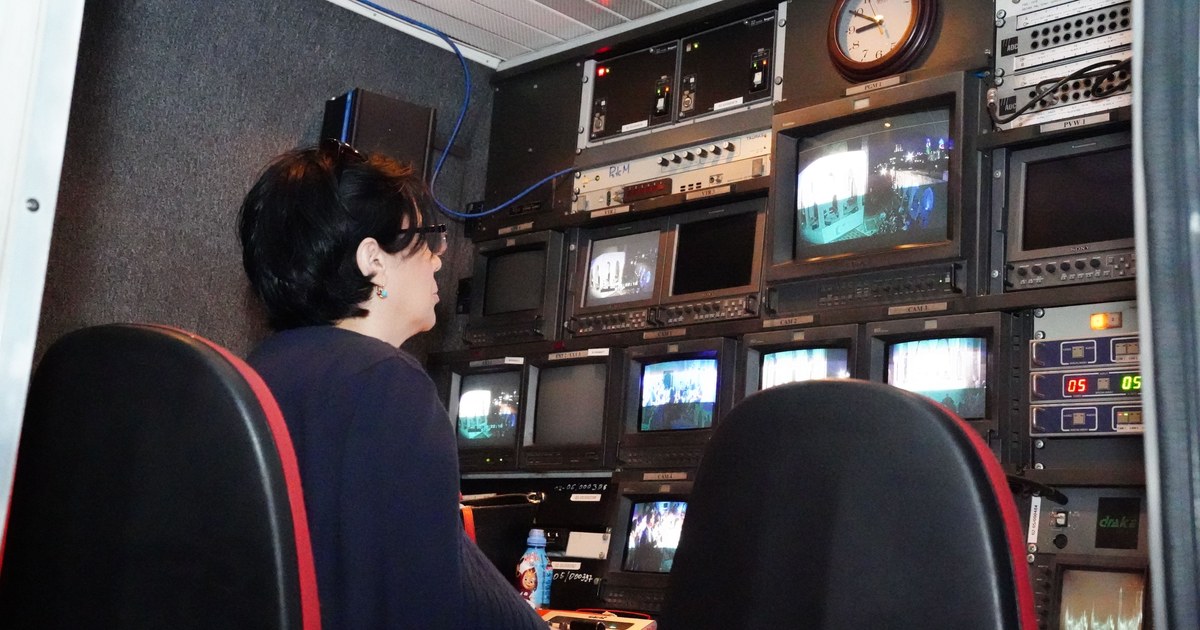
Replay is handled by EVS, a Liège, Belgium-based company that remains the dominant name in live sports replay servers and has built its LiveCeption and MediaCeption product lines around exactly this workflow (EVS, 2025). On the audio side, consoles from Calrec and Lawo are both actively being specified into new OB builds — a UK broadcaster recently outfitted two new trucks with Calrec Argo M consoles to cover 104 football matches a season, while a Swiss operator built an entirely IP-based truck around a Lawo mc²56 MkIII console (TVBEurope, 2025; Sports Video Group, 2025).
Graphics and telestration run on platforms like Vizrt and ChyronHego, both still cited as market leaders in recent industry gear surveys (SVG Gearbase Study, 2025). Comms is arguably the least visible but most operationally critical system: Riedel’s Artist intercom matrix, SmartPanels, and Bolero wireless beltpacks now appear repeatedly across new OB truck builds specifically because IP-based comms let broadcasters swap copper for fiber and hit vehicle weight limits without sacrificing channel capacity (Riedel, 2025). When Vitrina’s research team reviewed recent OB truck build announcements across 2025-2026, Riedel appeared in every documented new-build case we could verify — a concentration worth noting for any producer benchmarking comms vendors during a truck RFP.
How Do Flypacks Compare to Full Expando Trailers for Major Events?
Flypacks trade a fixed vehicle shell for rack-mounted portability, which makes them cheaper and faster to deploy at venues without truck access, while expando trailers trade portability for the fuller, multi-room production capability that flagship sports coverage requires. Neither is universally “better” — the right choice depends on venue access, camera count, and how many locations need coverage at once.
At the Paris 2024 Olympics, host broadcaster OBS reportedly used commercial off-the-shelf server infrastructure at some venues instead of trucks or flypacks specifically because of a truck shortage — with an OBS executive noting the difficulty of finding enough trucks to cover roughly 70 galleries across the Games (industry coverage via Sports Video Group, 2024). That scarcity is a useful illustration of why flypacks exist: they let a broadcaster scale coverage across dozens of simultaneous venues without needing dozens of full vehicles. Producers who have run multi-venue tournaments consistently describe flypack logistics — case counts, power drops, fiber runs to a central compound — as the real bottleneck, not the broadcast electronics itself.
Cost and timeline pressure typically decide the flypack-versus-truck question in practice. A flypack build can often be assembled, tested, and shipped in cases well ahead of an event, then set up in a rented room or temporary structure at the venue — useful when a venue’s loading dock cannot accommodate a 53-foot expando trailer, or when the event is in a location a fleet operator does not normally service with a dedicated vehicle. A full expando trailer, by contrast, arrives pre-integrated and pre-tested as a single unit, which reduces on-site setup risk but requires the venue to have suitable parking, power, and access for the vehicle itself. Neither approach eliminates the need for skilled crew, sufficient bandwidth back to base, and a tested backup plan for signal loss during the live window.
Expando trailers remain the standard for single-venue marquee events because they deliver dedicated physical rooms per function (production, audio, graphics, EVS) rather than a shared rack room, and because they can interconnect as A/B/C-unit fleets for productions that need 20+ cameras and multiple simultaneous feeds — exactly the model Game Creek Video builds for top-tier NFL coverage on ESPN and FOX Sports (Sports Video Group, 2025).
Evaluating a truck build or a flypack partner for an upcoming tournament? Vitrina’s supply-chain data covers 1.6 million+ titles and 5 million+ professionals — as of 2026 — mapped against the vendors who service them.
Who Are the Major Mobile Production Operators Worldwide?
The global mobile production market is now dominated by a small number of scaled operators — chiefly NEP Group, Game Creek Video, Mobile TV Group, and the combined Euro Media Group/Gravity Media entity (which includes the Gearhouse Broadcast and Telegenic brands) — following a wave of consolidation that culminated in a January 2024 EMG-Gravity Media merger. Understanding who owns what matters when a broadcaster is evaluating “independent” bids, because several historically separate brands now sit under the same parent company.
NEP Group operates one of the largest fleets in the world, with more than 50 mobile units in the U.S. alone and roughly 150 mobile units globally; it rolled out its IP-based “Supershooter 10” unit in 2025 and deployed 15 mobile units across 29 trailers for Super Bowl LX in February 2026, serving 14 separate customers across seven venues (TV Technology; Broadcast Now, 2026). Game Creek Video builds and operates named fleets of interconnected trucks for major U.S. sports rightsholders, standardizing recently on Grass Valley switching and Riedel comms across new NFL-dedicated units (Sports Video Group, 2025).
Mobile TV Group (MTVG) runs one of the largest U.S. mobile fleets under its “Flex Series” naming, recently debuting the 52FLEX unit and opening a fixed “Mountain Media Center” as a hybrid remote-production hub that pairs with on-site trucks (Sports Video Group, 2026). In Europe, Euro Media Group and Gravity Media — parent of the Gearhouse Broadcast, Telegenic, and CTV Outside Broadcasts brands — merged in January 2024 into a group with more than 100 outside broadcast trucks and flypacks, 40 studios, roughly 2,000 employees, and operations across 12 countries, servicing FIFA World Cup, Olympic, and UEFA coverage (SVG Europe, 2024).
For a broadcaster running an RFP, the practical implication is straightforward: a bid from “Gearhouse Broadcast” and a bid from “EMG” may not represent two independently competing suppliers anymore — they can be sibling brands inside one group, which changes how a producer should think about single-vendor concentration risk across a season-long contract.
| Operator | Primary Market | Approx. Scale | Recent Verified Signal |
|---|---|---|---|
| NEP Group | Global, U.S.-anchored | 50+ mobile units in the U.S.; ~150 globally | 15 mobile units / 29 trailers for Super Bowl LX, Feb 2026 |
| Game Creek Video | U.S. top-tier sports | Multiple named A/B/C-unit fleets | Standardized on Grass Valley K-Frame switchers, 2025 |
| Mobile TV Group (MTVG) | U.S. sports and live events | Flex Series fleet plus fixed Mountain Media Center hub | 52FLEX unit debut; hybrid remote coverage, Feb 2026 |
| EMG / Gravity Media (incl. Gearhouse Broadcast, Telegenic, CTV) | Europe, Middle East, U.S., Australia | 100+ OB trucks and flypacks, 40 studios, ~2,000 employees | Merger completed January 2024 |
Should You Buy, Lease, or Hire a Production Truck Per Event?
Buying a truck only makes financial sense with a season-long or multi-year rights commitment large enough to keep the vehicle utilized most weeks of the year; leasing suits mid-size broadcasters with recurring but not year-round needs; and hiring per event is the right default for producers covering occasional live broadcasts, one-off tournaments, or a single season of a new property. The build cost alone is the reason: a mid-size HD mobile unit for a major U.S. sports broadcaster was reported at roughly $8 million to build, with EVS replay equipment alone accounting for over $1 million of that, and flagship units running close to double — figures that are now nearly two decades old and should be read as historical scale context rather than current 2026 pricing (TV Technology, 2008).
Reliable, current, publicly sourced day-rate figures for OB truck hire are scarce — most pricing is negotiated privately per contract and varies enormously by camera count, crew size, and region, so this guide describes the economics qualitatively rather than citing an unverified number. What is well documented is the deployment pattern: major single-day events and season-long league deals both increasingly rely on fleets of multiple interconnected trucks rather than one vehicle, as seen in NEP’s 15-unit Super Bowl LX deployment and Game Creek’s standardized multi-truck NFL fleets (sources above).
| Model | Best Fit | Capital Exposure | Flexibility |
|---|---|---|---|
| Buy | Season-long or multi-year rights, high weekly utilization | Very high, multi-million-dollar build cost | Low — fixed fleet, technology ages in place |
| Lease | Recurring but not year-round coverage | Moderate, spread over contract term | Moderate — can step up/down between contract cycles |
| Hire per event | Occasional live broadcasts, new or unproven properties | Low — day-rate/contract-rate only | High — match truck class to each event |
How Do Live Sports Rights Economics Drive Mobile Production Demand?
Rising live sports broadcast rights fees push rightsholders toward more elaborate multi-camera, multi-replay productions to justify the spend, which directly increases demand for higher-capacity mobile production units and drives the fleet-scale consolidation seen among NEP, Game Creek, and the merged EMG-Gravity Media group. When a broadcaster commits nine or ten figures to a rights package, the production values around that content — camera count, replay depth, graphics sophistication — become part of how the rightsholder differentiates its coverage from a competing platform’s.
The EMG-Gravity Media merger is the clearest documented example of this dynamic: the companies explicitly framed the combination around the scale needed to service FIFA World Cups, the Olympics, UEFA EUROs, Roland Garros, the Tour de France, and Formula E simultaneously, rather than compete for each event with separate, smaller fleets (SVG Europe, 2024). Market-sizing estimates from industry research aggregators put the outside broadcast truck market in the low billions of dollars globally, though the underlying methodology for those specific figures is not independently disclosed, so we present that context qualitatively rather than as a hard verified statistic.
For financiers and broadcasters underwriting a new sports rights deal, mobile production capacity is a real supply constraint worth diligencing before signing — the Paris 2024 Olympics truck shortage referenced earlier shows that even top-tier global events can run short of available trucks during peak, overlapping demand windows.
Vitrina’s supply-chain data shows this same concentration pattern playing out across other entertainment procurement categories the platform tracks — as rights fees rise in a given content vertical, the pool of vendors capable of servicing top-tier demand tends to consolidate around fewer, larger operators, while mid-market and regional providers absorb the remaining volume. Mobile production is simply one of the more visible examples of that pattern, because the physical scarcity of trucks and flypacks makes the constraint tangible in a way that, say, post-production capacity often is not. A financier evaluating a new sports rights acquisition should treat “can our production partner actually staff and equip this at scale” as a real underwriting question, not an assumed yes.
How Should Broadcasters Source a Verified Mobile Production Vendor?
Broadcasters and producers should source mobile production vendors the same way they source any other mission-critical supply-chain partner: by verifying operating status, fleet specifications, prior deployment history, and financial stability before a contract is signed — not by relying on a vendor’s own marketing materials or a single personal referral. A live broadcast has no re-shoot; a truck that fails to show up, or arrives under-specified, is a production risk with no recovery window.
This is where the mobile production category differs from renting a camera package or booking a post-production house: the vendor pool is smaller, the assets are far more expensive and complex, and the consequences of an unqualified match are higher, because the failure surfaces live, on air, in front of an audience. Vitrina exists to close exactly this verification gap across the broader entertainment supply chain. As of 2026, the platform maps 300,000+ companies, 1.6 million+ titles, 5 million+ professionals, and 30 million+ mapped relationships across more than 100 countries, tracking an estimated $200 billion+ in annual industry spend — giving producers and financiers a way to check a vendor’s track record, prior credits, and operating footprint before committing to a mobile production contract.
For related sourcing needs, see how Vitrina helps producers source production, post, and VFX partners globally, and how producers vet video production companies more broadly — the same due-diligence discipline applies whether you’re hiring a studio or a truck.
What Should You Ask a Mobile Production Vendor Before Signing?
Before signing a mobile production contract, ask about the specific truck class being assigned, the switcher and replay hardware inside it, backup/redundancy plans, crew staffing and union affiliations, insurance and liability coverage, and whether the same physical unit — not a substitute — will actually be dispatched to your event. Vendor substitution is a common, under-discussed risk: a contract signed against a flagship expando trailer can quietly be fulfilled with a lower-spec regional truck if the agreement doesn’t name the specific unit.
Ask about the truck’s actual build date and most recent refresh — a chassis built a decade ago on legacy SDI infrastructure is a fundamentally different asset from a 2025-built IP truck, even if both are marketed under the same “flagship” label. Ask directly whether the truck runs IP-based (SMPTE ST 2110) or legacy SDI infrastructure, since that affects camera count ceilings and interconnect capability with other trucks on site. Ask for the EVS or replay server generation in use, since replay depth and camera-angle count for slow-motion coverage depend on it. Ask how comms is structured — wired intercom only, or wireless beltpack capacity for a larger crew — since this is often where under-specified trucks show their limits first, mid-broadcast. Finally, confirm insurance coverage and force majeure terms specific to live event production, where a truck breakdown or late arrival has no equivalent to a reshoot day.
Producers evaluating adjacent equipment categories can apply the same diligence framework used for camera equipment rental and production equipment rental services — verified operating history, named point of contact, and confirmed unit specifications, not marketing claims.
Don’t sign a mobile production contract on marketing claims alone. Vitrina tracks verified vendor history across 100+ countries — as of 2026.
Video production trucks sit at an unusual intersection of vehicle engineering, broadcast technology, and live-event risk management, which is exactly why sourcing decisions in this category deserve the same rigor as any other high-value supply-chain procurement. Related coverage on Vitrina digs deeper into adjacent decisions: how entertainment deal negotiation plays out across production and rights contracts, what a production house actually is versus a mobile production operator, how television rights management connects to production spend, and how AI deal intelligence for TV content deals extends the same verification logic to rights and licensing negotiations.
How Is Remote Production Changing the Video Production Truck Model?
Remote production, sometimes called REMI (REMote Integration), moves part of the production crew and equipment out of the on-site truck and into a fixed facility connected to the venue by fiber, letting broadcasters cover an event with fewer people and less hardware physically parked at the venue. This does not eliminate the video production truck — cameras, basic signal transport, and some on-site staff are still required — but it changes how much production capability needs to travel in the vehicle itself.
Mobile TV Group’s approach is a documented example: the company built a fixed “Mountain Media Center” as a remote-production hub and, in February 2026, used it alongside on-site trucks to cover League One Volleyball, splitting production responsibilities between the venue and the fixed facility rather than housing every system in a single mobile unit (Sports Video Group, 2026). For procurement teams, this hybrid model matters because it can reduce the truck class required at the venue itself — a producer might need only a lighter-weight signal-transport vehicle on site if the switching, replay, and graphics work happens back at a remote hub, which can materially change the buy-versus-hire calculation described earlier in this guide.
Remote production adoption is uneven across the industry and depends heavily on available fiber or satellite bandwidth at the venue, so it should be evaluated case by case rather than assumed as a drop-in replacement for a full on-site production truck. Producers weighing this option alongside traditional mobile units can review Vitrina’s guide to deals intelligence for TV content deal monitoring for how rights and production-delivery obligations typically get specified in a broadcast contract, and the major co-production markets guide for where these hybrid production compounds are most commonly deployed at scale.
Frequently Asked Questions
What is the difference between an OB van and a video production truck?
The terms are largely interchangeable in the industry — “OB van” (outside broadcast van) is more common in UK/European usage, while “production truck” or “mobile unit” is more common in the U.S. Both describe a vehicle-based facility housing switching, replay, audio, and comms systems for live broadcast production, as documented across operators like NEP Group and Game Creek Video (Sports Video Group, 2025).
How many cameras can a flagship production truck support?
Flagship expando-trailer trucks built for top-tier sports, such as Game Creek Video’s newest NFL-dedicated units, use switchers with a 192×96 IP fabric and nine mix-effects banks, supporting well over 20 simultaneous camera and replay sources depending on the production’s needs (TV Technology, 2025).
Is EVS the only replay system used in production trucks?
EVS is the dominant name in live sports replay and remains active with a global footprint of 20+ offices as of its 2025 annual report, but it is not the only vendor in the category — production trucks are also specified with a range of routing, switching, and graphics systems from Grass Valley, Ross Video, and Vizrt depending on the build (EVS, 2025).
Why did EMG and Gravity Media merge in 2024?
EMG and Gravity Media announced their merger on January 11, 2024, explicitly citing the scale needed to service major global rights properties — including FIFA World Cups, the Olympics, and UEFA EUROs — simultaneously, rather than compete for each event with smaller, separate fleets (SVG Europe, 2024).
Should a broadcaster buy or hire a production truck for a single tournament?
For a single tournament or an unproven property, hiring per event is almost always the right economic model, since buying requires multi-million-dollar capital exposure that only makes sense against season-long or multi-year utilization. Leasing sits between the two for recurring, non-year-round needs.
What is a flypack and when is it used instead of a truck?
A flypack is a rack-mounted broadcast production system that is flown or trucked to a venue in cases rather than built into a dedicated vehicle. It is used when a venue lacks truck access or parking, or when a broadcaster needs to cover many simultaneous venues without concentrating capacity in one truck — a real constraint reported at the Paris 2024 Olympics (industry coverage via Sports Video Group, 2024).
What is remote production and does it replace the need for a truck on site?
Remote production (REMI) moves part of the production crew and switching/replay equipment into a fixed facility connected to the venue by fiber, rather than housing every system in an on-site vehicle. It reduces, but does not eliminate, the on-site truck requirement — cameras and signal transport still need a physical presence, as shown by Mobile TV Group’s hybrid on-site-plus-Mountain-Media-Center model (Sports Video Group, 2026).
How long does it take to build a new production truck?
There is no single verified industry-wide build-time figure, since it depends heavily on chassis availability, the scope of custom routing/switching integration, and each manufacturer’s order backlog. What is consistent across operator statements is the planning horizon: major broadcasters and rental houses commission new flypacks or expando trailers years ahead of a rights cycle, not in reaction to a single event booking, precisely because lead times are long and unpredictable enough to rule out last-minute builds.
Vitrina AI
Source Verified Mobile Production Vendors With Confidence
As of 2026, Vitrina maps 300,000+ companies and 5 million+ professionals across the entertainment supply chain — including the vendors who build and operate the world’s production trucks.