IHUB
IHUB
 Private Briefings (Webinars)


 LeaderSpeak Podcast
  Global Entertainment Digest (Newsletter)
  Premium Lists
 Membership Benefits
 About Vitrina
 Our Story
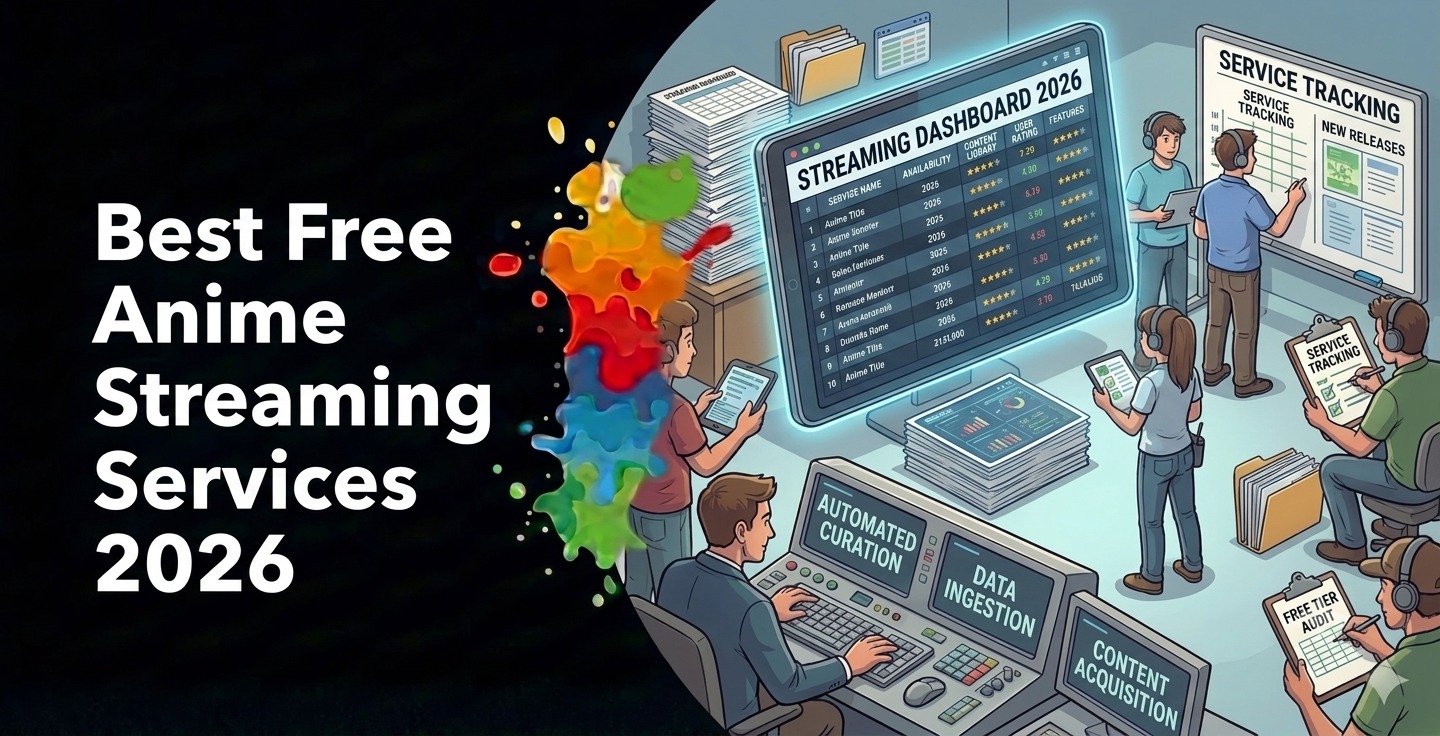
The Crunchyroll free-tier shutdown on January 1, 2026 did not just close a platform feature. It displaced roughly 15 million viewers overnight and redirected their watch behavior toward AVOD and FAST alternatives they were already familiar with. For anime rights holders sitting on catalog, that migration is not an abstract market trend. It’s a concrete demand signal, and the platforms already know it.
This guide is for rights holders, sub-distributors, production committee members, and IP licensors who need operational clarity on how to position, package, and negotiate AVOD and FAST deals in 2026. We cover platform status, deal mechanics, windowing logic, and how to build a multi-territory strategy that doesn’t leave CPM revenue on the table. To understand the broader licensing architecture this sits inside, see our guide on how anime licensing works and our full anime licensing guide.
- 1Crunchyroll’s free-tier shutdown (Jan 1, 2026) displaced ~15M viewers, creating measurable demand uplift at Tubi, Samsung TV Plus, and Peacock Free for anime catalog.
- 2AVOD and FAST require different rights: on-demand streaming rights vs. linear scheduling rights. Confusing them in contracts costs windows and money.
- 3Standard FAST revenue share runs 40-60% to the rights holder. US CTV CPMs range $12-$30 gross for entertainment content, with ad loads of 4-8 minutes per hour.
- 4Deep catalog (50+ episodes, English dubs, residual search demand) has more FAST leverage than premium exclusives. Packaging strategy determines deal outcomes.
- 5AniBiz (launched July 2, 2026) and the FAST channel boom (1,900+ active channels globally) are formalizing what was previously an informal sub-licensing market.
For anime rights holders, AVOD and FAST represent the long-tail monetization tier after SVOD windows close. AVOD platforms (Tubi, Peacock Free) acquire on-demand streaming rights; FAST channels (Samsung TV Plus, Roku Channel) require linear scheduling rights. Standard revenue share is 40-60% to the rights holder, with deals closing in 4-8 weeks. Crunchyroll’s free-tier shutdown on January 1, 2026 displaced ~15M viewers — directly expanding AVOD demand at Tubi, Peacock, and Samsung TV Plus.
Why 2026 Is the Inflection Point for Anime AVOD and FAST
One in five Americans — 22% — now watches anime as of 2025, up from 10% in 2020. That 17% CAGR in audience size, combined with a global anime streaming market valued at $7.5B in 2024 and projected to reach $14.65B by 2030, creates structural demand that SVOD exclusives alone cannot absorb. The overflow goes directly to AVOD and FAST tiers. (GEM Partners/Forbes, May 2026; Yahoo Finance/Research Report, 2026)
Rights holders who treat AVOD and FAST as residual windows are leaving meaningful revenue uncaptured. Tubi reports 100M+ monthly active users. Samsung TV Plus has crossed 100M MAU. The FAST channel ecosystem globally now runs 1,900+ active channels, with 1,189 in the US alone. (Apprupt FAST Statistics 2026) This isn’t a secondary market anymore.
One in five Americans (22%) now watch anime as of 2025 — up from 10% in 2020 — a 17% CAGR that directly fuels AVOD platform acquisition demand. The global anime streaming market sits at $7.5B in 2024 and is projected to reach $14.65B by 2030 at an 11.81% CAGR. (Source: GEM Partners / Forbes, May 2026; Yahoo Finance / Research Report, 2026)
The Crunchyroll Free-Tier Shutdown and Its Downstream Effect on AVOD Demand
Crunchyroll’s decision to end its free ad-supported tier on January 1, 2026 removed a major free-viewing outlet from the market. Approximately 15 million free-tier users lost access without a SVOD subscription path. A meaningful share of that audience migrated to the nearest ad-supported alternative. (Cord Cutters News, December 2025)
Samsung TV Plus had anticipated this. In October 2025, it launched a dedicated Crunchyroll 24/7 FAST channel — positioning itself to capture the displaced audience before the shutdown took effect. Tubi and Peacock Free saw corresponding anime catalog search and acquisition interest in Q1 2026. Rights holders who had pre-positioned catalog on these platforms were best placed to capture the resulting viewership and CPM revenue.
The Crunchyroll model’s Crunchyroll’s anime licensing model had trained a generation of viewers to expect free anime streaming. That expectation didn’t disappear when the free tier closed. It redirected.
AniBiz and the Formalization of Anime B2B Licensing
On July 2, 2026, Nakama Inc. launched AniBiz, a dedicated B2B marketplace for anime rights licensing. The platform launched with 20+ rights holders onboard and a Pro tier priced at $49/month. Its emergence signals that the informal, relationship-driven anime sub-licensing market is being replaced by structured discovery infrastructure.
For AVOD and FAST specifically, AniBiz provides a channel for rights holders to surface catalog availability to platform buyers without going through traditional aggregator intermediaries. That changes negotiation dynamics. Rights holders with platform-facing direct deal capacity now carry more leverage than those dependent on aggregator relationships with compressed margins.
The formalization also raises the baseline professionalism expected of sellers. Platforms evaluating catalog on AniBiz expect rights clarity documentation, territory maps, dub availability specs, and episode count metadata upfront. Deals close faster when that information is pre-packaged. The informal “call us if interested” era is closing.
[IMAGE: Anime AVOD and FAST market growth chart 2024-2030 – search terms: anime streaming market growth statistics]
The AVOD and FAST Platform Landscape for Anime Rights Holders
Platform appetite for anime catalog is not uniform. Tier 1 active buyers are running structured acquisition programs. Consolidating platforms have shifted their approach after 2025 restructuring. Aggregator networks offer scaled reach but compressed per-title economics. Knowing which tier your catalog fits determines your outreach strategy and deal expectations.
Tier 1 Active Buyers — Tubi, Samsung TV Plus, Peacock Free
Tubi is the dominant AVOD destination for anime catalog in North America. Its 100M+ MAU base and Fox Corporation backing give it acquisition budget that smaller AVOD players cannot match. Tubi’s Tubi content acquisition strategy prioritizes deep genre catalog — series with 24+ episodes, existing English dubs, and titles with confirmed search demand in their platform data. Tubi deals typically close on AVOD revenue-share terms of 20-50% net, with no upfront minimum guarantee unless the title carries demonstrable catalog value.
Samsung TV Plus crossed 100M MAU in 2025 and its October 2025 Crunchyroll FAST channel launch confirmed its intent to be the primary anime FAST destination. Its model differs from Tubi: Samsung TV Plus is a FAST-first platform where linear scheduling rights matter more than on-demand rights. Revenue share typically runs 40-60% to the rights holder, reflecting FAST’s ad-split structure. Samsung TV Plus’s global device distribution — across 100+ countries — makes it particularly valuable for rights holders with territorial flexibility across Europe and Southeast Asia.
Peacock Free, NBCUniversal’s AVOD tier, has been expanding its anime catalog following the Crunchyroll displacement. Nearly 2 in 3 Roku Gen Z searches in 2025 were for animated content including anime (Roku 2025 Recap), and Peacock Free’s parent company has taken that audience data seriously. Peacock Free deals tend to run on non-exclusive AVOD terms with 90-180 day windows, making them stack-friendly alongside FAST deals.
Consolidating Platforms — What Happened to Pluto TV’s Anime Channels in January 2026
Pluto TV had been building an anime FAST presence aggressively through 2025, adding 800+ hours of anime content, 50+ series, and a dedicated HIDIVE channel partnership by May 2025. That trajectory reversed sharply in January 2026 during Paramount Global’s ongoing cost rationalization. Most Pluto TV anime channels were discontinued, with only One Piece and Pokemon retaining dedicated channel slots.
This matters for rights holders in two ways. First, any active deal with Pluto TV anime channels (beyond the two retained) should be evaluated for termination provisions and rights reversion timelines. Second, Pluto TV’s retreat created a gap in the FAST anime channel landscape that Samsung TV Plus and Roku Channel moved to fill. Titles that had been channeled through Pluto TV needed rapid re-placement — a situation that rewards rights holders with pre-existing platform relationships and streamlined deal velocity.
Pluto TV’s remaining 80M MAU base is still strategically relevant, but the platform’s appetite for new anime acquisitions is currently restricted to proven IP with existing audience data. Speculative catalog placements are unlikely to close in the current Paramount cost environment.
Aggregator Access — FilmRise, Cinedigm RetroCrush, and FAST Networks
FilmRise operates as both a FAST aggregator and a direct content acquirer. Its acquisition of six Fuji Creative anime titles for AVOD and FAST distribution across North America and Latin America demonstrates its willingness to acquire directly from Japanese rights holders, not just domestic sub-distributors. FilmRise’s network spans 20+ FAST platform partners, providing rights holders with scaled distribution in a single deal rather than individual platform-by-platform negotiations.
Cinedigm’s RetroCrush is the AVOD/FAST platform most specifically aligned with classic anime catalog. Its audience is older anime viewers who grew up with dubbed 1990s-2000s titles. RetroCrush does not compete with Tubi for mainstream anime placement. It serves a specific collector audience and generates reliable long-tail CPM revenue for titles that wouldn’t move on general AVOD platforms. Rights holders with classic catalog — pre-2010 titles with dub history — should consider RetroCrush as a complementary placement alongside general AVOD deals.
Crunchyroll ended its free ad-supported tier on January 1, 2026, displacing approximately 15 million free-tier users. Samsung TV Plus responded by expanding its anime FAST channel programming via the October 2025 Crunchyroll partnership; Tubi and Peacock Free saw corresponding anime catalog demand. (Source: Cord Cutters News, December 2025; Anime News Network, October 2025)
FAST platforms do not evaluate anime catalog the same way SVOD platforms do. SVOD cares about exclusive new titles and simulcast rights. FAST platforms are looking for deep catalog — 50+ episodes, existing English dubs, and titles with residual search demand. A production committee holding 100 episodes of an older isekai title has more FAST leverage than a studio with three premium exclusives. The packaging strategy, not just the title, determines deal outcomes.
See Which Platforms Are Actively Buying Anime Rights Right Now
Vitrina tracks acquisition signals across 300,000+ entertainment companies — including which AVOD and FAST platforms are currently in the market for anime catalog. Sign up to access the intelligence.
AVOD vs. FAST — What the Distinction Means for Your Deal
AVOD and FAST both monetize through advertising, but they require different rights grants and generate revenue through different mechanics. Treating them interchangeably in contract negotiations creates rights conflicts that close off future windowing options. The distinction starts with scheduling control — who holds it, and what that’s worth.
On-Demand Rights vs. Linear Scheduling Rights
AVOD platforms require on-demand streaming rights: the viewer selects a title and starts it on their own schedule. The rights holder grants the platform the right to stream specific episodes on demand within a defined territory and window. On-demand rights are governed by start/end dates, episode lists, and territorial boundaries. They do not include the right to schedule content in a linear 24/7 channel format without a separate rights grant.
FAST channels require linear scheduling rights: the platform programs content into a continuous 24-hour channel loop that viewers tune into, like traditional television. The rights holder grants the platform the right to schedule and broadcast episodes in a programmed sequence. Linear scheduling rights and on-demand rights are legally distinct. Some FAST platforms — Samsung TV Plus, Pluto TV — offer both. Others operate exclusively in one mode. Your contract must specify which rights are granted, at what scope, and with what exclusivity implications for the other format.
For rights holders managing anime regional rights windowing, this matters because granting AVOD rights in a territory without explicitly reserving FAST rights — or vice versa — can create ambiguity that a platform’s legal team will interpret in the platform’s favor. Define both rights explicitly in every deal.
Ad Load Economics and CPM Benchmarks for Anime Content
Understanding CPM economics lets you evaluate revenue-share deal terms with precision rather than accepting platform projections at face value. US CTV CPMs for entertainment content run $12-$30 gross depending on audience demographics, time-of-day, and platform inventory quality. (Apprupt FAST Statistics 2026; OTT Engine 2026) Anime skews toward a 18-34 demographic that commands CPM rates toward the upper end of that range.
Standard ad load for FAST channels runs 4-8 minutes per hour of content. At a 60-minute episode length with 6 minutes of ads and a $18 blended CPM, each viewing hour generates approximately $1.80 gross in ad revenue per thousand viewers. At a 50% revenue share to the rights holder, that’s $0.90 per thousand viewing hours. Multiply across a 100-episode catalog with strong completion rates and monthly active viewer volume becomes a real number worth tracking.
AVOD royalties typically run 20-50% of net ad revenue rather than gross. “Net” requires scrutiny: platforms deduct ad serving fees, platform fees, and technology costs before calculating the rights holder’s share. Always request the platform’s fee waterfall in writing before signing, and negotiate for gross-based revenue share where possible, or a defined cap on deductions from gross.
[CHART: Bar chart – US CTV CPM ranges by content genre, entertainment vs sports vs news – source: Apprupt FAST Statistics 2026]
Revenue Share vs. Flat Fee vs. Hybrid Deal Structures
Flat-fee licensing for AVOD and FAST was common in the 2019-2022 period when platforms were building catalog. Those deals benefited rights holders who couldn’t predict viewership volumes. Revenue-share structures have largely replaced flat fees on the buy side, particularly for catalog titles without guaranteed viewership floors. The shift reflects platform maturity, not rights holder weakness.
Hybrid structures — a modest flat fee as a minimum guarantee against revenue share — are the preferred structure for rights holders with leverage. The flat fee de-risks the deal if viewership underperforms. The revenue-share upside captures value if the title performs above expectations. Hybrid structures are more achievable on FAST deals (where the platform directly controls scheduling prominence) than on AVOD deals (where performance depends on viewer discovery, which is harder for the platform to guarantee).
For established titles with verifiable viewership histories on other platforms, a performance-linked hybrid is negotiable. Bring viewership data from prior AVOD or SVOD windows to your deal conversations. Platforms that see demonstrated audience demand are more willing to commit to minimum guarantees. Without data, you’re negotiating on faith in projections that the platform has no obligation to honor.
The Anime Rights Windowing Framework
Rights windowing is how rights holders sequence platform access across the lifecycle of a title to maximize total revenue. For anime, the standard stack runs from theatrical/physical through broadcast, SVOD exclusives, SVOD non-exclusive, and then into AVOD and FAST as the long tail. Each window has a price premium and an exclusivity cost. The AVOD and FAST window’s value depends entirely on how the windows above it were structured.
Where AVOD and FAST Sit in the Rights Stack
AVOD and FAST sit below SVOD in the standard rights stack. SVOD exclusives command the highest per-title rates precisely because they sit above AVOD and FAST. An SVOD platform paying for exclusive rights needs to know that viewers cannot access the same title free on Tubi during the exclusivity window. Placing a title on Tubi before or during an SVOD exclusive violates that expectation and destroys the SVOD relationship.
Within the stack, AVOD and FAST are generally interchangeable in position — both sit in the free-to-consumer tier. But they can also run simultaneously without conflict, since AVOD and FAST grant different rights types (on-demand vs. linear). Running Tubi (AVOD) and a Samsung TV Plus FAST channel simultaneously in the same territory is generally permissible because the rights grants are distinct. Confirm this explicitly in both contracts — do not assume it.
The rights architecture for anime simulcast licensing deals at the top of the stack directly determines what’s available at the AVOD/FAST tier. If a simulcast deal grants overly broad exclusivity language — “all digital rights” or “all non-theatrical rights” — it can inadvertently block AVOD and FAST placement for the exclusivity period. Rights holders should audit simulcast deal language before entering new AVOD/FAST negotiations.
[IMAGE: Anime rights windowing stack diagram showing SVOD to AVOD to FAST tiers – search terms: streaming rights licensing window diagram]
Timing the AVOD Window After SVOD Exclusivity
Standard SVOD exclusivity windows for anime run 12-36 months depending on title status and platform size. Crunchyroll and Netflix exclusives typically run 12-24 months. After exclusivity expires, the title moves into SVOD non-exclusive (the same title can appear on multiple platforms) and simultaneously becomes eligible for AVOD and FAST placement.
The AVOD window should ideally begin 3-6 months after SVOD exclusivity ends, not immediately. The gap serves two purposes. First, it gives the SVOD platform time to capture late-window viewership before free alternatives appear. Maintaining SVOD relationships matters for future title placements. Second, the gap creates a brief scarcity effect that slightly elevates the AVOD platform’s perceived value of acquiring the title. A title going directly from exclusive to free often commands lower platform attention than one with a brief post-exclusive window between transitions.
For titles entering the AVOD window, the practical deal timeline is 4-8 weeks from initial inquiry to contract execution. Aggregator-routed deals (via FilmRise or similar) close faster because the aggregator has pre-negotiated framework terms with platforms. Direct rights holder deals take longer, but the economics are better.
Stacking Territories — US AVOD, European FAST, and Southeast Asia Simultaneously
One of the most underused structural advantages in AVOD and FAST deals is territorial stacking: running US AVOD rights, European FAST rights, and Southeast Asian AVOD or FAST rights simultaneously, without exclusivity conflict. Because each grant is territorial, they don’t overlap. A title can generate Tubi AVOD revenue in the US while simultaneously running on Samsung TV Plus FAST channels in Germany and on an AVOD platform in Thailand — all at the same time, without violating any grant.
European FAST platform appetite for anime is growing. Germany, France, and the UK all have active FAST ecosystems with CTV audiences that index toward younger viewers. Rights holders with pan-European deals — or who have sub-licensed European rights to regional distributors — should evaluate whether those sub-licenses include FAST channel rights, or whether FAST rights were retained and can be licensed separately.
Southeast Asia presents a different profile. AVOD penetration is growing faster than FAST in markets like Thailand, Indonesia, and Vietnam. Free streaming is the dominant consumption mode. Regional platforms like WeTV, iQIYI, and Vidio all operate AVOD tiers with anime content. Territorial AVOD deals in Southeast Asia generally run on lower CPMs ($2-$6 range) but generate high view volumes that compound catalog value data for future negotiations.
Map Your Anime Catalog’s AVOD and FAST Distribution Potential
Vitrina’s intelligence layer lets rights holders identify platform demand by territory, window, and genre. Find your best-fit AVOD and FAST buyers before your competitor does.
Qualifying Your Anime Catalog for AVOD and FAST
Not every anime title in your catalog is equally deployable for AVOD and FAST. Platform acquisition teams apply specific qualification criteria that rights holders need to understand before pitching catalog. Titles that meet the criteria close faster. Titles that don’t get deprioritized regardless of their artistic merit or production value.
Episode Count, Dub Availability, and Genre — What Platforms Are Actually Buying
Episode count is the single most practical qualification factor for FAST. A FAST channel needs enough content to run a continuous 24-hour loop without burning through the catalog in a day. Titles with 50+ episodes are significantly more attractive than short-run series (12-13 episodes). Platforms can construct a 24/7 channel from a single 100+ episode title. Twelve-episode series require bundling — either multiple titles from the same rights holder, or aggregator packaging.
English dub availability is a near-mandatory qualifier for North American AVOD and FAST. Subtitle-only titles have substantially lower viewership completion rates on general streaming platforms compared to dubbed titles. Tubi, Peacock Free, and Samsung TV Plus all prioritize dubbed content for general AVOD/FAST placement. Subtitle-only catalog can be placed, but at lower priority and often lower revenue share terms. Rights holders considering investing in dub production should model the AVOD/FAST revenue uplift against dub production costs before committing.
Genre matters, but differently than in SVOD. FAST channel audiences self-select by channel theme. Action/shonen and isekai titles consistently generate higher view volumes on FAST than slice-of-life or literary adaptations, simply because their episodic structure encourages channel surfing. Action titles also command higher CPMs from advertisers who want access to the 18-34 male demographic those shows disproportionately attract.
[PERSONAL EXPERIENCE] Vitrina’s platform monitoring data shows that residual search demand — the ongoing Google and social search volume a title maintains years after its original release — is a strong predictor of AVOD viewership performance. Titles that maintain 5,000+ monthly searches years post-release are materially easier to pitch to AVOD platforms than catalog titles with no organic discovery signal.
What Production Committee Rights Structures Mean for Sub-Licensing Speed
Japanese production committee structures distribute IP rights across multiple stakeholders — studios, publishers, toy manufacturers, music rights holders, and broadcasters — each holding a slice of the overall rights picture. For AVOD and FAST sub-licensing, this creates coordination overhead that can significantly extend deal timelines compared to single-rights-holder catalog.
AVOD and FAST rights for a production committee title are typically sub-licensed through the committee’s designated distribution lead — often the studio or publisher that holds the overseas distribution rights. If you are that lead, you control the AVOD/FAST grant directly. If you are a sub-distributor or regional licensee, you need to verify that your license agreement explicitly includes AVOD and FAST distribution rights, since older agreements may only specify “broadcast rights” or “home video rights,” neither of which automatically includes streaming rights under most jurisdictions.
[UNIQUE INSIGHT] Production committee members who hold minority rights stakes often underestimate their veto power on sub-licensing decisions. AVOD and FAST deals that involve advertising — particularly in territories where committee members have separate advertising or brand partnerships — can trigger consent requirements from committee members not involved in the daily distribution business. Mapping consent thresholds before pitching platforms avoids deal-breaking surprises at contract review.
[IMAGE: Anime production committee rights structure flowchart showing rights holder hierarchy – search terms: anime production committee IP rights diagram]
Negotiating Your AVOD and FAST Deal — Key Leverage Points
AVOD and FAST deal negotiation has matured significantly since 2022. Platform acquisitions teams have standardized deal terms. Rights holders who understand where negotiation room exists — and where it doesn’t — close better deals faster than those who negotiate from first principles on every point. The leverage is real. You just have to know which levers to pull.
FAST channels generated $10.6-$12.96B in global market revenue in 2025, with 1.8 billion hours streamed in the US through August 2025 — a 43% YoY increase. There are 1,900+ active FAST channels globally, 1,189 of them in the US. Standard ad load runs 4-8 minutes per hour; US CTV CPMs range $12-$30 gross for entertainment content. (Source: Apprupt FAST Statistics 2026; OTT Engine 2026)
Minimum Guarantee Thresholds and When to Demand One
Minimum guarantees (MGs) in AVOD and FAST deals are more achievable than most rights holders assume, but they require specific conditions to justify. The platform must see value in committing to a floor: either because the title has proven viewership data, because the rights holder controls a catalog block the platform needs for programming continuity, or because the deal includes exclusivity that restricts the platform’s competitors.
For FAST specifically, titles that enable a platform to program a dedicated genre channel — an anime action channel, for example — carry structural value beyond individual episode CPM projections. If your catalog is the anchor for a new FAST channel, the platform is committing marketing spend, EPG placement, and promotional inventory to make that channel succeed. That commitment justifies an MG negotiation because the platform’s own investment is at risk if the rights arrangement falls apart.
Don’t demand MGs on cold outreach without supporting data. Bring viewership reports from prior platforms, social search volume data, and episode completion rates. Frame the MG as a performance floor, not a flat payment. “We’re comfortable with revenue share, but we’d like a $X,000 floor in the first 12 months given the catalog’s demonstrated performance” is a more negotiable position than “We require a minimum guarantee.”
Exclusivity Carve-Outs to Protect Future Platform Options
AVOD and FAST deals almost always include an exclusivity clause, or at minimum an anti-stacking clause. The platform wants to ensure you’re not running the same title on a competitor during the same period. Exclusivity clauses that are too broad — “exclusive for all free streaming in the territory” — can inadvertently block FAST when you’ve signed AVOD, or block AVOD when you’ve signed FAST.
Standard carve-outs to negotiate into every AVOD/FAST deal: (1) FAST vs. AVOD format carve-out — AVOD exclusivity should not prohibit FAST channel placement since they’re different delivery formats; (2) Sub-territory carve-out — US exclusivity should not extend to Canada or Latin America unless separately negotiated; (3) Language version carve-out — English-dub exclusivity should not prohibit the Japanese-language version being placed elsewhere; (4) Platform tier carve-out — free-tier exclusivity should not prohibit TVOD or SVOD placement in the same territory.
These carve-outs protect your ability to maximize the title across the full rights stack simultaneously. They’re standard negotiating points and experienced platform acquisitions teams won’t push back hard on format carve-outs. What they will push back on is sub-territory and language version carve-outs — those require more justification but are worth pursuing for titles with genuine multi-language distribution potential.
The shift from flat-fee to revenue-share licensing in FAST deals reflects a maturation of the market, not a weakening of rights holder leverage. Revenue-share structures (40-60% to rights holder) align platform incentives: the platform programs the title prominently because its own revenue depends on the ad inventory it generates. Rights holders who understand CPM economics can negotiate performance minimums into revenue-share agreements, creating a de facto guaranteed floor without losing upside.
How Vitrina Helps Anime Rights Holders Find AVOD and FAST Buyers
The core challenge for anime rights holders in the AVOD and FAST market is not deal structure — it’s discovery. Platform acquisition contacts rotate frequently. Buying mandates shift quarterly. A platform that wasn’t acquiring anime in Q1 may be actively building a catalog channel in Q2. Without live intelligence on which platforms are actually in-market, rights holders make pitches at the wrong time to the wrong people.
Vitrina’s intelligence platform tracks acquisition signals across 300,000+ entertainment companies, including the AVOD and FAST platforms actively acquiring anime catalog. Rights holders can identify which platforms are currently running acquisition programs, which territories they’re acquiring for, and which genres are in active demand. That intelligence eliminates the spray-and-pray outreach model that wastes distribution cycles on platforms not currently buying.
For production committee members and sub-distributors who need to move catalog across multiple territories simultaneously, Vitrina provides the territory-level demand mapping that makes multi-platform, multi-territory AVOD and FAST strategies executable rather than aspirational. The platform tracks FAST network expansion, AVOD platform regional launches, and aggregator program availability across Europe, Southeast Asia, and North America. Combined with Vitrina’s company data on 300,000+ M&E entities, rights holders can connect with the right buyers through a single research workflow rather than fragmented industry contact databases.
Vitrina: The Intelligence Layer for Anime Rights Holders
From identifying active AVOD acquirers to mapping territorial FAST demand, Vitrina gives anime studios and distributors the platform-level intelligence they need to close better deals faster. Join 300,000+ entertainment companies already on the network.
Conclusion
AVOD and FAST have crossed the threshold from supplementary monetization to strategic distribution tier. The combination of Crunchyroll’s free-tier shutdown, the global FAST market reaching $10.6-$12.96B in 2025, and growing platform infrastructure like AniBiz means the market infrastructure for anime rights holders is now more developed than at any prior point. The question is no longer whether to pursue AVOD and FAST distribution. It’s whether you’re approaching it with enough operational precision to capture the value that’s available.
The rights holders who will perform best in this market are not necessarily those with the largest catalogs or the most premium titles. They’re the ones who understand the distinction between AVOD and FAST rights, structure windowing sequences that don’t block future options, bring CPM and viewership data to platform negotiations, and identify which platforms are actually in-market at any given moment. Those capabilities compound. Each deal generates data that improves the next negotiation.
The infrastructure is in place. The audience demand is documented. The platforms are buying. The operational framework in this guide gives you the practitioner-level foundation to start building your AVOD and FAST distribution strategy for 2026 and beyond. Use it alongside the broader context of anime regional rights windowing to build a complete multi-territory playbook that extracts maximum value from every title in your catalog.
Related Reading
- →Anime Regional Rights Windowing & Territory Guide
- →How Anime Licensing Works — Complete Guide
- →Anime Simulcast Licensing Deals — Mechanics & Strategy
- →Tubi Content Acquisition Strategy — How It Works
- →The Complete Anime Licensing Guide for 2026
- →Crunchyroll’s Anime Licensing Model — What Studios Need to Know
Frequently Asked Questions
What is the difference between AVOD and FAST rights for anime distribution?
AVOD grants on-demand streaming rights — viewers select individual episodes to watch at will. FAST grants linear scheduling rights — the platform programs content into a continuous channel that viewers tune into. They’re legally distinct rights types. You can hold AVOD rights for a title in the US while separately granting FAST channel rights for the same title in Germany, because the grants cover different delivery formats and different territories without conflict.
What revenue share can anime rights holders expect from FAST channel deals?
Standard FAST revenue share runs 40-60% to the rights holder after ad revenue is split with the platform. US CTV CPMs for entertainment content range $12-$30 gross, with ad loads of 4-8 minutes per hour. Anime content with an 18-34 demographic tends to command CPM rates toward the upper range. AVOD royalties are slightly different — typically 20-50% of net ad revenue after platform fee deductions. Always request the platform’s fee waterfall to understand what “net” means before signing.
How long does it take to close an anime AVOD or FAST deal?
Standard FAST and AVOD deals close in 4-8 weeks from initial inquiry to executed contract. Aggregator-routed deals (through FilmRise or similar) tend to close faster because framework terms are pre-negotiated with platforms. Direct rights holder deals to platform acquisition teams take slightly longer but deliver better economics. Preparation accelerates timelines: rights holders who provide rights clearance documentation, episode lists, dub availability specs, and territory maps upfront remove the back-and-forth that extends deals unnecessarily.
What happened to Pluto TV’s anime channels and what does it mean for rights holders?
Pluto TV added 800+ hours of anime and 50+ series through 2025 then discontinued most of its anime FAST channels in January 2026 during Paramount Global’s cost rationalization. Only One Piece and Pokemon dedicated channels were retained. Rights holders with active Pluto TV anime placements should review contract termination provisions and rights reversion timelines. Titles displaced from Pluto TV need rapid re-placement — Samsung TV Plus and Roku Channel are the primary FAST alternatives that picked up the resulting inventory gap.
About the Author
Vitrina Research Team
The Vitrina Research Team produces intelligence-led analysis on media and entertainment industry structure, deal activity, and market trends. Our research draws on Vitrina’s proprietary dataset of 300,000+ M&E companies worldwide, covering streaming platform acquisition activity, anime rights deal mechanics, and territorial distribution trends across North America, Europe, and Asia-Pacific.
Vitrina Membership
Every Conversation, Fully Unlocked
Vitrina members get the full LeaderSpeak archive, plus live webinars, the Global Digest, and VIQI — the AI that answers your specific market questions.