IHUB
IHUB
 Private Briefings (Webinars)


 LeaderSpeak Podcast
  Global Entertainment Digest (Newsletter)
  Premium Lists
 Membership Benefits
 About Vitrina
 Our Story
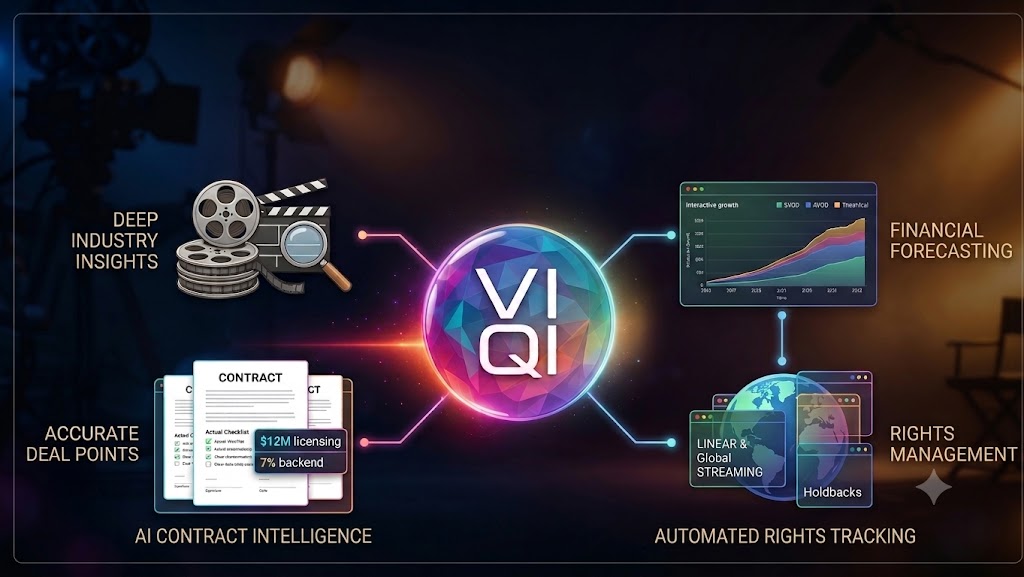
The entertainment industry runs on relationships, deals, and intelligence gathered over years of market participation. Now a new category of tool is changing how that intelligence is gathered: the AI agent for entertainment industry professionals. Unlike general-purpose AI chatbots, these agents are purpose-built for the specific data landscape of film, television, animation, streaming, and distribution.
This guide defines the category, explains what separates entertainment AI agents from generic tools, and shows how platforms like VIQI by Vitrina are setting the benchmark for verified, real-time M&E intelligence.
- Entertainment AI agents are vertical AI systems built on verified M&E data — not scraped open-web content
- They answer deal, company, contact, and financing queries that generic AI like ChatGPT cannot reliably handle
- Vitrina‘s VIQI indexes 300,000+ entertainment companies across production, distribution, financing, and post-production
- Key use cases span business development, acquisitions, sales, financing, development, and competitive strategy
- Verified data provenance is the critical differentiator between entertainment AI agents and generic models
What Is an AI Agent?
An AI agent is an autonomous software system that perceives its environment, processes queries using a language model, and takes goal-directed actions — often without step-by-step human instruction. Unlike a static chatbot that returns a fixed set of pre-written answers, an AI agent can reason across multiple data sources, chain tasks together, and surface structured outputs tailored to the user’s specific question.
The key distinction between a general-purpose AI agent and a vertical AI agent is the underlying data. General-purpose models like ChatGPT draw on broad web-trained corpora. Vertical AI agents are trained or grounded on domain-specific, curated, and often proprietary datasets — giving them accuracy and depth that no open-web model can match for specialist queries.
In the context of the entertainment business, that specialist dataset is M&E supply-chain data: production companies, broadcasters, streamers, financiers, distributors, talent agencies, and the deal flows connecting them.
Why Entertainment Needs Its Own AI Agent Category
Entertainment is a relationship business with unusually complex data structures. A single deal may involve a production company, a co-producer, a broadcaster, a distributor, a gap financier, a tax incentive body, and multiple talent agencies — each with their own decision-makers, deal histories, and mandate signals. No generic AI model has this data in structured, verified form.
The data problems in entertainment intelligence are specific:
- Company names change frequently — acquisitions, rebrands, and joint ventures are common
- Deal data is private — most transactions never appear in public press, let alone in AI training data
- Contacts move quickly — commissioning editors, acquisition heads, and BD teams turn over rapidly
- Mandates shift with strategy — what a streamer commissions in 2024 may differ significantly by Q1 2026
- Geography adds complexity — the same company may behave differently across territories, with local co-production rules, tax incentive eligibility, and buyer relationships
These problems cannot be solved with open-web scraping or a general-purpose language model. They require a purpose-built AI agent for the entertainment industry — one trained on a dedicated, maintained graph of verified M&E company data.
According to Omdia‘s media technology research, studios and streamers that adopted AI-assisted intelligence workflows in 2024–2025 reported 30–40% reductions in research time during deal preparation. The gap between AI-assisted and unassisted teams is widening each quarter.
See What an Entertainment AI Agent Can Do
VIQI answers real questions — who finances Nordic drama, which Indian studios work with streamers, which VFX vendors have open capacity — with verified answers from 300,000+ M&E companies.
The Four Core Capabilities of Entertainment AI Agents
Not all AI tools marketed to the entertainment industry qualify as true AI agents. The category-defining capabilities of a genuine entertainment AI agent are:
1. Verified Company Intelligence
A real entertainment AI agent can answer structured queries about specific companies: their production history, current slate, co-production relationships, financing sources, and geographic focus. This requires a verified, continuously updated company graph — not a knowledge cut-off from a training snapshot.
2. Deal and Transaction Tracking
Entertainment intelligence is fundamentally about deal flows: who is buying what, who is financing which genres, and which distribution relationships are active. An AI agent in this category must surface deal patterns — by territory, genre, format, and company type — from a structured dataset of verified transactions. This is entirely different from what you get asking ChatGPT about entertainment deal research.
3. Contact and Decision-Maker Mapping
The practical goal of most entertainment intelligence queries is reaching the right person. An AI agent must map contacts to roles, to companies, and to mandates — so a sales agent asking “who is the acquisitions head at [streamer] for LATAM unscripted?” gets a verified, current answer rather than a hallucinated name.
4. Query-Based Research Automation
The defining capability of an AI agent rather than a plain database is the ability to accept natural-language queries and return structured, actionable outputs. “Find me animation studios in Korea that have co-produced with European broadcasters in the last two years” is not a search query — it is a complex multi-filter research task that an entertainment AI agent can execute in seconds.
How VIQI Works as an Entertainment AI Agent
VIQI is Vitrina’s AI agent built on top of the world’s largest verified entertainment company graph — 159,223 production companies, broadcasters, streamers, distributors, financiers, post-production houses, talent agencies, and related entities, maintained with active data verification rather than passive scraping.
When a user submits a natural-language query through VIQI, the system:
- Parses the intent — breaking the query into company type, territory, genre, role, and time filters
- Queries the verified graph — running structured lookups against Vitrina’s proprietary database rather than searching the open web
- Surfaces ranked results — returning companies, contacts, or deal patterns with provenance data (source, verification date, relationship strength)
- Enables follow-up queries — the agent remembers session context, so follow-up questions refine rather than restart the search
This architecture means VIQI can answer queries that no general-purpose AI can reliably handle — not because it has a better language model, but because it has better data. As Vitrina’s verified M&E graph grows and is refreshed, VIQI’s answers improve in real time. Explore the full capabilities at vitrina.ai/viqi/.
Use Cases by Role: Who Benefits From an Entertainment AI Agent
The value of an AI agent for entertainment industry professionals is not uniform — it depends on the specific intelligence need of each role. Here is how different teams apply entertainment AI agents:
Apply VIQI to Your Specific Role
Whether you’re a producer sourcing partners, a buyer tracking sellers, or a strategist benchmarking competitors — VIQI delivers verified answers from 300,000+ entertainment companies instantly.
Entertainment AI Agent vs Generic AI: Key Differences
Understanding what separates a purpose-built entertainment AI agent from a general-purpose model is critical before making a tool decision. The differences are structural, not superficial:
| Dimension | Entertainment AI Agent (VIQI) | Generic AI (ChatGPT etc.) |
|---|---|---|
| Data Source | Verified M&E graph — 159,223 companies, active maintenance | Open-web training data, public sources, knowledge cut-off |
| Company Data | Current slate, deal history, contacts, financiers — verified | May hallucinate company details; no deal-level data |
| Contact Accuracy | Verified decision-maker names, roles, and companies | High hallucination rate for specific contacts and roles |
| Deal Intelligence | Real deal flow patterns by territory, genre, format | General knowledge only — no proprietary deal data |
| Query Type | Natural-language M&E queries with structured outputs | General text generation; poor at structured data retrieval |
| Data Currency | Rolling updates — reflects current market activity | Training cut-off; stale for fast-moving market data |
| Use Case Fit | BD, acquisitions, sales, financing, strategy, co-production | Drafting, summarising, general research — not deal intelligence |
Why Verified Data Is the Foundation of Entertainment AI Agents
The entertainment industry has a fundamental data problem: the most valuable intelligence — who is financing what, which companies are actively seeking co-production partners, which decision-makers have changed — is rarely published in reliable public sources. Trade press captures a fraction of deals, and what it does capture often lags months behind the actual transaction.
For an AI agent to be genuinely useful in this environment, it must be grounded in data that is:
- Verified — confirmed through direct company contact, licensed data sources, or structured regulatory filings rather than web scraping alone
- Current — updated on a rolling basis so that a query run today reflects this quarter’s market, not last year’s press release
- Structured — organised by entity type, territory, and relationship so that AI queries can filter and rank rather than just search
- Provenance-tracked — so users can understand where a data point came from and how recently it was verified
According to the European Audiovisual Observatory, the European co-production and co-financing market involves thousands of company relationships per year, the vast majority of which are never fully documented in public databases. Any AI agent attempting to answer European M&E queries without a verified underlying dataset will systematically miss the most commercially relevant relationships.
Vitrina’s Role in the Entertainment AI Agent Category
Vitrina built its entertainment data graph over years of structured data collection, licensing, and verification — long before AI agents became a commercially viable product category. The underlying graph — 300,000+ verified M&E companies across 100+ territories — is the result of sustained investment in data quality, not a one-time scrape.
VIQI represents Vitrina’s decision to make that data accessible through an intelligent interface: rather than requiring users to navigate a structured database manually, VIQI interprets natural-language queries and returns precise, actionable answers. The result is an AI agent that combines the depth of a specialist data product with the accessibility of a conversational interface.
As the M&E industry continues to adopt AI tooling, the distinction between generic AI and verified entertainment AI agents will become a standard evaluation criterion. Teams that adopt purpose-built tools now will build data advantages that compound — faster deal identification, better partner matching, and earlier sight of market signals than competitors still relying on trade press and conference networks.
Conclusion
The AI agent for the entertainment industry is a distinct and emerging product category — one defined not by language model capability but by the quality of the underlying M&E data. Generic AI tools like ChatGPT are not substitutes. They lack verified company data, deal history, contact accuracy, and the structured query architecture that entertainment BD, acquisitions, sales, and strategy teams require.
VIQI by Vitrina is the leading example of this category: a purpose-built AI agent grounded in a verified graph of 300,000+ entertainment companies, capable of answering the specific deal, partner, and contact queries that drive commercial decisions in film, TV, animation, streaming, and distribution.
As deal volumes and market complexity grow, the teams with the best intelligence infrastructure will consistently outperform those relying on traditional research methods. An entertainment AI agent is no longer a competitive advantage — it is rapidly becoming a baseline requirement.
Start Using the Industry’s Leading Entertainment AI Agent
Join entertainment professionals using VIQI to research companies, track deals, and find partners across 300,000+ verified M&E entities. Free trial — no credit card required.