IHUB
IHUB
 Private Briefings (Webinars)


 LeaderSpeak Podcast
  Global Entertainment Digest (Newsletter)
  Premium Lists
 Membership Benefits
 About Vitrina
 Our Story
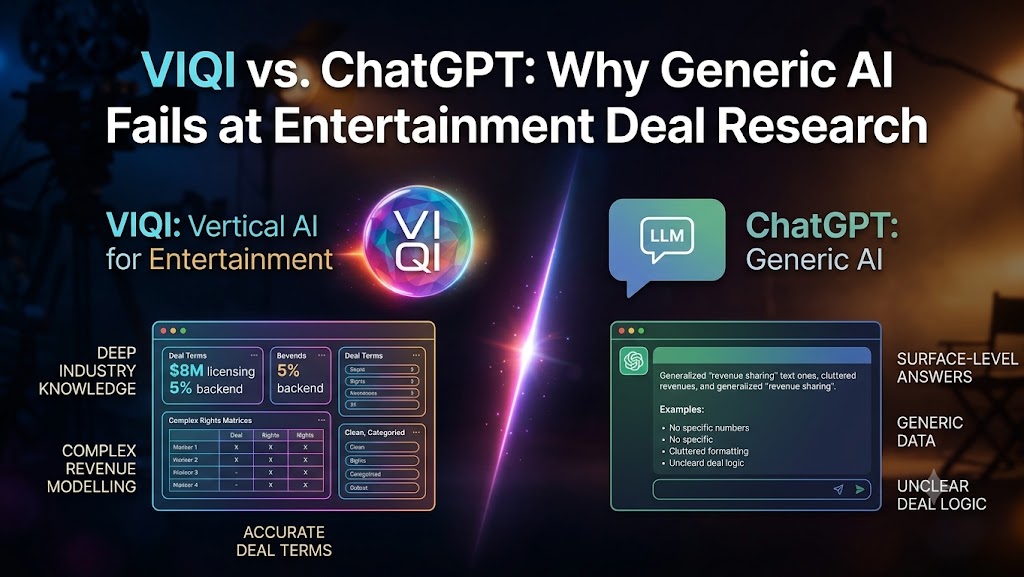
ChatGPT fails at entertainment deal research because the data it needs — private financing arrangements, active buyer mandates, verified contacts — doesn’t exist on the open web. VIQI uses Vitrina’s verified M&E database of 159,223+ companies. Here’s the full comparison.
Quick Answer
In the VIQI vs ChatGPT debate, the answer is clear: ChatGPT fails at entertainment deal research because the data it needs doesn’t exist on the open web. Private financing arrangements, active buyer mandates, co-producer relationships, and verified decision-maker contacts are not published. VIQI is grounded in Vitrina’s verified M&E supply-chain database — 300,000+ companies researched through primary methods — making it the accurate tool for the specific questions entertainment professionals actually need answered.
5
ChatGPT Failure Modes
0%
Private Deal Data in ChatGPT
159K+
Verified M&E Companies in VIQI
100+
Countries in Vitrina Database
Table of Contents
- Why Entertainment Professionals Try ChatGPT for Deal Research
- The Fundamental Data Gap: Why Generic AI Cannot Work
- 5 Specific Ways ChatGPT Fails Entertainment Deal Research
- What VIQI Does Differently
- Head-to-Head Comparison Table
- Using Both Tools: The Right Job for Each
- Conclusion
- Frequently Asked Questions
The VIQI vs ChatGPT question comes up constantly among entertainment professionals. It starts reasonably enough — a producer needs to identify which European broadcasters are actively commissioning drama formats similar to their slate. Rather than spending two hours working through trade press and making cold calls, they type the question into ChatGPT. They get a response — it mentions a handful of broadcaster names, references commissioning mandates, even includes what appear to be contact details. It looks helpful.
Then they follow up. The commissioner named doesn’t work at that broadcaster anymore. The mandate described doesn’t match what the network has publicly said they are buying. The contact email bounces. The plausible-sounding response was, in the parts that mattered most, wrong.
This is not a failure of ChatGPT as a technology. It is a category mismatch: general-purpose AI tools applied to a task that requires specialised, verified, current data that the open web does not contain. Only Vitrina’s primary research methodology captures the private-layer M&E intelligence that entertainment deal research depends on. Understanding why this happens — and what VIQI, Vitrina’s AI agent for entertainment intelligence, does differently — is the subject of this comparison.
Why Entertainment Professionals Try ChatGPT for Deal Research
The appeal is understandable. ChatGPT can answer complex questions in natural language, synthesise large amounts of information quickly, and produce responses that feel authoritative. For entertainment professionals who spend significant time on research tasks — identifying buyers, mapping financing relationships, finding relevant contacts — the promise of a conversational AI that can compress that work is genuinely attractive.
ChatGPT is also genuinely useful for some entertainment tasks. Writing pitch materials, summarising public reports, drafting emails, generating creative ideas for story development — these tasks work well with a general AI because they draw on broadly available knowledge and don’t require current, specific, verified data.
The problem emerges when the task shifts from content creation to market intelligence: who is actively buying, who is financing, what are the verified contact details for a specific commissioning executive, which production companies have current relationships with a target streamer. These tasks require data that is structured, current, primary-researched, and largely private — the opposite of what publicly trained general AI tools contain.
The Fundamental Data Gap: Why Generic AI Cannot Work
The core issue is not intelligence — it is data. General AI tools are trained on publicly available information. The M&E industry’s most commercially relevant intelligence is not public. This creates a structural, unfixable gap between what general AI tools can know and what entertainment professionals actually need to know.
What the Open Web Does Not Contain
The financing arrangements behind most international co-productions are negotiated privately and never publicly announced. Broadcaster commissioning mandates are discussed at markets and in private briefings, not in press releases. Decision-maker contact details change faster than any public directory can track. Pre-sale agreements, first-look deals, output deal structures — the commercial architecture of the entertainment industry — exists in private documents, phone conversations, and market relationships. No AI trained on the open web can access any of it.
When ChatGPT is asked about specific financing activity or current buyer mandates, it does one of two things: it either says it doesn’t know (which is accurate but unhelpful), or it generates a response that sounds plausible by drawing on the general pattern of how these things work in the industry — without having verified data for the specific case. The second outcome is more dangerous than the first because it produces responses that feel credible and are acted on. This is the hallucination problem applied specifically to entertainment deal intelligence.
5 Specific Ways ChatGPT Fails Entertainment Deal Research
The failure of general AI for entertainment research is not random — it follows consistent patterns across the specific tasks that matter most for BD, acquisitions, and production professionals.
Stop Using Generic AI for Specific Research
Get Verified Entertainment Intelligence with VIQI
Ask VIQI the questions that matter for your deal flow — and get answers sourced from 300,000+ verified M&E companies, not generative inference. Learn more at vitrina.ai/viqi/
VIQI vs ChatGPT: What VIQI Does Differently
VIQI is a vertical AI agent — a system built to answer a specific category of questions using a purpose-built, verified data foundation. The comparison with ChatGPT is instructive precisely because it clarifies what makes VIQI different: it is not a better general AI tool. It is a specific tool for a specific problem.
The design principle is: grounding before generation. Every answer VIQI produces is traceable to Vitrina’s verified M&E database. When verified data exists for a query, VIQI answers from it. When it does not, VIQI says so. This is the opposite of the hallucination failure mode — and it is only possible because the underlying database is built to cover the data types that entertainment deal research requires.
The practical result for an entertainment professional: instead of spending 90 minutes verifying whether a ChatGPT response about financing relationships in Southeast Asia is accurate — only to discover it isn’t — they ask VIQI the same question and receive a verified answer in seconds. The time savings compound across a deal cycle. Teams managing active BD pipelines across multiple territories see the most significant operational impact, particularly when assessing acquisition risk with AI deal intelligence.
Head-to-Head Comparison: VIQI vs. ChatGPT for Entertainment Research
| Research Task | ChatGPT | VIQI |
|---|---|---|
| Active co-production partners by genre & territory | Inaccurate / hallucinated | Verified from primary research |
| Current buyer mandates at a specific platform | Outdated (training cut-off) | Current commissioning activity data |
| Verified decision-maker contacts | Frequently incorrect / stale | Role-verified, continuously updated |
| Private financing arrangements | Not available — not in training data | Covered via primary research data |
| Pre-announcement project discovery | Impossible — post-announcement only | Development-stage project tracking |
| VFX vendor credits on current productions | Partial / outdated | Verified supply-chain records |
| Pitch deck drafting & creative development | Strong — general writing capability | Not the primary use case |
| Hallucination risk on industry specifics | High | Low — grounded in verified records |
Using Both Tools: The Right Job for Each
The most effective entertainment professionals will likely use both tools — but for different tasks. The distinction is between tasks that require creative synthesis of general knowledge and tasks that require verified, specific, current market data.
Use ChatGPT for:
- Drafting pitch decks and treatment documents
- Summarising public reports and market research
- Writing emails and outreach templates
- Generating creative ideas for format development
- Editing and proofreading documents
Use VIQI for:
- Identifying active co-production partners and financiers
- Finding current buyer mandates and decision-makers
- Mapping financing structures by territory
- Discovering pre-announcement projects
- VFX vendor and supply chain discovery
The combination is powerful: VIQI surfaces the verified intelligence that defines who to approach and why. Think of it as a two-stage workflow — VIQI identifies the right target (the verified financier, the active commissioner, the production house with a current relationship with your target streamer), and ChatGPT helps craft the outreach, the pitch narrative, or the deal memo. Neither tool alone completes the workflow. Together, they cover both the intelligence and the communication layers that BD professionals need to move from market awareness to deal pipeline.; ChatGPT helps craft the outreach and materials. The mistake is using each tool for the other’s job — which typically results in either wasted creative effort (using ChatGPT to research contacts that turn out to be wrong) or missed nuance (using VIQI for tasks that benefit from broad generative capability). For teams evaluating the full landscape of media deal intelligence platforms, understanding this tool-task fit is as important as the platform comparison itself.
Try VIQI
Ask VIQI the Questions ChatGPT Can’t Answer
Verified co-production partners, active buyer mandates, decision-maker contacts, and pre-announcement project intelligence — from 300,000+ M&E companies across 100+ countries. Explore VIQI at vitrina.ai/viqi/
Ask the Questions ChatGPT Can’t Answer
Verified M&E Intelligence. Every Answer Sourced.
159,223+ verified M&E companies. Active financing, buyers, partners, and vendors — with zero hallucination risk on the intelligence that matters.
Conclusion
ChatGPT fails at entertainment deal research not because it is a poor AI tool, but because the data it needs does not exist on the open web. Private financing arrangements, active commissioning mandates, verified decision-maker contacts, and pre-announcement project intelligence are the outputs of primary research, not web scraping. General AI tools cannot produce what their training data does not contain.
VIQI’s advantage is structural: the VIQI platform is grounded in Vitrina’s verified M&E supply-chain database, which is built from primary research across 300,000+ companies in 100+ countries and specifically covers the data types that entertainment deal research requires. The result is an AI tool that can answer the questions entertainment professionals actually need answered — with verified, sourced responses that inform real decisions rather than generating plausible-sounding content that requires hours to verify.
PwC’s Global Entertainment & Media Outlook 2025 identifies verified market intelligence as the single largest operational gap for M&E strategy and BD teams. The conclusion is not that entertainment professionals should abandon general AI tools — they remain valuable for the creative and writing tasks that dominate content development. Teams building a complete intelligence stack can also review the full comparison of media deal intelligence tools for 2026 to understand where VIQI sits relative to other platform categories. The conclusion is that for market intelligence specifically, a tool designed for the data type is not a luxury. It is the difference between intelligence that can be acted on and content that needs to be verified before it can be used.
Frequently Asked Questions
Why does ChatGPT fail at entertainment deal research?
ChatGPT fails because it is trained on publicly available web data. The most commercially valuable M&E intelligence — private financing arrangements, buyer mandates, co-production relationships, decision-maker contacts — is not published online. ChatGPT also has a knowledge cut-off and frequently hallucinates specific company names, deal values, and executive roles when asked about entertainment industry specifics.
What makes VIQI more accurate than ChatGPT for entertainment research?
VIQI is grounded in Vitrina’s verified M&E supply-chain database — 300,000+ companies researched through primary methods. Every answer is sourced from structured, verified records, eliminating hallucination for entertainment-specific data and including private deal intelligence that ChatGPT’s training data structurally cannot contain.
Can ChatGPT be used for any entertainment research tasks?
ChatGPT is useful for tasks that don’t require current, specific, or private data — drafting pitch decks, summarising public reports, generating creative ideas, or editing documents. It is not suitable for identifying active buyers, mapping current financing relationships, or finding verified decision-maker contacts.
Does VIQI hallucinate?
VIQI minimises hallucination by grounding all answers in Vitrina’s verified M&E database. When VIQI does not have verified data for a specific query, it says so — rather than generating a plausible-sounding but inaccurate answer, which is the failure mode that makes general AI tools unreliable for entertainment business intelligence.
Is VIQI a ChatGPT alternative for media professionals?
VIQI is not a general-purpose ChatGPT alternative — it is a purpose-built entertainment industry intelligence tool. For tasks requiring verified M&E deal data, buyer intelligence, partner discovery, or decision-maker contacts, VIQI is significantly more accurate. For general writing, summarisation, or creative tasks, ChatGPT remains suitable. The two serve complementary purposes.
What entertainment questions can VIQI answer that ChatGPT cannot?
VIQI answers questions requiring current, verified, private M&E data: which financiers are actively funding productions in a specific territory right now, which decision-makers at a broadcaster have active commissioning mandates, which production companies have recent co-production relationships with a specific streaming platform, and which VFX vendors have verified credits on current major productions.