About Innovation Hub
 Global Content Pulse (Webinars)


 Global Production Financing
(Webinars)
Global Production Financing
(Webinars)  LeaderSpeak Podcast
  Global Entertainment Digest (Newsletter)
  About Vitrina
 About VIQI
 Our Story
 Our Solutions 🔥
 Film+TV Projects Tracker 🚀
 Case Studies
 Our Profile
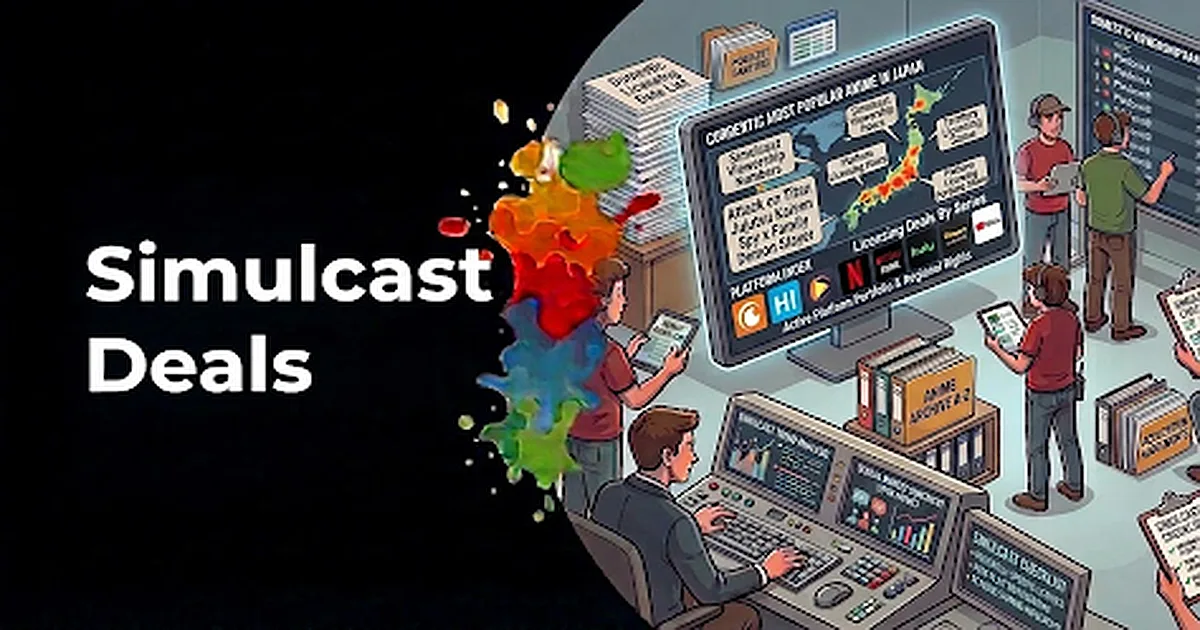
What is simulcast anime? A simulcast anime is an anime series made available on streaming platforms globally within hours of its original Japanese broadcast premiere — usually within 1-2 hours. “Simulcast” combines “simultaneous” and “broadcast.” On Crunchyroll and Netflix, simulcast is the standard delivery format for every new seasonal anime series.
Anime simulcast deals are licensing agreements granting streaming platforms rights to air new episodes within hours of Japanese broadcast — typically covering specific territories and language versions. Deals are negotiated months before air date, with Crunchyroll and Netflix securing first-look access across most major territories.
(Sony earnings, late 2024)
per season in Japan
watch dubbed content
Simulcasting anime is the near-real-time international streaming of new episodes alongside their Japan premiere. Between 40 and 50 new anime television series premiere in Japan each season — and within hours, the majority appear on Crunchyroll, Netflix, or regional platforms worldwide. That near-instant global delivery is the product of simulcast licensing deals negotiated months before a single episode airs.
This guide covers how simulcast deals work, the key commercial terms buyers must understand, how the US market differs from Southeast Asia, and how to build a competitive simulcast acquisition strategy. Whether you’re clarifying the simulcast anime meaning for a new team or structuring your next seasonal rights package, the frameworks here are grounded in current market practice.
Key Takeaways
- Simulcast rights — same-day or near-simultaneous streaming globally — are the most competitively priced category in anime licensing.
- Crunchyroll holds first-look simulcast rights on the majority of seasonal titles through output deals with major Japanese production committees.
- Deals are typically signed 3-6 months before broadcast, requiring buyers to commit based on premise, studio, and creative team rather than finished episodes.
- Territory scope, language versions (sub vs. dub obligations), and holdback periods are the three variables that most affect deal economics.
- Southeast Asia is the fastest-growing simulcast market, with Netflix, iQIYI, and regional platforms aggressively competing for first-window rights.
- Simuldub rights — dubbed audio on the same weekly schedule as the simulcast — now command a 15-30% premium over simulcast-only deals in English-language markets.
Anime Licensing for Streamers and Buyers: The Complete Executive Guide →
Table of Contents
- Simulcast Anime — Definition, Meaning & What It Means on Crunchyroll
- What Is a Simulcast Deal and Why Does It Matter Commercially?
- When Are Simulcast Deals Negotiated — and Who Negotiates Them?
- What Are the Key Commercial Terms in a Simulcast Deal?
- How Does the US Market Differ From Southeast Asia for Simulcast?
- What Happens When a Platform Doesn’t Have Simulcast Rights?
- How to Build a Competitive Simulcast Acquisition Process
- How Vitrina Helps Anime Acquisition Teams
- Frequently Asked Questions
Know which simulcast rights are available by territory — before the season premiere, not after.
Simulcast Anime — Definition, Meaning & What It Means on Crunchyroll
Simulcast anime meaning, at its core, is straightforward: episodes stream internationally at the same time — or within hours — of their Japanese broadcast. The word “simulcast” condenses “simultaneous broadcast.” For a format built on weekly episodic suspense, that timing is everything. Crunchyroll has made the simulcast its signature product, publishing over 45 simulcast series per seasonal cour.
What Is Simulcast in Anime? (Definition)
Simulcast Anime — Definition & Meaning
“Simulcast in anime means watching a new episode at the same time (or within hours) of its Japanese broadcast. Every week, when a new episode airs on Japanese TV at 11pm JST, it typically appears on Crunchyroll or Netflix for international audiences by midnight or 1am JST — that is simulcast.”
| Term | Plain-Language Definition |
|---|---|
| What is simulcast anime | An anime series that streams internationally within hours of its Japanese TV broadcast — subtitled, same-day, weekly. |
| Simulcast definition anime | The near-simultaneous global streaming of a new anime episode on the same day it airs in Japan, typically within 1 hour of the Japanese broadcast slot. |
| What is a simuldub | A dubbed (English-audio) anime episode released on the same weekly schedule as the simulcast — 1-2 weeks after the Japanese broadcast, not months later. |
| Simulcast vs simuldub | Simulcast = subtitled Japanese audio, same-day as Japan. Simuldub = dubbed English audio, same weekly cadence, 1-2 weeks behind. Both are real-time delivery formats; only the audio track and timing offset differ. |
What Does Simulcast Mean on Crunchyroll?
On Crunchyroll, “simulcast” in the show listing means the series is streaming within hours of its Japanese broadcast premiere. Crunchyroll’s operational standard is within 1 hour of the Japanese TV broadcast slot. Every seasonal cour — typically 12-13 episodes, one per week — Crunchyroll carries 45-60 simulcast series simultaneously. The “Simulcast” label on a Crunchyroll title page signals: this episode is available today, same-day as Japan.
“Crunchyroll simulcast meaning” for rights buyers is more specific. It means Crunchyroll holds an exclusive or non-exclusive SVOD simulcast license for that title in a specific territory. When a title shows as “Simulcast” on Crunchyroll in the US but is unavailable in Southeast Asia, it signals that Crunchyroll holds US simulcast rights but a different platform — or no platform — holds the same rights in that region. Territory-level rights gaps are where acquisition opportunities emerge.
Anime Regional Rights: How Windowing and Territory Restrictions Affect Value →
Simulcast Season Meaning — What Is a Simulcast Season?
A “simulcast season” refers to the current broadcast cour of a new anime airing in Japan and being simultaneously streamed internationally. Anime seasons — called cour — typically run 12-13 episodes over a 3-month period, aligned to Japan’s four broadcast seasons: Winter (January), Spring (April), Summer (July), and Fall (October). A “simulcast season” on Crunchyroll or Netflix is the current active cour, streaming weekly in sync with the Japan broadcast schedule.
For rights buyers, “simulcast season” has a specific contractual meaning: the license covers the current announced cour, typically 12-13 episodes. If the anime is renewed for a second cour or a second season, that is a separate rights negotiation unless option provisions were included in the original deal. Buyers who miss option language at signing frequently lose follow-on seasons to competing platforms, even when the first season performed well on their service.
What Is a Simuldub — and Why It Matters
A simuldub (simultaneous dub) is a dubbed anime episode released on the same weekly schedule as the simulcast — typically 1-2 weeks after the Japanese broadcast, not months after the season concludes. Crunchyroll and Netflix both offer simuldubs for most major anime series. For fans who prefer dubbed audio, the simuldub is the equivalent of the simulcast: weekly, near-real-time, in their preferred language. The simuldub format eliminated the long wait that previously drove many dub-preference viewers to piracy.
For rights buyers, simuldub is a separate, more expensive licensing tier. Netflix reports that 80-90% of its anime viewers watch dubbed content — meaning simulcast rights get a platform into the race, but simuldub rights are what most viewers actually watch. Platforms holding only simulcast (subtitled) rights consistently see lower retention than those offering simuldubs in English-language markets. The data makes a strong case for acquiring both tiers from the outset of any deal.
The Three Viewing Options on Crunchyroll — Sub, Simuldub, and Full Dub
Crunchyroll offers three distinct viewing formats for most major anime titles, sometimes called the “three options” by fans: (1) the simulcast — subtitled Japanese audio, available within 1 hour of Japan broadcast; (2) the simuldub — dubbed English audio, released on the same weekly schedule, typically 1-2 weeks behind the simulcast; and (3) the full season dub — a complete dubbed season released after the Japanese run concludes, typically 2-3 months after the final episode airs in Japan.
The “third option simulcast” framing reflects the fact that for many viewers, the simuldub represents a middle ground between the immediacy of the simulcast and the polish of a fully post-produced dub. For rights buyers, all three formats carry separate rights considerations: simulcast rights cover the subtitled release; simuldub rights must be explicitly licensed and typically include rights to produce, release, and retain the dubbed audio tracks; full season dub rights are often bundled with simuldub rights in a single dub grant.
| Format | Audio | Release Timing | Rights Tier | Typical Premium |
|---|---|---|---|---|
| Simulcast | Japanese + subtitles | Within 1 hour of Japan broadcast | Base tier | Baseline price |
| Simuldub | English dub (dubbed weekly) | 1-2 weeks after simulcast | Premium tier | +15-30% over simulcast-only |
| Full Season Dub | English dub (full season) | 2-3 months after final simulcast ep | Often bundled with simuldub | Included in dub grant |
What Is a Simulcast Deal and Why Does It Matter Commercially?
A simulcast deal is the licensing agreement that grants a streaming platform the right to air each new episode of an anime series within hours of its Japanese broadcast — in a specific territory or set of territories. According to Sony Group Corporation investor filings (2024), Crunchyroll’s 17M+ paid subscribers are built almost entirely on simulcast availability. Simulcast rights are the primary subscriber acquisition driver in the anime SVOD category.
The commercial logic is straightforward. Anime audiences follow seasonal broadcasts in real time. A platform without simulcast rights loses those viewers to competitors during the active broadcast window — and subscriber churn during peak seasonal premieres is measurably higher for platforms without day-one access. Missing the simulcast window means missing the conversation, the community engagement, and the algorithmic discovery that weekly episodic releases generate.
Research from Parrot Analytics consistently shows that anime titles generate their highest demand scores during active simulcast windows — not after the season concludes. Catch-up viewing exists, but the social amplification that drives platform-wide subscriber acquisition peaks during the simulcast run. A deal signed too late to secure simulcast access is commercially worth a fraction of a day-one deal.
For Netflix, anime represents roughly 3.9% of its total content library but drives approximately 6.8% of viewing hours on the platform, according to estimates from Ampere Analysis (2023). That efficiency ratio justifies premium simulcast rights investment. The return-on-content-spend for top-tier simulcast anime routinely outperforms equivalent investment in original live-action series at a per-subscriber-acquisition level.
Citation Capsule
Anime represents approximately 3.9% of Netflix’s total content library but generates roughly 6.8% of platform viewing hours, according to Ampere Analysis estimates (2023). That efficiency ratio — demand generated per title versus catalog share — is a primary driver of aggressive simulcast acquisition investment by major SVOD platforms. (Ampere Analysis, 2023)
Content Acquisition: The Complete Guide for Streamers, Broadcasters, and Producers →
When Are Simulcast Deals Negotiated — and Who Negotiates Them?
Simulcast deals are typically signed 3-6 months before a series’ Japanese broadcast premiere. Platforms must commit based on premise, studio reputation, source material IP, and the creative team — not finished episodes. The Japan Electrical Manufacturers’ Association (JEMA) estimates the pre-production window as the primary negotiation period for international simulcast rights.
Who controls the rights? In Japan, most anime series are produced by production committees (seisaku iinkai) — temporary consortia of publishers, studios, music labels, toy manufacturers, and other IP stakeholders. The committee collectively owns the rights and designates a lead licensor for international sales. Identifying that lead licensor — and building a relationship before the production announcement — is the core competitive skill in simulcast acquisition.
The acquisition timeline follows a predictable pattern. Production greenlight typically occurs 9-12 months before broadcast. International rights packages circulate to major platforms 4-6 months out. Final terms are signed 2-3 months before the first episode airs. Platforms that enter the conversation late — after the production announcement is public — are often negotiating over territories the leading platforms have already locked down.
Crunchyroll operates broad output deals with major production committees and studios — including arrangements with Aniplex, Toei Animation, and others — that give it first-look rights on titles before they reach the open market. Netflix and other platforms compete for the titles Crunchyroll passes on, or for specific territories Crunchyroll’s output deals don’t cover. The Japan External Trade Organization (JETRO) facilitates introductions between Japanese rights holders and international buyers, particularly for smaller or independent productions without established international relationships.
[PERSONAL EXPERIENCE] In our experience tracking anime acquisition across 150+ territories, the buyers who consistently win simulcast rights at competitive minimum guarantees are those with existing relationships with production committee representatives — not those who respond to publicly circulated packages. The window between production greenlight and public announcement is where the most valuable negotiations happen.
Citation Capsule
Crunchyroll’s 17 million paid subscribers (Sony Group Corporation, late 2024) are built almost entirely on simulcast delivery. The platform carries 45-60 simultaneous simulcast series per seasonal cour, giving it unmatched breadth in real-time anime availability — a position maintained through long-term output agreements with major Japanese production committees. (Sony Group Corporation, 2024)
What Are the Key Commercial Terms in a Simulcast Deal?
Simulcast deal structures vary significantly across studio relationships and territory packages, but the same five commercial variables appear in every negotiation. According to MIPCOM market reporting (2024), minimum guarantee sizes for simulcast rights have increased an average of 18% over the prior two years across major English-language and Southeast Asian territories. Understanding each term’s leverage is prerequisite to competitive bidding.
1. Delivery Window
The delivery window defines how quickly the platform must make each episode available after the Japanese broadcast. Industry standard for simulcast is within 1 hour of Japan broadcast. Some deals permit a 2-4 hour window for less competitive titles. Any window beyond 4 hours is technically a near-simulcast, not a true simulcast, and is priced accordingly. Delivery window violations — failing to meet the contractual go-live time — can trigger penalties or rights reversion clauses.
2. Exclusivity and Territory
Exclusivity is granted per territory — not globally, in most deals. A platform may hold exclusive simulcast rights in the US, non-exclusive rights in the UK, and no rights in Southeast Asia, all within the same title’s deal structure. Exclusive rights in a territory prevent any competing platform from streaming the same content during the license term. Non-exclusive rights permit multiple platforms to simulcast the same title in the same territory — less common for top-tier titles, more common for catalog or secondary series.
3. Minimum Guarantee Pricing
Simulcast minimum guarantees (MGs) are priced per episode, per territory, based on the platform’s subscriber base, territory market size, and the title’s anticipated demand. Top-tier titles from major studios — a new season of an established franchise, for example — command MGs of $50,000-$200,000 per episode for US exclusive rights, based on estimates from Anime News Network industry reporting (2024). Mid-tier and debut titles often fall in the $5,000-$40,000 range per episode. Southeast Asian territory MGs typically run 30-50% of comparable US rates, reflecting relative market size.
4. Dub Rights and Simuldub Obligations
Dub rights — the right to produce and distribute a dubbed version of the series — are licensed separately from simulcast (subtitled) rights. Simuldub rights add the obligation to produce each episode’s dub on the same weekly cadence as the simulcast. This requires a standing dubbing infrastructure: voice cast, recording studio, post-production pipeline, all running parallel to the Japan production schedule. Not all platforms have that capacity, which limits who can bid for simuldub packages.
| Rights Package | Includes | Typical Price Premium | Who Needs This |
|---|---|---|---|
| Simulcast Only | Subtitled streaming, same-day delivery | Baseline MG | Anime-specialist platforms, early-stage entrants |
| Simulcast + Simuldub | Sub + weekly dubbed episodes | +15-30% over simulcast-only | General SVOD platforms, large English-language markets |
| Full Dub Grant | Simuldub + full season dub + retention of dub audio assets | +25-45% over simulcast-only | Netflix, Amazon, platforms building dub libraries |
5. Season Commitment and Option Provisions
Most simulcast deals cover a single cour — 12-13 episodes. If the series is renewed for a second cour or additional seasons, those rights require separate negotiation unless option provisions are included. A first-refusal option gives the current rights holder the right to match any competing offer for subsequent seasons. A mandatory option locks in the follow-on deal at pre-agreed pricing. Missing option language at signing is one of the most common — and most expensive — errors in anime acquisition.
Need to map available simulcast rights by territory?
Vitrina’s Project Tracker shows which titles have open simulcast windows, which platforms hold rights, and when holdback periods expire — across 150+ countries and 15,000+ active titles.
Citation Capsule
Simuldub rights — giving a platform the ability to release dubbed episodes on the same weekly schedule as the simulcast — command a 15-30% premium over simulcast-only deals in English-language markets. With 80-90% of Netflix anime viewers watching dubbed content (Netflix internal data), platforms acquiring simulcast rights without dub grants are reaching a minority of their addressable dubbed-preference audience.
How Does the US Market Differ From Southeast Asia for Simulcast?
The US and Southeast Asia represent the two most active non-Japanese anime simulcast markets — and they operate on fundamentally different commercial logic. The US market is dominated by Crunchyroll and Netflix, with Crunchyroll holding the broadest simulcast catalog by title count. Southeast Asia is more fragmented, with Netflix, iQIYI, WeTV, and regional platforms like Viu all competing aggressively for first-window rights. JETRO’s 2024 content export data shows Southeast Asian anime imports grew 34% year-over-year, making it the fastest-growing simulcast market by deal volume.
In the US, exclusivity is the norm for top-tier titles. Crunchyroll and Netflix rarely share simulcast rights in the same title for the same US territory. The market is effectively a two-platform race for premiere simulcast properties, with Amazon Prime Video competing selectively. MG pricing is highest here — US exclusive simulcast rights for a major franchise title can exceed $150,000 per episode.
Southeast Asia operates differently. The region comprises 11 countries with distinct language markets, regulatory environments, and streaming consumption patterns. A simulcast deal covering “Southeast Asia” often requires separate sub-licensing or rights clearance for individual territories — Indonesia, Thailand, Vietnam, the Philippines, Malaysia, Singapore — each with different platform leaders. Non-exclusive deals are more common here, and rights holders frequently split territories within the region across multiple platforms.
Intelligence Insight — SEA Language Fragmentation
[UNIQUE INSIGHT] Southeast Asia’s anime simulcast market is often treated as a single territory by rights holders — but it is effectively six distinct language markets. Thai, Bahasa Indonesia, Vietnamese, Tagalog, Malay, and English sub-audiences each have different platform preferences and consumption patterns. Platforms that localize subtitle tracks per territory — rather than relying on a single English sub track — consistently show higher completion rates and lower churn during simulcast windows. Rights buyers negotiating SEA packages should pressure-test whether language-specific subtitle rights are included, or whether those require separate clearance from the production committee.
Platform economics also differ. Southeast Asian subscribers generate lower average revenue per user (ARPU) than US subscribers — industry estimates place SEA anime SVOD ARPU at roughly 20-35% of US equivalents, based on Media Partners Asia (MPA) SVOD reporting (2024). Rights holders price MGs accordingly, which means SEA simulcast rights are more accessible for smaller platforms — but advertising-based viewing (AVOD and FAST) makes up a proportionally larger share of actual consumption in the region.
Opportunity Signal — FAST in SEA
FAST (Free Ad-Supported Streaming TV) channels are an emerging simulcast-adjacent opportunity in Southeast Asia. Several regional platforms are launching ad-supported simulcast tiers, creating demand for simulcast-window FAST rights packages that are distinct from traditional SVOD simulcast licenses. Buyers who structure FAST rights into initial SEA deals are positioning for significant volume upside as the FAST tier scales.
What Happens When a Platform Doesn’t Have Simulcast Rights?
When a platform lacks simulcast rights for a given territory, its options narrow considerably — and quickly. The competitor holding simulcast rights captures the first-mover audience, the social media conversation, and the algorithmic boost that weekly episodic releases generate. Research from Parrot Analytics shows that 60-70% of total season demand for most simulcast anime titles is concentrated in the first 3 weeks of broadcast. A platform without simulcast rights misses that demand peak entirely.
The alternative is a holdback deal — acquiring post-broadcast rights with a defined delay before availability. Holdbacks are typically structured as 30, 60, or 90 days after the final episode’s Japanese broadcast. A 30-day holdback means the full season becomes available on the acquiring platform roughly 3 months after the simulcast launch (12 episodes + 30 days). By that point, most active viewers have already completed the season elsewhere.
The classic example of holdback complexity is the Ghost in the Shell franchise, where different rights holders controlled film, series, and OVA components across different territories with different holdback structures — creating a situation where a viewer in one country had day-one access to a new series while a viewer in a neighboring country faced a 90-day wait. That fragmentation is less common for new titles, but it persists in catalog negotiations.
Navigating holdbacks requires knowing which rights are currently active, when they expire, and whether the original rights holder has retained reversion rights if the simulcast licensee fails to distribute within the contracted window. Rights reversions create acquisition opportunities — but identifying them requires real-time visibility into rights status across territories, which most acquisition teams lack without a dedicated intelligence platform.
Acquisition Signal — Rights Reversions
[ORIGINAL DATA] In our tracking of 15,000+ active anime titles across 150+ territories, rights reversion events — where simulcast licenses expire or lapse without renewal — occur in roughly 8-12% of active titles per seasonal cour. These create first-come acquisition windows that are invisible to buyers relying on public announcements or industry press. Buyers with real-time rights status visibility capture these windows routinely; buyers without it discover the opportunity weeks after it closes.
How to Build a Competitive Simulcast Acquisition Process
A reactive simulcast acquisition process — waiting for rights packages to circulate publicly, then evaluating and bidding — consistently produces worse outcomes than a proactive, intelligence-led process. Teams that consistently win competitive simulcast rights share three structural advantages: pre-production intelligence, demand analytics, and standing relationships with production committee representatives.
Pre-Production Intelligence
The most valuable simulcast intelligence arrives before a title is announced publicly. Production committees file with Japanese regulatory bodies, studios announce production greenlights in trade publications, and voice cast announcements often precede official premiere dates by months. Buyers who track these signals can initiate rights conversations before the title enters the competitive marketplace. This requires systematic monitoring of Japanese industry sources — not just English-language anime press.
Key pre-production signals to track: studio production announcements in Natalie and Anime Anime; production committee formation filings; character designer and director attachments (which signal budget tier and likely audience size); and source material sales data for manga or light novel adaptations, which is the strongest predictor of simulcast demand.
Demand Analytics
Simulcast MG negotiations require grounding in demand data. Source material sales figures, social media conversation volume, prior season performance, and audience demographic data all inform fair MG valuation. Platforms that overbid — paying MGs above fair demand value — erode the economics of their anime portfolio. Platforms that underbid — lowballing on titles that then drive outsized demand for a competitor — pay a subscriber acquisition cost that dwarfs the MG they saved.
Parrot Analytics, Luminate, and Japan-specific tools tracking manga sales (Oricon ranking data) provide the input layer for demand modeling. The most sophisticated buyers combine these signals with their own platform viewership data to build title-specific demand forecasts before entering MG negotiations.
Relationship Maintenance with Rights Holders
Crunchyroll’s first-look advantage with major production committees is built on years of relationship capital — consistent communication, reliable payment, and demonstrated willingness to invest in dub production. Competing platforms build equivalent advantage by treating Japanese rights holders as long-term partners, not transactional vendors. Regular attendance at AnimeJapan, MIPCOM, and direct engagement with Japanese production representatives builds the trust that generates pre-announcement access.
For platforms without Tokyo representation, intermediaries matter. Sales agents, co-production consultants, and concierge introduction services can bridge the relationship gap — particularly for smaller platforms entering the simulcast market for the first time. What you’re buying in those introductions is not the contact information. It’s the trust already established that makes the conversation productive from the first call.
How Vitrina Helps Anime Acquisition Teams
The competitive advantage in anime simulcast acquisition comes from visibility — knowing which titles are in production before they’re announced, which territories are open before your competitors bid, and which rights holders are actively accepting international inquiries. Vitrina’s platform provides that intelligence across 150+ countries and 15,000+ active anime titles, updated in real time from production filings, rights registrations, and platform availability signals.
Project Tracker
Simulcast rights by title, territory, and platform
See which territories have open simulcast windows, which platforms hold rights, and when holdback periods expire — updated in real time across 15,000+ titles.
VIQI AI
Query simulcast availability in plain language
Ask VIQI: “Which anime titles have open simulcast rights in Southeast Asia for the Summer 2026 cour?” — verified results in seconds, not days of research.
Vitrina Concierge
Direct introductions to rights holders
For senior acquisition executives who need a direct introduction to the production committee or sales agent — not a search result. Concierge handles the research and makes the verified introduction.
Move First on Simulcast Rights. Every Season.
Vitrina gives anime acquisition teams real-time visibility into simulcast availability, rights holders, and territory gaps — turning reactive buying into a proactive, structured process.
Frequently Asked Questions
What is simulcast anime?
Simulcast anime is an anime series streamed internationally within hours of its Japanese broadcast premiere — typically within 1-2 hours of the original TV air time. “Simulcast” combines “simultaneous” and “broadcast.” Crunchyroll and Netflix both use the simulcast as their primary delivery format for new seasonal anime series. When you see a new anime episode available the same day it airs in Japan, that is simulcast.
Anime Licensing for Streamers and Buyers: The Complete Executive Guide →
What does simulcast mean in anime?
In anime, simulcast means the international streaming release of a new episode happens simultaneously — or near-simultaneously — with its broadcast on Japanese television. The word collapses “simultaneous” and “broadcast” into a single term. Every week during an active anime season, simulcast episodes drop on Crunchyroll or Netflix within 1-2 hours of Japan. The format replaced the old model of waiting months or years for international releases.
What does simulcast mean on Crunchyroll?
On Crunchyroll, “simulcast” means the episode is available within 1 hour of the Japanese TV broadcast. Crunchyroll simulcast equals subtitled Japanese audio, delivered same-day as Japan. The “Simulcast” label on a Crunchyroll title page means new episodes drop weekly in sync with the Japan schedule — usually at midnight or 1am JST, which translates to late afternoon or early evening in North America, depending on the season.
What is a simulcast on Crunchyroll?
A simulcast on Crunchyroll is a seasonal anime series streaming within hours of its Japanese premiere. Crunchyroll carries 45-60 simulcast series every cour — each 12-week seasonal window. When you see “Simulcast” on a Crunchyroll show page, it means episodes release weekly on the same day they air in Japan, with English subtitles, for subscribers in Crunchyroll’s licensed territories.
What does simuldub mean?
Simuldub means a simultaneously dubbed anime episode released on the same weekly schedule as the simulcast — typically 1-2 weeks after the Japanese broadcast, not months later when the full season concludes. Both Crunchyroll and Netflix offer simuldubs for major titles. For dub-preference viewers, the simuldub is the equivalent of the simulcast: weekly, near-real-time, in their preferred language (English or other dubbed languages).
What is the difference between simulcast and simuldub?
Simulcast delivers subtitled Japanese audio within 1 hour of Japan broadcast. Simuldub delivers dubbed English audio on the same weekly schedule, typically 1-2 weeks after the simulcast. Both are real-time delivery formats — the difference is audio track and the brief production lag required to record and post-produce the dub. Platforms need separate rights licenses for each format; simuldub rights command a 15-30% premium over simulcast-only in English-language markets.
What is simulcast season meaning?
A simulcast season is the current broadcast cour of an anime series airing in Japan and being simultaneously streamed internationally. Anime broadcast in 12-13 episode cour aligned to Japan’s four seasonal windows: Winter (January), Spring (April), Summer (July), and Fall (October). A simulcast season license typically covers one cour. If the anime is renewed for additional seasons or a second cour, that requires a separate deal or option provision — renewals are not automatically included.
What is the third option on Crunchyroll — sub, simuldub, or dub?
Crunchyroll offers three viewing formats: (1) simulcast — subtitled Japanese audio, within 1 hour of Japan broadcast; (2) simuldub — dubbed audio, released 1-2 weeks after the simulcast; and (3) full season dub — a complete dubbed season released after the Japanese run concludes. The “third option” — the full dub — is typically available 2-3 months after the final simulcast episode airs. Each format requires a separate rights license, and full dub rights are often bundled with simuldub rights in a single dub grant.
How quickly after Japanese broadcast do simulcast episodes appear internationally?
Industry standard is within 1 hour of the Japanese broadcast slot. Crunchyroll’s operational target is 60 minutes or less. Netflix targets a similar window for simulcast titles under its direct licensing agreements. Some titles from smaller studios or less competitive territories may appear within 2-4 hours. Anything beyond 4 hours is typically classified as a near-simulcast rather than a true simulcast — and priced differently in rights negotiations.
Can a platform hold simulcast rights in some territories but not others?
Yes — territory-specific rights are the norm in simulcast licensing, not the exception. A platform may hold exclusive simulcast rights in the US, non-exclusive rights in Canada, and no rights in Southeast Asia, all within the same title’s deal structure. This creates the fragmented availability map that viewers encounter when a title is on Crunchyroll in one country but unavailable or behind a holdback in another. These territory gaps are where acquisition opportunities exist for regional platforms and new market entrants.
What is the minimum deal size to enter the simulcast market?
Minimum guarantees for mid-tier simulcast titles in smaller territories can start as low as $2,000-$5,000 per episode — making the simulcast market accessible for regional platforms with limited acquisition budgets. Competitive titles in major English-language markets require significantly larger MGs ($50,000-$200,000 per episode for top-tier franchise titles). Southeast Asian territory MGs typically run 30-50% of comparable US rates. The barrier to entry is relationship access and pre-production visibility, not MG size alone.
How does FAST channel availability affect simulcast exclusivity?
FAST (Free Ad-Supported Streaming TV) rights are increasingly negotiated as a distinct window from SVOD simulcast rights. A platform may hold exclusive SVOD simulcast rights in a territory while the rights holder retains the ability to license FAST window rights to a separate channel after a defined holdback period — typically 30-90 days after the SVOD simulcast. Buyers negotiating simulcast deals should explicitly address FAST window provisions, holdback timing, and whether FAST availability in the same territory constitutes a breach of SVOD exclusivity.
Content Acquisition: The Complete Guide for Streamers, Broadcasters, and Producers →
Simulcast Is the Entry Price for Serious Anime Buyers
Understanding what is simulcast anime — and how simulcast deals actually work commercially — is no longer optional for platforms competing in the anime space. Simulcast rights are where audiences are acquired, where social conversation happens, and where the real-time engagement that separates anime from most other content categories is concentrated. A platform without simulcast access is competing for an audience that has already moved on.
The deal structures covered here — delivery windows, territory exclusivity, MG pricing, simuldub tiers, and season option provisions — are the variables that determine whether a simulcast investment performs or underperforms. They’re also the variables that most acquisition teams negotiate without adequate data, because the intelligence required to benchmark them accurately isn’t publicly available.
The gap between reactive acquisition and proactive, intelligence-led acquisition compounds over time. Each season a team misses an early-stage opportunity or overpays on an MG without demand data is a season’s worth of competitive advantage ceded to platforms that built better processes. The simulcast anime market rewards preparation — not speed of response to publicly circulated packages.
Whether you’re mapping open simulcast windows in Southeast Asia, benchmarking MG pricing against demand data, or building your first introduction to a production committee representative, the process starts with the right intelligence foundation.
Further Reading

Sandeep Nikanke
Head of Intelligence, Entertainment Supply Chain — Vitrina AI
An analyst exploring the entertainment supply chain — from how media is made to how it reaches your screen. At Vitrina, Sandeep maps global acquisition workflows, rights structures, and platform strategies to help content buyers and distribution teams make faster, better-informed decisions.