About Innovation Hub
 Global Content Pulse (Webinars)


 Global Production Financing
(Webinars)
Global Production Financing
(Webinars)  LeaderSpeak Podcast
  Global Entertainment Digest (Newsletter)
  About Vitrina
 About VIQI
 Our Story
 Our Solutions 🔥
 Film+TV Projects Tracker 🚀
 Case Studies
 Our Profile
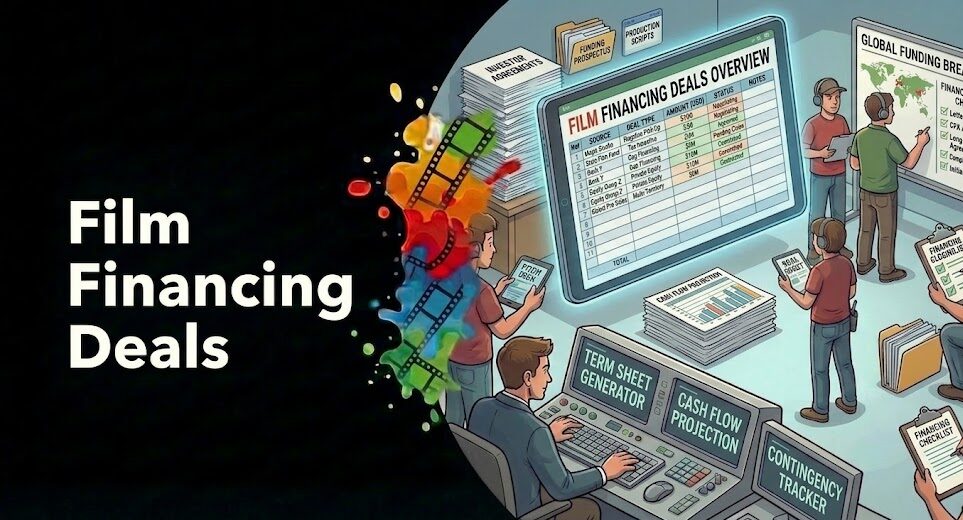
A film financing deal signed in excitement can quietly destroy a production. Not because the money dried up—but because no one defined what “net profits” meant. A properly structured deal separates secured financing from risk capital, creates a clear recoupment waterfall, defines profit participation with precision, and gives investors meaningful rights without ceding creative control. Get those four elements right, and you have a deal that can actually close—and hold up when things get complicated.
Most disputes in independent film financing don’t come from bad faith. They come from vague language. “Net profits” that never materialize. Undefined “creative approval” rights. Recoupment positions that weren’t clearly negotiated upfront. The deals that survive have structure—and that structure starts before a single dollar moves.
Here’s how to build one that protects your investors, preserves your creative control, and actually gets your film greenlit.
Table of Contents
- What Makes a Film Financing Deal Actually Work
- The Recoupment Waterfall: Who Gets Paid First
- Defining “Net Profits” — The Most Dangerous Phrase in Film
- Investor Rights Without Killing Creative Control
- Deferral Agreements: The Silent Capital You’re Underusing
- Common Mistakes That Turn Good Deals Into Disputes
- Frequently Asked Questions
- Conclusion
Ask VIQI: Which deal structure is right for your project?
VIQI is Vitrina’s AI assistant—trained on 1.6 million titles, 360,000 companies, and 5 million entertainment professionals. Ask it about recoupment waterfalls, deferral agreements, or how to compare equity versus debt for your specific budget range.
✓ Included with 200 free credits | ✓ No credit card needed
What Makes a Film Financing Deal Actually Work
A film financing deal isn’t just about where the money comes from. It’s about who gets paid back first, under what conditions, and what happens when the film underperforms. That last part is where most deals get into trouble.
The deals that hold up—across hundreds of independently financed productions—share four structural elements that are locked in before any money moves:
- A clear recoupment waterfall with defined positions for each capital source
- A precise definition of “net profits” (or profit participation) that leaves no room for interpretation
- Investor rights that are meaningful—without giving a committee veto over creative decisions
- Deferral agreements for key talent that are modeled as real financial obligations
Miss any one of these and you’re exposed. Not necessarily legally—though that’s possible too. Exposed to months of renegotiation, a damaged investor relationship, and a production that stalls at the worst possible moment.
Here’s the thing: these aren’t complicated concepts. But they require specificity. “We’ll work it out” is not a deal structure. What follows is.
Before diving in, it helps to understand how the film capital stack is assembled—the layers of equity, debt, and incentives that form the foundation of any properly structured deal.
The Recoupment Waterfall: Who Gets Paid First (and Why It Matters)
The recoupment waterfall defines the order in which investors, lenders, and talent get paid from the film’s revenue. It’s the most important structural element in any film financing agreement—and the one most often left vague.
A standard independent film waterfall looks something like this:
- Distribution and sales agent fees (typically 15–25% off the top)
- P&A recoupment — if the distributor advanced marketing costs
- Senior debt — gap loans, bank production loans, plus interest
- Equity investors — in order of seniority if multiple tranches
- Deferred fees — key talent, producer deferrals
- Net profit participants — remaining upside sharing
Here’s what producers consistently get wrong: they treat all equity as equal. It isn’t. If you’ve raised from three sources—a film fund, a family office, and a private investor—each needs a defined position. “Pari passu” (equal ranking) is one approach. Seniority structures are another. Whichever you choose, it needs to be in the deal documents before the money arrives.
One practical reality that catches producers off-guard: senior debt sits above equity, always. If you have a gap loan or a production loan from a specialist lender, that’s repaid first—before your equity investors see any return. Build that into your financial model from day one. Andrea Scarso of IPR VC—which has co-financed over 15 A24 films—reviews waterfall structure as part of their core due diligence on every project. Get it wrong, and you’ll be renegotiating with institutional money mid-production.
For a deeper breakdown, see Vitrina’s guide on understanding recoupment waterfalls in film finance.
Phil Hunt (Founder & CEO, Head Gear Films) discusses how deal structure shapes real-world outcomes for independent producers:

Defining “Net Profits” — The Most Dangerous Phrase in Film Financing
“Net profits” is the most dangerous phrase in entertainment finance. Not because it’s dishonest—but because it means something different to every lawyer who drafts it.
In studio deals, net profits are legendary for never materializing. Independent film is subtler: the definition just isn’t precise enough. When revenue finally arrives—often 18–36 months post-delivery—there’s a dispute about what qualifies.
Your deal documents need to address, in writing:
- What constitutes “gross receipts” — all revenue streams, or just theatrical? Does it include streaming, physical, airline, and library sales?
- Which costs are deducted before calculating net profits — distribution fees, overhead, interest, deferral payments?
- Whether recoupable costs include a premium — most equity investors recoup 120–125% of capital before any profit split kicks in. That 20–25% premium is their risk return.
- How foreign sales are treated — territory-by-territory accounting, or consolidated?
- What happens with future library sales — streaming rights sold five years later need a defined accounting methodology now.
Phil Hunt of Head Gear Films—which has financed 550+ films over 25 years—makes this point consistently: independent producers underestimate how much the definition of “distribution advance” versus “net revenue” shapes their eventual return. The numbers look dramatically different depending on which methodology applies.
And don’t shorthand it. “Net profits as customarily defined in the entertainment industry” is not a definition. It’s an invitation to litigation.
Track Every Active Financing Deal Before It Hits the Trades
Trusted by Netflix, Warner Bros, and Paramount. Join 140,000+ companies tracking the global entertainment supply chain on Vitrina.
✓ 200 free credits | ✓ No credit card required | ✓ Full platform access
Investor Rights Without Killing Creative Control
Investors want rights. That’s not unreasonable—they’re putting real money into a high-risk asset class. The tension is real: give too much control and you’ve created a creative committee that can’t make fast decisions. Give too little and sophisticated capital walks away, or creates legal challenges mid-production.
Here’s a workable framework that most institutional investors will accept.
Financial Oversight Rights (Give These Freely)
These don’t touch creative decisions and protect the investor’s capital. Don’t negotiate too hard against them—you’ll lose goodwill on issues that actually matter.
- Quarterly financial reporting with audited statements
- Audit rights (usually limited to 12 months post-revenue period)
- Budget approval at signing, with defined change-of-scope thresholds (e.g., investor consent required for overruns exceeding 10% of approved budget)
- Approval over distribution deals above a defined minimum guarantee floor
Creative Approval Rights (Define Carefully)
These are where deals get complicated. The key is specificity—not blanket restrictions, but precisely defined triggers.
- Casting approval — for “principal cast” only. Define it: top two billing? Top three? Name the specific roles.
- Director replacement — typically only triggered by incapacity, material breach of contract, or abandonment. Not “creative differences.”
- Script changes — limit to material changes defined as modifications exceeding a percentage of the approved shooting script (common threshold: 15–20%).
What you should avoid: a general “creative consultation right” with no defined scope. That’s a recipe for interference at the worst moment. Better to specify exactly what triggers an investor consent right—and what doesn’t.
Joshua Harris, President of Peachtree Media Partners, structures his company’s financing specifically to preserve filmmaker creative control. His model—advancing against future territory values before distribution deals are executed—avoids the dilutive effect of equity that demands heavy creative oversight. As he notes, the goal is enabling producers to “maintain control over the project and maintain upside”—two things a poorly drafted investor rights clause can quietly eliminate.
Worth reading alongside this: Vitrina’s breakdown of equity versus debt financing in film, which shows how the choice of capital type shapes what rights you’re actually negotiating.

Your AI Assistant, Agent, and Analyst for the Business of Entertainment
VIQI AI helps you plan content acquisitions, raise production financing, and find and connect with the right partners worldwide.
- Find active co-producers and financiers for scripted projects
- Find equity and gap financing companies in North America
- Find top film financiers in Europe
- Find production houses that can co-produce or finance unscripted series
- I am looking for production partners for a YA drama set in Brazil
- I am looking for producers with proven track record in mid-budget features
- I am looking for Turkish distributors with successful international sales
- I am looking for OTT platforms actively acquiring finished series for the LATAM region
- I am seeking localization companies offer subtitling services in multiple Asian languages
- I am seeking partners in animation production for children's content
- I am seeking USA based post-production companies with sound facilities
- I am seeking VFX partners to composite background images and AI generated content
- Show me recent drama projects available for pre-buy
- Show me Japanese Anime Distributors
- Show me true-crime buyers from Asia
- Show me documentary pre-buyers
- List the top commissioners at the BBC
- List the post-production and VFX decision-makers at Netflix
- List the development leaders at Sony Pictures
- List the scripted programming heads at HBO
- Who is backing animation projects in Europe right now
- Who is Netflix’s top production partners for Sports Docs
- Who is Commissioning factual content in the NORDICS
- Who is acquiring unscripted formats for the North American market
Deferral Agreements: The Silent Capital You’re Probably Underusing
Deferrals are one of the most filmmaker-friendly financing tools available. They’re also consistently underused—and when they are used, frequently under-structured.
A deferral agreement is a contractual commitment to pay key talent—director, lead actors, key producers—from first revenues. The talent takes a reduced or deferred fee up front, in exchange for a defined payment once the film generates income. They sit in the waterfall above net profit participants but below equity investors.
Why this matters for your deal structure:
- Deferrals reduce your cash budget — the amount of equity you need to raise up front shrinks
- They align talent with the film’s commercial success
- They’re a real signal to institutional investors: key talent believes in the project
- They sit in a defined waterfall position—but only if you draft them that way
The mistake producers make: treating deferrals as “soft” commitments that might or might not be paid depending on how things go. They’re not. A deferral agreement is a real contractual obligation. If the film generates revenue, those payments trigger. Model them as such—and make sure your investors understand they exist before they sign.
Structure them clearly:
- Define the total deferral amount per participant
- Specify waterfall position (usually after equity recoupment, before net profits)
- Define “first revenues” precisely — gross receipts minus distribution fees? Minus P&A?
- Set a long-stop date — if no revenue within X years, deferrals may be renegotiated
For more on how deferred structures interact with your overall financing plan, Vitrina’s overview of production finance term sheets covers the standard provisions and how deferral language typically appears in term sheet drafts.
Common Mistakes That Turn Good Deals Into Disputes
These structural errors show up repeatedly in independent film deals that later fall apart. None of them are complicated to fix. All of them are expensive to ignore.
No “change of control” provisions. What happens if the production company is acquired? Or a key producer departs mid-production? Your deal documents should define what triggers renegotiation or investor consent rights—not leave it for a lawyer to argue about later.
Vague budget approval language. “Material budget overrun” means nothing without a percentage. Define it: investor consent required for any overrun exceeding 10% of approved production budget. That’s a negotiated term—not a vague standard that means whatever a judge decides it means.
Missing the completion bond requirement. Most institutional lenders require a completion bond before they’ll close. If your deal documents don’t reference it as a condition precedent, you may find lenders—including gap lenders and banks—won’t fund. Build it in from the start.
Conflating pre-sales with equity. Pre-sale contracts are accounts receivable—usable as collateral for debt financing, but not equity. Don’t present them to equity investors as “secured revenue” unless they are specifically assigned and bankable through a recognized sales agent. As reported by Screen International, the distinction between collateralizable pre-sales and conditional distribution agreements has become a flashpoint in more than a few post-production financing disputes.
No governing law provision in cross-border deals. International co-productions need a clear choice of law. A dispute between a UK co-producer and a MENA co-producer is slow and expensive without a governing law clause agreed upfront—before anyone needs to enforce it.
Treating the deal memo as the deal. Deal memos are term sheets. They’re not binding contracts. Producers sometimes proceed on the basis of a signed term sheet, and then find that long-form negotiation surfaces issues no one flagged during the memo phase. Get to long-form documents before production begins.
Need Financing Partners for Your Project? We’ll Find Them.
Vitrina Concierge doesn’t give you a list—we make warm introductions directly to decision-makers actively seeking your type of content.
- LA producer → Netflix UK, Fifth Season, Fox Entertainment (48 hours)
- Korean studio → Netflix Adult Animation (week one)
- MENA production → Legendary Pictures (direct access)
Frequently Asked Questions
Who gets paid first in a film financing deal?
Distribution and sales agent fees come off the top first—typically 15–25% of gross receipts. After that, any P&A costs recouped by the distributor. Then senior debt (gap loans, bank production loans) plus interest. Then equity investors in order of seniority. Deferred fees for key talent come after equity recoupment, and net profit participants sit last. The exact order depends on what’s been negotiated in the deal documents.
What is a recoupment waterfall in film?
A recoupment waterfall is the defined sequence in which all parties to a film financing deal get repaid from the film’s revenue. It’s the structural backbone of any financing agreement—determining not just who gets paid, but in what order, under what conditions, and at what multiple. Without it clearly defined, every investor assumes they’re first in line. That’s where disputes start.
How is “net profits” defined in a film financing agreement?
It should be defined as precisely as possible—but it often isn’t. A proper definition specifies: what constitutes gross receipts (all revenue streams or just theatrical), which costs are deducted before the calculation, whether investors recoup at a premium (typically 120–125%), and how foreign and library sales are treated. “Net profits as customarily defined in the entertainment industry” is not a definition. It’s an invitation to a legal dispute.
How do I protect creative control when taking equity investment?
Define investor approval rights narrowly and specifically. Financial oversight rights (reporting, audit, budget approval thresholds) can be granted freely—they don’t touch creative decisions. Creative approval rights should be limited to defined triggers: named roles in casting, specified conditions for director replacement, material script changes above a defined percentage. A general “creative consultation right” with no defined scope is the most common mistake. Don’t use it.
What are deferral agreements and how do they work?
A deferral agreement is a contract committing to pay key talent (director, lead actors, producers) from first revenues instead of upfront. The talent takes a reduced or zero fee now, in exchange for a defined payment once the film generates income. Deferrals sit above net profit participants in the waterfall but below equity investors. They reduce your up-front cash needs—but they’re real financial obligations, not soft commitments. Model them as money owed.
Do I need a completion bond to structure a film financing deal?
If you’re raising from institutional lenders—yes, almost certainly. Completion bonds guarantee the film will be delivered on time and on budget. Most gap lenders and production banks require one before they’ll close. Specialist bond companies like Film Finances and Unifi provide the insurance, backed by major reinsurers. Cost is typically 3–6% of the production budget. Include it as a condition precedent in your deal structure from the first term sheet.
How long does it typically take to recoup equity investment in a film?
The minimum timeline from investment to first revenue is roughly 18–24 months—production plus post-production plus release window. Full recoupment, where the equity investor recovers 100% (or their defined premium), typically takes 2–5 years and depends entirely on commercial performance. Andrea Scarso of IPR VC notes that project-level investments often begin generating revenue within two years of investment, but full recoupment across a portfolio takes longer. Plan
Find Film+TV Projects, Partners, and Deals – Fast.
VIQI matches you with the right financiers, producers, streamers, and buyers – globally.
Producers Seeking Financing, Co-Pros, or Pre-Buys?
Vitrina Concierge helps producers reach the right financiers, commissioners, distributors, and co-production partners — with precision outreach, not cold pitching.
Join Industry Briefings Trusted by Leaders

The New Deal Room: A 2026 Playbook for Global Content Licensing
How global content licensing is shifting beyond flat fees to flexible, deal-driven models.

Film & TV Production Financing: 2026 Trends
Production financing conditions are changing quickly. Understanding where money is moving and what buyers are backing is key to getting projects approved and funded in 2026.

Unreleased Film+TV Projects: Opportunities & Showcase
A curated view of unreleased Film and TV projects open for financing and collaboration