About Innovation Hub
 Global Content Pulse (Webinars)


 Global Production Financing
(Webinars)
Global Production Financing
(Webinars)  LeaderSpeak Podcast
  Global Entertainment Digest (Newsletter)
  About Vitrina
 About VIQI
 Our Story
 Our Solutions 🔥
 Film+TV Projects Tracker 🚀
 Case Studies
 Our Profile
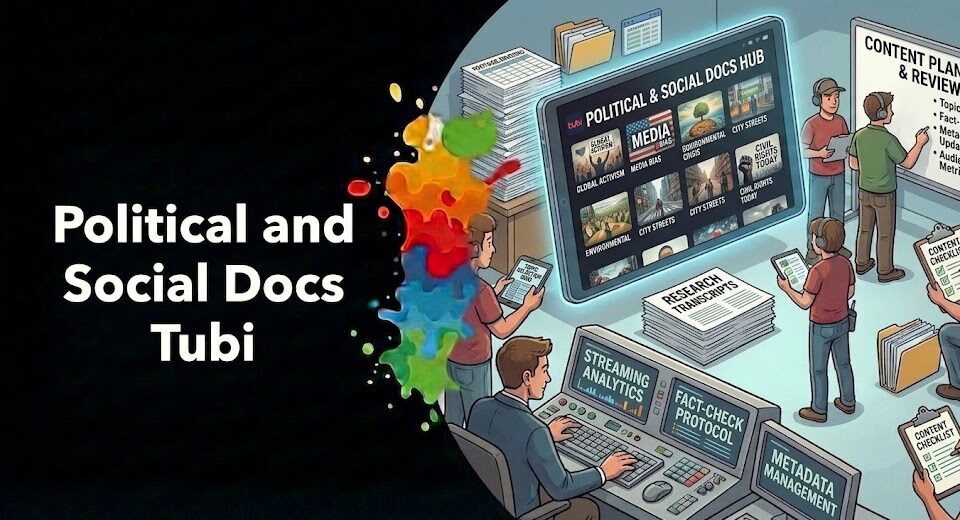
The best political and social justice documentaries streaming free on Tubi don’t just document history. They disrupt the assumptions you carry into the room—about criminal justice, surveillance, media power, gender, and who the system was actually designed to serve. That’s a harder brief than it sounds, and most political docs fail it completely.
Most political documentaries preach to the converted. The genuinely challenging ones—the films that have generated congressional testimony, corporate policy reversals, and lasting shifts in public discourse—do something structurally different. They build their arguments on evidence you can trace, sources who went on record knowing the consequences, and intellectual frameworks rigorous enough to withstand hostile scrutiny. That’s what separates a real political documentary from two hours of confirmation bias.
Tubi—Fox Corporation’s free ad-supported streaming service with over 78 million monthly active users—carries a rotating catalog of political and social justice content that reaches audiences who’d never pay a premium subscription fee for this material. That access asymmetry matters enormously in the political documentary space. And it’s exactly why these films’ cultural impact has continued long past their theatrical premieres. As with any AVOD platform, catalog availability shifts as licensing agreements expire—always verify current listings on Tubi directly before you sit down to watch.
In This Guide
Ask VIQI What Political Docs Are Being Acquired Right Now
VIQI is Vitrina’s AI research assistant—it searches 400,000+ projects and 140,000+ companies across the global entertainment supply chain to answer your specific questions about documentary acquisition, distribution deals, and what’s moving on platforms like Tubi. Trusted by teams at Netflix, Warner Bros, and Paramount.
What Makes a Political Documentary Genuinely Challenging—Not Just Validating
Here’s the uncomfortable truth about political documentary as a genre: most of it fails on its own terms. Films that position themselves as exposés of power rarely hold power to any standard they couldn’t clear themselves. They rely on anonymous sources when named sources would have been more credible. They present selective data as comprehensive analysis. They reach the conclusion in the trailer.
The films ranked here clear a different bar. Each one demonstrates at least two of three critical qualities:
- Structural argument over emotional manipulation — The film makes a case with traceable evidence, not just affecting images of suffering. You can disagree with its conclusion only if you engage with the underlying data.
- Sources with genuine skin in the game — Experts, whistleblowers, and witnesses who went on record knowing full well what that disclosure would cost them. Anonymous sources are a credibility floor, not a ceiling.
- Documented real-world consequences — The film produced something verifiable beyond audience approval: legislation, corporate policy changes, institutional reform, or sustained shifts in public discourse you can trace.
Apply this filter and the list gets short fast. That’s the honest reality of the political documentary genre—and it’s exactly what makes the films that pass the test worth your time. Understanding how this content finds its way to free platforms like Tubi is part of a broader story about how documentary content moves through the entertainment supply chain—a market dynamic that’s accelerated significantly since 2020.
13th (2016) — Ava DuVernay’s Constitutional Case Against Mass Incarceration
13th, directed by Ava DuVernay, opens with a single statistic: the United States holds 5% of the world’s population but 25% of the world’s prisoners. Then it spends 100 minutes explaining exactly how that happened—using the exception clause in the 13th Amendment that permitted slavery as criminal punishment, and tracing its legal and political exploitation across 150 years of American history.
The sourcing is exceptional. Named scholars, former congressional officials, civil rights attorneys, ACLU leadership, and—unusually for this genre—conservative policy voices who reached similar conclusions from different starting points. Newt Gingrich appears on camera. So does Bryan Stevenson, founder of the Equal Justice Initiative, and scholars including Angela Davis and Michelle Alexander, whose book The New Jim Crow provides much of the intellectual architecture DuVernay’s argument builds on.
The film received an Academy Award nomination for Best Documentary Feature and premiered on Netflix in October 2016—but its distribution story didn’t stop there. DuVernay and Netflix made 13th temporarily free to stream on YouTube in 2020, generating millions of additional views during a period of intense national focus on criminal justice. That decision—to bypass paywall entirely during a moment of maximum cultural relevance—is a distribution case study that the documentary industry still references. And it’s exactly the kind of content economics that informs how Tubi and other AVOD platforms compete for social justice documentary licensing.
I Am Not Your Negro (2016) — James Baldwin’s Unfinished America
Directed by Haitian filmmaker Raoul Peck and narrated by Samuel L. Jackson, I Am Not Your Negro builds its argument almost entirely from James Baldwin’s unfinished 1979 manuscript—a meditation on the deaths of Medgar Evers, Malcolm X, and Martin Luther King Jr. and what their murders said about American democracy. Not about civil rights as distant history. About the psychological and political infrastructure of racial violence that Baldwin identified in 1979 and Peck argues is structurally unchanged.
What makes it remarkable is the formal restraint. No talking heads. No archival interview narration from well-meaning academics. Just Baldwin’s prose—cut against contemporary footage that Peck selects with devastating precision—forcing you to reconcile what Baldwin wrote 47 years ago against what you can see on your phone today.
It was nominated for an Academy Award for Best Documentary Feature in 2017. It won the BAFTA for Best Documentary. Magnolia Pictures distributed it theatrically—generating $1.5 million at the US box office on a film with no commercial stars and a runtime built around a 40-year-old manuscript. That kind of theatrical performance for a political documentary is nearly unprecedented, and it’s what drove subsequent AVOD licensing interest that has kept this film in continuous free-platform circulation for nearly a decade.
Track Documentary Licensing Deals Across Every Major Platform
Vitrina tracks 400,000+ projects and 140,000+ companies—including acquisition teams, distributors, and licensors at Tubi, Pluto TV, Peacock, and beyond. Start with 200 free credits. No credit card required.
Citizenfour (2014) — The Documentary Where History Was Happening in Real Time
Citizenfour presents a structural problem for any ranking methodology. Directed by Laura Poitras, it isn’t really a documentary in the traditional sense—she didn’t reconstruct historical events. She was in the room at the Mira Hotel in Hong Kong in June 2013 when Edward Snowden handed over documents proving the NSA was conducting mass surveillance on American citizens and essentially every major global leader. The camera was running. The history was happening.
The film won the Academy Award for Best Documentary Feature in 2015. But its actual weight in the political documentary canon comes from what it documented—not Snowden’s decisions, which you can argue from multiple political positions—but the institutional architecture of a surveillance state that existed without public knowledge or democratic authorization. That’s a structural argument that doesn’t require you to be sympathetic to Snowden personally. The evidence is in the documents he provided, which were subsequently verified by independent journalists at The Guardian and The Washington Post—two publications that won Pulitzer Prizes for that reporting.
Poitras, Glenn Greenwald, and journalist Ewen MacAskill all appear on camera with full identification. No anonymous sources. No reconstructed conversations. As reported by Deadline and other outlets covering its long-form distribution lifecycle, Citizenfour has maintained continuous licensing activity on AVOD platforms across multiple catalog cycles—exactly the kind of sustained market performance that makes political documentary a viable content vertical for free streamers.
Miss Representation (2011) — The Media Argument That Got More Relevant, Not Less
Directed by Jennifer Siebel Newsom and premiered at the 2011 Sundance Film Festival, Miss Representation investigates how mainstream media’s representation of women—in news, entertainment, advertising, and political coverage—systematically undermines women’s access to leadership positions. The argument isn’t moral. It’s causal: specific content patterns correlate with specific political and professional outcomes for women and girls, and the data is traceable across decades.
The expert sources are unusually strong. Katie Couric, Condoleezza Rice, Rachel Maddow, Geena Davis—who founded the Geena Davis Institute on Gender in Media, an actual research organization with a longitudinal data set—and Gloria Steinem all appear on record. That ideological range across the expert panel is rare in political documentary and is exactly what gives the film durability beyond its initial cultural moment.
But here’s the honest difficulty: Miss Representation was genuinely prescient in 2011. Fifteen years later, much of what it documented has intensified rather than resolved. That’s a strange position for a documentary—to remain culturally urgent precisely because the conditions it identified never actually changed. It’s adopted in educational curricula across the United States and has been in continuous distribution on free streaming platforms since its theatrical run. That institutional staying power is a signal worth paying attention to, both as a viewer and as a distribution professional.
Whose Streets? (2017) — Ferguson From the Inside, Not the Broadcast Truck
Whose Streets?, directed by Sabaah Folayan and Damon Davis, does something specific that most civil rights documentaries don’t: it embeds entirely within the community it’s documenting rather than observing it from an institutional distance. The film covers the Ferguson uprising following the death of Michael Brown in August 2014—but from the perspective of residents, organizers, and activists who were living inside the events, not journalists who arrived with satellite trucks.
That structural choice produces a different kind of evidence. You’re not watching protest footage from broadcast cameras positioned behind police lines. You’re watching community members describe their own reasoning, in their own words, while the events are still unfolding. The result is a primary source document—flawed in the ways that all primary sources are flawed, incomplete in the ways that ground-level perspectives always are—but genuinely irreplaceable as a record of what Ferguson meant from inside Ferguson.
Premiered at the 2017 Sundance Film Festival and acquired by Magnolia Pictures for US distribution. It’s the kind of independent social justice documentary that demonstrates exactly how the Fragmentation Paradox works in practice—theatrical release generates enough press to drive AVOD acquisition interest, which keeps the film in front of audiences years after the credits first rolled. Tracking where titles like this land across distribution windows is what Vitrina’s global documentary trends intelligence maps in detail.
Find Distribution Partners for Social Justice Documentary Projects
VIQI—Vitrina’s AI-powered research assistant—helps documentary filmmakers, producers, and distributors identify acquisition partners, track competitive licensing deals at AVOD platforms, and connect with the right decision-makers. Used by professionals at Netflix, Warner Bros, and leading independent distribution companies worldwide.
Dark Money (2018) — The Citizens United Story Nobody Told the Way This Film Did
Directed by Kimberly Reed, Dark Money investigates the effects of the Supreme Court’s Citizens United decision not in Washington or New York—but in Montana, where the consequences of unlimited, anonymous political spending hit a small-population state with particular force. That geographic specificity is the film’s structural masterstroke.
Abstract arguments about campaign finance law are notoriously difficult to dramatize. Reed solves this by following the money down to individual state legislative races—showing exactly how dark money enters a small-market political ecosystem, which specific incumbents were targeted, and what the documented quid pro quos looked like in practice. John Adams of the Montana Democracy Project provides substantial on-record testimony. So do former elected officials and investigative journalists from the region who spent years tracing the money flows.
The film won the Sundance Film Festival Special Jury Award in 2018 and was co-produced with support from PBS—a distribution infrastructure that positioned it well for extended AVOD licensing. As Variety noted in festival coverage, Dark Money’s state-level focus gave it unusual traction with news organizations covering mid-term election cycles—and that evergreen political relevance is exactly why it continues circulating on free platforms years after its theatrical release.
Why Political Docs Perform Exceptionally Well on Tubi Specifically
Political and social justice documentary is one of the highest-performing content verticals on AVOD platforms—and the economics behind that performance aren’t obvious. Here’s what’s actually driving it.
Completion rates are unusually high. Political documentary viewers who start a film are statistically more likely to finish it than viewers of most other documentary sub-genres. Long viewing sessions directly drive advertising revenue on ad-supported platforms—making political docs genuinely valuable inventory, not just culturally worthy programming.
Licensing costs are manageable. Most of the films on this list have moved past their primary theatrical and SVOD windows. Rights holders are motivated to license them to AVOD platforms at rates that make economic sense for both parties. That’s the content economics story behind why you can watch Academy Award-nominated political documentaries for free—it’s not charity. It’s a mature rights lifecycle doing exactly what it was designed to do.
Cross-demographic appeal generates real volume. Political content that isn’t purely partisan—films like Citizenfour (surveillance state affects both left and right), Dark Money (campaign finance reform has bipartisan support), and 13th (criminal justice reform has attracted conservative backers)—performs across demographic segments that other content categories don’t reach simultaneously. For Tubi’s advertising model, that breadth is commercially significant. Professionals tracking Tubi’s content acquisition strategy can see this dynamic playing out in real-time across Vitrina’s platform—where documentary deal activity consistently shows political content punching above its weight in AVOD licensing negotiations.
Frequently Asked Questions
Are these political documentaries currently free to stream on Tubi?
All films in this guide have been available on Tubi during documented catalog periods. But Tubi’s catalog updates as licensing agreements expire and renew—this is standard AVOD platform behavior, not an anomaly. Always check Tubi directly before you plan a screening. If a title isn’t currently on Tubi, Pluto TV, Plex, and The Roku Channel often carry overlapping political documentary catalogs.
What is the most important political documentary ever made?
By the criteria used in this ranking—structural argument quality, source credibility, and documented real-world consequences—13th (2016, Ava DuVernay) holds the strongest overall case. Its sourcing spans ideological lines, its data is fully traceable, and it directly influenced criminal justice reform conversations at the legislative level. Citizenfour is the most consequential in terms of immediate geopolitical impact—it documented revelations that changed NSA policy and international diplomatic relationships.
Are the best political documentaries streaming free on Tubi biased?
Every documentary has a point of view—anyone who claims otherwise is either naive or being deliberately evasive. The honest question isn’t whether a political documentary has a perspective; it’s whether that perspective is supported by evidence you can independently verify. The films ranked #1 through #3 in this guide—13th, I Am Not Your Negro, and Citizenfour—all build their arguments on traceable sources and documented evidence. You’re entitled to disagree with their conclusions. But you’ll need to engage with the underlying data to do it credibly.
Why does Tubi carry politically sensitive documentaries for free?
Because the content economics work. Political documentaries—especially those past their primary theatrical and SVOD windows—can be licensed at rates that generate positive returns for AVOD platforms through advertising. Completion rates on political documentary are high, which drives long viewing sessions, which drives ad revenue. Tubi is a commercial platform, not a civic institution. It carries political content because political content performs. That said, as an AVOD platform owned by Fox Corporation, catalog decisions are made on commercial grounds rather than ideological curation.
Did 13th change criminal justice policy in any measurable way?
Yes, with appropriate nuance. 13th contributed to an accelerated national conversation about mass incarceration that correlated with specific legislative actions—including the passage of the First Step Act in 2018, a bipartisan criminal justice reform bill that DuVernay’s film is frequently cited in political accounts as having influenced. The film doesn’t take credit for legislation, and crediting any single documentary with policy change oversimplifies political causation. But its role in making mass incarceration data accessible to non-specialist audiences was demonstrably significant.
What is the best social justice documentary for classroom use?
Miss Representation and 13th are the most widely adopted in educational settings, with curriculum materials available for both. Miss Representation’s combination of media literacy framing and gender equity data makes it accessible across age groups and disciplines. 13th’s rigor and bipartisan sourcing makes it appropriate in contexts where political balance is a pedagogical requirement. Both are available on free platforms, which matters enormously for institutional adoption in under-resourced educational environments.
How are social justice documentaries licensed to free streaming platforms like Tubi?
Social justice documentaries follow the same multi-window distribution lifecycle as other content. After theatrical release, rights typically flow through premium SVOD platforms (Netflix, Amazon), then into ad-supported tiers, then into AVOD platforms like Tubi—where licensing fees are lower but audience reach is often substantially broader. Rights holders negotiate territory-by-territory, and deal structures vary depending on whether the film has existing broadcast commitments, prior AVOD exclusivity arrangements, or institutional licensing agreements with educational distributors.
What are the best political documentaries on free streaming platforms besides Tubi?
Pluto TV, Plex, The Roku Channel, and Peacock’s free tier all carry rotating political documentary libraries that overlap with Tubi’s catalog. YouTube’s free tier also hosts documentary content through channel partnerships, including some political films that rights holders have made permanently available without ads. If a title from this guide isn’t on Tubi in a given catalog period, those four platforms are the most reliable alternatives. Kanopy—available free through many public library systems—is worth checking for political documentary titles with institutional distribution agreements.
Conclusion: The Political Docs Worth Your Time Are Already Free
The best political and social justice documentaries streaming free on Tubi aren’t there by accident. They’re there because the content economics of AVOD platforms reward exactly the qualities these films have in abundance—high completion rates, cross-demographic reach, evergreen relevance, and licensing costs that make sense for both rights holders and platforms at this stage of their distribution lifecycle.
But—and this matters—catalog availability shifts. What’s streaming free today may not be there next month. The six films in this guide have demonstrated sustained multi-platform distribution longevity, which is your best signal for current availability. Verify on Tubi directly. Watch what’s there now.
And if you’re tracking this content professionally—understanding which political and social justice documentary titles are being acquired, which platforms are licensing them, and what the deal terms look like across distribution windows—that intelligence is what Vitrina was built to surface, across 140,000+ companies and 400,000+ projects in the global entertainment supply chain.
Key Takeaways
- 13th and Citizenfour are the strongest films on this list by the criteria that actually matter—structural argument quality, source credibility, and documented real-world consequences.
- Political docs perform commercially on AVOD platforms because completion rates are high, cross-demographic reach is broad, and licensing costs are manageable at mature distribution stages—it’s content economics, not civic charity.
- Catalog availability shifts constantly on Tubi and other free platforms—always verify current listings directly before planning a screening.
- The best political documentary you can watch is the one that forces you to engage with evidence rather than simply validate what you already believe—apply that filter before pressing play on anything in this genre.
- For industry professionals, political and social justice documentary is one of the most reliably licensed AVOD verticals—evergreen relevance and high viewer engagement make it commercially predictable content for free streaming platforms.
De-Risk Your Documentary Distribution Strategy With Real Data
Vitrina tracks documentary acquisition deals, AVOD licensing activity, and distribution partner intelligence across 140,000+ companies and 400,000+ projects. Trusted by teams at Netflix, Warner Bros, and Paramount. Start with 200 free credits—no credit card required.
✔ 200 free credits | ✔ No credit card required | ✔ Full platform access
Find Film+TV Projects, Partners, and Deals – Fast.
VIQI matches you with the right financiers, producers, streamers, and buyers – globally.
Producers Seeking Financing & Partnerships?
Book Your Free Concierge Outreach Consultation
(To know more about Vitrina Concierge Outreach Solutions click here)
Join Industry Briefings Trusted by Leaders
The Mid-Budget Comeback: Why Mid-Budget Films Is the Smartest Bet in the Room
Mid-budget films are attracting new capital. See why this segment is becoming one of the strongest bets in Film today.
Franchise Fatigue vs. IP Dependency: What Studios Should Be Betting On Now
s franchise performance softens, where will the next generation of valuable IP come from? Join the briefing.
Unscripted Is Eating the World: The Multi-Billion Reality and Format Boom
Unscripted is the new prestige — inside the $19.8B global format boom reshaping how streaming platforms compete.
How Co-Productions and Regional IP Are Reshaping Global Drama
As global drama evolves, which stories travel, which stay local, and how are they getting financed?