About Innovation Hub
 Global Content Pulse (Webinars)


 Global Production Financing
(Webinars)
Global Production Financing
(Webinars)  LeaderSpeak Podcast
  Global Entertainment Digest (Newsletter)
  About Vitrina
 About VIQI
 Our Story
 Our Solutions 🔥
 Film+TV Projects Tracker 🚀
 Case Studies
 Our Profile
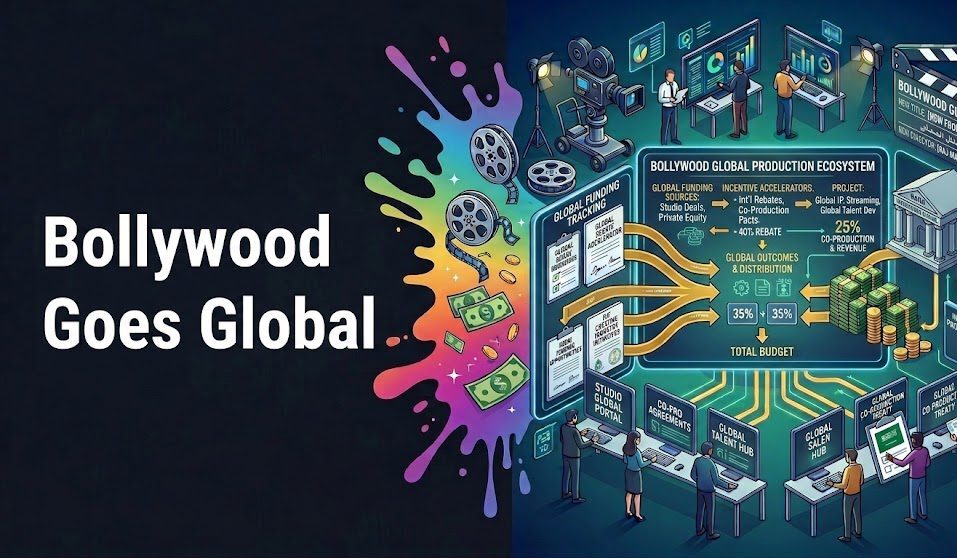
Here’s a number that should stop you mid-scroll: only 3% of Indian films are official international co-productions. For the world’s largest film industry by output — a market generating thousands of titles annually across Hindi, Tamil, Telugu, Malayalam, and a dozen other language verticals — that co-production rate is the lowest among any major producing nation. Compare it to Belgium at 72%. Or Canada, running 60+ official co-productions a year at a combined value of $500M CAD. The gap is staggering.
But that gap is exactly why Bollywood international co-production is the most underpriced deal flow in global entertainment right now. India upgraded its federal cash rebate to 40% in 2024.
The NFDC (National Film Development Corporation) has bilateral Audio-Visual Co-Production Agreements active with the UK, Canada, Australia, Italy, Germany, Brazil, China, and a growing list of others. Netflix is building a creative technology hub in Hyderabad. And studios from Mumbai to Chennai are actively — not passively — seeking international financing partners for the first time in the industry’s modern history.
The question isn’t whether India is a serious co-production destination. It is. The question is whether you know how to structure the deal correctly — because the mechanics here are genuinely different from a UK-Canada or France-Australia bilateral, and the mistakes that catch producers off guard are avoidable if you go in with the right intelligence.
This guide covers everything you need: how India’s incentive stack actually works in 2026, which treaty routes give you the most capital efficiency, how to navigate the Fragmentation Paradox™ in a market with hundreds of competing production entities, and what the deal structures that are actually closing look like.
Table of Contents
- Why India? Why Now? The 2026 Case for Bollywood Co-Production
- India’s Incentive Stack: The 40% Rebate and What It Actually Covers
- The Treaty Routes: NFDC Bilateral Agreements and How to Use Them
- How Deals Are Actually Structured: Capital Stack Mechanics
- Beyond Bollywood: Regional Cinema and the South Indian Opportunity
- The Streaming Layer: Netflix, Hotstar, and How Platforms Change the Financing Equation
- Five Mistakes International Producers Make in India Co-Productions
- How to Find and Vet Indian Co-Production Partners at Scale
- FAQ
- Conclusion
Ask VIQI: Which Indian Production Companies Are Actively Seeking International Co-Producers in 2026?
VIQI is Vitrina’s AI assistant — trained on 1.6 million titles, 360,000 companies, and 5 million entertainment professionals. Get the partner intelligence that doesn’t exist in any trade directory.
✓ Included with 200 free credits | ✓ No credit card needed
Why India? Why Now? The 2026 Case for Bollywood Co-Production
Let’s be honest about what’s changed — because “India is a big market” has been true for decades and hasn’t historically translated into significant international co-production activity. What’s different in 2026 is the combination of structural factors that are converging simultaneously.
First, the incentive is real and it’s competitive. India’s federal cash rebate landed at 40% of qualifying expenditure in 2024 — upgraded from 30% — with a cap of $3.6M per project and an additional 5% uplift for productions with significant Indian content. Cover features, documentaries, VFX work, and animation under a single framework. That’s genuinely attractive math for any project that can anchor production spend in India.
Second — and this is the piece most Western producers still miss — India’s infrastructure is no longer just cost-competitive. It’s capability-competitive. Mumbai, Hyderabad, and Chennai now host production facilities running at international technical standards. Red Chillies VFX (Shah Rukh Khan’s studio) and Prime Focus handle Marvel-level visual effects work from Indian soil. The Hyderabad Film City complex covers over 2,000 acres. You’re not talking about a location that services your project cheaply — you’re talking about a production ecosystem that can own significant creative and technical responsibility.
Third: Indian IP is traveling internationally in ways it simply didn’t five years ago. RRR grossed over $130M worldwide and won an Oscar. Pathaan broke records across the Gulf, UK, and North America diaspora markets. South Indian tentpoles routinely outperform Hindi releases in APAC theatrical markets. The global appetite for Indian stories — not just Indian-diaspora stories, but genuinely Indian-rooted narratives — is no longer a hypothesis. It’s a data point with box office behind it.
And finally: Indian studios want international partners now in a way they didn’t before. The post-COVID financing crunch — what Phil Hunt (Founder & CEO, Head Gear Films) accurately calls the “big crunch” in production financing — has made sophisticated Indian producers recognize the structural advantages of official co-production treaties. Access to multiple capital pools, shared risk, and diversified recoupment aren’t abstract benefits anymore. They’re competitive necessities.

Your AI Assistant, Agent, and Analyst for the Business of Entertainment
VIQI AI helps you plan content acquisitions, raise production financing, and find and connect with the right partners worldwide.
- Find active co-producers and financiers for scripted projects
- Find equity and gap financing companies in North America
- Find top film financiers in Europe
- Find production houses that can co-produce or finance unscripted series
- I am looking for production partners for a YA drama set in Brazil
- I am looking for producers with proven track record in mid-budget features
- I am looking for Turkish distributors with successful international sales
- I am looking for OTT platforms actively acquiring finished series for the LATAM region
- I am seeking localization companies offer subtitling services in multiple Asian languages
- I am seeking partners in animation production for children's content
- I am seeking USA based post-production companies with sound facilities
- I am seeking VFX partners to composite background images and AI generated content
- Show me recent drama projects available for pre-buy
- Show me Japanese Anime Distributors
- Show me true-crime buyers from Asia
- Show me documentary pre-buyers
- List the top commissioners at the BBC
- List the post-production and VFX decision-makers at Netflix
- List the development leaders at Sony Pictures
- List the scripted programming heads at HBO
- Who is backing animation projects in Europe right now
- Who is Netflix’s top production partners for Sports Docs
- Who is Commissioning factual content in the NORDICS
- Who is acquiring unscripted formats for the North American market
India’s Incentive Stack: The 40% Rebate and What It Actually Covers
India’s incentive framework has two distinct components — and confusing them is where a lot of international producers make their first structural error. Let’s separate them cleanly.
The Federal Incentive Scheme (NFDC-Administered)
Administered by the NFDC under the Ministry of Information and Broadcasting, the federal incentive covers international productions filming or doing post-production work in India. The headline numbers:
- Base rate: 40% on qualifying Indian expenditure (increased from 30% in 2024)
- Cap: $3.6M per project
- Additional 5% for significant Indian cultural content
- Scope: Features, documentaries, VFX/animation projects, and live-action shoots qualify
- Administered via: NFDC — contact and application through film.india.gov.in
What this means in practical terms: a $10M production with $4M in qualifying Indian spend can recover up to $1.6M in rebate — before you even layer in treaty benefits. That’s a meaningful contribution to your capital stack and often the difference between a project getting greenlit and sitting in development.
But — and this matters — the $3.6M cap means the rebate has diminishing utility at higher budget levels unless your Indian spend is genuinely substantial. For productions above $15M with limited Indian footprint, the incentive arithmetic changes and the treaty structure becomes more important than the rebate alone. Our detailed breakdown of India’s new film incentive program covers the qualifying expenditure categories in full.
Stacking India’s Incentive with Partner Territory Benefits
Here’s where the real EBITDA leverage lives. Under an official bilateral co-production treaty, your project qualifies as a national film in both countries simultaneously — meaning you can access India’s 40% alongside your co-producing country’s incentives. A UK-India co-production accessing the UK’s Audio-Visual Expenditure Credit (AVEC) at 25.5% plus India’s 40% on the Indian spend portion creates a combined soft money position that can cover 60-80% of total budget across the two jurisdictions, depending on spend allocation.
That’s not padding your capital stack. That’s structurally de-risking it — which is exactly what sophisticated international lenders like Head Gear Films and Peachtree Media Advisors are looking for when they assess gap financing eligibility. For more on how to stack incentives across two jurisdictions effectively, the mechanics are consistent regardless of which specific territories you’re working across.
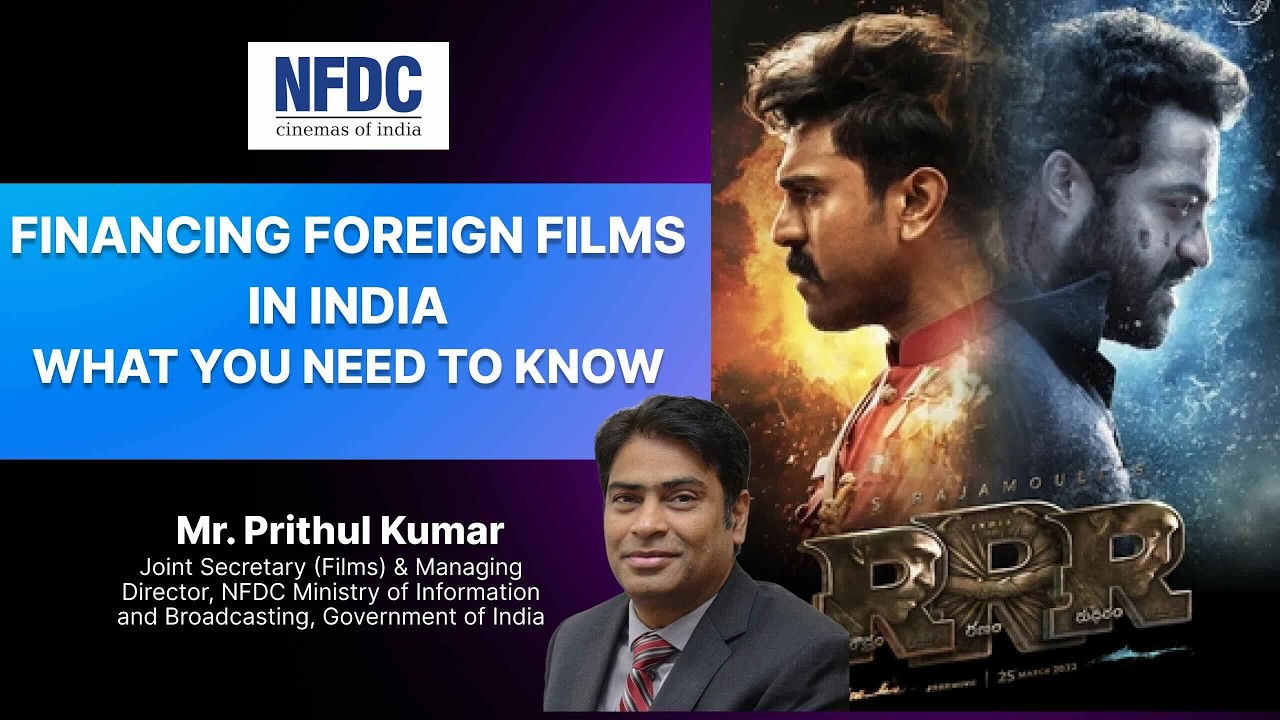
Prithul Kumar (Joint Secretary, Films & Managing Director, NFDC) breaks down India’s official incentive scheme and bilateral Audio-Visual Co-Production Agreements in detail — including live shoots, animation, VFX services, and how official co-production applications work in practice:
The Treaty Routes: NFDC Bilateral Agreements and How to Use Them
India has bilateral Audio-Visual Co-Production Agreements with a meaningful and growing list of territories — including the UK, Canada, Australia, Italy, Germany, Brazil, and China. The NFDC acts as India’s competent authority for all official co-production applications, mirroring the role that Telefilm Canada plays for Canadian bilateral treaties, or the BFI Certification Unit for the UK.
But how you use these treaties — and which one you select for a given project — requires strategic judgment, not just administrative compliance.
The Canada-India Treaty: The Most Capital-Efficient Route
Canada’s bilateral treaty network (60+ countries) includes India — and for most internationally-structured Bollywood co-productions, the Canada-India bilateral delivers the most advantageous combined capital position. Why? Because Canadian federal and provincial incentives stack independently. A project accessing Ontario and federal programs alongside India’s 40% can build a genuinely exceptional soft money position. Canada administers these through Telefilm Canada, and they’re experienced in the process.
The treaty requirements follow standard bilateral rules: minimum 10% financial contribution from each country’s producers, maximum 90% from the majority co-producer. Creative and technical contribution must be proportional to financial stake. And you need to apply to both competent authorities — NFDC and Telefilm — at least 4 weeks before principal photography begins. Start that conversation during development, not pre-production. The producers who run into timeline problems aren’t the ones who got rejected — they’re the ones who applied late.
The UK-India Treaty: The Creative Co-Production Route
The UK-India bilateral is the most active in terms of actual production output — driven partly by the large British-Indian diaspora market and partly by the established business relationships between UK sales companies and Indian studios. If your project has natural creative and talent roots in both territories, the UK-India treaty is likely your cleanest structural fit.
The BFI administers UK certification. Official UK-India co-productions automatically pass the UK cultural test — which eliminates one of the more time-consuming elements of the standard AVEC application process. That alone can save weeks in your financing timeline, and it makes the UK-India bilateral particularly attractive for projects where the cultural authenticity question is already solved by the story itself.
What If There’s No Treaty? The Production Service Agreement Alternative
For US producers — who notoriously lack a co-production treaty network (the US has none) — the route into India is through an unofficial co-production structured as a Production Service Agreement (PSA). You don’t get automatic national status in both countries, and you’re limited to India’s incentives only (no US-side treaty benefits). But you do get full flexibility on production structure, no minimum/maximum contribution percentages, and access to India’s 40% rebate on your qualifying Indian spend.
For major streamers — Netflix, Amazon, Apple — the PSA model is actually the more common structure because it doesn’t require them to navigate the official co-production requirements that constrain creative control. That’s a trade-off, not a failing. Know which route your project and financing structure actually needs.
Map India’s Production Ecosystem — Before Your Competitors Do
Trusted by Netflix, Warner Bros, and Paramount. Join 140,000+ companies using Vitrina to track the global entertainment supply chain — including every active Indian production entity, studio, and NFDC-registered co-producer.
✓ 200 free credits | ✓ No credit card required | ✓ Full platform access
How Deals Are Actually Structured: Capital Stack Mechanics
Understanding the incentive framework and the treaty routes is step one. But how do the deals that are actually closing in 2026 look from a capital stack perspective? Let’s be specific.
A well-structured Bollywood international co-production typically assembles capital from four layers simultaneously. The soft money layer — incentives from both treaty countries — provides the foundation. On a $12M production with roughly equal spend split between India and the UK, you’re looking at ~$1.6M from the Indian rebate plus ~$1.5M from UK AVEC = approximately $3.1M in confirmed soft money before you approach a single lender or equity investor. That’s over 25% of budget covered in non-returnable incentive capital.
Layer two is pre-sales. Indian content — particularly genre titles with recognized cast — has genuine pre-sale value in the Gulf, UK, Canada, Australia, Singapore, and Southeast Asia. A project with A-list Bollywood cast attached can generate territory pre-sales covering 15-25% of budget in unsold rights before production starts. These pre-sales become the collateral base for gap financing — which is precisely the structured lending approach that firms like Head Gear Films use across their 35-40 films per year.
Layer three is equity. Indian studio equity and international co-producer equity — proportional to creative contribution under treaty requirements. The financial contribution minimums (10% from each side) and maximums (90% from majority co-producer) define the structural constraints here. In practice, most healthy co-productions aim for a 60/40 or 70/30 split that reflects genuine creative partnership rather than a majority producer simply papering a minority co-producer to access incentives.
Layer four — the gap — is what closes whatever remains. And this is where the international co-production structure creates a genuine lender advantage over a purely domestic Indian production: the verified incentive position from two countries, combined with multi-territory pre-sales, gives a gap lender a more robust collateral package than most single-territory independent films can offer. For producers asking whether India’s regulatory complexity is worth it — this is where the math answers the question.
As Screen International has reported, the number of formal India-Europe co-production partnerships has increased meaningfully since 2022, driven precisely by this capital efficiency argument rather than purely creative motivations.
Beyond Bollywood: Regional Cinema and the South Indian Opportunity
Stop thinking about Indian co-production as a single market. It isn’t. And this is where most international producers operating on outdated intelligence make their most consequential structural mistake.
India’s film industry runs across multiple distinct language markets — Hindi (Bollywood), Tamil (Kollywood), Telugu (Tollywood), Malayalam (Mollywood), Kannada, Bengali, Marathi — each with its own production ecosystem, star system, audience base, financing norms, and international distribution potential. And as of 2026, the South Indian markets — particularly Telugu and Tamil — are outperforming Hindi Bollywood on international box office metrics per-film.
RRR (Telugu, SS Rajamouli) grossed over $130M worldwide. The KGF franchise (Kannada) crossed $100M globally in its second chapter. These aren’t outliers feeding a Bollywood pipeline. They’re signals that South Indian cinema has achieved genuine international theatrical viability — and the productions behind them are actively looking for international partners to help finance the next tier of global-scale ambitions.
The key practical implication: your co-production partner search should not default to Mumbai. If your story has natural cultural alignment with South India — or if you’re specifically targeting the pan-Asian theatrical circuit where Tamil and Telugu films over-index — you need to be looking at production houses in Hyderabad, Chennai, and Bengaluru. Naveen Chandra, CEO of 91 Film Studios, has spoken extensively about the business dynamics of India’s regional cinema markets and the scale of international opportunity that most Western producers are systematically missing by staying anchored in their Bollywood frame of reference.
Our guide to India’s regional film markets maps the specific production landscape in each language vertical — including which markets have the most active international co-production interest and where the infrastructure is most developed for foreign partnerships.
The Streaming Layer: Netflix, Hotstar, and How Platforms Change the Financing Equation
You can’t discuss Bollywood international co-production in 2026 without addressing how the streaming platforms have restructured the distribution landscape — and therefore the financing logic that hangs beneath it.
Netflix has made its India commitment structural, not episodic. The new creative technology hub in Hyderabad isn’t a marketing gesture — it’s an infrastructure investment that signals Netflix is treating India as a production origin market, not just a content acquisition territory. Netflix’s Indian originals — from Sacred Games to the Singham Returns theatrical-to-streaming pipeline — have demonstrated that Indian content can travel globally on a streaming platform with the right distribution muscle behind it.
Hotstar (now Disney+ Hotstar in most markets, with Disney’s recent JV restructuring in India under Reliance) remains the dominant local streaming platform — and its content acquisition strategy has a direct impact on what theatrical productions can command in OTT rights licensing post-theatrical. A confirmed Hotstar deal materially affects your recoupment waterfall, and sophisticated Indian co-producers know how to use that licensing value as leverage in pre-production financing conversations.
But here’s the financing reality that streaming investment hasn’t changed: platform deals are not pre-sales in the traditional structural sense. A Netflix commission or a confirmed Hotstar OTT deal doesn’t typically provide the same gap financing collateral as a territory minimum guarantee from a theatrical distributor. The lenders who understand the difference — and who can structure around the nuances of platform licensing vs. theatrical distribution rights in the Indian market — are the ones worth working with early. For more on how international co-production strategies mitigate risk and maximize value, the platform financing variable is addressed in detail.
As Variety has tracked, Netflix’s expanding India investment — combined with Amazon Prime Video’s deep content pipeline in the market — has created competitive upward pressure on content rights values that benefits Indian co-production projects seeking pre-sales across OTT territories. That competition is your leverage if you know how to Weaponize it.
Five Mistakes International Producers Make in India Co-Productions
This is the insider candor section. These are the patterns that show up repeatedly when co-production deals in India stall, underperform, or close but underdeliver on their financing potential.
Mistake 1: Treating India as a single production market. Telugu and Tamil cinema are not Bollywood. They have different stars, different distribution circuits, different international reach, and increasingly different financing ecosystems. Approaching every India co-production through a Mumbai frame of reference is like treating France and Germany as the same European production market. They’re not.
Mistake 2: Applying for treaty certification too late. The NFDC and partner-country competent authorities require application at least 4 weeks before principal photography. That’s the minimum — not the target. Projects with any structural complexity (multi-territory spend, animation components, VFX-heavy post) should be in conversation with NFDC during development, not pre-production. The producers who get this wrong aren’t rejected — they delay, and delay in production financing is expensive.
Mistake 3: Confusing co-production minority contribution with a production services deal. A 10% minority co-production stake under a bilateral treaty carries genuine creative responsibilities — personnel from your territory, proportional to financial contribution. You can’t paper a 10% financial contribution with zero creative footprint and expect treaty certification. The competent authorities on both sides check this. Structure it correctly from the outset.
Mistake 4: Underestimating the Fragmentation Paradox™. India has one of the most opaque production ecosystems in global entertainment — thousands of registered production companies, highly variable capability verification, and a relationship network that favors insiders. Without real-time supply chain intelligence, you’re selecting Indian co-production partners from an extremely incomplete information set. That’s not a cultural observation — it’s a data deficit with direct financial consequences.
Mistake 5: Failing to account for currency exposure. Indian Rupee-denominated production costs carry FX risk relative to USD/GBP/EUR-denominated financing. Smart co-production deal structures either hedge this explicitly or allocate spend categories by currency to minimize exposure. It’s a line-producer conversation, but it needs to happen in the term sheet phase — not after you’ve already locked your financing.
How to Find and Vet Indian Co-Production Partners at Scale
And here’s the practical problem sitting underneath everything discussed above. India’s production sector — Hindi, Tamil, Telugu, and beyond — represents hundreds of active production companies across multiple cities, multiple language markets, and multiple capability profiles. Finding the right verified partner for your specific project, budget level, genre, and treaty route isn’t a market visit away. It’s a data problem.
This is the Fragmentation Paradox™ in its most acute form: the market with the most opportunity has the least information transparency. Most international producers approaching India for the first time rely on festival introductions, agent referrals, or trade directory listings — all of which give you an extraordinarily incomplete picture of which production houses are actually active, verified, and currently seeking international co-production partners at your budget level.
Vitrina maps 140,000+ active film and TV companies globally — including the full landscape of Indian production entities across all language markets, with verified hero projects, current deal activity, and capability profiles. You can filter by budget range, genre, territory focus, treaty eligibility, and production phase. Instead of a six-month relationship-building process with an outcome you can’t verify, you get a shortlist of qualified Indian partners matched to your specific brief — within days, not months.
And when you need strategic intelligence beyond partner identification — which NFDC bilateral route makes most sense for your project’s financing structure, which Indian VFX companies can support the post requirements your international distributor expects, which regional language market has the audience profile that best fits your distribution plan — ask VIQI. Our AI assistant pulls from 400,000+ verified project records to answer the questions that no trade directory can.
Find Your India Co-Production Partner — Verified, Filtered, and Brief-Ready
Trusted by Netflix, Warner Bros, Paramount, and Google TV. Track 400,000+ projects. Access 3 million verified executives. Ask VIQI strategic questions about your India co-production brief.
✓ 200 free credits | ✓ No credit card required | ✓ Cancel anytime
Need direct introductions to Indian studios and co-production partners? Explore Concierge Service →
Frequently Asked Questions
What is the current cash rebate rate for filming in India in 2026?
India’s federal incentive scheme offers a 40% cash rebate on qualifying expenditure (increased from 30% in 2024), administered by the NFDC under the Ministry of Information and Broadcasting. The cap is $3.6M per project, with an additional 5% uplift available for productions with significant Indian cultural content. The incentive covers features, documentaries, VFX work, animation projects, and live-action shoots.
Which countries have bilateral co-production treaties with India?
India has official bilateral Audio-Visual Co-Production Agreements with the UK, Canada, Australia, Italy, Germany, Brazil, China, and other territories — all administered through the NFDC. The UK-India and Canada-India bilaterals are the most active routes for Western co-productions. Under these agreements, projects qualify as national films in both countries, granting access to incentives and funding in each territory simultaneously.
What are the minimum financial contribution requirements for an India bilateral co-production?
Standard bilateral treaty requirements apply: a minimum 10% financial contribution from each co-producing country’s producers, with a maximum 90% from the majority co-producer. Financial contribution must be proportional to creative and technical contribution — personnel (directors, cast, crew) from each territory must reflect the financial stake. Applications must be submitted to both competent authorities (NFDC plus the partner country’s authority) at least 4 weeks before principal photography.
What percentage of Indian films are international co-productions?
Only 3% of Indian films are official international co-productions — the lowest rate among any major producing nation globally. For comparison, Belgium co-produces 72% of its films internationally, and Canada runs 60+ official co-productions annually totaling over $500M CAD. This gap represents one of the most significant underexploited opportunities in international film financing in 2026.
Who administers India’s bilateral co-production agreements?
The NFDC (National Film Development Corporation), under India’s Ministry of Information and Broadcasting, is India’s competent authority for all official bilateral Audio-Visual Co-Production Agreements. Prithul Kumar, serving as Joint Secretary (Films) and Managing Director at NFDC, has outlined how international producers can access India’s incentive scheme — covering live shoots, animation, VFX services, and official co-productions under India’s bilateral agreements.
How does a Bollywood co-production capital stack typically look?
A well-structured Bollywood international co-production typically assembles four capital layers: (1) Soft money — incentives from both treaty countries (India’s 40% + partner country’s incentive) covering 20–30% of budget; (2) Pre-sales — territorial MGs from distributors in the Gulf, UK, Canada, Australia, and Southeast Asia covering 15–25%; (3) Equity — proportional contributions from Indian and international co-producers; (4) Gap financing — structured lending against the verified incentive position and unsold territory pre-sales. Combined soft money from two jurisdictions can cover 60–80% of total budget depending on spend allocation.
Can American producers access India’s co-production incentives?
The US has no bilateral co-production treaty network — meaning American producers cannot access the official treaty route that grants national status in both countries. However, US producers can still access India’s 40% federal rebate on qualifying Indian expenditure through an unofficial co-production structured as a Production Service Agreement (PSA). This provides more creative flexibility with no minimum/maximum financial contribution requirements, but limits you to India’s incentives only — no US-side treaty benefits.
Is Bollywood the only Indian cinema market worth pursuing for international co-production?
No — and treating it that way is one of the most common strategic mistakes international producers make. South Indian cinema — particularly Telugu and Tamil — has demonstrated genuine international theatrical viability. Telugu film RRR grossed over $130M worldwide and won an Academy Award. The KGF franchise (Kannada) crossed $100M globally. South Indian production houses in Hyderabad, Chennai, and Bengaluru are actively seeking international co-production partners, and they operate in distinct financing ecosystems from Mumbai’s Bollywood infrastructure.
Conclusion: India’s Co-Production Window Is Open — But You Need the Right Intelligence to Navigate It
The case for Bollywood international co-production in 2026 is structurally stronger than it’s ever been. A 40% federal rebate, bilateral treaties with the UK, Canada, Australia and beyond, world-class production infrastructure in Mumbai, Hyderabad and Chennai, South Indian cinema demonstrating genuine global theatrical pull, and Indian studios actively — not reluctantly — seeking international partners. But the Fragmentation Paradox™ is real: the market’s opacity means producers relying on 2022 intelligence and festival-circuit introductions are making decisions with an incomplete information set.
Key Takeaways:
- The Incentive Gap: Only 3% of Indian films are official co-productions — the lowest rate among major producers globally. The upside potential for producers who structure correctly is enormous.
- 40% Federal Rebate: Upgraded in 2024, capped at $3.6M, with a 5% cultural content uplift — India’s incentive is now genuinely competitive with any major production destination, and it stacks with partner-country incentives under bilateral treaties.
- Treaty Architecture: The UK-India and Canada-India bilaterals are the most active routes. Apply to NFDC at least 4 weeks before principal photography — earlier is always better.
- Beyond Bollywood: South Indian cinema (Telugu, Tamil, Kannada) is delivering international box office results that can no longer be dismissed as regional. Your co-production partner search should span Hyderabad and Chennai, not just Mumbai.
- Partner Intelligence: With hundreds of Indian production entities across multiple language markets, finding the right verified partner requires real-time supply chain data — not a directory or a festival contact list.
Access India’s Production Ecosystem — 140,000+ Companies, Real-Time Intelligence
Trusted by Netflix, Warner Bros, and Paramount. Join 140,000+ companies using Vitrina to navigate the global entertainment supply chain — including every active Indian studio, production house, and NFDC-eligible co-producer across all language markets.
✓ 200 free credits | ✓ No credit card required | ✓ Full platform access
Find Film+TV Projects, Partners, and Deals – Fast.
VIQI matches you with the right financiers, producers, streamers, and buyers – globally.
Producers Seeking Financing & Partnerships?
Book Your Free Concierge Outreach Consultation
(To know more about Vitrina Concierge Outreach Solutions click here)
Join Industry Briefings Trusted by Leaders

The Mid-Budget Comeback: Why Mid-Budget Films Is the Smartest Bet in the Room
Mid-budget films are attracting new capital. See why this segment is becoming one of the strongest bets in Film today.
Franchise Fatigue vs. IP Dependency: What Studios Should Be Betting On Now
s franchise performance softens, where will the next generation of valuable IP come from? Join the briefing.

Unscripted Is Eating the World: The Multi-Billion Reality and Format Boom
Unscripted is the new prestige — inside the $19.8B global format boom reshaping how streaming platforms compete.

How Co-Productions and Regional IP Are Reshaping Global Drama
As global drama evolves, which stories travel, which stay local, and how are they getting financed?