IHUB
IHUB
 Private Briefings (Webinars)


 LeaderSpeak Podcast
  Global Entertainment Digest (Newsletter)
  Premium Lists
 Membership Benefits
 About Vitrina
 Our Story
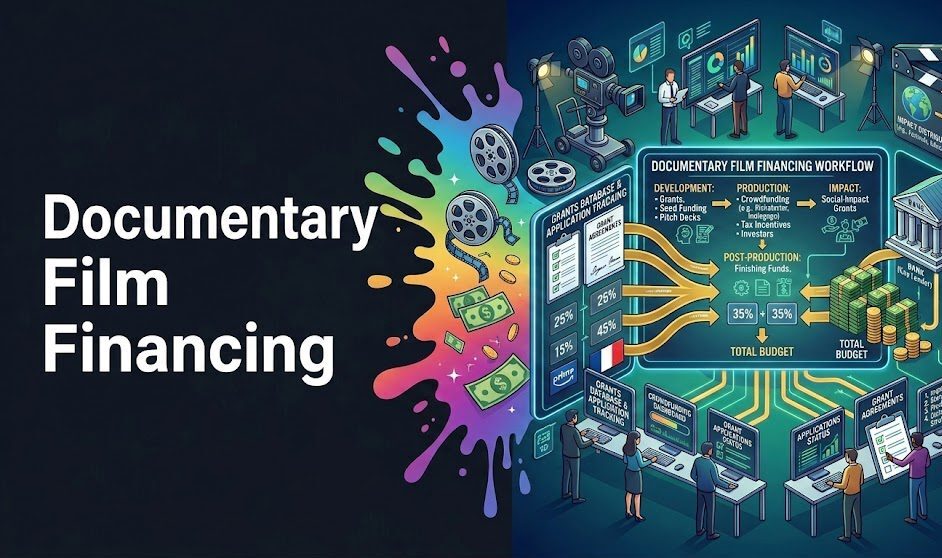
Here’s the uncomfortable truth most documentary film financing guides skip: the capital stack for a doc doesn’t look anything like a narrative feature. There’s no minimum guarantee from a German distributor sitting at the base. No completion bond lender running the waterfall math.
What you’ve got instead is a patchwork—a grant from ITVS here, a broadcaster pre-buy from Channel 4 there, a streaming license from an HBO Max acquisitions exec who takes a meeting if your Sundance screener hits hard enough. Getting it to close requires sequencing, not luck. And the sequence has changed considerably in 2026.
Streaming platforms ate the mid-level theatrical documentary market almost entirely. The upside: Netflix, Apple TV+, HBO Max, and Amazon are all actively buying and commissioning docs at price points that would have been unthinkable a decade ago. The downside: they want global rights, which means the moment you close a streaming deal, your broadcaster pre-sales in Germany, France, and Scandinavia vanish. Threading that needle—getting maximum grant and broadcaster money in place before a streamer takes everything off the table—is now the central strategic challenge of documentary financing. This guide shows you how.
Whether you’re building the capital stack for a $300,000 personal essay film or a $3 million investigative series, the architecture is the same: layer non-repayable money first, anchor with a broadcast commission, and approach streamers only when you’ve de-risked enough of the budget to negotiate from strength—not desperation. Let’s break down each layer in deal-ready detail.
Table of Contents
- Why Documentary Financing Works Differently in 2026
- The Documentary Capital Stack: How the Layers Fit
- Grants: Non-Repayable Funding and What Each Fund Wants
- Broadcaster Commissions and Pre-Buys: The Anchor Layer
- Streaming Deals: What Netflix, HBO Max, and Apple TV+ Actually Buy
- Tax Incentives That Work for Documentaries in 2026
- Equity and Impact Funding: The Two Private-Capital Routes
- Step-by-Step: How to Close a $500K–$3M Documentary Budget
- FAQ
- Conclusion
Ask VIQI: Which Broadcasters and Funds Are Actively Commissioning Docs Right Now?
VIQI is Vitrina’s AI research assistant—trained on 1.6 million titles, 300,000+ companies, and 5 million entertainment professionals. Ask it which documentary funds have open application windows, which streamers are buying your genre, and which broadcaster co-production slots have been announced this quarter.
✓ 200 free credits included | ✓ No credit card required
Why Documentary Financing Works Differently in 2026
The mechanics of narrative feature financing are relatively predictable. You’ve got pre-sales, gap, tax incentives, equity—a stack that’s been pressure-tested over 30 years of independent production cycles. Documentary financing was never that clean. But in 2026, it’s more structurally distinct than ever, and understanding why matters before you touch a single budget line.
Three structural realities define the current documentary market. First, the budget range for commercially viable documentaries has widened dramatically—from $80,000 observational films that win Sundance to $15 million prestige series commissioned directly by Apple TV+. The financing approach for each end of that spectrum shares almost no overlap. Second, non-repayable money (grants, public funds, impact capital) typically represents 20–40% of a documentary budget—a far higher proportion of soft money than narrative features normally access. Third, the rights negotiation is uniquely adversarial between broadcasters (who want linear windows in specific territories) and streamers (who want global SVOD exclusivity). You can rarely satisfy both simultaneously—which means timing your approach to each becomes a critical strategic skill, not an afterthought.
Kirsty Bell, founder and CEO of Goldfinch, which has built one of independent film’s most distinctive financing models, has described the current environment succinctly: the producers who get their films made are the ones who understand that financing is a discipline, not a relationship. What’s changed most in documentary financing specifically is that the relationship-dependent funding universe—the broadcaster who took a lunch meeting and greenlit your idea—has been compressed by institutional scrutiny. Every commissioning editor at every broadcaster is now defending their slate choices against streaming viewership benchmarks. That affects how you need to package and present a documentary project before it ever reaches a pitch.
The capital reality: most commercially viable documentary features today carry total budgets between $500,000 and $4 million. Investigative series and prestige nature documentaries sit higher—$5–15 million for multi-part streaming commissions. A well-structured capital stack for a mid-budget documentary ($1.5–3M) typically looks like: grants and public funds (20–35%), broadcaster pre-buy or commission (25–40%), tax incentive rebate (10–20%), equity or impact investment (10–20%), and a streaming license or acquisition deal filling the remainder—either at development stage or post-production once festival traction is established.
Stop Guessing Who’s Financing. Get Targeted Outreach.
Stop searching and start getting funded. We identify the exact decision-makers currently backing projects like yours, turning raw data into risk-aligned capital partnerships.
Major Studios
Scouting early stage projects, IP, and Regional partners for global studio pipelines.
IP Owners & Leads
Connecting creative leads with qualified financiers and major streaming platforms.
Streamers
Securing high-value pre-buy content and discovering early-stage global IP for platforms.
Indie Producers
Bridging the gap for indie filmmakers to reach executive production partners and capital.
Global Financing Ecosystems
Mapping complex markets and pairing projects with disciplined, risk-aligned capital across global territories worldwide.
The Documentary Capital Stack: How the Layers Fit
Unlike a narrative feature—where debt (gap loan, bank facility) sits at the base of the stack and equity absorbs upside—documentary financing inverts that logic. You build from the top of the risk-adjusted stack down. Non-repayable money first. Broadcaster commissions second. Tax incentives third. Equity and impact capital fourth. Streaming licenses or acquisition deals last—either locking distribution at development stage (for Netflix-commissioned projects) or post-festival (for acquisitions).
Why does sequencing matter? Because each funding layer affects the rights you can offer the next one. Sundance Documentary Fund and ITVS grants typically don’t restrict territorial rights—which means they don’t compete with broadcaster pre-buys or streaming acquisition windows. But a full BBC commission for UK rights creates a holdback that reduces what you can offer a European streaming platform. An Apple TV+ global commission makes the BBC irrelevant—and also eliminates your German ZDF/Arte pre-buy, your French broadcaster advance, and every Scandinavian public broadcaster who might have contributed €40,000 apiece to your co-production. The rights logic cascades. Plan the stack before you approach a single funder.
Here’s a model capital stack for a $2 million investigative documentary:
The critical discipline: build the bottom four rows before approaching streaming platforms. The moment a streamer offers global rights—which most will insist on—your broadcaster pre-sales become structurally difficult or impossible. Close grants and broadcaster money first. Then go to streamers from a position where you’re choosing their distribution deal, not depending on it.
Grants: Non-Repayable Funding and What Each Major Fund Actually Wants
Grant funding is the most misunderstood layer in documentary finance. Producers treat it as a lottery—apply broadly, hope something lands. But the top documentary funds have very specific programming agendas, clear preferences on where projects are in development, and submission cycles that require 12–18 months of planning to sequence properly. Know what each fund is actually buying before you write a word of your application.
ITVS (Independent Television Service) — United States
ITVS is one of the most significant documentary funders in the US, with direct ties to PBS broadcast placement. It operates two core programs: the Open Call for independent documentary features and series, and the International Co-Production Fund for cross-border projects. ITVS grants typically range from $50,000 to $350,000 per project. The critical point: ITVS funding is tied to PBS broadcast rights in the United States—which means it doesn’t compete with UK, European, or streaming rights, making it highly stackable with broadcaster money from Channel 4, Arte, or ZDF. Priority areas include social justice, underrepresented communities, and civic engagement. Application cycles open twice annually.
Sundance Documentary Fund — United States
The Sundance Documentary Fund offers grants at two stages: development ($5,000–$25,000) and production/post-production ($25,000–$100,000). The fund prioritizes films with strong festival ambitions and social impact potential—subject matter around justice, environment, health, and cultural identity consistently performs well in review. Critically, Sundance grants come with no rights attached, which makes them purely additive to your capital stack. Festival exposure through Sundance’s programming adds a separate layer of value well beyond the grant amount itself. Applications open annually in the spring.
Doc Society (BFI Doc Society Fund) — UK / International
Doc Society (formerly BRITDOC) operates the BFI Doc Society Fund in partnership with the British Film Institute, providing £50,000–£150,000 for feature documentaries with strong UK creative involvement. Beyond the BFI fund, Doc Society manages a global network of impact campaigns and distribution partnerships—which means their support often extends well past the check into strategic distribution and audience-building. Priority is given to projects with clear festival strategy and demonstrable social impact ambition. The fund also co-curates with the Sundance Institute, creating an unofficial transatlantic pipeline for projects that qualify for both programs.
Creative Europe MEDIA Programme — European Union
Creative Europe’s MEDIA programme provides development funding for documentary features and series, with individual project grants reaching €25,000–€30,000 at development stage. For co-productions between multiple European producers, production support grants scale higher. The strategic value of Creative Europe for documentary is less about the grant amount and more about what it signals: a MEDIA-supported project carries institutional credibility that meaningfully improves your chances with ZDF/Arte, RTBF, and SVT commissioning editors, who all participate in the MEDIA ecosystem. Projects must involve producers from at least two eligible European countries.
Ford Foundation JustFilms and Open Society Documentary Fund
Impact-oriented grants from foundations like the Ford Foundation (through its JustFilms program) and the Open Society Foundations provide some of the largest single-check grant amounts available for social justice documentaries—individual grants in the range of $100,000–$500,000 for projects that align with their advocacy agendas. These grants are highly competitive and require clear articulation of impact outcomes beyond festival programming. But they’re also among the most rights-neutral funders in the ecosystem—they don’t want distribution windows, they want the film to reach audiences who need to see it. For investigative docs and advocacy-driven projects, these foundations should be in your first outreach wave, not your last.
Find Documentary Commissioners and Co-Production Partners Across 140,000+ Companies
Trusted by Netflix, Warner Bros, Paramount, and Google TV. Track 159,223 active projects, identify which broadcasters are actively commissioning documentaries in your genre, and find verified co-production partners whose credit history and current capacity you can review before the first conversation.
✓ 200 free credits | ✓ No credit card required | ✓ Cancel anytime
Broadcaster Commissions and Pre-Buys: The Anchor Layer of Your Budget
A broadcaster commission or pre-buy is the closest thing documentary financing has to a pre-sale in narrative features—it’s guaranteed, licensed money that doesn’t require your film to perform commercially after delivery. And unlike grants, which can be tiny relative to your budget, a commission from a major broadcaster can represent 25–40% of your total budget in a single deal. That makes broadcaster relationships the highest-ROI financing activity in documentary development.
But here’s what the trades don’t report on documentary broadcaster dynamics: each major commissioning outlet has a completely different programming philosophy, budget range, rights structure, and approach to creative control. Treating them as interchangeable is one of the most common mistakes documentary producers make when building their financing plan. Here’s how the major commissioning outlets actually operate in 2026.
PBS / POV / Frontline — United States
PBS (often through POV, the arts and culture strand, or Frontline for investigative journalism) is the anchor broadcaster for American documentary. PBS licensing fees typically range from $30,000–$150,000 for a feature documentary license, which is lower than European public broadcasters in absolute terms—but the US rights they take are narrow enough to leave most international, streaming, and theatrical windows open. POV’s strand specifically focuses on socially engaged, first-person perspective films with festival pedigree. Frontline commissions investigative series directly with significantly higher budgets—$300,000–$2 million for multi-part investigations. The ITVS relationship creates a natural pipeline: ITVS-funded projects get first consideration for POV broadcast placement.
Channel 4 / More4 — United Kingdom
Channel 4 is one of the most documentary-active broadcasters in the world, with Dispatches (investigative), True Stories, and its 4Doc digital strand all actively commissioning independent documentary work. UK license fees for a feature documentary typically range from £50,000–£200,000—and because Channel 4 is a UK rights-only deal, it stacks cleanly with US (PBS/ITVS), European (Arte, RTBF), and Australian (ABC/SBS) broadcaster money. Channel 4’s commissioning editors are accessible at Sheffield Doc/Fest and IDFA. The key pitch requirement: Channel 4 needs a clear UK angle or significant UK creative involvement. An international story told by a UK filmmaker, or a story with material UK subject relevance, opens the door effectively.
Arte / ZDF — France and Germany
The Arte joint channel (jointly operated by France Télévisions and ZDF) is the prestige documentary broadcaster in continental Europe, and it operates the most active co-production model of any broadcaster in this category. Arte typically licenses for France and Germany simultaneously—territory coverage that can translate into a combined license fee of €80,000–€300,000 for a prestige feature documentary. More importantly, Arte’s co-production model means they’ll sometimes invest at development stage, take an executive producer role, and actively work to attract additional co-production partners from within the European Broadcasting Union network. Getting an Arte commitment early is one of the most powerful credibility signals for the rest of your broadcaster conversations.
Scandinavian Public Broadcasters — SVT, NRK, DR, YLE
The Scandinavian broadcasters—SVT (Sweden), NRK (Norway), DR (Denmark), and YLE (Finland)—are smaller in absolute license fee terms (€25,000–€80,000 each) but are highly significant in documentary financing strategy for two reasons. First, they’re rights-constrained to very small territories, so you can accumulate 3–4 Scandinavian broadcaster deals totaling €150,000+ without losing any material rights window for a UK, US, or streaming deal. Second, they respond strongly to social justice, environmental, and Nordic-adjacent subject matter—and their involvement signals quality to European co-production partners and public funds. The Doc/Fest and IDFA markets are the primary access points.
Find the Financiers Backing Your Genre
Stop searching and start getting funded. We identify the exact decision-makers currently backing projects like yours, turning raw data into risk-aligned capital partnerships.
Streaming Deals: What Netflix, HBO Max, and Apple TV+ Actually Buy
Streaming platforms have become the most visible buyers in documentary—but they’re not all buying the same thing. And understanding what each platform actually acquires versus what it commissions, what it pays, and what rights it demands is the difference between a strategic streaming approach and walking into a negotiation with the wrong project at the wrong time.
Netflix: Global Rights, High Budgets, Full Control
Netflix operates in two documentary modes. The first is direct commissioning—where Netflix funds the entire production at budgets ranging from $500,000 for a single feature to $8–15 million for a prestige multi-part series. In this model, Netflix owns global rights, controls creative to varying degrees, and the producer retains little backend. The second mode is acquisition—buying global streaming rights to finished or nearly-finished films, typically post-festival, at prices ranging from $200,000 to $3 million+ depending on festival performance and subject profile. True crime, celebrity, sports, and investigative subject matter performs strongest. The key reality: if Netflix commissions your film, your broadcaster capital stack becomes moot—they’re paying for everything. If you’re seeking acquisition, build your broadcaster and grant stack first, festival the film hard, then negotiate from proven audience interest.
HBO Max: Premium Investigation and Prestige Documentary
HBO Max has the most defined programming taste of any streaming platform in documentary—it’s the prestige investigative and arts documentary destination. Budget commissions range from $1–8 million per film or series. HBO’s acquisition prices for strong festival films have historically been in the $500,000–$3 million range for global SVOD rights, with theatrical often retained by the producer or handled through a theatrical partner. The critical pitch insight: HBO’s documentary programming has historically been subject-driven first, filmmaker-driven second—a strong access story, a high-stakes investigation, or a genuinely unusual protagonist matters more than festival pedigree alone. Apply to HBO Max through your sales agent—direct unsolicited approaches rarely move at speed.
Apple TV+: Prestige, Long-Form, and Science
Apple TV+ is the most selective documentary buyer of the major streamers, but it also offers the highest per-title budgets for commissioned work—$5–20 million for prestige documentary series. Apple’s documentary slate has leaned heavily toward science, technology, wildlife, culture, and music—reflecting its brand positioning. Acquisition happens, but rarely; Apple prefers commission relationships with established documentary production companies. If your project sits in the prestige, visually ambitious, globally relevant category, Apple is worth pursuing through a development relationship. But don’t build your financing plan around Apple acquisition as a closing mechanism—it’s too low-probability for most independent documentary producers. Track Apple’s current commissioning activity on Vitrina’s Apple TV+ project tracker.
Amazon Prime Video: Broad Range, Acquisition-Focused
Amazon Prime Video acquires more documentary films per year than any other streaming platform—but at lower price points. Acquisition offers for mid-festival docs typically run $75,000–$400,000 for US and global rights. Amazon’s documentary slate is broader and less curated than Netflix or HBO, which creates opportunity for films that don’t fit the prestige narrative but have strong subject-matter audience appeal. The practical implication: Amazon is a realistic closing mechanism for your capital stack in ways that Apple TV+ and Netflix often aren’t. It won’t fund your entire budget, but an Amazon acquisition offer post-festival can genuinely retire equity investor exposure at a reasonable return multiple. Our guide to tracking Amazon MGM Studios projects covers their acquisition patterns in detail.
Tax Incentives That Work for Documentaries in 2026
Documentary producers often assume tax incentives are a narrative feature tool. That’s a costly misconception. Most of the major international production incentives—the UK AVEC, Ireland’s Section 481, Canada’s CPTC, and Australia’s Producer Offset—explicitly qualify documentary content. The budget thresholds are often lower than feature fiction requirements, making them highly accessible for documentary budgets in the $300,000–$3 million range.
Ireland’s Section 481 is the most documentary-friendly major incentive currently operating. Films under €20 million qualify for a 40% total credit (32% base + 8% uplift)—and the minimum budget threshold for documentaries is just €250,000. For a $1.5 million documentary filmed or post-produced in Ireland, the effective rebate approaches $420,000—a meaningful contribution to any capital stack. Ireland has an established documentary production infrastructure in Dublin, and Channel 4’s relationship with independent Irish producers creates a natural broadcaster-incentive combination.
The UK’s AVEC at 25% applies to documentary features and series with UK qualifying expenditure, subject to the cultural test. Documentaries often pass the cultural test more easily than fiction films—UK subject matter, UK creative team, and UK-based production activity all earn cultural test points organically. For a $2 million documentary with £1 million in UK qualifying spend, the AVEC generates approximately £250,000 in cash rebate. Canada’s federal 25% CPTC qualifies documentary content, with provincial stacking available through British Columbia and Ontario. And Australia’s Producer Offset runs at 40% for qualifying feature documentaries—the highest documentary-eligible rate of any major Anglophone incentive program.
The bankability question: can you finance against a documentary tax incentive the way you’d finance a narrative feature rebate? Generally, yes—but lender appetite is narrower for documentary. Lenders like Peachtree Media Partners, which has built its model around advancing against tax incentives and distribution agreements, will look at documentary projects where the incentive is certified and the production timeline is credible. But the rebate loan market for documentary is shallower than for fiction feature, which means your timeline to access the capital during production—rather than post-production—requires earlier certification and stronger lender relationships. Our full guide to tax credits vs. rebates for documentary accounting covers the certification mechanics in detail.
Need Direct Access to Broadcasters, Funders, and Co-Production Partners? Vitrina Concierge Makes the Introduction.
Not a directory. A Virtual Agent that makes warm, verified introductions to the commissioning editors, documentary fund executives, and international co-production partners your project needs—in the window that matters.
- LA producer → Netflix UK Documentary (48 hours)
- UK filmmaker → Arte co-production slot + Sundance Fund intro (week one)
- European studio → HBO Max documentary acquisitions (direct access)
Equity and Impact Funding: The Two Private-Capital Routes
Private capital in documentary takes two distinct forms, and conflating them is a financing plan error that costs producers significant time and money. The first is traditional equity—investors who want a financial return, take a position in the film’s recoupment waterfall, and participate in any upside from festival sales, streaming acquisition, or broadcast licensing. The second is impact investment—capital from foundations, social enterprises, or mission-driven investors who want the film made because of the change it drives, not because of the return it generates. The structures are completely different. The conversations are completely different. The investor personas are completely different.
Traditional Equity for Documentary
Andrea Scarso, Managing Partner of IPR VC—a Helsinki-based fund management company that has been bridging institutional capital and film/TV production for over 12 years—describes the challenge with documentary equity clearly: the revenue timeline is long, the IP value is lower than fiction, and the upside scenario requires a significant streaming or theatrical exit to generate competitive returns. “When you hit a successful IP, the upside can be greater than the overall risk you’re taking on a portfolio,” Scarso notes—but that “hit scenario” depends on the documentary finding a distribution exit that the equity investor’s timeline can accommodate.
IPR VC takes equity positions in projects, not companies, with a portfolio approach that spreads risk across multiple titles—which reduces the pressure any single documentary faces to over-perform. For documentary producers seeking traditional equity, the most realistic institutional investor profiles are: family offices with entertainment interest (where passion for the subject matter supplements return expectations), content-focused equity funds structured like IPR VC, and angel investors with specific subject-matter alignment. Single-project equity raises for documentaries typically target $100,000–$500,000 from a small number of investors at a targeted return of 120–125% of invested capital—the same return expectation structure as narrative feature equity, positioned after all soft money, broadcaster fees, and tax incentives in the recoupment waterfall.
Impact Investment: The Distinctly Documentary Funding Category
Impact investment—sometimes called social investment or mission-driven capital—is the funding category that barely exists in narrative feature financing but can be genuinely transformative in documentary. The basic proposition: foundations, NGOs, and social enterprises whose advocacy agendas align with your film’s subject matter will sometimes provide direct investment—not grants, but structured capital that may be partially or wholly recoupable if the film generates revenue—in exchange for the film being made and distributed to the audiences they’re trying to reach.
The Catapult Film Fund operates in this space, providing development-stage financing for documentaries that demonstrate measurable impact potential. Chicken & Egg Pictures invests specifically in documentary films by women and non-binary filmmakers with social change goals. The Perspective Fund backs films on reproductive rights, voting, and democracy. Each of these funders operates somewhere between grant and equity—they want returns to be possible, but they’re not maximizing financial ROI. For documentary producers whose subject matter aligns, the impact funding ecosystem can realistically contribute $100,000–$400,000 to a production budget with far less competitive pressure than equivalent grant applications. Pair them with non-traditional equity sources for maximum coverage.
Step-by-Step: How to Close a $500K–$3M Documentary Budget in 2026
The strategic concepts above only matter if you can sequence them into a working production timeline. Here’s the step-by-step execution model for closing a mid-budget documentary in the current market—built around the rights sequencing logic that protects your broadcaster and grant money before streaming platforms enter the picture.
Step 1: Identify Your Incentive Jurisdiction and Structure Production Accordingly (Months 1–2)
Before you approach a single funder, decide where you’re going to produce and post-produce the film. This determines which tax incentive program you qualify for—and that decision structurally affects your budget, your qualifying cost base, and the cash flow model you’ll present to equity investors and broadcasters. Ireland’s 40% rate is the aggressive choice for smaller budgets. The UK’s 25% AVEC is the broadest qualifying program for English-language content. Canada’s CPTC stacks well with documentary series that have large below-the-line crew spend. Document your preliminary incentive analysis before you start pitching—funders will ask.
Step 2: Apply to Grant Programs at Development Stage (Months 2–4)
Target 3–5 grant programs with staggered application timelines to maintain pipeline flow without overwhelming your development bandwidth. Priority order: ITVS Open Call (if US subject matter or US creative lead), Sundance Documentary Fund development grant (spring cycle), Doc Society/BFI (if UK involvement present), Creative Europe MEDIA development (if European co-producer attached). At this stage you’re applying on a treatment and development budget—not a finished script or confirmed production plan. Grant decisions typically take 8–16 weeks from application close to notification.
Step 3: Pitch Broadcasters Before Streamers (Months 4–7)
This is the sequence discipline that most documentary producers get wrong. Armed with early grant support (which signals institutional quality) and a refined production plan, approach broadcasters for commission or pre-buy discussions. Target at minimum: your primary market broadcaster (Channel 4 or BBC for UK-led projects; PBS/POV for US-led), one European broadcaster (Arte or a Scandinavian), and an adjacent territory if your subject supports it. The goal at this stage is a commission letter or letter of intent—even a conditional one—that demonstrates broadcaster commitment to the budget and de-risks your approach to equity investors. Don’t approach Netflix, HBO Max, or Apple TV+ yet. A global streaming commitment will shut down your European broadcaster conversations before they start.
Step 4: Close Equity and Impact Capital (Months 6–9)
With grants confirmed and broadcaster commitments in place, you now have a genuine closing story for private capital. Your equity pitch shows: 30–35% of the budget already covered by non-repayable money, a broadcaster anchor generating a defined license fee, a credible tax incentive model reducing production cost by 15–20%, and a streaming acquisition narrative that provides a realistic exit path for equity recoupment. Approach 2–4 equity investors or impact funders whose subject-matter alignment is strong—and target a total equity raise that covers your remaining gap (typically 15–25% of total budget).
Step 5: Approach Streaming Platforms at Production or Post (Months 8–18)
Now—and only now—engage streaming platforms. You have two options depending on your remaining gap. If you have a substantial financing shortfall (20%+) remaining, approach mid-range streamers for pre-buys on specific non-exclusive streaming windows that your broadcaster deals don’t cover. If you’re nearly fully financed, produce the film, festival it aggressively (IDFA, Sheffield Doc/Fest, HotDocs, Tribeca), and approach streamers as acquisition targets post-festival. A strong festival premiere—particularly a world premiere at Sundance, IDFA, or Tribeca—creates genuine competitive streaming interest that improves your acquisition price and negotiating position materially. Our guide to finding documentary distributors covers the acquisition process in detail.
Frequently Asked Questions
How is documentary film financing different from narrative feature financing?
Documentary financing inverts the narrative feature stack in two key ways. First, non-repayable money—grants, public funds, impact investment—represents a much higher proportion of the budget, typically 20–40% versus 5–10% for fiction films. Second, the rights sequencing challenge is more acute: broadcasters (who want territorial linear rights) and streamers (who want global SVOD exclusivity) are directly competing for the same rights windows, which means the order in which you approach each funder is itself a strategic decision with major financial consequences. Documentary financing also involves longer development timelines due to grant application cycles, and lower total budgets on average—making each percentage of soft money proportionally more significant.
Which documentary grants should I apply to first?
Priority order depends on your project’s geography, subject matter, and stage of development. For US-based or US-subject films at development stage, the Sundance Documentary Fund development grant (spring cycle) and ITVS Open Call (twice yearly) are the highest-value starting points. For UK-involved projects, the BFI Doc Society Fund is essential. For European co-productions, Creative Europe MEDIA development support is highly stackable with other funding. Subject-matter-specific foundations—Ford Foundation JustFilms, Open Society Documentary Fund, Catapult Film Fund—should be assessed based on your topic’s alignment with their advocacy agenda. Apply to 3–5 programs in your first cycle, staggering submission timelines to maintain continuous pipeline flow through development.
Does Netflix commission documentaries directly, or only buy finished films?
Both. Netflix commissions documentary features and series directly at budgets ranging from $500,000 for a single feature to $8–15 million for prestige multi-part series—in which case they fund the entire production and own global rights. They also acquire finished or nearly-finished films post-festival, typically for global streaming rights at $200,000–$3 million+ depending on subject profile and festival performance. True crime, celebrity, sports, and investigative content consistently drives the highest acquisition prices. If Netflix commissions your film, your broadcaster stack becomes unnecessary—they’re paying for everything. If you’re targeting acquisition, build grants and broadcaster money first, festival the film, and approach Netflix once you have proven audience interest and festival traction working in your favor.
Can documentaries access the same production tax incentives as fiction films?
Yes—most major production incentives explicitly qualify documentary content. Ireland’s Section 481 offers 40% for films under €20 million with a minimum budget of just €250,000, making it highly accessible for documentary. The UK’s AVEC at 25% applies to documentary features and series with UK qualifying expenditure. Canada’s federal CPTC at 25% qualifies documentaries. Australia’s Producer Offset reaches 40% for qualifying feature documentaries. The key difference from fiction feature incentives is that some lenders are less comfortable advancing rebate loans against documentary productions due to lower perceived IP value. For bankability against your incentive, work with a production accountant who has documentary-specific experience with the program you’re targeting.
Why should I approach broadcasters before streaming platforms?
Because streaming platforms—Netflix, HBO Max, Apple TV+—require global rights, which structurally eliminates your ability to sell territorial broadcast rights to Channel 4, Arte, PBS, and the Scandinavian broadcasters. Those broadcaster deals can collectively represent 30–45% of your total budget in non-repayable license fees. If a global streamer takes everything off the table at development stage, you lose that entire capital layer. By closing broadcaster pre-buys and commissions first, you capture that soft money for your stack, then approach streamers for whatever residual rights remain—or post-festival as a full-rights acquisition once the film has proven audience interest. The only exception is direct streaming commission (where Netflix or Apple funds the entire project)—in which case broadcaster discussions are irrelevant from the start.
What is impact investment in documentary film and how does it differ from grants?
Impact investment is mission-driven capital from foundations, social enterprises, or advocacy-aligned investors whose primary motivation is the social change the film enables—but who structure their contribution as a returnable investment rather than an outright grant. Practically, this means: the money is contributed to your production budget and is recoupable from the film’s revenues, but the investor’s return expectation is modest or secondary to the impact goal. Key players include the Catapult Film Fund, Chicken & Egg Pictures, and the Perspective Fund. Impact investment typically contributes $100,000–$400,000 and comes with fewer competitive hurdles than equivalent grant applications because you’re being selected for subject-matter alignment as much as creative quality. It’s most relevant for films on social justice, environmental, health, and democracy topics.
How much does a Channel 4 documentary commission pay?
Channel 4 documentary license fees for independent productions typically range from £50,000 to £200,000 for a feature documentary, depending on the slot (Dispatches vs. True Stories vs. More4), the production budget, and the creative team’s track record. Channel 4 takes UK linear and digital rights, which leaves all international, co-production, and streaming rights (outside the UK) available for separate deals. This territorial specificity is what makes Channel 4 highly stackable with ITVS, Arte, and Scandinavian broadcaster pre-buys. Channel 4 commissions editors are most accessible at Sheffield Doc/Fest (June) and IDFA (November)—and a warm introduction from a UK-based sales agent or executive producer with an existing Channel 4 relationship significantly improves your chances of moving quickly.
Which festivals matter most for documentary financing and acquisition?
For financing (development-stage access to commissioners, funders, and co-production partners): Sheffield Doc/Fest (June, UK) and IDFA (International Documentary Film Festival Amsterdam, November) are the primary international documentary markets. HotDocs (Toronto, spring) is essential for North American broadcaster and funder relationships. Tribeca and Sundance are important for US acquisition conversations. For post-production acquisition (approaching streamers with a finished film): Sundance world premiere has the highest streaming acquisition conversion rate for documentary; IDFA is the equivalent for European and international acquisitions. A strong world premiere at either festival creates genuine competitive streaming interest that measurably improves acquisition terms versus films that come to market without festival context.
Conclusion: Build From the Bottom Up, Protect Your Rights, and Time Your Streaming Approach
Documentary film financing in 2026 rewards producers who understand the rights architecture before they touch the capital architecture. The money is there—in grants, broadcaster commissions, tax incentives, impact investment, and streaming acquisition. But the sequence in which you access it determines whether you’re building a robust multi-source capital stack or painting yourself into a rights corner that forecloses your best funding options before production starts.
Key Takeaways:
- Sequence Grants First: Non-repayable money from ITVS, Sundance Documentary Fund, Doc Society, Creative Europe, and impact foundations should be your first outreach wave—it carries no rights implications and builds institutional credibility that strengthens every subsequent pitch.
- Anchor with Broadcasters Before Streamers: A Channel 4, PBS, or Arte commission can represent 25–40% of your total budget in guaranteed, non-repayable license fees—but only if you close those deals before a global streamer takes all the rights. Approach broadcasters second, streamers last (or post-festival for acquisitions).
- Tax Incentives Work for Documentary: Ireland’s 40% Section 481, the UK’s 25% AVEC, Canada’s 25% CPTC, and Australia’s 40% Producer Offset all qualify documentary content. Decide your production jurisdiction in month one and build your qualifying spend plan accordingly—it can contribute 15–20% of your total budget in genuine soft money.
- Know Which Streamer Wants What: Netflix buys global rights at high prices for true crime, celebrity, and investigation. HBO Max prioritizes prestige and investigative content. Apple TV+ commissions at premium levels but rarely acquires. Amazon acquires broadly at lower price points and is a realistic closing mechanism for most independent documentary budgets.
- Festival Strategy Is Financing Strategy: A Sundance or IDFA world premiere doesn’t just build audience—it creates genuine competitive streaming acquisition interest that improves your deal terms. Build your production timeline so delivery aligns with a premier festival application window. The festival is not the end of the financing process; it’s the final lever in it.
The documentary producers who close their budgets in 2026 aren’t the ones with the most compelling stories—they’re the ones who understand the rights and capital architecture well enough to sequence their approach correctly. Get the sequence right, and the story does the rest of the work.
Track Documentary Commissioners, Funders, and Co-Production Partners in Real Time
Trusted by Netflix, Warner Bros, Paramount, and Google TV. Access 140,000+ verified entertainment companies and 159,223 active projects—filtered by content type, commissioning status, and territory. Use VIQI to ask which broadcaster strands have open documentary slots right now, which funds have upcoming application windows, and which acquisition executives at streaming platforms are actively buying your genre.
✓ 200 free credits | ✓ No credit card required | ✓ Cancel anytime