IHUB
IHUB
 Private Briefings (Webinars)


 LeaderSpeak Podcast
  Global Entertainment Digest (Newsletter)
  Premium Lists
 Membership Benefits
 About Vitrina
 Our Story
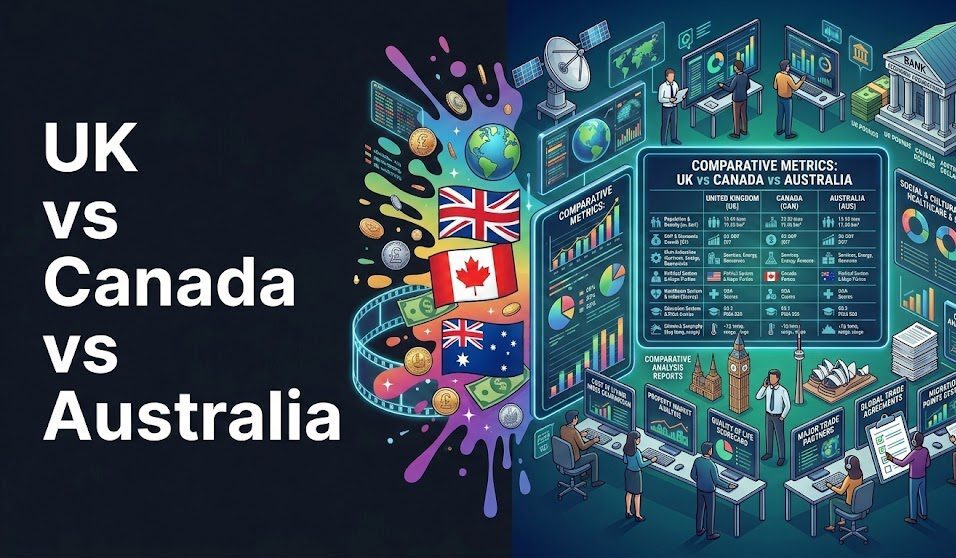
Here’s the trap most producers fall into: they compare headline percentages, pick the biggest number, and call it a location decision. But a UK Canada Australia production incentive comparison isn’t a percentage race—it’s a total economics calculation.
The jurisdiction that returns the most cash on paper may cost you more in practice once you account for crew rates, currency exposure, qualifying cost rules, cultural test friction, and the 6–18 months it takes for that rebate to actually hit your account.
In 2026, all three markets have meaningfully upgraded their programs. The UK pushed its VFX rate to 29.25% and stripped the cap on qualifying costs. Australia doubled its Location Offset from 16.5% to 30% in July 2024—the biggest single incentive jump in that program’s history. Canada continues to offer the most sophisticated provincial stacking structure in the world, with British Columbia, Ontario, and Quebec each running complementary programs on top of the federal 25% baseline. The competition is real. And it’s getting sharper.
This guide cuts through the percentage noise to tell you which market actually wins for your project type—whether you’re running a VFX-heavy action franchise, a mid-budget international drama, a streamer-backed TV series, or a co-production structured to access multiple incentive stacks at once. By the time you’re done reading, you’ll know exactly which jurisdiction to put on page one of your financing plan. And more importantly, you’ll know why.
Table of Contents
- Why This Comparison Matters More in 2026
- The UK: AVEC, the 29.25% VFX Rate, and the Cultural Test Reality
- Canada: The Federal + Provincial Stack That Changes Everything
- Australia: The 30% Location Offset and What Changed in 2024
- Head-to-Head: UK vs Canada vs Australia by Project Type
- The Co-Production Angle: Stacking Incentives Across Borders
- The Total Economics Framework: Beyond the Headline Rate
- 5 Decision Scenarios: Which Market Wins and Why
- FAQ
- Conclusion
Ask VIQI: Which Incentive Program Fits Your Specific Budget and Genre?
VIQI is Vitrina’s AI research assistant—trained on 1.6 million titles, 300,000+ companies, and 5 million entertainment professionals. Ask it which incentive program qualifies for your genre and budget tier, what the real all-in cost looks like after audit timing, and which territories are greenlighting comparable projects right now.
✓ 200 free credits included | ✓ No credit card required
Why This Comparison Matters More in 2026
Three years ago, production incentive decisions were relatively straightforward. You went where your story was set, you added a VFX facility in the most cost-efficient jurisdiction, and your financing plan reflected that. The incentive was a secondary optimization—not the primary decision driver.
That’s changed. Significantly. The post-COVID production squeeze has compressed margins across independent film and TV—and the incentive is no longer an optimization. It’s load-bearing. For most projects in the $5–50 million budget range, the difference between a 25% and a 40% effective incentive rate—when applied to a qualifying spend base of $8–30 million—is the difference between a viable capital stack and a 24-month financing scramble. Those numbers aren’t theoretical. They’re in every finance meeting right now.
Phil Hunt, Founder and CEO of Head Gear Films—which has financed over 550 films and currently processes 35–40 productions per year—describes the current environment plainly: “The whole industry has become much, much harder in terms of getting movies off the ground and getting movies sold.” In that environment, the incentive jurisdiction isn’t just a tax planning question. It’s a greenlight question. And the UK, Canada, and Australia represent three very different answers to it.
What the trades don’t always report: the three markets also offer meaningfully different co-production treaty networks, cultural test structures, and bankability profiles—all of which affect how quickly your incentive can be monetized into production cash. Let’s go market by market.
The UK: AVEC, the 29.25% VFX Rate, and the Cultural Test Reality
The UK’s Audio-Visual Expenditure Credit (AVEC) delivers a 25% cash rebate on qualifying UK production expenditure—but the headline tells only part of the story. As of April 2025, VFX costs attract an enhanced 29.25% rate, and critically, the 80% cap on qualifying VFX expenditures has been removed entirely. For productions with heavy digital work, that cap removal is significant: previously, productions could only claim on 80% of their VFX spend. Now it’s 100%—which on a $10 million VFX budget at a $50 million production adds roughly $425,000 in additional rebate value that simply didn’t exist before.
The government’s commitment is structural, not cyclical. The 40% business rate relief on UK film studios—guaranteed through 2034—signals a decade-long policy commitment to maintaining the UK’s position as the world’s primary English-language production infrastructure hub. Major productions running at Pinewood, Leavesden, and the wider studio ecosystem attracted £4.2 billion ($5.3 billion) in production spend in 2023 alone. Jurassic World 4, Mission: Impossible, and Fantastic Four all based principal photography in the UK—not because of relationships, but because the economics supported it.
The Cultural Test: What It Actually Requires
Here’s where US and international producers sometimes stumble. The UK requires a cultural test—a points-based qualification system administered by the BFI—to access AVEC. You need 18 of 35 available points, earned across four categories: cultural content (subject matter, characters, locations), cultural contribution (UK heritage representation), cultural hub (shooting in the UK, post in the UK), and cultural practitioners (UK cast and crew).
The practical implication: you don’t need to be telling a British story. But you do need to genuinely commit UK resources—crew, facilities, post-production—in a way that makes the point threshold reachable. Productions filing as official UK co-productions automatically pass the cultural test, which is one reason UK co-production treaties are so strategically valuable. With 13 active bilateral treaties covering Australia, Canada, Brazil, India, South Africa, and more, the UK’s treaty network is one of the strongest of the three markets.
Bankability profile: excellent. The AVEC program is well-established, well-administered, and fully bankable at 80–90% of estimated value at major entertainment lenders including those working with Peachtree Media Partners-style structures. Rebate loan availability is robust. Audit-to-payment timelines run 6–12 months post-wrap for well-documented productions. Our full guide on navigating cultural test requirements covers the point-scoring strategy in detail.
UK Strengths and Limitations at a Glance
- Strengths: 29.25% VFX rate with no cap; world-class studio infrastructure; 40% business rate relief to 2034; strong banking relationships; broad co-production treaty network; established AVEC program with proven bankability
- Limitations: Base rate of 25% is lower than Canada’s best provincial stacks; cultural test adds qualification overhead; GBP exchange rate exposure adds currency risk for USD-budgeted productions; crew costs in London are among the highest in the three markets
- Best for: VFX-heavy productions, high-budget studio service work, co-productions structured through UK treaty partners, projects with natural UK creative elements
Canada: The Federal + Provincial Stack That Changes Everything
Canada’s real incentive power isn’t the federal rate—it’s the stacking architecture. No other market in this comparison offers the same ability to combine national-level credits with provincial programs in a way that materially increases effective returns. When producers and CFOs say Canada, they typically mean one of three specific configurations: British Columbia, Ontario, or Quebec.
The federal baseline: the Canadian Film or Video Production Tax Credit (CPTC) at 25% on Canadian labor—refundable nationwide. That’s the floor. What provincial programs do is extend that floor into competitive territory, often dramatically so. British Columbia’s BC Production Services Tax Credit runs at 33% on BC resident labor (35% for officially Canadian content projects), on a minimum budget of C$1 million for features. Ontario’s production credit delivers between 21.5% and 40% depending on project type. Quebec offers 36–40% for services to foreign productions—the highest single rate in the country for qualifying international work. Montreal’s post-production and VFX sector in particular has built a strong competitive position on those Quebec rates.
Find Production Service Companies Qualified for Your Target Incentive
Trusted by Netflix, Warner Bros, Paramount, and Google TV. Track 159,223 active projects and access 140,000+ verified entertainment companies—filtered by jurisdiction, incentive qualification status, and active production capacity.
✓ 200 free credits | ✓ No credit card required | ✓ Cancel anytime
The Warner Bros Signal: What $500M Annually Tells You
Strategic players understand that the best market intelligence doesn’t come from commission websites—it comes from where the largest studios are actually committing capital. Warner Bros has committed $500 million annually to Canadian production, pending confirmation of cap increases. That’s not location loyalty. That’s a financial decision made at CFO level after running the total economics of the stack.
Canada’s treaty network is the broadest of the three markets—over 60 bilateral treaties administered by Telefilm Canada, generating over 60 official co-productions per year totaling C$500 million. The breadth of that network creates flexibility that UK and Australia simply can’t match on volume. If your project involves a French co-producer, a German equity partner, or an Irish broadcaster pre-buy, Canada’s treaty architecture can usually accommodate the structure. Our detailed BC tax credit guide covers the provincial qualification specifics that national-level summaries routinely understate.
Canada’s Cultural Test and Content Requirements
Canada uses a points-based system to determine Canadian content eligibility. But it applies primarily to the highest-rate Canadian-content credits—and is less restrictive for foreign service productions using the production services credit stream. The distinction matters: most US and international productions accessing Canadian incentives do so through the services route, which prioritizes Canadian below-the-line spend rather than editorial control or cultural subject matter. That makes it significantly more accessible for international producers than the UK cultural test at equivalent qualifying rates.
Canada Strengths and Limitations at a Glance
- Strengths: Best provincial stacking potential in the comparison (Federal + BC/Ontario/Quebec effectively delivers highest all-in rates for qualifying labor); 60+ co-production treaties; services route accessible without editorial cultural requirements; Vancouver and Toronto offer deep crew bases
- Limitations: Labor-based credits mean non-resident ATL costs (international stars, directors) don’t qualify for provincial rates; currency risk (CAD vs. USD); not the optimal single-jurisdiction rate for VFX-only work; Quebec requires meaningful in-province activity for best rates
- Best for: TV series with large below-the-line crew, productions with significant VFX houses in Vancouver/Montreal, complex multi-country co-productions leveraging Telefilm treaties, projects where stacking Federal + Provincial generates 35%+ effective rates on labor-heavy budgets
Australia: The 30% Location Offset and What Changed in 2024
Australia made its most aggressive incentive move in years when it doubled the Location Offset—the primary rebate for international productions filming on Australian soil—from 16.5% to 30% in July 2024. That’s not an incremental adjustment. That’s a policy decision to compete directly with established markets, and it’s repositioned Australia from a mid-tier incentive destination to a legitimate first-look option for productions in the right budget range and genre profile.
But the Location Offset is just the starting point. Australia runs a three-tier rebate system that sophisticated producers stack by design. The PDV (Post, Digital, Visual Effects) Offset delivers 30% on qualifying post-production spend—including VFX—and it can be accessed independently by productions that shot elsewhere, making it an option for hybrid structures. And for qualifying Australian productions, the Producer Offset reaches 40% for feature films and 20% for television. The 40% feature rate is the highest single incentive rate of any of the three markets for domestically qualifying content.
The Regional Stack: Where Australia’s Total Economics Get Interesting
Here’s what most international producers miss: Australia’s state-level incentives are genuinely stackable with the federal programs, and several states run meaningful programs. Queensland offers a 15% Production Attraction Incentive on top of the federal Location Offset—putting effective total incentives in Queensland at 45% for qualifying international productions. New South Wales, Victoria, and South Australia all run 10% regional incentives. Gold Coast, Sydney, and Melbourne each have established studio infrastructure—Village Roadshow Studios, Fox Studios Australia, and Docklands respectively—supported by experienced crew bases that have grown substantially through the streamer-era production boom.
The jump from 16.5% to 30% on the Location Offset also changes the bankability math. Higher effective rates create stronger collateral positions against rebate loans—lenders advance 80–90% of certified incentive value, so the absolute cash available during production increases proportionally. For a production spending A$20 million in qualifying Australian costs, the jump represents an additional A$2.7 million in available rebate loan capacity versus pre-2024 rates. That’s not a marginal improvement. It’s a capital stack shift.
Phil Hunt at Head Gear Films notes that productions choosing jurisdictions right now are running much tighter total economics analyses than they were even two years ago: the mix of incentive rate, crew availability, and infrastructure quality all need to stack up simultaneously for a location decision to hold under lender scrutiny. Australia—particularly post-2024—passes that test for a wider category of projects than it did before. The global incentives tracker on Vitrina keeps current rates and qualifying criteria updated as programs evolve.
Australia Strengths and Limitations at a Glance
- Strengths: 30% Location Offset (up from 16.5% in July 2024); 40% Producer Offset for qualifying features; Queensland stack reaches 45%; PDV Offset accessible for post-only work; diverse locations (desert, urban, tropical, coastal); English-language production base
- Limitations: ATL costs (international cast, directors) generally don’t qualify for Location Offset; AUD/USD exposure; smaller crew pool than UK or Canadian centers; fewer bilateral co-production treaties than Canada (though UK and Canada are both covered); longer time zones create coordination complexity for US-based productions
- Best for: Action/adventure productions requiring diverse locations, high-budget features qualifying for the 40% Producer Offset, post-production and VFX work via PDV Offset, productions looking for high stacked rates (Queensland at 45%), Asia-Pacific distribution strategies that benefit from Australian creative involvement
Head-to-Head: UK vs Canada vs Australia by Project Type
The table below shows headline rates—but read the notes column. That’s where the real decision lives.
Phil Hunt (Founder & CEO, Head Gear Films) explains how tighter production economics in 2026 are forcing producers to rethink jurisdiction decisions from first principles—and why the incentive calculus has shifted:
The Co-Production Angle: Stacking Incentives Across Borders
The single biggest incentive optimization opportunity that most independent producers leave on the table isn’t within any one jurisdiction—it’s between them. All three markets have bilateral co-production treaties with each other. UK–Canada, UK–Australia, and Canada–Australia are all active bilateral agreements. And because official co-productions qualify for national film status in both co-producing countries, they can access incentive programs in both territories simultaneously.
What that means in practice: a UK–Australia official co-production can access the UK’s AVEC on UK qualifying expenditure and Australia’s Location Offset (or Producer Offset) on Australian qualifying expenditure—from the same production budget. The combined effective rate on a properly structured co-production, with spend allocated intelligently between both jurisdictions, can reach 55–60% of qualifying costs on the respective portions. That’s not theoretical—it’s how mid-budget English-language co-productions have been built for decades, and the treaty frameworks make it administratively manageable if you begin the application process early.
The requirement: both countries’ competent authorities—the BFI in the UK, Screen Australia in Australia, Telefilm Canada in Canada—must provisionally approve the co-production at least 4 weeks before principal photography. The financial contribution from each country must be proportional to the creative/technical contribution—typically with minimums of 10–20% from the minority co-producer and maximums of 80–90% from the majority. The earlier you structure the co-production agreement, the more flexibility you have in allocating spend between jurisdictions for maximum incentive capture. Our full breakdown on stacking incentives across two jurisdictions covers this in deal-ready detail.
Need Help Structuring Your Incentive Strategy? Vitrina Concierge Connects You Directly.
Vitrina Concierge is your Virtual Agent—making warm introductions to film commissioners, co-production specialists, and financing partners in your target jurisdiction. Not a directory. A direct line.
- LA producer → Netflix UK, Fifth Season, Fox Entertainment (48 hours)
- Korean animation studio → Netflix Adult Animation (week one)
- Middle Eastern studio → Legendary Pictures (direct access)
The Total Economics Framework: Beyond the Headline Rate
The insiders’ rule for production incentive decisions: the headline rate is where the conversation starts, not where it ends. Four variables routinely override the percentage number when you run full-budget analysis.
1. Qualifying Cost Base
A 30% rebate on 60% of your budget can outperform a 25% rebate on 85% of your budget—because what qualifies matters more than the rate. Canada’s labor-based credits exclude international star salaries and director fees, which can represent 20–35% of a mid-budget production’s ATL costs. The UK’s AVEC includes a broader qualifying cost base. Australia’s Location Offset similarly focuses on in-territory spend, excluding non-Australian ATL. Build your qualifying cost model before you compare rates.
2. Currency Exposure
If you’re budgeting in USD and the incentive pays in GBP, CAD, or AUD, exchange rate movement between greenlight and payment affects your effective return. For a $15 million qualifying spend budget, a 5% adverse currency move reduces your real incentive value by $112,500–$225,000 depending on the rate. Forward contracts can hedge this—but they add cost and complexity that needs to be factored. The currency impact guide for international co-productions covers hedging strategies in detail.
3. Audit and Payment Timeline
The incentive is backend money. It pays out after production wraps, after a third-party audit confirms spend, and after the film commission processes your application—a cycle that runs 6–18 months from wrap in all three markets. The faster you get audited, the sooner you can retire your rebate loan and stop paying daily interest. UK programs have developed strong audit processing infrastructure; Canada’s provincial programs vary by province; Australia’s post-2024 upgrade has brought administration resources online to match the higher volume the new rates are expected to attract. Factor the interest cost on your rebate loan at the 12–18 month horizon, not the 6-month optimistic scenario.
4. Clawback Risk
All three programs include clawback provisions—conditions under which a certified incentive can be partially or fully revoked post-payment. Common triggers: failure to meet local spend minimums, crew residency misrepresentations, or audit findings that reclassify qualifying costs. Joshua Harris at Peachtree Media Partners is explicit that every tax incentive a lender advances against requires independent certification and an opinion letter—specifically to protect against clawback scenarios. Build your production accounting infrastructure to audit-standard from day one, not retroactively. Our guide to the clawback risk in global incentive strategy covers the specific triggers to monitor in each market.
5 Decision Scenarios: Which Market Wins and Why
Scenario 1: VFX-Heavy Action Franchise ($40–80M, primarily digital production)
Winner: UK — The 29.25% VFX rate with no qualifying cap is decisive for productions where VFX represents 25–40% of total budget. On a $60 million production with $20 million in VFX, the UK’s uncapped rate generates roughly $5.85 million in VFX rebate alone—more than the Australian PDV Offset would deliver on the same work, and comparable to what Montreal’s Quebec rate delivers with fewer location constraints. The UK’s established VFX vendor ecosystem (DNEG, Framestore, Cinesite) adds depth that reduces execution risk.
Scenario 2: 10-Episode Streamer Drama Series ($3–6M per episode)
Winner: Canada (BC or Ontario) — TV series have large below-the-line crew bases and extended shooting schedules—exactly what the Federal + Provincial stack is optimized for. A $40 million season filming in British Columbia with a qualifying Canadian crew spend of $22 million generates meaningful federal plus provincial credits at combined effective rates well above what equivalent UK or Australian programs deliver on labor-heavy production structures. Warner Bros’ $500M annual Canadian commitment didn’t happen by accident.
Scenario 3: Mid-Budget Action Film with Exotic Locations ($12–20M)
Winner: Australia (Queensland) — The combination of diverse locations (desert, tropical, coastal, urban within short travel distances), the 30% Location Offset, and Queensland’s additional 15% Production Attraction Incentive creates a compelling proposition for action productions that need location variety without the cost and logistics of multi-country shoots. At 45% effective rate on qualifying Australian spend, a $14 million Australian qualifying cost base generates $6.3 million in combined federal and state incentives—a stack comparable to Canada’s best provincial combinations but with location optionality that neither the UK nor Canadian markets easily match.
Scenario 4: International Drama Co-Production (Complex Multi-Partner Structure)
Winner: Canada — With 60+ bilateral treaties, Canada has more co-production architecture options than any other single market. A Canada–France or Canada–Germany official co-production accessing both Telefilm’s framework and European funding systems can build a capital stack that draws on multiple incentive pools, broadcaster pre-buys, and regional funds simultaneously. For producers whose projects have multi-national creative DNA, Canada’s treaty breadth is genuinely unique.
Scenario 5: US-Produced Film Seeking Maximum International Rebate (No Cultural Requirements)
Winner: Australia — The Location Offset requires no cultural test for international productions. You film in Australia, you spend qualifying Australian dollars, you get 30% back. The absence of editorial or cultural content requirements makes it the most straightforward market of the three for US producers who want maximum rebate value without BFI cultural test navigation or Telefilm Canadian-content qualification. The 2024 rate increase specifically targets this audience.
Frequently Asked Questions
Which country has the best film production incentive in 2026—UK, Canada, or Australia?
There’s no single winner—it depends on your project type, budget structure, and qualifying cost profile. The UK leads on VFX at 29.25% with no cap. Canada delivers the highest all-in rates for TV series through Federal + Provincial stacking (35–40% on labor). Australia offers the cleanest access for US producers at 30% on qualifying spend with no cultural test, plus Queensland’s 45% combined stack for location-heavy productions. Run your qualifying cost model against each market before deciding.
What did Australia’s 2024 Location Offset increase change?
In July 2024, Australia doubled its Location Offset from 16.5% to 30%—a policy decision to compete directly with established production incentive markets. This nearly doubles the rebate value available to international productions filming in Australia, increases the bankable collateral value for rebate loans, and repositions Australia as a first-look destination for action and location-driven productions that previously went to Canada or Eastern Europe for economics reasons. Queensland’s additional 15% state incentive, stacked on top, now creates an effective 45% total incentive for qualifying work.
Do above-the-line costs (cast, director fees) qualify for incentives in all three markets?
Only in the UK. The UK’s AVEC includes above-the-line costs in its qualifying expenditure base, which is a significant advantage for productions with high ATL budgets—international stars, name directors, and producer fees all contribute to the rebate calculation. Canada’s production services credit (the route most international productions use) applies only to Canadian below-the-line labor costs. Australia’s Location Offset similarly focuses on in-territory production spend, generally excluding non-Australian ATL. This distinction means the UK’s effective rate on total budget is often higher than the headline 25% suggests when ATL costs are included.
How does the UK cultural test work and can international productions pass it?
The UK cultural test requires 18 of 35 available points, earned across four categories: cultural content (subject matter and characters), cultural contribution (representation of UK heritage), cultural hub (using UK studios and post-production facilities), and cultural practitioners (UK cast and crew). International productions don’t need to tell a British story—they need to genuinely commit UK resources in qualifying categories. Productions structured as official UK co-productions automatically pass the cultural test, bypassing the point-scoring exercise entirely. Consulting a BFI-experienced entertainment lawyer before packaging is strongly recommended.
Can I stack UK and Australian incentives on the same production?
Yes—through the UK–Australia bilateral co-production treaty administered by the BFI and Screen Australia. A qualifying official co-production between a UK and an Australian producer can access AVEC on UK qualifying expenditure and the Australian Location Offset (or Producer Offset) on Australian qualifying expenditure simultaneously. The combined effective rate on a properly split budget can approach 55–60% across the respective jurisdictions. You must apply for provisional approval from both competent authorities at least 4 weeks before principal photography begins, and financial contributions must be proportional to creative contributions from each territory.
How bankable are these incentives—can lenders advance against them during production?
All three markets offer strong bankability, but with nuance. Lenders typically advance 80–90% of certified incentive value against rebate loans. The UK’s AVEC is the most deeply established program with the longest lender track record—it banks cleanly at major entertainment lenders. Canada’s federal CPTC is equally well-established; provincial credits vary slightly by province. Australia’s Location Offset has benefited from the 2024 uplift both in value and in lender confidence—the higher rate has improved the collateral profile meaningfully. Lenders always require an opinion letter from a local entertainment accountant confirming the qualifying cost estimate before advancing. Joshua Harris at Peachtree Media Partners describes this certification as non-negotiable in their lending model.
What is the Australia PDV Offset and when should I use it?
The Australian PDV (Post, Digital, Visual Effects) Offset delivers a 30% rebate on qualifying post-production, digital, and VFX spend conducted in Australia—and it can be accessed independently of where principal photography took place. A production that shot in the UK or US can still claim the PDV Offset on work completed at an Australian facility. This makes it an option for hybrid production structures, allowing producers to split VFX work between UK DNEG/Framestore (at 29.25%) and Australian houses (at 30%) based on the best combination of rate, capacity, and timeline. Minimum qualifying Australian PDV expenditure thresholds apply.
How long does it take for incentive rebates to pay out in these markets?
In all three markets, the incentive payment process runs 6–18 months from principal photography wrap—covering post-production spend documentation, third-party audit, film commission review, and payment processing. Well-organized productions with clean accounting and experienced local production accountants typically clear the lower end of that range. The practical implication: you’ll need a rebate loan to bridge production cash flow, and the interest on that loan accrues until the rebate pays and retires the advance. Budget your incentive financing at the 12-month horizon as a baseline, not the 6-month best case.
Conclusion: Pick the Jurisdiction That Fits the Deal—Not the Headline
The real dynamic in production incentive decisions is this: the market that wins on paper rarely wins in practice unless the total economics align with how your specific budget is structured. The UK’s 29.25% VFX rate with no cap is decisive for digital-heavy franchises. Canada’s Federal + Provincial stack is unmatched for TV series and productions where labor is the dominant cost. Australia’s new 30% Location Offset—stackable to 45% in Queensland—is a genuine competitive option for action films and US productions seeking maximum cash with minimum qualification friction.
Key Takeaways:
- UK Wins on VFX: The 29.25% enhanced rate with no qualifying cap is the most aggressive VFX incentive of the three markets. For productions where digital work represents 25%+ of budget, the UK’s uncapped VFX credit materially outperforms Australia’s PDV Offset and Canada’s provincial rates on comparable spend.
- Canada Wins on TV Series and Stacking: Federal + Provincial stacking—particularly through British Columbia (33%) and Quebec (36–40%)—delivers the highest effective rates on labor-heavy TV production structures. Warner Bros’ $500M annual commitment is the market signal that confirms the math.
- Australia Wins on Locations and No-Test Access: The 30% Location Offset (doubled in July 2024) requires no cultural test—the most accessible qualification structure of the three. Queensland’s 15% state incentive brings the effective total to 45%. For US producers seeking maximum rebate with minimum qualification overhead, Australia is now a first-look destination.
- Co-Productions Unlock Both: UK–Canada, UK–Australia, and Canada–Australia bilateral treaties all exist. Official co-productions can access incentive programs in both countries simultaneously—creating combined effective rates of 55–60% on qualifying split-budget structures that individual jurisdictions can’t match.
- Total Economics Beat Headline Rates: ATL qualification rules, currency exposure, audit timeline, and clawback risk all affect real returns. Run your qualifying cost model against each market with the correct rate applied to your actual budget composition—not the headline percentage on your total budget.
The jurisdiction decision is a financing decision. Make it with the same rigor you’d apply to any other line item in your capital stack.
Track Active Projects and Incentive-Qualified Companies Across All Three Markets
Trusted by Netflix, Warner Bros, Paramount, and Google TV. Access 140,000+ verified entertainment companies filtered by jurisdiction, incentive qualification, and current production capacity. Use VIQI to ask which productions are currently greenlighting in your target market—and which lenders are most active against each incentive program.
✓ 200 free credits | ✓ No credit card required | ✓ Cancel anytime