IHUB
IHUB
 Private Briefings (Webinars)


 LeaderSpeak Podcast
  Global Entertainment Digest (Newsletter)
  Premium Lists
 Membership Benefits
 About Vitrina
 Our Story
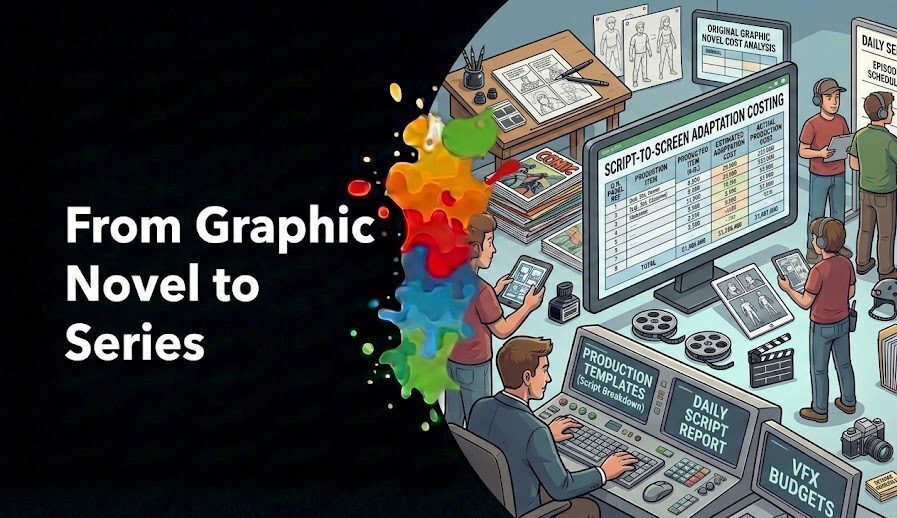
You’ve found the graphic novel. The IP is strong—built-in fanbase, distinct visual grammar, story arcs that map cleanly onto episodic TV. Now comes the part that trips up most producers: the graphic novel series rights acquisition process. Getting the rights locked. Structuring the option. And then—the harder problem—identifying the studio partner who’s actually right for the material, not just the one who returned your call first.
Here’s what we’re seeing across the market right now: graphic novels have become one of the most contested IP categories in global scripted development. Netflix, Amazon Prime Video, and Apple TV+ have all greenlit comic-origin series in the last 24 months. The competition for optionable material—especially anything with a proven readership above 500,000 copies—is serious. And the producers winning those rights aren’t necessarily the biggest. They’re the most prepared.
In This Guide
- Why Studios Are Chasing Graphic Novel IP Right Now
- Option vs. Outright Purchase: What Actually Makes Sense
- Chain of Title Issues Unique to Graphic Novels
- How to Structure the Option Agreement
- Finding the Right Studio Partner—Not Just Any Studio
- What Studios Actually Look for in Graphic Novel Adaptations
- Co-Development Deal Structures That Protect Your Position
- FAQ
Find Your Studio Partner in 48 Hours—Not 6 Months
Ask VIQI which studios have actively greenlit comic and graphic novel adaptations in your genre. Filter by budget range, territory, and current development slate—before you pitch.
✓ 200 free credits | ✓ No credit card required | ✓ 140,000+ companies tracked
Why Studios Are Chasing Graphic Novel IP Right Now
The logic is simple. In a market where development risk has become existential—Phil Hunt, founder of Head Gear Films, put it plainly when he noted the industry has become “much, much harder in terms of getting movies off the ground and getting movies sold”—studios want proof of concept baked into the IP before they commit capital.
Graphic novels deliver that. You get pre-existing visual storyboarding, established character arcs, world-building that’s already fan-tested, and—critically—measurable audience data via sales figures and social engagement. That’s not sentiment. It’s de-risked development collateral.
As reported by Variety, IP-based series from non-Marvel/DC sources have accelerated significantly since 2023 as streamers moved away from expensive original development toward properties with built-in audiences. The mid-tier graphic novel—sales between 100,000 and 800,000 copies, niche but passionate fanbase—has become a particular sweet spot for streamers who want engagement without franchise-scale competition.
But here’s the thing: the producers who get there first aren’t waiting for agents to call. They’re proactively scanning for rights availability and mapping studio appetite before the material gets shopped broadly. See our guide to how IP rights work in entertainment deals for the full framework.
Your AI Assistant, Agent, and Analyst for the Business of Entertainment
VIQI AI helps you plan content acquisitions, raise production financing, and find and connect with the right partners worldwide.
- List the top commissioners at the BBC
- List the post-production and VFX decision-makers at Netflix
- List the development leaders at Sony Pictures
- List the scripted programming heads at HBO
- Find active co-producers and financiers for scripted projects
- Find equity and gap financing companies in North America
- Find top film financiers in Europe
- Find production houses that can co-produce or finance unscripted series
- Who is backing animation projects in Europe right now
- Who is Netflix’s top production partners for Sports Docs
- Who is Commissioning factual content in the NORDICS
- Who is acquiring unscripted formats for the North American market
- Show me recent drama projects available for pre-buy
- Show me Japanese Anime Distributors
- Show me true-crime buyers from Asia
- Show me documentary pre-buyers
- I am looking for production partners for a YA drama set in Brazil
- I am looking for producers with proven track record in mid-budget features
- I am looking for Turkish distributors with successful international sales
- I am looking for OTT platforms actively acquiring finished series for the LATAM region
- I am seeking localization companies offer subtitling services in multiple Asian languages
- I am seeking partners in animation production for children's content
- I am seeking USA based post-production companies with sound facilities
- I am seeking VFX partners to composite background images and AI generated content
Option vs. Outright Purchase: What Actually Makes Sense
The instinct is to secure the rights outright. Don’t. For most graphic novel acquisitions—especially where you’re pre-studio, pre-greenlight—an option is the correct move. Here’s why it matters: an outright purchase ties up capital you don’t have yet, creates IP liability before the project’s packaged, and often alarms rights holders who’d rather see the project develop before fully transferring control.
An option agreement gives you the exclusive right to develop and eventually purchase the screen rights for a defined period—typically 12 to 18 months, with one or two renewal options. You pay an upfront option fee (usually 2–10% of the negotiated purchase price), which is credited against the full purchase if you exercise the option. If you don’t exercise, the rights revert to the creator.
For a full breakdown of how optioning works in practice, the what it means to option content in Hollywood guide covers deal mechanics in detail. But the short version: you want enough runway to attach a studio or network before you’re writing the full purchase check.
The option fee for a mid-list graphic novel typically runs $10,000–$75,000. Franchise-potential properties from established publishers—Image Comics, Dark Horse, IDW—command significantly more. And yes, competition is real. If you’ve identified a title, someone else probably has too.
Chain of Title Issues Unique to Graphic Novels
This is where deals fall apart. Not in the negotiation—in the documentation. Graphic novels have a multi-party rights structure that prose novels don’t: you’re typically dealing with a writer, an artist (who often retains visual IP rights), a colorist who may have independent copyright claims depending on their contract, and—if it’s publisher-originated IP—a publishing house with its own licensing framework.
Before you option anything, get your entertainment attorney to audit the following:
- Writer/artist agreement: Does the writer hold all adaptation rights, or does the artist have veto rights on character design in screen versions?
- Publisher contract: Some publisher agreements—especially older Dark Horse and Image deals—retain screen rights reversion clauses that aren’t obvious on first read.
- Moral rights: EU jurisdictions (France especially) give creators strong moral rights that can complicate international co-productions involving European broadcasters.
- Character vs. story rights: If a character appeared in an anthology before the graphic novel, who owns the character’s screen rights independent of the collected story?
Studios will want a clean chain of title opinion letter before committing development funds. Don’t wait for them to ask. Get it done before you’re in those rooms.
Track 159,223 Projects—Including What’s in Active Development Right Now
Netflix, Warner Bros, and Paramount use Vitrina to surface studio partners and track IP across the global supply chain. Join 300,000+ companies already on the platform.
✓ 200 free credits | ✓ No credit card required | ✓ Cancel anytime
How to Structure the Option Agreement
Every option agreement for a graphic novel adaptation should address these components. Get your lawyer involved on all of them—but understand the deal logic yourself before you’re at the table.
Option Period and Renewal Terms
Structure for 12–18 months initial term with at least one 12-month renewal at a pre-agreed fee. Renewals typically cost 50–100% of the initial option fee. Build in the renewal before you sign—don’t assume you’ll renegotiate under friendly terms if the project gains traction.
Purchase Price Structure
The purchase price—what you pay when you exercise the option—is typically structured as a flat fee plus backend participation. For mid-tier graphic novels, flat fees run $150,000–$500,000 for screen rights. Creators will push for backend. Be realistic about what backend looks like in streaming deals where net profit accounting is notoriously complex—see the how book adaptations work in film and TV guide for context on how these deals typically close.
Credit and Creative Control Provisions
Creators—especially artists—will often seek meaningful creative consultation rights. Be careful here. “Approval” rights on casting or scripts can become blockers in production. “Consultation” rights you can live with. Get the distinction in writing and make sure your studio partner is comfortable with whatever you’ve agreed to before you attach them.
Finding the Right Studio Partner—Not Just Any Studio
The real dynamic that most producers miss: studio fit isn’t about who’s biggest—it’s about whose active slate actually has room for your project and whose in-house creative sensibility matches the material. A premium cable network actively commissioning genre-adjacent content is a better first call than a major studio whose genre division is currently in turnaround.
How do you know which studios are actively developing in your category right now? The Fragmentation Paradox™ is the structural problem here: 600,000+ production, distribution, and development entities operating globally, with deal-state information scattered across press releases, trade reports, and private conversations—most of it 6 to 8 weeks stale by the time it surfaces publicly.
Strategic players understand the answer to this problem isn’t networking harder. It’s getting better data faster. The Vitrina platform tracks 1.6 million+ projects in active development across 300,000+ companies, updated continuously—so you can identify which studios have recently greenlit or are actively tracking comparable IP before you build your shortlist. That’s what “Smart Pairing” means in practice: matching your material to actual current appetite, not hypothetical interest.
As The Hollywood Reporter has tracked, streamer development budgets have compressed since 2023 as platform growth slowed. Studios are commissioning more selectively—which means your pitch needs to land in front of people who are actively looking, not just theoretically open.
What Studios Actually Look for in Graphic Novel Adaptations
Insiders recognize a consistent set of criteria across almost every studio or platform currently commissioning graphic novel adaptations. Get these right and your project is packageable. Miss them and even strong IP struggles to get traction.
- Series architecture: Does the source material support 3–5 seasons without obvious strip-mining? Studios want to see natural season breaks, not just “it’s 12 volumes.”
- Visual identity: Graphic novels with a strong and distinctive visual style create natural VFX and production design frameworks—studios see this as production efficiency, not just aesthetics.
- Character ensemble depth: Episodic TV lives and dies on secondary characters. Source material with a robust supporting cast dramatically reduces development risk.
- Audience data: Goodreads ratings, Reddit community size, BookTok engagement—studios are using social proof to de-risk the greenlight conversation internally.
- Clean rights: A fully cleared chain of title isn’t just legal housekeeping. It’s a signal of producer sophistication that accelerates trust with studio business affairs teams.
Need a Studio Partner for Your Graphic Novel Adaptation?
Vitrina’s concierge team helps producers connect with the right studio, co-production partner, or financier—matched to your specific material and budget range. Used by Emmy-nominated and Oscar-nominated production companies.
Co-Development Deal Structures That Protect Your Position
When you attach a studio to a graphic novel adaptation you’ve optioned, you’re entering a co-development arrangement—and the deal structure matters as much as which studio it is. Get this wrong and you’re the producer in name only, with no meaningful creative or financial stake in what gets made.
The two structures you’ll typically encounter: a development deal where the studio funds development (scripts, showrunner attachment, pilot) in exchange for first-look or exclusive rights to produce; and a co-development arrangement where you share creative control and ownership through the development process. For independent producers bringing optioned IP to a studio, the second structure generally offers more protection—though it also requires more leverage to negotiate.
For more on how these arrangements are structured in practice, the co-development deal structures guide covers the mechanics. But the core principle: your producing credit, consulting fee, and first-position producing role should be in the agreement before the studio advances development funding. Studios are not your partners in a project’s best interest—they’re capital allocators managing portfolio risk. Structure accordingly.
And if you get a first-look deal offer from a studio while you’re still shopping the material—understand what you’re giving up. A first-look arrangement gives the studio the right to pass before you can take the project elsewhere. Understand what “first-look” actually means in practice: the first-look deal structure explained walks through the key terms.
Frequently Asked Questions
The Bottom Line on Graphic Novel Rights Acquisition
The market for graphic novel adaptations has never been more competitive—or more structured. Studios aren’t buying potential anymore. They’re buying packaged, rights-cleared, audience-validated IP with a clear series architecture and a producer who’s done the homework.
That means your job isn’t just to find the right graphic novel. It’s to get the option structured correctly, the chain of title clean, the studio match based on real current appetite (not hope), and the co-development terms negotiated before you’re desperate. Every one of those steps is winnable—but they’re sequential. Don’t pitch until the rights are locked. Don’t lock the rights without a title opinion. Don’t approach studios without knowing their current development priorities.
Key Takeaways:
- Option before pitching: Secure exclusive rights first—typically 12–18 months with renewal options—before generating studio interest.
- Audit chain of title early: Graphic novels have multi-party rights structures; address writer, artist, publisher, and character rights before approaching studios.
- Match studio to material: Use current development data—not relationship assumptions—to identify which studios are actively acquiring comparable IP right now.
- Protect your position in co-development: Secure your producing credit, fee, and first-position role in the agreement before studio development funds arrive.
- De-risk the pitch: Studios want proof of concept, audience data, series architecture clarity, and a clean rights package—arrive with all four.
Start Tracking Studio Deal Activity Before Your Next Pitch
Netflix, Warner Bros, Paramount, and Google TV use Vitrina to navigate the global entertainment supply chain. Join 300,000+ companies and get 200 free credits to start tracking what’s getting greenlit right now—no credit card required.