IHUB
IHUB
 Private Briefings (Webinars)


 LeaderSpeak Podcast
  Global Entertainment Digest (Newsletter)
  Premium Lists
 Membership Benefits
 About Vitrina
 Our Story
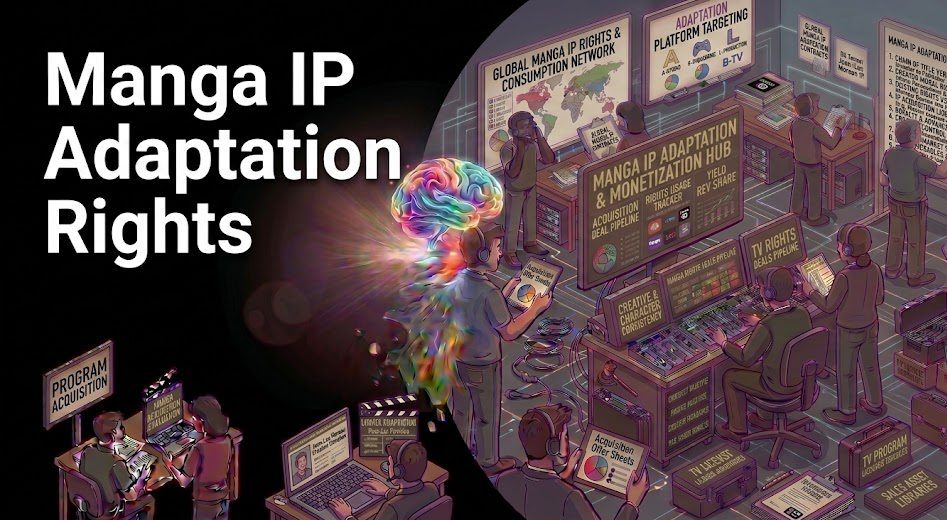
Anime co-production deals are no longer reserved for the handful of studios with decade-long Tokyo relationships. Netflix committed $2.5 billion to Korean production. Disney forged a landmark content partnership with CJ ENM’s TVING to distribute K-content globally. Toonz Media Group and Japan’s 1st Place formalized a cross-border anime production alliance built specifically for non-Japanese studios. The infrastructure for international anime co-production has arrived—and the deal structures that govern it are more standardized than most people outside Japan assume.
But here’s what separates studios actually closing these deals from the ones still mapping their “Japan strategy”: the financing architecture, IP ownership terms, and partner-matching logic are fundamentally different from conventional live-action co-productions. Get any of those three wrong, and the deal collapses—or worse, closes on terms that leave you holding the production risk while your Japanese or Korean co-producer holds the franchise upside.
This is the 2026 playbook. Real structures. Real numbers. No generic co-production theory.
Table of Contents
- Why Anime Co-Production Deals Are Accelerating in 2026
- The 3 Core Anime Co-Production Structures (And When to Use Each)
- How the Capital Stack Works in Anime Co-Productions
- IP Ownership: The Negotiation That Defines Everything
- Japan’s 50% Incentive and Korea’s Treaty Network: The Sovereign Hub Advantage
- The Fragmentation Paradox in Anime Partner Matching
- The Anime Co-Production Deal Closing Checklist
- FAQ: Anime Co-Production Deals
- Key Takeaways
Ask VIQI: Which Anime Studios Are Actively Seeking International Co-Production Partners Right Now?
VIQI is Vitrina’s AI intelligence assistant—trained on 1.6 million titles, 300,000+ companies, and 5 million entertainment professionals across the M&E supply chain. Get live deal signals on which Japanese and Korean animation studios are actively in the co-production market before the competition does.
✓ 200 free credits included | ✓ No credit card required
Why Anime Co-Production Deals Are Accelerating in 2026
The global anime market crossed $30 billion in 2024—and the majority of that value isn’t being created by Japanese studios working alone. It’s being generated by a new class of cross-border partnerships that combine Japanese or Korean IP and animation expertise with western platform relationships, distribution muscle, and production capital.
And the drivers are structural, not cyclical. Japanese animation studios—even major ones like MAPPA or Production I.G.—are running at capacity. They don’t need creative direction from international partners. What they need is capital, international distribution windows, and presale contracts that let them finance productions that their domestic market alone can’t sustain at competitive global budgets. That’s the opening for international studios who understand how to structure the deal correctly.
On the Korean side, the webtoon-to-animation pipeline is moving faster than any single studio can fund. CJ ENM has deployed AI-powered animation pipelines specifically designed to compress the production timeline from webtoon IP acquisition to deliverable content—but even with that efficiency, the capital requirements for premium global content outpace what domestic commissioning fees cover. International co-producers who come with financing are genuinely valued, not just tolerated.
As our strategic guide to Korean animation IP acquisition and co-production tracks, the deal volume in this space has increased sharply—but so has the complexity. Studios that don’t understand the structure are either overpaying for rights they don’t need, or underfunding partnerships that collapse during production.
The 3 Core Anime Co-Production Structures (And When to Use Each)
Not all anime co-production deals are built the same way. The structure you use determines your rights position, your risk exposure, and—critically—what you actually own when the project delivers. There are three main structures in play right now.
Structure 1: Official Treaty Co-Production
Official treaty co-productions operate under bilateral agreements between countries—Australia and South Korea, Canada and Japan, the UK and a growing list of APAC partners. The project qualifies as a national production in both countries, unlocking access to each country’s local incentives, broadcaster pre-buy requirements, and national funding bodies simultaneously.
The financial contribution minimums are real: bilateral treaties typically require each partner to contribute at least 10% of the total budget, with a ceiling of 90% from any single co-producer. Multilateral treaties (three or more countries) lower the floor to 5%. And those contributions must be proportional to the creative and technical contributions from each territory’s personnel—it’s not a paperwork exercise. Competent authorities in each country verify compliance.
Use this structure when: you have qualified domestic production spend in both countries, you need access to broadcaster quotas or national film funds in the partner territory, and you have the administrative capacity to manage multi-jurisdiction compliance. Japan’s domestic broadcaster relationships and Korea’s CNC-equivalent frameworks are genuinely valuable—but only to studios that can actually meet the treaty requirements.
Structure 2: Production Service Agreement (PSA)
The PSA—sometimes called an unofficial co-production—is the workhorse of international anime partnerships. Here, the international studio commissions the Japanese or Korean animation studio to produce a specified number of episodes to a defined quality standard, in exchange for a production fee plus a negotiated rights package.
It’s faster to execute than a treaty co-production, more flexible on creative structure, and doesn’t require treaty compliance. The tradeoff? You don’t access the production partner’s domestic incentives as directly, and the rights negotiation is entirely contractual rather than treaty-governed—which means more room for creative structuring, but also more room for misaligned expectations on sequel rights, franchise control, and merchandising participation.
Use this structure when: speed matters, the primary value you’re bringing is capital and distribution access (not creative equity in the source material), and you want to retain clear international rights ownership from the outset.
Structure 3: Platform-Led Co-Commission
The third structure is the one that’s reshaped the market in the past three years. Netflix, Amazon, and Disney are co-commissioning anime directly—contributing production budgets in exchange for first-window global streaming rights, while the Japanese or Korean production entity retains other exploitation rights (theatrical, merchandise, gaming, domestic broadcast). The platform isn’t the co-producer in the traditional sense—but their commissioning fee functions as the anchor of the capital stack, replacing the presale function that foreign territory sales agents used to play.
For independent studios working with these platforms, the practical implication is this: if you’re sourcing and packaging an anime project for a major streamer, you’re operating as the bridge between the Japanese/Korean production entity and the commissioning platform. Your value is in the packaging—the IP option, the production partnership, the delivery guarantee—and your margin lives in the gap between the platform fee and the all-in production cost.
Our full framework for how co-production financing models work for global content executives covers how to position yourself in that bridge role without getting squeezed from both sides.
Track Every Active Anime Co-Production Partnership Before It Hits the Trades
Trusted by Netflix, Warner Bros, Paramount, and Google TV. Join 140,000+ companies tracking live deal signals across 159,223 projects worldwide—including anime production partnerships, webtoon acquisition activity, and APAC co-producer availability.
✓ 200 free credits | ✓ No credit card required | ✓ Full platform access on day one
How the Capital Stack Works in Anime Co-Productions
This is where most international studios without deep animation finance experience get into trouble. They treat anime co-production budgets like live-action co-production budgets—and the two are structurally different in ways that matter at the term sheet stage.
A typical anime series co-production capital stack for a premium streaming title might look like this: a platform commissioning fee covering 50–65% of the production budget, with the remainder assembled from a combination of equity contributions from the co-production partners, territory presales for markets the platform hasn’t locked (typically Southeast Asia, MENA, or Eastern Europe in platform-led deals), and—for treaty co-productions specifically—domestic production incentives from both participating territories.
On the debt side: gap financing at 10–20% of the production budget is available from specialized entertainment lenders, secured against the unsold territorial rights. The waterfall on repayment follows a standard priority structure—distribution and sales agent fees (typically 20–35% of gross receipts) come off the top, then P&A recoupment, then senior debt, then gap, then equity investors. As Phil Hunt—CEO of Head Gear Films, which has structured over 550 films—notes, the projects that get financed in this market are the ones “the market really wants.” And in anime right now, the market wants projects with confirmed platform interest, named IP, and production partners with verifiable track records.
But—and this is the piece that trips up newcomers—presales for anime work differently than presales for live-action. The major territories aren’t Germany and France. They’re markets like China, Southeast Asia, Brazil, and MENA, where appetite for anime content is growing faster than platform coverage. A smart international co-producer builds their presale strategy around those underserved markets, not the ones already locked by Netflix or Amazon.
Our deep-dive into international co-production as a financing imperative covers the full capital stack mechanics—including how to stack incentives from two jurisdictions without triggering compliance issues with either territory’s competent authority.

Your AI Assistant, Agent, and Analyst for the Business of Entertainment
VIQI AI helps you plan content acquisitions, raise production financing, and find and connect with the right partners worldwide.
- List the top commissioners at the BBC
- List the post-production and VFX decision-makers at Netflix
- List the development leaders at Sony Pictures
- List the scripted programming heads at HBO
- Find active co-producers and financiers for scripted projects
- Find equity and gap financing companies in North America
- Find top film financiers in Europe
- Find production houses that can co-produce or finance unscripted series
- Who is backing animation projects in Europe right now
- Who is Netflix’s top production partners for Sports Docs
- Who is Commissioning factual content in the NORDICS
- Who is acquiring unscripted formats for the North American market
- Show me recent drama projects available for pre-buy
- Show me Japanese Anime Distributors
- Show me true-crime buyers from Asia
- Show me documentary pre-buyers
- I am looking for production partners for a YA drama set in Brazil
- I am looking for producers with proven track record in mid-budget features
- I am looking for Turkish distributors with successful international sales
- I am looking for OTT platforms actively acquiring finished series for the LATAM region
- I am seeking localization companies offer subtitling services in multiple Asian languages
- I am seeking partners in animation production for children's content
- I am seeking USA based post-production companies with sound facilities
- I am seeking VFX partners to composite background images and AI generated content
IP Ownership: The Negotiation That Defines Everything
No single clause in an anime co-production deal has more long-term financial consequence than the IP ownership structure. Get it right and you’re positioned for franchise participation—sequel commissions, merchandise royalties, gaming licenses, and theme park deals. Get it wrong and you’ve spent production capital to build somebody else’s franchise.
Here’s how the typical IP ownership split plays out across the three structures.
In official treaty co-productions, IP ownership is negotiated proportional to financial contribution. A 60/40 funding split typically produces a 60/40 IP ownership split—with territory-specific exploitation rights allocated by geography. The Japanese or Korean partner controls domestic rights; the international partner controls their home territory; all other territories are either split by formula or jointly exploited with a revenue share.
In PSA structures, the default is that the commissioning party (the international studio) owns the completed work—but this is negotiable, and Japanese studios in particular often push for co-ownership of the underlying character IP even in service deal structures. Don’t let this clause slide through unsigned. If you’re commissioning original characters or storylines developed collaboratively during pre-production, character IP ownership needs explicit definition in the agreement—not left to “as per industry standard.”
In platform co-commissions, the platform will often push for global IP ownership or a ROFR (right of first refusal) on all future exploitation. That’s a franchise handover, not a production deal. If the underlying manga or webtoon IP you optioned has real sequel potential—and you’re building a co-production around it—you need to structure the platform deal as a first-window license, not a rights transfer. According to
Variety, the most contested negotiations in streamer-backed anime originals are consistently over exactly this point: who owns the franchise once the first series performs.
Japan’s 50% Incentive and Korea’s Treaty Network: The Sovereign Hub Advantage
Two Sovereign Content Hubs dominate the anime co-production landscape in 2026—and each offers a distinct incentive architecture that smart studios are weaponizing in their financing models.
Japan launched a production incentive program offering up to 50% cash rebate on qualifying international production expenditure, capped at approximately $6.7M (¥1B) per project. That’s not a rounding error. On a $15M premium anime series, a qualifying production partnership that directs at least $13.4M of spend through Japanese infrastructure can recover up to $6.7M—reducing your effective net budget to roughly $8.3M before your platform commissioning fee. The numbers change the greenlight calculus entirely.
But the strategic value of Japanese production co-location goes beyond the rebate. As we covered in discussing manga IP adaptation rights, shooting in Japan—or more precisely, routing significant production spend through Japanese animation infrastructure—signals cultural investment to the publishers and mangaka whose IP you’re adapting. The incentive and the relationship leverage are the same move.
South Korea plays differently. The treaty network is the advantage. Korea has active co-production treaties with Australia, Canada, the UK, and a growing list of European countries—and Netflix’s $2.5 billion Korea production commitment has supercharged the domestic production infrastructure. This means that a Canadian studio co-producing with a Korean animation company can access Canadian federal incentives, Korean domestic broadcaster obligations, and Netflix’s commissioning appetite simultaneously—a capital stack trifecta that simply doesn’t exist in most other international production partnerships.
CJ ENM‘s AI animation pipeline deployment and the Disney/TVING landmark K-content partnership both signal the same thing: the Korean animation Sovereign Hub has crossed the threshold from “emerging market of interest” to “primary production infrastructure for global anime content.” As Screen International has tracked, the volume of inbound international co-production inquiries to Korean animation studios in 2024 and 2025 set successive records—and the production capacity is still not keeping up with demand.
The Fragmentation Paradox in Anime Partner Matching
Here’s the structural problem no one talks about openly at markets: the anime production supply chain is simultaneously one of the most vibrant in global entertainment—and one of the most opaque for international studios trying to navigate it systematically.
Japan alone has over 430 registered animation studios. Korea’s webtoon platform ecosystem connects thousands of independent creators to production entities across Naver Webtoon, Kakao Entertainment, and independent studios. But the information infrastructure that would let an international studio efficiently identify which of those 430+ Japanese studios has available production capacity, active international co-production interest, and the specific genre expertise for a given project—that doesn’t exist in any organized public form. That’s the Fragmentation Paradox™ in action: enormous supply, invisible inventory.
And the cost of that opacity is real. Studios that don’t have deep APAC networks either over-pay for introductions through intermediaries, spend three to six months in exploratory conversations that go nowhere, or default to the two or three Japanese studios they’ve already heard of—which are also the two or three studios getting every other international inquiry. That’s not a partner-matching strategy. That’s market-rate competition for the most oversubscribed production slots in the ecosystem.
Vitrina’s platform maps 300,000+ companies across the M&E supply chain—including the full spectrum of Japanese and Korean animation studios, their recent co-production partnerships, their genre track records, and their international distribution relationships. When a studio signals readiness for international partnerships through deal announcements, festival presence, or market behavior, that signal propagates through deal intelligence data before it surfaces in trade press. Our
guide to mastering anime licensing and distribution breaks down how to build that sourcing funnel systematically.
Need Direct Introductions to Japanese and Korean Animation Co-Production Partners?
Vitrina Concierge is your Virtual Agent. We make warm introductions directly to the decision-makers at the studios, publishers, and platform executives actively building international co-production pipelines right now.
- LA producer → Netflix UK, Fifth Season, Fox Entertainment (48 hours)
- Korean animation studio → Netflix Adult Animation (week one)
- International studio → Japanese co-production partner (direct access)
The Anime Co-Production Deal Closing Checklist
Before you execute an anime co-production deal, these are the variables that need to be resolved—not assumed. Studios that skip any of these at LOI stage are doing expensive renegotiations at the delivery stage.
- Structure selection locked. Official treaty, PSA, or platform co-commission—and all parties aligned on which structure governs the relationship. Each one has different implications for tax compliance, creative approval rights, and recoupment sequencing.
- Financial contribution percentages confirmed. For treaty co-productions: both parties at or above the bilateral minimum (10%) with proportional creative contributions documented. For PSA and platform deals: the production fee, equity stakes, and platform commissioning fees all mapped to the capital stack before execution.
- IP ownership and franchise rights explicitly defined. This means character IP, sequel rights, spinoff rights, merchandise rights, gaming rights, and the ROFR position of any commissioning platform. Don’t leave any of these to “to be agreed” language in the LOI.
- Incentive qualification confirmed. For Japanese co-productions: qualifying production expenditure mapped to the 50% rebate threshold. For Korean treaty deals: compliance with the co-production treaty’s cultural test requirements verified with both countries’ competent authorities before the deal closes, not after.
- Presale strategy and gap financing plan in place. Know which territories your platform commissioning fee leaves open. Build your presale strategy around those markets. And if gap financing is in the structure, have your lender relationship and sales estimates confirmed—gap lenders require sales estimates at 1.5–2x the gap amount, and they only lend against credible territory valuations.
- Recoupment waterfall agreed in writing. Distribution fees, P&A recoupment, senior debt, gap repayment, equity recoupment, and backend profit participation—all sequenced explicitly. Waterfall disputes kill more indie co-production partnerships post-delivery than any other single issue.
- Completion bond arranged. Almost every gap lender requires a third-party completion guarantee (adding 3–6% to your production budget). Build it into the budget from day one. Don’t find out at the financing close that your budget is short by a completion bond you didn’t factor in.
FAQ: Anime Co-Production Deals
What is an anime co-production deal?
An anime co-production deal is a formal partnership between studios or production entities from different countries to jointly finance and produce an animated series or film in the anime style. These deals are structured across three primary frameworks: official treaty co-productions (governed by bilateral government agreements), production service agreements (contractual service relationships), and platform co-commissions (where a streaming platform’s commissioning fee anchors the capital stack). Each structure carries different implications for IP ownership, incentive access, and profit participation.
How much does it cost to co-produce an anime series?
Premium anime series for global streaming platforms typically cost between $2M and $8M per episode—a wide range driven by animation complexity, production studio, and delivery timeline. Mid-tier series targeting regional platforms run $500K–$2M per episode. A standard 12-episode season at the premium tier therefore represents a total production budget of $24M–$96M, with co-production partnerships typically dividing that budget along financial contribution percentages that also govern creative responsibility and rights ownership.
Who owns the IP in an anime co-production?
IP ownership in anime co-productions is negotiated, not automatic. In official treaty co-productions, ownership is typically proportional to financial contribution. In PSA structures, the commissioning party defaults to ownership of the completed work—but Japanese studios often negotiate co-ownership of character IP developed collaboratively. In platform co-commissions, platforms frequently push for global IP ownership or first-refusal rights on sequel exploitation. Studios should define character IP, sequel rights, merchandise rights, gaming rights, and platform ROFR positions explicitly at the LOI stage—not in the delivery agreement.
What is Japan’s 50% production incentive and how does it affect co-production deals?
Japan’s production incentive offers international productions a 50% cash rebate on qualifying production expenditure, capped at approximately $6.7M per project. For international studios co-producing with Japanese animation partners, routing qualifying spend through Japanese production infrastructure—personnel, facilities, post-production—can recover up to $6.7M in production cost. Beyond the financial benefit, production co-location in Japan also strengthens relationships with Japanese publishers and creators whose IP co-productions typically depend on, making the incentive and the relationship strategy the same move.
How do I find a Japanese or Korean anime co-production partner?
The traditional route—film markets, introductions through agents, and direct outreach—is slow and heavily dependent on existing relationships. Vitrina maps 300,000+ companies across the global M&E supply chain, including Japanese and Korean animation studios with their current project pipelines, recent co-production partnerships, genre specializations, and international distribution relationships. VIQI, Vitrina’s AI assistant, can surface co-production partner candidates with matching genre profiles, available capacity, and verifiable international co-production track records in minutes rather than months.
What is the capital stack in an anime co-production?
The capital stack in an anime co-production typically comprises a platform commissioning fee (covering 50–65% of budget for platform-anchored deals), equity contributions from both co-producing parties, territorial presales for markets not covered by the platform deal, domestic production incentives from qualifying jurisdictions, and gap financing against unsold rights (typically 10–20% of budget). The recoupment waterfall—the order in which revenue is distributed to stakeholders—flows from distribution fees and P&A recoupment through senior debt, gap repayment, equity recoupment, and finally backend profit participation.
What is the difference between an official treaty co-production and a PSA in anime?
An official treaty co-production is governed by a formal bilateral agreement between countries (Canada-Korea, Australia-Korea, UK-Japan, etc.) that grants the project national status in both countries, unlocking each country’s domestic incentives, broadcaster quotas, and national funding access. A production service agreement is a purely contractual relationship with no treaty backing—faster to execute, more flexible, but without access to treaty benefits. Use treaty structures when the incentive and funding access they unlock is worth the compliance overhead; use PSAs when speed, flexibility, or the absence of a relevant treaty makes the treaty route impractical.
What is gap financing and how does it work in anime co-productions?
Gap financing is a mezzanine debt product that bridges the difference between confirmed financing (platform fees, presales, equity, incentives) and the total production budget—typically covering 10–20% of the budget. It’s secured against the value of unsold territorial distribution rights and repaid from the film’s future revenues, sitting ahead of equity in the recoupment waterfall. Gap lenders require sales estimates at 1.5–2x the gap amount, a completion bond, and a reputable sales agent. All-in costs for gap financing typically run 15–22% of the loan amount annually, including upfront fees and interest.
Key Takeaways: Anime Co-Production Deals in 2026
The infrastructure for international anime co-production has matured faster in the past three years than in the previous two decades. Platform capital, regional incentives, and formalized treaty networks have created genuine pathways for non-Japanese studios to build sustainable anime production partnerships—but only for studios that understand what they’re actually structuring.
- Choose your structure deliberately. Official treaty co-productions, PSAs, and platform co-commissions each carry different implications for IP ownership, incentive access, and recoupment sequencing. The structure isn’t a formality—it’s the deal architecture.
- Japan’s 50% incentive (up to $6.7M per project) changes the economics of qualifying co-productions—and doubles as relationship leverage with the publishers and creators whose IP most anime adaptations depend on.
- IP ownership must be defined at LOI stage. Character IP, sequel rights, merchandising rights, gaming rights, and platform ROFR positions all need explicit language before execution—not at delivery.
- Korea’s treaty network plus Netflix’s $2.5B commitment makes Korean animation co-productions the most capital-efficient international partnership structure available to non-Asian studios right now.
- The Fragmentation Paradox™ in partner matching means most studios are negotiating with a fraction of their available partner pool—and defaulting to the most oversubscribed Japanese and Korean studios by default.
- Gap financing requires sales estimates at 1.5–2x the gap amount, a completion bond, and a confirmed sales agent—build all three into your financing plan before the LOI, not after.
Find Your Anime Co-Production Partner—Before the Window Closes
Trusted by Netflix, Warner Bros, Paramount, and Google TV. Track 159,223 projects. Access 3 million verified executives. Identify Japanese and Korean animation studios with active international co-production mandates—in your genre, at your budget tier—before they sign with someone else.
✓ 200 free credits | ✓ No credit card required | ✓ Cancel anytime
Need warm introductions to Japanese animation studios or Korean webtoon platforms? Explore Concierge Service →