About Innovation Hub
 Global Content Pulse (Webinars)


 Global Production Financing
(Webinars)
Global Production Financing
(Webinars)  LeaderSpeak Podcast
  Global Entertainment Digest (Newsletter)
  About Vitrina
 About VIQI
 Our Story
 Our Solutions 🔥
 Film+TV Projects Tracker 🚀
 Case Studies
 Our Profile
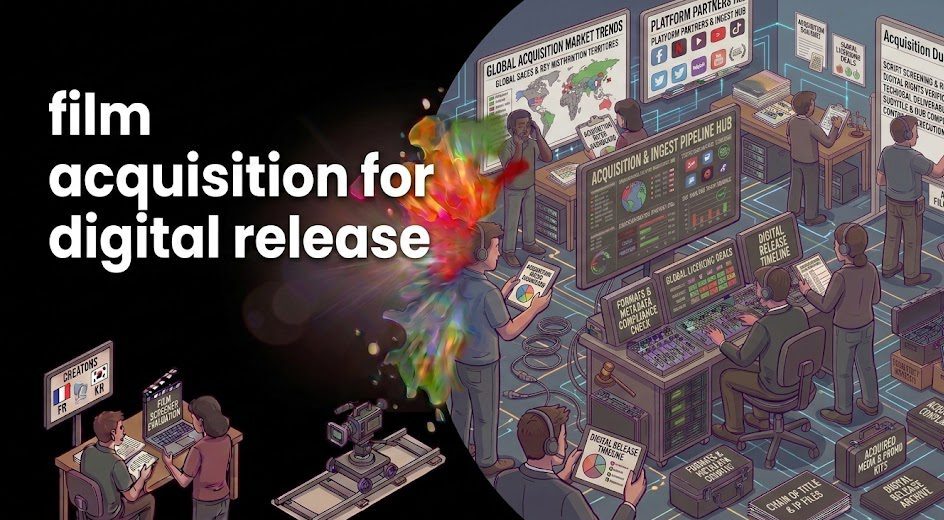
If your film is looking for a digital home, you need to know exactly who’s buying—and what they’re actually looking for right now. Film acquisition for digital release isn’t one market. It’s ten parallel markets operating on entirely different economics, content mandates, and territory logic. Pitching Netflix is nothing like pitching MUBI. And neither looks anything like OSN.
Here’s what the landscape actually looks like in 2025: the dominant SVOD players have pulled back from volume acquisition and moved to selective, high-concept buys. Meanwhile, AVOD and FAST platforms have accelerated catalog appetite dramatically. Regional Sovereign Content Hubs—OSN across 23 MENA countries, JioCinema touching 500M+ Indian consumers, Rakuten Viki commanding Korean and Asian content—are building acquisition pipelines that most Western producers haven’t even mapped yet.
This is the definitive shortlist. Ten companies. Real acquisition criteria. No filler. And the intelligence framework to know which door to knock on before you waste six months on the wrong pitch.
Table of Contents
- What Drives Film Acquisition Decisions in 2025?
- The Vitrina Digital Acquisition Tier Matrix™
- Tier 1: SVOD Leaders (Global Buyers)
- Tier 2: Indie Film Acquisition Specialists
- Tier 3: AVOD and FAST Platform Buyers
- Tier 4: Sovereign Content Hub Platforms
- Which Film Acquisition Platform Is Right for Your Project?
- How Vitrina Surfaces Active Acquisition Opportunities
- Frequently Asked Questions
- Key Takeaways
Ask VIQI: Which Digital Platforms Are Actively Acquiring Your Genre Right Now?
VIQI is Vitrina’s AI assistant—trained on 1.6 million titles, 360,000 companies, and 5 million entertainment professionals. Get real-time acquisition intelligence before your pitch window closes.
✓ Included with 200 free credits | ✓ No credit card needed
What Drives Film Acquisition Decisions in 2025?
Every platform acquiring films for digital release is running the same core calculation: content cost vs. subscriber or advertising value generated. But how they run that math—and what inputs they weight—varies dramatically by business model.
SVOD platforms (Netflix, Amazon, Apple) optimize for subscriber acquisition and retention. A film that drives 5 million new sign-ups is worth the $50M+ spend. A film that sustains subscribers through a dry patch has a different but equally real value. That’s why they’ll buy a quiet drama nobody else wants if the data signals audience appetite.
AVOD and FAST platforms (Tubi, Pluto TV, Peacock’s free tier) monetize through advertising. Their calculation is simpler: CPM × impressions × watch time. They need volume—catalogs of hundreds or thousands of titles—which makes them active buyers of library content, mid-budget genre films, and second-window SVOD releases.
And the regional platforms? They’re fighting a different war entirely—local content mandates, subscriber growth in markets where Hollywood still represents 70–90% of available premium content, and the urgent need to develop “from the region, for the region” libraries that resonate with local audiences. As Rolla Karam, SVP Content Acquisition at OSN, put it directly: she receives over 150 pitch emails per day. You need to be the right fit—not just a good film.
Understanding our full analysis of content acquisition across the OTT industry helps you position your project before the first conversation. But let’s start with the framework that cuts through the noise.

Your AI Assistant, Agent, and Analyst for the Business of Entertainment
VIQI AI helps you plan content acquisitions, raise production financing, and find and connect with the right partners worldwide.
- Find active co-producers and financiers for scripted projects
- Find equity and gap financing companies in North America
- Find top film financiers in Europe
- Find production houses that can co-produce or finance unscripted series
- I am looking for production partners for a YA drama set in Brazil
- I am looking for producers with proven track record in mid-budget features
- I am looking for Turkish distributors with successful international sales
- I am looking for OTT platforms actively acquiring finished series for the LATAM region
- I am seeking localization companies offer subtitling services in multiple Asian languages
- I am seeking partners in animation production for children's content
- I am seeking USA based post-production companies with sound facilities
- I am seeking VFX partners to composite background images and AI generated content
- Show me recent drama projects available for pre-buy
- Show me Japanese Anime Distributors
- Show me true-crime buyers from Asia
- Show me documentary pre-buyers
- List the top commissioners at the BBC
- List the post-production and VFX decision-makers at Netflix
- List the development leaders at Sony Pictures
- List the scripted programming heads at HBO
- Who is backing animation projects in Europe right now
- Who is Netflix’s top production partners for Sports Docs
- Who is Commissioning factual content in the NORDICS
- Who is acquiring unscripted formats for the North American market
The Vitrina Digital Acquisition Tier Matrix™
Before pitching any platform, map your project against four variables: budget range, content type, territory scope, and platform business model. The matrix below tells you which tier fits your project—so you’re not pitching Netflix when you should be pitching Tubi, and vice versa.
The Vitrina Digital Acquisition Tier Matrix™
| Tier | Budget Range | Content Type | Territory |
|---|---|---|---|
| Tier 1 — SVOD Leaders | $5M+ | High-concept, star-driven, event film | Global / Multi-territory |
| Tier 2 — Indie Specialists | $500K–$15M | Festival circuit, awards-driven, genre | US + Select International |
| Tier 3 — AVOD / FAST | Any (library-first) | Genre, catalog, second-window | US-centric / National |
| Tier 4 — Sovereign Hubs | $200K–$10M | Regional, local-language, Western premium | MENA / APAC / LATAM |
The Fragmentation Paradox makes this harder than it should be—600,000+ companies operating in acquisition, distribution, and licensing, with no central visibility layer. But the ten companies below represent the most active, most strategically significant buyers in each tier right now.
Tier 1: SVOD Leaders — The Global Film Acquisition Buyers
1. Netflix
Type: SVOD | Territory: 190+ countries | HQ: Los Gatos, CA
Verdict: The most powerful single buyer in global film acquisition—but increasingly selective about what it acquires outright vs. what it commissions.
Netflix acquires films across every genre but has shifted acquisition strategy post-2022 toward concept-driven, commercially viable content with clear audience signals. Festival circuit wins still turn heads. Think All Quiet on the Western Front (acquired pre-Oscars), CODA (Sundance, $25M acquisition—largest in Sundance history at the time), and international-language films with global appeal. Their $17B+ annual content spend includes both originals and acquisitions, though originals have increasingly dominated.
What they want: Proven talent, commercial genre, or awards-track films with 190-country audience potential. Their full content acquisition strategy breakdown explains exactly what signals their algorithm prioritizes.
2. Amazon Prime Video
Type: SVOD + TVOD | Territory: 240+ countries | HQ: Seattle, WA
Verdict: Post-MGM acquisition, Amazon operates a two-track strategy—premium theatrical crossovers via MGM and direct digital acquisitions via Prime Video.
Amazon Prime Video closed the $8.5B MGM acquisition in 2022, adding 4,000 film titles and 17,000 TV episodes to its library overnight. But it still actively acquires from the market. Their sweet spot: genre films ($3M–$30M budget), international prestige projects, and franchise-adjacent IP. TVOD (premium rentals) on Prime also means films can get digital releases even without a full streaming deal. See our detailed Amazon Prime Video acquisition strategy analysis for submission intelligence.
3. Apple TV+
Type: SVOD (Prestige) | Territory: 100+ countries | HQ: Cupertino, CA
Verdict: The most selective major buyer in the market—but willing to spend aggressively when the project fits their prestige-only mandate.
Apple TV+ acquired CODA—then let it win Best Picture. That wasn’t luck; it was strategy. Apple’s acquisition philosophy is quality over volume: fewer titles, bigger prestige. Their $6B+ annual content budget goes deep on a small number of films. Killers of the Flower Moon was their theatrical co-investment model. Entry point for independents is typically through established producers or world-premiere festival plays. Check our Apple TV+ acquisition strategy deep dive for what they actually look for.
Track Active Acquisition Deals Across 400,000+ Projects
Trusted by Netflix, Warner Bros, and Paramount. Join 140,000+ companies tracking the global entertainment supply chain in real time.
✓ 200 free credits | ✓ No credit card required | ✓ Full platform access
Tier 2: Indie Film Acquisition Specialists
4. A24
Type: Independent Distributor + SVOD | Territory: US + International | HQ: New York, NY
Verdict: The gold standard for film acquisition digital release in the independent space—and the most culturally influential buyer operating below studio scale.
A24 has redefined what “indie” acquisition looks like. From Hereditary and Midsommar to Everything Everywhere All at Once and Past Lives, they consistently acquire films the studios passed on—then turn them into cultural events. Their digital strategy is intentional: theatrical-first, then streaming window, with A24 on Apple TV+ as a distribution pipeline for their back catalog.
Andrea Scarso at IPR VC cited A24 specifically as a company that “clearly pushes their boundaries” in marketing innovation—noting that Marty Supreme‘s promotional strategy (with Timothée Chalamet) is already being studied as a new model industry-wide. A24 acquires on voice, vision, and distinctive sensibility. Pitch deck-first, relationship-second. But the relationship matters more than you’d think.
5. Neon
Type: Independent Distributor (Theatrical + Digital) | Territory: US | HQ: New York, NY
Verdict: The most aggressive rising acquirer in the US indie market—and the company that brought Parasite to American audiences.
Neon acquired Parasite for $5.1M at Cannes 2019—and watched it become the first non-English film to win Best Picture. That deal set their template: bold bets on world-cinema films with crossover potential. In 2024, Longlegs (acquired pre-release) generated $73M domestic box office against a minimal budget. Their digital pipeline follows theatrical release—films go to streaming after the theatrical window via partnerships with Max and other platforms. For international films with US ambitions, Neon is the most important relationship to build.
6. MUBI
Type: Curated SVOD + Theatrical | Territory: 190+ countries | HQ: London, UK
Verdict: The world’s most respected curated film platform—now a $1B valuation company (post Sequoia Capital’s $100M Series G)—and the buyer for films that don’t fit the commercial algorithm anywhere else.
MUBI selects a curated rotation of films for subscribers across 190+ countries—operating on a cultural authority model, not a volume model. Their acquisition slate prioritizes auteur cinema, world premieres, and retrospective restorations. But their acquisition reach is growing. MUBI GO (theatrical access subscription) extends their footprint into cinema screens. For arthouse, documentary, and festival-circuit films, MUBI is the most globally impactful single buyer you’ll find at this scale. See our analysis of MUBI’s content acquisition approach for precise fit criteria.
Tier 3: AVOD and FAST Platform Buyers
Don’t underestimate this tier. AVOD platforms now generate billions in advertising revenue—and they need catalog at scale. The economics work differently, but the acquisition volume is significantly higher than Tier 1 or Tier 2.
Carol Hanley, CEO of Whip Media, breaks down exactly how AVOD, FAST, SVoD, and TVoD platforms measure content performance—the analytics that drive every acquisition decision these platforms make:

Carol Hanley (CEO, Whip Media) on streaming analytics, royalty tracking, and how digital platforms evaluate content ROI across FAST, SVoD, TVoD, and AVoD models.
7. Tubi (Fox Entertainment)
Type: AVOD / FAST | Territory: US, Canada, Australia, Mexico, UK | HQ: San Francisco, CA
Verdict: The largest AVOD platform in the US—and now commissioning originals from partners like Hartbeat (Kevin Hart’s company), signaling a shift toward active acquisition, not just library licensing.
Tubi passed 97 million monthly active users in 2024—making it larger than most traditional cable networks. Their content model: massive catalog depth (50,000+ titles) across genre, horror, action, thriller, and romance. They’re a natural second-window home for films that have done theatrical or SVOD runs, and increasingly a first-window option for mid-budget genre content. Ad revenue means they need content that holds audiences through mid-roll breaks—genre films with strong second-act momentum outperform literary adaptations significantly on their platform. Read our full Tubi acquisition strategy and submission guide.
Need Direct Introductions to Active Acquisition Executives?
Vitrina Concierge makes warm introductions to decision-makers actively acquiring your content type—not a list of names, but direct access.
- Korean animation studio → Netflix Adult Animation (week one)
- LA producer → Netflix UK, Fifth Season, Fox Entertainment (48 hours)
- Middle Eastern studio → Legendary Pictures (direct access)
Tier 4: Sovereign Content Hub Platforms — The Buyers Most Producers Haven’t Mapped
Here’s where the real opportunity gap lives. The Sovereign Content Hubs—government-backed regional platforms in MENA, APAC, and LATAM—represent the fastest-growing acquisition markets in the world. But most Western producers haven’t mapped them, haven’t built the relationships, and haven’t structured their content for regional fit. That’s your competitive advantage if you move first.
8. OSN / OSN Plus (Orbit Showtime Network)
Type: Premium Pay TV + SVOD | Territory: 23 MENA Countries | HQ: Dubai, UAE
Verdict: The premier premium content platform across 23 MENA and North Africa countries—and the most important single acquisition buyer for Western content seeking Middle East digital distribution.
OSN—formed from the 2008 merger of Orbit Network and Showtime Arabia—operates two distinct products: OSN TV (linear/hybrid box) and OSN Plus (streaming app), with strategic investment clearly shifting toward the streaming platform. Rolla Karam, SVP Content Acquisition, heads acquisition negotiations regionally and with global studios. Her current content mix: 90% Western content, with a growing Arabic and Turkish catalog (“from the region, for the region”)—and Turkish content performing “amazingly well” on the platform.
Core markets: Saudi Arabia (primary), GCC, Egypt. OSN acquires across entertainment genres—drama, thriller, comedy—with premium positioning as the non-negotiable filter. If your film has Western premium credentials, OSN is the MENA door. And with Saudi Arabia now backed by $71.2B in Vision 2030 entertainment investment, the appetite is only accelerating. Our film distribution strategy guide covers MENA positioning in detail.
9. JioCinema / JioStar
Type: AVOD + SVOD | Territory: India (500M+ users) | HQ: Mumbai, India
Verdict: The dominant streaming platform in the world’s most populous country—and a strategic acquisition buyer for both international and Indian-language content at unprecedented scale.
JioCinema (now merged under JioStar following the Disney Star merger) reaches 500M+ users through Reliance’s Jio network—one of the largest content distribution reach positions on the planet. India’s streaming market is projected to hit $13B by 2030, and JioStar sits at the center of that growth. Their acquisition appetite spans Bollywood, Hollywood acquired titles (they hold major league cricket, IPL rights worth $3B+), and increasingly international cinema. For any film with South Asian audience potential or Hindi-language theatrical ambition, this is the must-have digital partner.
10. Rakuten Viki
Type: AVOD + SVOD (Asian Content) | Territory: 200+ Countries | HQ: San Francisco, CA (Rakuten Group, Japan)
Verdict: The global home for Korean, Japanese, Chinese, and Southeast Asian content—with a community-powered subtitling model that gives Asian-language films genuine international reach.
Rakuten Viki reaches audiences in 200+ countries with a focus on Asian cinema and drama that no Western platform can replicate. The Hallyu Wave has driven Korean content demand to extraordinary levels—and Viki sits at the center of that distribution funnel. Their acquisition model is notably community-engaged: fans vote on which content gets subtitled into which languages, creating organic demand signals before acquisition decisions are finalized. For Korean, Japanese, Chinese, and broader APAC films, Viki is the most strategic digital partner that most Western sales agents still don’t have relationships with. Our Rakuten Viki acquisition intelligence guide breaks down their content criteria in detail.
Which Film Acquisition Platform Is Right for Your Project?
Here’s the question that matters more than the list: where does your specific film belong in this ecosystem? And the honest answer is: probably multiple tiers simultaneously, across different territories. Netflix acquires worldwide rights—but that’s not always the best deal. Selling North America to Neon, MENA to OSN, and APAC to Rakuten Viki might generate more total revenue than a single global deal at a discounted MG.
The Fragmentation Paradox that costs producers 15–20% in margin leakage is most acute here: the right multi-territory digital strategy requires knowing which platform has active acquisition budget in your genre, in which territory, in what window. That’s not static information. It changes quarterly. A platform that was actively buying documentaries in Q1 can freeze its acquisition budget by Q3 when it hits its content cap for the year.
That’s precisely the kind of real-time intelligence that turns a six-month pitch cycle into a six-week deal. Understanding the global content acquisition watchlist gives you the baseline. But real-time platform data is what closes deals before your window closes.
How Vitrina Surfaces Active Film Acquisition Opportunities
The ten companies above are the known market. But Vitrina tracks 140,000+ companies across the global entertainment supply chain—including acquisition executives, platform content buyers, and regional distributors who don’t have the profile of a Netflix but are actively deploying budgets right now.
Ask VIQI which platforms are acquiring your genre in your territory. Track which Sovereign Content Hub is deploying acquisition capital this quarter. Identify OSN’s current content priorities before your pitch. Map which AVOD platforms have open acquisition budgets in the window you’re targeting. That’s intelligence that doesn’t come from reading trade press—it comes from real-time supply chain data across 400,000+ tracked projects.
And for producers who need warm introductions rather than just intelligence—Vitrina Concierge puts you directly in front of the acquisition executive who’s actively looking for your type of content. Not a contact list. A conversation, already pre-qualified.
Frequently Asked Questions: Film Acquisition for Digital Release
What companies specialize in film acquisition for digital release?
The leading companies specializing in film acquisition for digital release span four tiers: SVOD leaders (Netflix, Amazon Prime Video, Apple TV+), indie specialists (A24, Neon, MUBI), AVOD/FAST platforms (Tubi), and regional Sovereign Hub platforms (OSN for MENA, JioCinema/JioStar for India, Rakuten Viki for APAC). Each operates on different budget thresholds, content mandates, and territory logic.
How do streaming platforms decide what films to acquire?
SVOD platforms optimize for subscriber acquisition and retention—paying premium for high-concept or award-winning films that drive sign-ups. AVOD and FAST platforms calculate CPM × watch time—prioritizing genre content with broad audience appeal and catalog depth. Regional platforms weigh local content mandates, cultural fit, and Western premium positioning. All platforms assess competitive alternatives before setting acquisition prices.
What is the difference between SVOD and AVOD film acquisition?
SVOD (Subscription Video on Demand) acquisition means the platform pays a licensing fee or MG for exclusive or non-exclusive rights, monetizing through subscriber fees. AVOD (Ad-Supported Video on Demand) acquisition typically involves a revenue-share model where the platform earns through advertising—often lower upfront payments but longer licensing windows and less exclusivity restriction. SVOD pays more per title; AVOD acquires more titles at volume.
Which companies buy independent films for streaming?
The most active buyers of independent films for streaming are A24 (US distribution + Apple TV+ pipeline), Neon (theatrical to digital, world cinema specialists), MUBI (curated arthouse across 190+ countries), Netflix (for high-concept festival films), and Tubi (AVOD, genre-focused, high volume). Regional buyers like OSN and Rakuten Viki are also significant acquirers of independent content in their territories.
How does OSN acquire content for MENA digital distribution?
OSN acquires content through its SVP Content Acquisition team, handling both regional deals (Turkish, Arabic content) and global studio deals covering 23 MENA countries. Their content mix is currently 90% Western premium content with a growing Arabic and Turkish catalog. Acquisition priorities: premium entertainment positioning, Saudi Arabia and GCC market fit, and dual-window compatibility across OSN TV (linear) and OSN Plus (streaming). OSN receives over 150 pitch submissions per day—fit and premium positioning are non-negotiable filters.
Is it better to sell film rights globally or territory-by-territory for digital release?
It depends on the project and your negotiating leverage. A global deal (Netflix, Amazon) offers simplicity and speed—one negotiation, one payment, global reach. But territory-by-territory deals typically generate higher total MG value: North America to Neon, MENA to OSN, APAC to Rakuten Viki, India to JioCinema. The trade-off is complexity, time, and the need for a strong sales agent to manage multiple relationships simultaneously.
What genres do AVOD platforms like Tubi acquire most aggressively?
Tubi and AVOD platforms consistently outperform with horror, action, thriller, and romance—genres with strong genre-loyal audiences who tolerate ad interruptions. True crime and documentary content also performs well. Literary adaptations and art-house films tend to underperform on AVOD because their audiences expect uninterrupted viewing. Budget range for AVOD acquisition: virtually unlimited for catalog titles, typically $500K–$5M original acquisition fees for films with theatrical track records.
Key Takeaways
The market for film acquisition for digital release in 2025 is more segmented—and more globally diverse—than it’s ever been. Knowing the tier, the buyer, and the territory logic before you pitch is the difference between six months of dead ends and a deal that closes in six weeks.
- SVOD leaders (Netflix, Amazon, Apple) pay premium but are highly selective. Entry points are festival wins, proven talent, or high-concept scripts with global audience signals. Volume acquisition is not their model in 2025.
- Indie specialists (A24, Neon, MUBI) are the most culturally significant buyers below studio scale. Voice and vision matter as much as commercial viability—but relationships and timing matter more than most producers realize.
- AVOD/FAST platforms (Tubi) offer volume acquisition at accessible entry points. Genre and catalog content with strong audience retention outperforms prestige fare in this model. The economics are different but real.
- Sovereign Content Hub platforms (OSN, JioCinema, Rakuten Viki) represent the largest unmapped opportunity. 23 MENA countries through OSN alone. 500M+ Indian users through JioCinema. 200+ countries through Rakuten Viki. Most Western producers haven’t built the relationships yet—that’s your window.
- Territory-by-territory deals often outperform global deals on total MG value. But they require a strong sales agent and real-time intelligence on which buyers have active acquisition budgets in your genre, right now.
Find Your Film’s Digital Acquisition Partner Before the Window Closes
Trusted by Netflix, Warner Bros, Paramount, and Google TV. Track 400,000+ projects. Identify active acquisition buyers. Get introductions that close deals.
✓ 200 free credits | ✓ No credit card required | ✓ Cancel anytime
Need warm introductions to acquisition executives? Explore Vitrina Concierge—direct access to the buyers actively seeking your content.
Find Film+TV Projects, Partners, and Deals – Fast.
VIQI matches you with the right financiers, producers, streamers, and buyers – globally.
Producers Seeking Financing, Co-Pros, or Pre-Buys?
Vitrina Concierge helps producers reach the right financiers, commissioners, distributors, and co-production partners — with precision outreach, not cold pitching.
Join Industry Briefings Trusted by Leaders

Books, Novels & Comics Adaptations: Global Trends
Books, webtoons, and manga driving the next global screen hits. Discover how in this webinar.

Micro-Dramas & Mobile-First Storytelling
Micro-dramas are building real audiences and revenue. Understand the platforms, buyers, and economics behind the growth.

Navigating Global Content Licensing Trends
How global content licensing is shifting beyond flat fees to flexible, deal-driven models.