About Innovation Hub
 Global Content Pulse (Webinars)


 Global Production Financing
(Webinars)
Global Production Financing
(Webinars)  LeaderSpeak Podcast
  Global Entertainment Digest (Newsletter)
  About Vitrina
 About VIQI
 Our Story
 Our Solutions 🔥
 Film+TV Projects Tracker 🚀
 Case Studies
 Our Profile
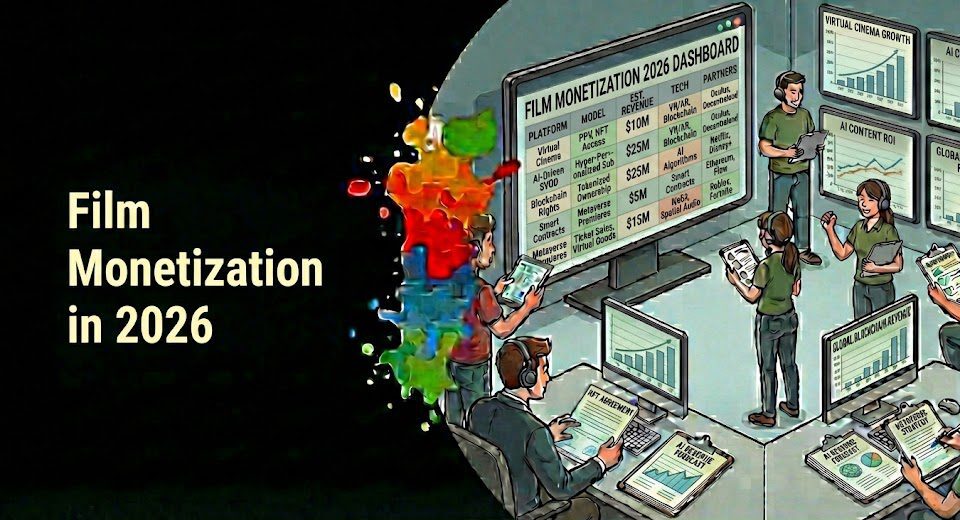
Film monetization in 2026 is no longer about a single “big sale” to a streamer. It’s a high-stakes transition to hybrid monetization models where SVOD, AVOD, and FAST channels coexist with shoppable commerce and extended IP licensing.
The era of platform exclusivity has collapsed, replaced by a “Weaponized Distribution” strategy that prioritizes cash flow over walled-garden vanity.
The capital reality? It’s tougher. With major buyers consolidating and interest rates stabilizing at a “new normal,” producers can’t just rely on pre-sales. You’ve got to architect revenue from day one.
Whether you’re navigating the streaming consolidation effect or planning for post-production financial oversight, the goal is simple: maximize ARPU (Average Revenue Per User) across every possible window.
In This Guide:
Stop Guessing Who’s Financing. Get Targeted Outreach.
Stop searching and start getting funded. We identify the exact decision-makers currently backing projects like yours, turning raw data into risk-aligned capital partnerships.
Major Studios
Scouting early stage projects, IP, and Regional partners for global studio pipelines.
IP Owners & Leads
Connecting creative leads with qualified financiers and major streaming platforms.
Streamers
Securing high-value pre-buy content and discovering early-stage global IP for platforms.
Indie Producers
Bridging the gap for indie filmmakers to reach executive production partners and capital.
Global Financing Ecosystems
Mapping complex markets and pairing projects with disciplined, risk-aligned capital across global territories worldwide.
Why Subscription-Only Ended in 2026
Look, the “Streaming Wars” were won by the balance sheet, not just the content library. By early 2026, the industry recognized that relying solely on monthly subscriptions was a recipe for churn-induced suicide. That’s why hybrid monetization models became the standard.
The shift was driven by consumer fatigue. Nobody wants to manage fifteen siloed $15/month apps. Instead, we’ve seen a massive pivot toward “Convergence Tiers.” Think about it: an ad-light tier for the budget-conscious, a premium tier for the purists, and a “shoppable” tier for the fans who want that jacket the lead actor is wearing—right now. Streaming and OTT deals in 2026 are now structured around these multi-layer revenue triggers.
“The 2026 reality? If you aren’t monetizing the metadata and the engagement, you’re leaving 40% of your potential revenue on the table.” — Insider Analysis
FAST and AVOD: The New Ad-Supported Engines
If you thought FAST (Free Ad-supported Streaming TV) was just a dumping ground for old reruns, you missed the memo. In 2026, FAST and AVOD monetization is where the volume lives. It’s the ultimate anti-churn mechanism.
Platforms are now using FAST channels as a “top-of-funnel” acquisition strategy. You give away the first season of a microdrama for free on a FAST channel to drive the audience into a paid subscription for season two. It’s a classic drug-dealer model, and it works perfectly for financing vertical video and short-form storytelling.
Phil Hunt, CEO of Head Gear Films, on the shifting revenue landscape:

The Vitrina Monetization Stack™
To navigate this complexity, we’ve developed The Vitrina Monetization Stack™. This framework helps producers categorize their revenue potential across four distinct layers of the supply chain.
| Layer | Monetization Mechanism | Target Metric |
|---|---|---|
| Core Screen | SVOD, AVOD, TVOD, FAST | ARPU / CPM |
| Extended IP | Gaming, Licensing, Merch | LTV (Lifetime Value) |
| Community | Direct-to-Consumer, Events | Retention Rate |
| Data/Assets | Catalog Licensing, AI Training | Asset Utilization |
Find the Financiers Backing Your Genre
Stop searching and start getting funded. We identify the exact decision-makers currently backing projects like yours, turning raw data into risk-aligned capital partnerships.
5 Methods to Monetize Your IP Beyond the Screen
The screen is just the starting point. In 2026, the most successful producers are treating their stories as “IP Engines.” Here’s how to actually monetize your IP beyond the screen:
- Weaponized Gaming: Don’t just license a game; build a hardware-agnostic cloud experience that allows fans to “play the movie.”
- Shoppable Environments: Use AI-driven metadata to allow viewers to purchase items from the scene in real-time.
- Micro-Community Access: Charge for “behind-the-scenes” governance or exclusive community events pre-release.
- Authorized AI Licensing: License your character’s likeness and voice for authorized AI training data.
- Sovereign Hub Bundling: Partner with regional hubs to access local commerce and tourism offsets.
This is how you turn a one-off film into long-term media asset value. You’re not just selling a ticket; you’re selling an ecosystem.
The ROI of Localization: Why Subtitles Aren’t Enough
The market for English-only content has hit a ceiling. The growth is in the non-English-speaking world, particularly APAC and MENA. But here’s the thing: simple translation is a cost; strategic localization is a revenue driver.
Culturally adapted content allows you to tap into regional advertising budgets that are twice as large for local-language productions. It also allows you to execute audience segmentation for investors. When you can prove that your film has been “localized for intent”—meaning it resonates with the cultural nuances of a high-spending region like Saudi Arabia or Indonesia—your valuation spikes.
How Vitrina Helps with Film Monetization
Navigating the 2026 monetization landscape requires more than just a good script. It requires data-powered connections. Vitrina’s supply chain intelligence platform is designed to de-risk your revenue strategy by connecting you with the right partners at the right time.
Ask VIQI about 2026 Monetization Models →
Get Expert Concierge Support for Your Deal →
Frequently Asked Questions
What is the most profitable monetization model in 2026?
There’s no “silver bullet,” but hybrid models that combine SVOD and AVOD typically show the highest ARPU. By capturing both high-value premium subscribers and mass-market ad revenue, platforms stabilize their cash flow and reduce churn.
How does FAST channel revenue actually reach the producer?
Revenue is usually distributed through a Revenue Share (RevShare) model. Platforms pay a percentage of the ad revenue generated by your channel, often based on completion rates and impressions. It’s slower than a flat license fee, but the long-tail upside is significantly higher.
Is vertical video storytelling actually financeable?
Yes, but it’s financed differently. Brands are increasingly acting as “executive producers” for microdramas on platforms like TikTok or Reels. The monetization is built into the content itself through shoppable links and brand integration rather than just backend residuals.
Can independent films survive the streaming consolidation?
Survival requires Weaponized Distribution. Instead of fighting for a “walled garden” exclusive on one platform, producers are licensing their films to multiple “frenemy” platforms to recoup production costs faster. It’s about being everywhere, not just in one place.
Does AI help or hurt film monetization?
It helps the efficient and hurts the slow. AI-driven localization and automated metadata tagging reduce the “monetization delay” from months to days. The faster you can deploy your content across global territories, the faster your ROI starts to manifest.
The Bottom Line
Film monetization in 2026 is a game of diversified risk and maximized ARPU. The era of “selling and forgetting” is dead. Today, you must build a capital stack that factors in hybrid revenue streams from the first draft. Focus on your IP’s lifetime value, weaponize your distribution across consolidated platforms, and never underestimate the ROI of a culturally localized strategy.
Ready to structure your next deal for the 2026 market? Vitrina’s Concierge team can connect you with the financiers and distributors you need to close your budget in record time.
Find Film+TV Projects, Partners, and Deals – Fast.
VIQI matches you with the right financiers, producers, streamers, and buyers – globally.
Producers Seeking Financing, Co-Pros, or Pre-Buys?
Vitrina Concierge helps producers reach the right financiers, commissioners, distributors, and co-production partners — with precision outreach, not cold pitching.
Join Industry Briefings Trusted by Leaders

Micro-Dramas & Mobile-First Storytelling
Micro-dramas are building real audiences and revenue. Understand the platforms, buyers, and economics behind the growth.

Navigating Global Content Licensing Trends
How global content licensing is shifting beyond flat fees to flexible, deal-driven models.
Film & TV Production Financing: 2026 Trends
Production financing conditions are changing quickly. Understanding where money is moving and what buyers are backing is key to getting projects approved and funded in 2026.
Unreleased Film+TV Projects: Opportunities & Showcase
A curated view of unreleased Film and TV projects open for financing and collaboration