About Innovation Hub
 Global Content Pulse (Webinars)


 Global Production Financing
(Webinars)
Global Production Financing
(Webinars)  LeaderSpeak Podcast
  Global Entertainment Digest (Newsletter)
  About Vitrina
 About VIQI
 Our Story
 Our Solutions 🔥
 Film+TV Projects Tracker 🚀
 Case Studies
 Our Profile
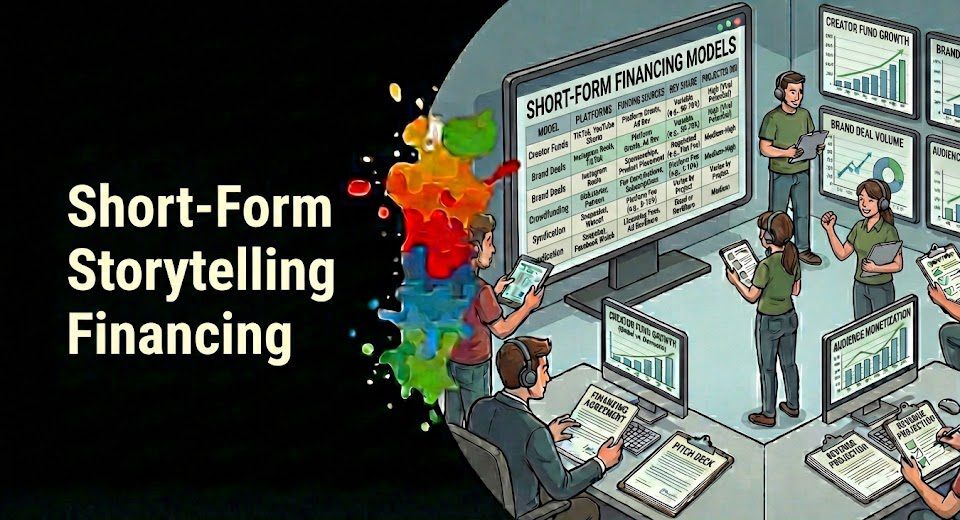
The next billion-dollar media franchise isn’t premiering at Cannes or Sundance—it’s being swiped through in 90-second increments on a crowded subway. Short-form storytelling financing has shifted from the “creator fund” pennies of the early TikTok era to a sophisticated, institutional capital stack.
Today, professionalized microdramas command budgets of $150,000 to $300,000 per series, funded by a mix of platform grants, private equity slates, and revenue-share models that prioritize algorithm metrics over traditional artistic prestige.
The Reality?
Short-form financing is now a metrics-first game. Unlike traditional TV, vertical series are funded based on Hook Rates (>65%) and Day 1 Retention (>40%). Capital is moving away from “Peak TV” and toward high-frequency content hubs where ROI is realized in weeks. For producers, the first step in de-risking is exploring verified short-form lenders on Vitrina to secure reliable production capital.
In This Article
Stop Guessing Who’s Financing. Get Targeted Outreach.
Stop searching and start getting funded. We identify the exact decision-makers currently backing projects like yours, turning raw data into risk-aligned capital partnerships.
Major Studios
Scouting early stage projects, IP, and Regional partners for global studio pipelines.
IP Owners & Leads
Connecting creative leads with qualified financiers and major streaming platforms.
Streamers
Securing high-value pre-buy content and discovering early-stage global IP for platforms.
Indie Producers
Bridging the gap for indie filmmakers to reach executive production partners and capital.
Global Financing Ecosystems
Mapping complex markets and pairing projects with disciplined, risk-aligned capital across global territories worldwide.
The Rise of the Swipe-to-Pay Economy
We’ve seen this play before—but never at this speed. Platforms like ReelShort, DramaBox, and ShortTV have weaponized the mobile experience, turning episodic drama into a retail product. Unlike Netflix, where you pay for a monthly “all-you-can-eat” buffet, microdrama platforms charge per episode. It’s a direct-to-consumer (DTC) model that functions more like a mobile game than a traditional TV show.
This shift fundamentally changes how projects are greenlit. In traditional production financing, a project lives or dies on its cast and director. In short-form storytelling financing, it lives or dies on its Hook Rate. If you can’t stop a user from swiping in the first three seconds, your financing is effectively evaporated. Hard truth? The algorithm is your first executive producer.
Financing Models: Buyouts vs. Revenue Share
Look, behind closed doors, the conversation usually splits into two camps: the safe buyout or the risky rev-share. Here’s the real dynamic we’re tracking at Vitrina:
- The Buyout (Platform Original): A platform like ReelShort pays for 100% of the production budget. You get your producer fee (typically 10-15%) and move on. They own the IP forever. (Safe, but you lose the upside).
- The Revenue-Share (Co-Financing): You bring 50% of the capital, they bring 50%. After the platform recoups its User Acquisition (UA) spend—which can be triple the production cost—you split the net profit. This is where the real money is made.
Matthew Helderman (BondIt Media Capital) on the speed of modern media financing.
The Vitrina Micro-ROI Matrix™
Our analysis shows that financiers are using a new scorecard. If your project doesn’t hit these benchmarks in the first 48 hours of release, the capital tap shuts off immediately. Not quite what you’re used to in indie film? Fair enough, but this is the retail reality.
| Metric | Target Range | Impact on Financing |
|---|---|---|
| 3-Sec Hook Rate | >65% | Determines UA cost efficiency. |
| Day 1 Retention | >40% | Predicts long-term LTV. |
| Conversion to Paid | >5% | The primary ROI driver for equity. |
Find the Financiers Backing Your Genre
Stop searching and start getting funded. We identify the exact decision-makers currently backing projects like yours, turning raw data into risk-aligned capital partnerships.
Slate Financing: The Professional’s Play
Smart players understand that short-form storytelling financing isn’t about single-project bets. It’s about slates. Because the algorithm is fickle—and user tastes change by the hour—private equity firms are now funding “batches” of 10-15 microdramas at once. And that’s where it gets interesting.
This de-risks the entire investment thesis; one viral hit pays for the nine that “only” broke even. We’re seeing capital flows toward “Vertical Content Studios”—factory-like production hubs that can script, shoot, and deliver a 60-episode series in 21 days. If you’re building a slate, Ask VIQI about current platform grant requirements to see where your projects fit.
Regional Spotlight: MENA’s Micro-Series Explosion
Saudi Arabia’s Vision 2030 isn’t just about $200 million blockbusters. The real momentum is in localized, vertical content. The MENA region has some of the highest mobile penetration rates in the world. (And that’s being generous). Platforms like DramaBox are aggressively funding Arabic-language microdramas to capture this high-ARPU audience.
How Vitrina Helps with Short-Form Storytelling
Finding the right financing partner for a vertical series requires moving faster than traditional film markets allow. Vitrina’s database connects you with the specialized lenders and platforms driving this sector.
- Explore Short-Form Lenders: Filter by budget range and platform preference on our Global Platform.
- Ask VIQI: Get requirements for ReelShort, DramaBox, and more in seconds.
- Contact Concierge: Let our experts match your slate with institutional capital via the Vitrina Concierge Service.
Frequently Asked Questions
How do microdramas make money?
They monetize through a “pay-per-episode” model. Users typically get the first 5-10 episodes free, then must buy “coins” or watch ads to unlock the rest.
What is the average budget for a vertical video series?
Professional microdramas currently range from $150,000 to $300,000 for a full series (60-80 episodes).
Can I get gap financing for a microdrama?
Traditional gap financing is rare here because platforms demand global rights. However, debt facilities based on platform “minimum guarantees” are becoming available.
The Bottom Line
Short-form storytelling financing is no longer a niche for influencers—it’s a multi-billion dollar industrial machine. The producers who thrive won’t just be great storytellers; they’ll be masters of UA metrics and slate management. Ready to fund your next vertical series? Connect with our Concierge team today to find qualified investors in 48 hours.
Find Film+TV Projects, Partners, and Deals – Fast.
VIQI matches you with the right financiers, producers, streamers, and buyers – globally.
Producers Seeking Financing, Co-Pros, or Pre-Buys?
Vitrina Concierge helps producers reach the right financiers, commissioners, distributors, and co-production partners — with precision outreach, not cold pitching.
Join Industry Briefings Trusted by Leaders

Micro-Dramas & Mobile-First Storytelling
Micro-dramas are building real audiences and revenue. Understand the platforms, buyers, and economics behind the growth.

Navigating Global Content Licensing Trends
How global content licensing is shifting beyond flat fees to flexible, deal-driven models.
Film & TV Production Financing: 2026 Trends
Production financing conditions are changing quickly. Understanding where money is moving and what buyers are backing is key to getting projects approved and funded in 2026.
Unreleased Film+TV Projects: Opportunities & Showcase
A curated view of unreleased Film and TV projects open for financing and collaboration