About Innovation Hub
 Global Content Pulse (Webinars)


 Global Production Financing
(Webinars)
Global Production Financing
(Webinars)  LeaderSpeak Podcast
  Global Entertainment Digest (Newsletter)
  About Vitrina
 About VIQI
 Our Story
 Our Solutions 🔥
 Film+TV Projects Tracker 🚀
 Case Studies
 Our Profile
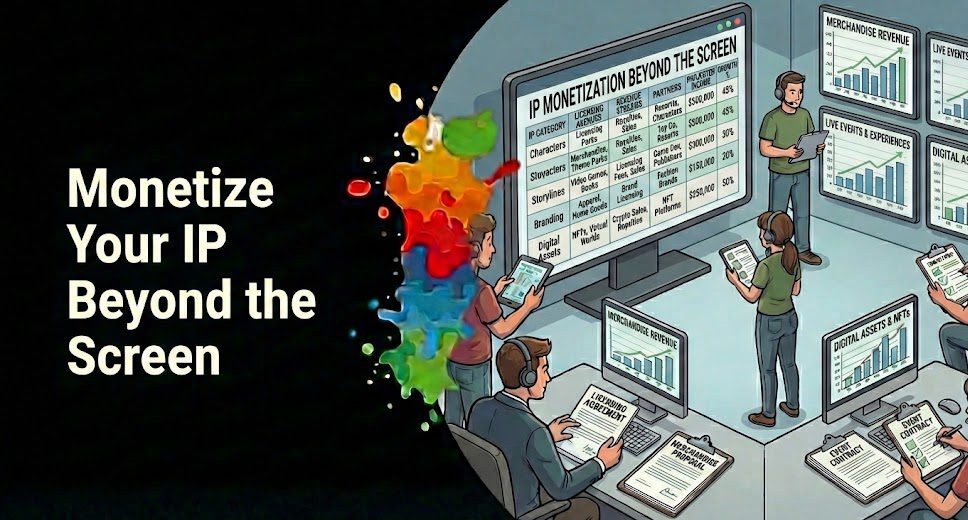
IP monetization beyond the screen isn’t just an “ancillary” consideration anymore—it’s the core survival strategy for 2025. With theatrical windows collapsing and streamers slashing licensing fees, your IP must work harder outside the frame. By diversifying into merchandising ($55B market), immersive entertainment, and digital ownership, producers can de-risk their slate and capture value that traditional exhibition models simply can’t touch.
The reality? If you’re only counting on screen revenue, you’re leaving 70% of your potential profit on the table. Here’s how to weaponize your intellectual property across the physical and digital supply chain.
Table of Contents
- The New Reality: Why Screen Revenue Is No Longer Enough
- Method 1: The $55B Merchandising & Peripheral Market
- Method 2: Transmedia Storytelling: Narrative as a Multi-Platform Asset
- Method 3: Location-Based Entertainment (LBE): Immersive ROI
- Method 4: Digital Assets & Web3: Weaponizing Fan Ownership
- Method 5: Weaponized Distribution™ & Brand Licensing
- Frequently Asked Questions
Stop Guessing Who’s Financing. Get Targeted Outreach.
Stop searching and start getting funded. We identify the exact decision-makers currently backing projects like yours, turning raw data into risk-aligned capital partnerships.
Major Studios
Scouting early stage projects, IP, and Regional partners for global studio pipelines.
IP Owners & Leads
Connecting creative leads with qualified financiers and major streaming platforms.
Streamers
Securing high-value pre-buy content and discovering early-stage global IP for platforms.
Indie Producers
Bridging the gap for indie filmmakers to reach executive production partners and capital.
Global Financing Ecosystems
Mapping complex markets and pairing projects with disciplined, risk-aligned capital across global territories worldwide.
The New Reality: Why Screen Revenue Is No Longer Enough
We’re currently living through what industry veterans call “The Big Crunch.” Traditional pre-sales are harder to close, and the “Cost Plus” models of the major streamers have turned many producers into work-for-hire contractors rather than IP owners. It’s a tough environment for anyone trying to build a sustainable studio.
As Phil Hunt, CEO of Head Gear Films, points out—the landscape has shifted. Lenders and investors are no longer just looking at your box office projections; they’re looking at your brand durability. Can this IP live on a T-shirt? Does it have a “phygital” future? If the answer is no, your project is exponentially higher risk.
Producers looking to evaluate their IP’s marketability can ask VIQI, Vitrina’s AI research assistant, for a strategic audit of current licensing trends in their specific genre.
Method 1: The $55B Merchandising & Peripheral Market
The global film and TV IP peripherals market is projected to reach **$55.1 billion in 2025**. This isn’t just about plastic toys; it’s a sophisticated ecosystem of apparel, collectibles, and “lifestyle integrations” that keep your brand relevant between seasons or sequels.
Why Toys Still Dominate (33% Market Share)
Toys remain the king of IP monetization. Why? Because they’re the ultimate physical manifestation of fandom. In 2025, we’re seeing a massive rise in “kidult” spending—adults buying high-end collectibles that serve as both nostalgia and investment assets. If your IP has characters with distinctive silhouettes or iconic props, you have a merchandising goldmine waiting to be tapped.
But here’s the catch: the retail landscape is fragmented. You’re not just fighting for shelf space at big-box retailers; you’re fighting for “drops” on social commerce platforms. Smart IP holders are bypassing traditional retail to launch direct-to-fan storefronts. If you’re looking for partners to help with this, you can explore verified licensing partners on Vitrina.
Method 2: Transmedia Storytelling: Narrative as a Multi-Platform Asset
Transmedia storytelling isn’t just “marketing”; it’s a revenue multiplier. It involves telling a single story across multiple platforms, where each medium adds a unique piece of the narrative puzzle. Think of a podcast that serves as a prequel to your series, or a mobile game that unlocks exclusive “backstory” content.
Phil Hunt, CEO of Head Gear Films, explains why owning the audience relationship is critical:

As Hunt notes, the “Big Crunch” means you can’t rely on the streamers to do your brand building for you. You have to create a “dynamic story ecosystem” that lives where your fans live—on social platforms, in their ears, and on their mobile devices.
Find the Financiers Backing Your Genre
Stop searching and start getting funded. We identify the exact decision-makers currently backing projects like yours, turning raw data into risk-aligned capital partnerships.
Method 3: Location-Based Entertainment (LBE): Immersive ROI
Location-Based Entertainment is the fastest-growing sector of IP monetization in 2025, with a projected CAGR of 22-28%. We’re talking about escape rooms, immersive pop-up “museums,” and themed dining experiences. Fans are increasingly valuing *experiences* over *possessions*, and they’re willing to pay a premium for it.
The Vitrina IP Monetization Ladder™
Use this scoring system to determine if your IP is ready for an LBE expansion:
- Visual Iconography (1-5): Does the world have distinctive, reproducible aesthetics?
- Narrative Interactive Potential (1-5): Can fans “play” in your world without breaking the canon?
- Audience Density (1-5): Is your fanbase concentrated in major urban “hotspots”?
- Repeatability (1-5): Is the experience deep enough to warrant a second visit?
Score 15+? Your IP is prime for LBE licensing.
LBE doesn’t require you to build a theme park. It requires you to license your rights to specialized experiential operators who handle the overhead while you collect the royalties. It’s a high-margin play that deepens fan loyalty like nothing else.
Method 4: Digital Assets & Web3: Weaponizing Fan Ownership
The 2025 digital asset landscape has moved far beyond the “NFT hype” of years past. Today, it’s about **digital ownership**. This means creating in-game assets, “interoperable skins,” and digital trophies that fans actually own. When a fan owns a piece of your IP—even a digital one—their “churn rate” drops to nearly zero.
Digital Ownership in 2025 refers to the use of blockchain technology to grant fans verifiable, tradable rights to unique digital assets—such as characters, costumes, or early-access perks—within a franchise’s ecosystem.
Secondary marketplaces now generate ongoing revenue for IP holders through “creator royalties” on every subsequent trade. It’s the first time in history that a producer gets a cut of the “second-hand” market. If you’re exploring Web3 integration, join Vitrina to find tech partners specialized in entertainment Web3 deployments.
Method 5: Weaponized Distribution™ & Strategic Brand Licensing
At Vitrina, we call this **Weaponized Distribution™**. It’s the strategic use of your IP to open doors in entirely different industries. Think of a high-end streetwear collaboration for a gritty drama series, or a themed skincare line for a period piece. You aren’t just selling products; you’re borrowing the marketing might of other global brands.
This model follows the “Mickey Mouse Blueprint”: Disney didn’t build every factory; they licensed the swoosh. By licensing your association to lifestyle, fashion, or even consumer electronics brands, you achieve a “borderless” reach that theatrical distribution could never match. It’s capital-efficient, high-leverage, and fundamentally de-risks your entire investment thesis.
How Vitrina Helps with IP Monetization
Navigating the IP supply chain is complex. With over 600,000 companies in opaque silos—what we call The Fragmentation Paradox™—finding the right licensing partner or LBE operator is often a matter of who you know. Vitrina changes that.
- Verified Database: Explore 140+ specialized licensing and merchandising partners.
- VIQI AI Assistant: Get instant answers on territory-specific licensing requirements.
- Concierge Service: Our team provides hands-on support for high-stakes IP diversification deals.
Ready to stop leaving money on the table? Create your Vitrina account today and start exploring the secondary revenue landscape.
Frequently Asked Questions
What is IP monetization beyond the screen?
IP monetization beyond the screen refers to the process of generating revenue from a film or TV brand through ancillary channels like merchandising, licensing, gaming, location-based entertainment, and digital assets. It allows IP holders to maximize value by engaging fans in their daily lives, independent of traditional viewing windows.
How much does it cost to start a merchandising line?
Costs vary wildly, but the beauty of licensing is that the *licensee* (the manufacturer) usually bears the production and distribution costs. The IP holder typically receives a “minimum guarantee” (MG) upfront, plus ongoing royalties ranging from 5-15% of wholesale or retail sales. Your primary cost is legal and brand-management oversight.
Is transmedia storytelling profitable for indie producers?
Yes, if handled strategically. You don’t need a Marvel budget to execute transmedia. Low-cost entries like podcasts, web-comics, or social-media-first “narrative fragments” can build an audience and serve as “proof of concept” for larger licensing deals later. It’s about building a world, not just a single project.
What is Location-Based Entertainment (LBE)?
LBE involves physical venues or events that leverage IP to create immersive experiences. This includes escape rooms, themed cafes, immersive theater, and pop-up exhibits. It is one of the fastest-growing sectors in media, driven by a generational shift toward “experiential” spending.
The Bottom Line
In 2025, your IP is either a “walled garden” or a “borderless brand.” The producers who succeed aren’t just making great content; they’re building economic engines that thrive across the entire fan experience. If you’re ready to de-risk your project through strategic diversification, Vitrina’s Concierge service is here to connect you with the right partners.
Find Film+TV Projects, Partners, and Deals – Fast.
VIQI matches you with the right financiers, producers, streamers, and buyers – globally.
Producers Seeking Financing, Co-Pros, or Pre-Buys?
Vitrina Concierge helps producers reach the right financiers, commissioners, distributors, and co-production partners — with precision outreach, not cold pitching.
Join Industry Briefings Trusted by Leaders

Micro-Dramas & Mobile-First Storytelling
Micro-dramas are building real audiences and revenue. Understand the platforms, buyers, and economics behind the growth.

Navigating Global Content Licensing Trends
How global content licensing is shifting beyond flat fees to flexible, deal-driven models.
Film & TV Production Financing: 2026 Trends
Production financing conditions are changing quickly. Understanding where money is moving and what buyers are backing is key to getting projects approved and funded in 2026.
Unreleased Film+TV Projects: Opportunities & Showcase
A curated view of unreleased Film and TV projects open for financing and collaboration