About Innovation Hub
 Global Content Pulse (Webinars)


 Global Production Financing
(Webinars)
Global Production Financing
(Webinars)  LeaderSpeak Podcast
  Global Entertainment Digest (Newsletter)
  About Vitrina
 About VIQI
 Our Story
 Our Solutions 🔥
 Film+TV Projects Tracker 🚀
 Case Studies
 Our Profile
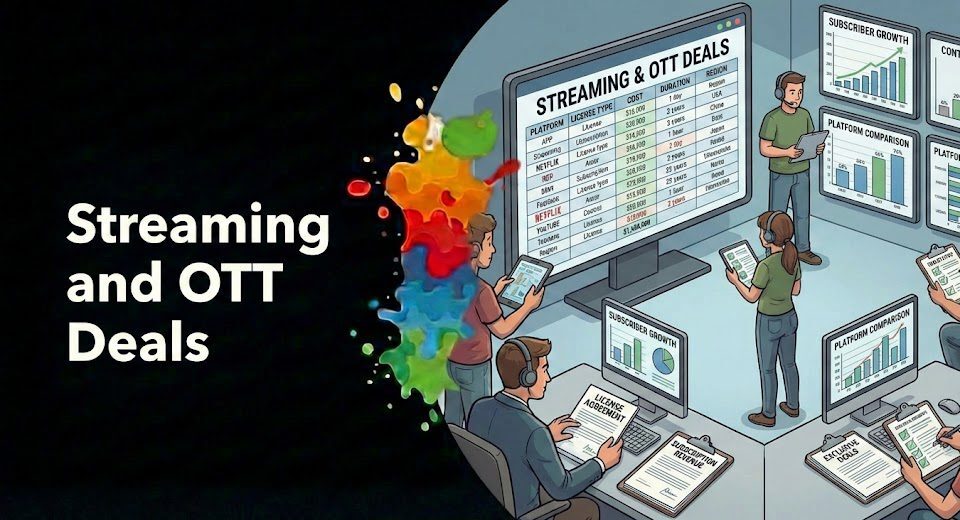
Streaming and OTT deals in 2026 have pivoted from a “growth-at-all-costs” subscriber race to a disciplined focus on ARPU (Average Revenue Per User) and strategic consolidation. The headline event—Netflix’s $82.7 billion acquisition of Warner Bros. Discovery—has fundamentally redrawn the licensing map, forcing competitors into aggressive bundling and “frenemy” co-licensing structures to survive the convergence crisis.
The reality for producers? The days of easy exclusivity checks are over. In 2026, streamers aren’t just buying content; they’re buying retention. If your project doesn’t have “stickiness” or cross-territory appeal, it’s getting left on the shelf. We’re seeing a market where the supply chain is finally tightening, and only the most strategically grounded deals are reaching greenlight status.
In This Article:
Stop Guessing Who’s Financing. Get Targeted Outreach.
Stop searching and start getting funded. We identify the exact decision-makers currently backing projects like yours, turning raw data into risk-aligned capital partnerships.
Major Studios
Scouting early stage projects, IP, and Regional partners for global studio pipelines.
IP Owners & Leads
Connecting creative leads with qualified financiers and major streaming platforms.
Streamers
Securing high-value pre-buy content and discovering early-stage global IP for platforms.
Indie Producers
Bridging the gap for indie filmmakers to reach executive production partners and capital.
Global Financing Ecosystems
Mapping complex markets and pairing projects with disciplined, risk-aligned capital across global territories worldwide.
The 2026 M&A Landscape: Netflix-WBD and Beyond
Behind closed doors, the conversation throughout early 2026 has been dominated by one number: $82.7 billion. That’s the price tag for Netflix’s aggressive move to swallow Warner Bros. Discovery’s studios and HBO Max. What the trades don’t always report is the sheer operational complexity of this merger—specifically how Netflix is de-risking the deal by spinning off the linear networks into “Discovery Global.”
This isn’t just a corporate land grab. It’s a signal that the “Streaming Wars” have entered their final, consolidated phase. With Netflix now controlling a combined 453 million subscribers, rivals like Disney+ and the rumored Paramount-Peacock merger are shifting to “survival mode.” For producers, this means the pool of buyers has shrunk, but the buyers remaining have deeper pockets and a much higher bar for entry.
Strategic players understand that this consolidation drives a new kind of “Weaponized Distribution™.” Streamers are now more likely to license their own library titles to competitors—a “frenemy” strategy designed to squeeze every cent of EBITDA out of existing assets rather than letting them sit in exclusive silos.
The Vitrina Streaming Convergence Framework™
The Vitrina Streaming Convergence Framework™
In 2026, successful OTT deals must satisfy three critical pillars to ensure platform sustainability and ROI.
This framework explains why we’re seeing deals like the Disney-Sora partnership. By integrating AI-assisted publishing engines, Disney can generate thousands of localized “moments” to keep fans inside the Disney+ interface. It’s not about the movie anymore; it’s about the ecosystem.
Producers looking to align with these trends can ask VIQI for a deep-dive into platform-specific licensing requirements for 2026.
Find the Financiers Backing Your Genre
Stop searching and start getting funded. We identify the exact decision-makers currently backing projects like yours, turning raw data into risk-aligned capital partnerships.
Is Exclusivity Dead? The New Co-Licensing Reality
The capital reality is harsh: streaming services can no longer afford to keep their best content in the dark. In 2026, “Streaming and OTT Deals” increasingly feature non-exclusive windows or “First Window” exclusivity that expires in as little as 12 months. After that? The content travels.
Look at the Warner-Netflix dynamics before the acquisition. HBO titles were already popping up on Netflix to find new life. In 2026, this is the standard operating procedure. This co-licensing model helps platforms split the cost of high-budget productions while ensuring the content reaches the widest possible audience to fuel ad-tier revenue.
Phil Hunt, CEO of Head Gear Films, discusses the shifting economics of the supply chain:

As Hunt notes, the “Big Crunch” has arrived. Financing a film is no longer about one big check from a streamer. It’s about a complex capital stack involving production financing, tax credits, and layered distribution deals. The 2026 producer is effectively a financial engineer.
Why ARPU Replaced Subscriber Counts as the North Star
If you’re still tracking subscriber counts, you’re looking at the wrong map. In 2026, the market signals are clear: Average Revenue Per User (ARPU) is the only metric that matters. Netflix and Disney+ have stopped reporting quarterly subscriber adds precisely because those numbers are too volatile and don’t reflect actual profitability.
The pivot toward AVOD (Advertising Video On Demand) has transformed streaming into a high-frequency ad business. Ad-supported tiers now account for all net new subscription growth in the U.S. market. For producers, this means “comfort TV”—procedurals, reality, and episodic content—is now more valuable than the one-off auteur drama. Why? Because long viewing sessions drive more ad impressions. It’s that simple.
Strategic players are optimizing slates for “Shoppable Video.” Imagine watching a cooking show and buying the chef’s knife directly through your TV remote with a QR-driven flow. This is no longer a pilot program; it’s a integrated revenue stream in 2026 OTT deals.
Producers need to understand how their content facilitates these secondary revenue streams. Are you just making a show, or are you building a commerce engine? The answer determines your deal terms.
How Vitrina Helps You Navigate 2026 OTT Deals
Navigating the 2026 landscape requires more than just a sales agent; it requires real-time supply chain intelligence. Vitrina’s platform is built to solve the “Fragmentation Paradox™” where deal data is hidden in thousands of opaque silos.
- Verified Intelligence: Access data on 600,000+ companies involved in global distribution and licensing.
- Lender & Financier Discovery: Find 140+ verified gap lenders and slate financiers actively deploying capital in 2026.
- Regional Mapping: Identify Sovereign Content Hubs™ in Saudi Arabia, UAE, and APAC with the highest current incentives.
Ask VIQI About Streaming Trends →
Contact Concierge for Deal Support →
Frequently Asked Questions
What is the most significant change in streaming deals for 2026?
The shift from exclusivity to strategic co-licensing. Streamers now prioritize revenue optimization (ARPU) over library exclusivity, leading to “frenemy” deals where content is shared across multiple ad-supported platforms to maximize reach and EBITDA.
How does the Netflix-WBD deal affect independent producers?
It reduces the number of major buyers but creates a massive, high-spending entity. Producers now face a higher quality bar and must prove “global travelability.” However, Netflix has signaled it will ramp up original production slates to feed its 453M subscriber base.
Are AVOD tiers actually profitable for content creators?
Yes, especially for long-form scripted content and “comfort TV.” The ad-revenue share models in 2026 are becoming more transparent, allowing creators to participate in the upside of high-engagement content that drives multiple ad breaks.
What happens to theatrical windows in these new OTT deals?
There is significant tension. While exhibitors want 45-day windows, rumors suggest Netflix-WBD may push for 17-day windows on tentpole films. Most mid-budget deals in 2026 now feature “Hybrid-Day-and-Date” or extremely compressed theatrical windows.
The Bottom Line
The 2026 streaming market is no longer a playground for experimentation; it’s a high-stakes arena for capital efficiency. Deals are structured around retention, ad-tier performance, and ecosystem “stickiness.” If you’re looking to close a project in this environment, you need to think like a platform, not just a filmmaker.
Ready to secure your next deal? Vitrina’s Concierge team is ready to match you with the right streamers and financiers today.
Find Film+TV Projects, Partners, and Deals – Fast.
VIQI matches you with the right financiers, producers, streamers, and buyers – globally.
Producers Seeking Financing, Co-Pros, or Pre-Buys?
Vitrina Concierge helps producers reach the right financiers, commissioners, distributors, and co-production partners — with precision outreach, not cold pitching.
Join Industry Briefings Trusted by Leaders
The New Deal Room: A 2026 Playbook for Global Content Licensing
How global content licensing is shifting beyond flat fees to flexible, deal-driven models.
Film & TV Production Financing: 2026 Trends
Production financing conditions are changing quickly. Understanding where money is moving and what buyers are backing is key to getting projects approved and funded in 2026.
Unreleased Film+TV Projects: Opportunities & Showcase
A curated view of unreleased Film and TV projects open for financing and collaboration