IHUB
IHUB
 Global Content Pulse (Webinars)


 Global Production Financing
(Webinars)
Global Production Financing
(Webinars)  LeaderSpeak Podcast
  Global Entertainment Digest (Newsletter)
  About Vitrina
 About VIQI
 Our Story
 Our Solutions 🔥
 Film+TV Projects Tracker 🚀
 Case Studies
 Our Profile

By Vitrina Research Team | Published: July 25, 2026 | 8 min read
The entertainment supply chain is one of the most complex commercial ecosystems on earth. A single theatrical film can touch hundreds of vendors across a dozen countries before it reaches a paying audience. Yet for most studios, streamers, and distributors, the chain remains poorly mapped, fragmented, and vulnerable to disruptions that compound fast. Understanding how content moves from a writer’s room to a global screen is no longer optional for executives; it’s a competitive requirement.
The global media and entertainment market was valued at approximately USD 2.8 trillion in 2025 and is forecast to reach USD 3.4 trillion by 2030, according to PwC’s Global Entertainment and Media Outlook 2025-2029. That growth is built on supply chain velocity. Whoever moves content faster, smarter, and at lower friction cost wins market share. The industry’s best operators have learned this. The rest are catching up.
This article breaks down every stage of the modern entertainment supply chain, maps the key players at each node, examines how streaming restructured traditional flows, and explains how intelligence platforms are helping executives make faster, more confident decisions. If you’re sourcing content, commissioning originals, or building distribution networks, this is the map you need.
Key Takeaways
- The entertainment supply chain spans six stages: development, production, post-production, distribution, exhibition, and streaming delivery.
- Streaming has compressed the chain but added new complexity, including simultaneous multi-territory release windows and platform-specific technical specs.
- The 2023 WGA and SAG-AFTRA strikes cost the U.S. industry an estimated USD 6.5 billion in lost output (Deadline, 2023).
- AI, co-production structures, and supply chain intelligence platforms are the three fastest-growing tools for reducing friction and risk.
- VIQI’s dataset of 159,223 verified M&E companies gives executives a full-chain view of potential partners, vendors, and buyers worldwide.
Quick Answer
The entertainment supply chain in modern media covers six interconnected stages, from creative development through streaming delivery. Streaming platforms have compressed traditional windows while adding new complexity. Supply chain intelligence tools now help studios, distributors, and streamers identify partners, reduce risk, and accelerate decisions across all six stages.
What Is the Entertainment Supply Chain?
The entertainment supply chain is the end-to-end system through which a creative idea becomes a finished, monetizable piece of content delivered to an audience. According to the Motion Picture Association, the U.S. film and television industry supports more than 2.4 million direct jobs and generates USD 229 billion in total economic output annually. Every dollar of that output flows through a chain with many interdependent nodes.
Unlike manufacturing supply chains, the entertainment chain produces a non-physical good: intellectual property. That IP gets packaged, licensed, and delivered across multiple formats simultaneously. A single franchise can generate revenue across theatrical, broadcast, streaming, home entertainment, licensing, and live experiences. Each revenue stream adds its own supply chain layer.
What makes the chain difficult to manage is its project-based nature. Each production is essentially a temporary enterprise assembled from hundreds of independent contractors, vendors, and service companies. When one node fails, the delays compound. Studios and streamers that map this chain in advance are far better positioned to absorb shocks than those operating blind.
For a broader look at how entertainment companies track and analyze production activity, see our related article on how entertainment production data improves decision-making.
The Six Stages of the Entertainment Supply Chain
The entertainment supply chain in modern media runs through six distinct stages. Each stage has its own vendor ecosystem, risk profile, and decision-makers. Global content spending by streaming platforms alone exceeded USD 230 billion in 2024, according to Ampere Analysis, making the economics of each stage more consequential than ever before.
Key Stat
Global streaming platform content investment exceeded USD 230 billion in 2024, a figure that flows through every stage of the entertainment supply chain from script development through final delivery. This spending level creates both opportunity and systemic risk for vendors, studios, and distributors at every node. (Ampere Analysis, 2024)
Stage 1: Development
Development is where IP is identified, optioned, and shaped into a producible script or format. This stage involves writers, literary agents, producers, script editors, and development executives. It’s the longest and most unpredictable stage. Studios typically develop ten projects to greenlight one. The others are abandoned but represent real sunk cost.
Stage 2: Production
Production is the physical or virtual creation of the content. It involves directors, cast, crew, equipment vendors, location services, catering, insurance, and production financing. On a mid-budget studio film, 300-500 vendors may be engaged. Managing vendor quality and timeline across this vendor web is where most budget overruns originate.
Stage 3: Post-Production
Post-production covers editing, visual effects, color grading, sound design, music, dubbing, and subtitling. This stage has been transformed by the rise of remote workflows and cloud-based tools. VFX, in particular, is increasingly outsourced globally. India, Canada, and the UK are the dominant VFX hubs, offering a mix of cost efficiency and technical quality.
Stage 4: Distribution
Distribution is the commercial licensing and delivery of finished content to buyers across territories and platforms. This stage involves sales agents, distributors, licensing attorneys, and territorial broadcasters. Rights are carved by territory, language, format, and window. A single title can have 80 or more separate license agreements worldwide before all windows close.
Stage 5: Exhibition
Exhibition covers theatrical release through cinema chains. This remains a critical revenue and prestige window despite streaming’s growth. Global box office recovered to USD 33.9 billion in 2023, according to the MPA, driven by franchise titles and event cinema. Exhibitor relationships remain a priority for major studios and prestige distributors alike.
Stage 6: Streaming and Digital Delivery
Streaming delivery is now the largest revenue-generating stage for most content types. It requires mastering and quality control, metadata packaging, digital asset management, and CDN delivery. Each platform has its own technical delivery specification. A title delivered to Netflix, Amazon, Apple TV+, and Disney+ simultaneously requires four separate technical packages.
How Has Streaming Changed the Entertainment Supply Chain?
Streaming has fundamentally restructured power dynamics across the entertainment supply chain. Where traditional studios acted as integrated supply chain operators, streaming platforms created a new commissioning model that bypassed many traditional intermediaries. Netflix, for example, went from spending USD 13 billion on content in 2020 to an estimated USD 17 billion in 2024, according to Statista, reshaping vendor relationships and deal structures at every stage.
Key Stat
Netflix’s annual content spend grew from USD 13 billion in 2020 to approximately USD 17 billion in 2024, driving a structural shift in how studios, independent producers, and post-production vendors position themselves in the entertainment supply chain. Platform direct-commission deals now represent the largest single source of production finance for many mid-tier studios. (Statista, 2024)
Compressed Windows, Expanded Complexity
Streaming shortened the traditional release window from 90-180 days to as few as 17-45 days in some territories. This compression forced distributors to renegotiate exhibition agreements and rewire their licensing timelines. The benefit is faster cash flow. The cost is higher operational coordination pressure and frequent conflicts with theatrical exhibitors.
Platform-Specific Technical Requirements
Each streaming platform runs a different technical delivery specification. Netflix requires IMF packages with specific audio stems and HDR color grades. Disney+ has its own asset packaging requirements. Apple TV+ mandates specific ProRes and Dolby Vision standards. Post-production houses now maintain dedicated platform-spec teams, adding cost and time to the post-production stage.
The Rise of the SVOD Commission Model
Platform commissioning shifted creative risk back to independent producers. Under the old studio model, studios funded development and absorbed losses. Under SVOD commission models, independent producers often fund development themselves and sell a completed package. This has increased demand for co-production partners and gap financing, restructuring upstream supply chain relationships significantly.
For a deeper look at how streamers approach content decisions, see our analysis of how streamers approach content licensing decisions.
Map Your Entertainment Supply Chain
Vitrina’s VIQI platform gives you verified intelligence on 159,223 M&E companies across every stage of the entertainment supply chain. Find production partners, distributors, post houses, and buyers in one place.
Who Are the Key Players at Each Stage?
The entertainment supply chain involves a layered ecosystem of principals, service providers, and intermediaries at every stage. Mapping these players is essential for anyone trying to source, finance, distribute, or acquire content at scale. The relationships between them have changed significantly as streaming platforms took on roles previously held by studios and distributors.
Key Stat
Global box office revenue recovered to USD 33.9 billion in 2023 and continued growing into 2025, driven largely by franchise sequels and event cinema. Exhibition remains a critical supply chain stage for studios despite declining theatrical windows, because theatrical performance directly determines downstream licensing value for all other windows. (Motion Picture Association, 2024)
Development and Production Layer
At the development and production layer, key players include major studios (Disney, Universal, WB, Paramount, Sony), streaming studios (Netflix Studios, Amazon MGM Studios, Apple TV+ Original Films), independent production companies, literary agencies, talent management firms, and script development consultancies. Co-production treaties between countries add national film bodies and public broadcasters to this mix.
Post-Production and VFX Layer
The post-production layer is dominated by VFX studios, color houses, sound mixing facilities, music licensing companies, subtitling providers, and quality control services. Companies like Industrial Light and Magic, DNEG, Framestore, and MPC lead the VFX tier. The dubbing and localization segment has grown sharply, driven by the demand for multi-language versions from global streaming platforms.
Distribution and Exhibition Layer
Distribution involves sales agents, territorial distributors, broadcast rights buyers, and streaming platform acquisition teams. Key intermediaries include international sales companies such as Wild Bunch, Studiocanal, and eOne, alongside market platforms at Cannes, Berlin, and AFM where rights deals are negotiated. Exhibition is controlled by cinema chains: AMC, Cineworld, Vue, PVR Inox, and their regional equivalents worldwide.
Understanding which companies operate at which stages is the core intelligence need for content buyers and sellers. Our guide to top content licensing trends shaping the industry in 2026 covers how acquisition strategies are evolving across these layers.
Disruptions That Shake the Chain: Strikes, Pandemics, and AI
The entertainment supply chain is more exposed to disruption than most industries because of its project-based structure and heavy reliance on human creative labor. Three types of disruption have dominated the last five years: labor actions, pandemic-related shutdowns, and the emergence of AI tools that are rewriting the economics of several supply chain stages.
The 2023 Strikes and Their Lasting Impact
The simultaneous WGA and SAG-AFTRA strikes of 2023 cost the U.S. entertainment industry an estimated USD 6.5 billion in lost economic output, according to Deadline’s economic analysis. Production halted across more than 150 projects in various stages. Supply chain damage extended far beyond writers and actors; crew members, equipment houses, caterers, and location services all felt cascading revenue losses within weeks.
The strikes surfaced something important: the upstream supply chain, specifically development and production, is entirely dependent on a small pool of organized creative labor. When that labor stops, nothing else can move. Studios that had diversified into international production partnerships recovered faster by redirecting attention to non-U.S. projects during the standstill.
Pandemic-Era Supply Chain Restructuring
COVID-19 shutdowns in 2020-2021 functioned as an accelerated stress test. Productions halted globally. Theatrical exhibition collapsed. Streaming surged. The permanent legacy of that period is a remote-capable post-production infrastructure and a lasting preference for simultaneous streaming release strategies among many distributors. Supply chain resilience became a boardroom conversation, not just an operations one.
AI as Supply Chain Disruptor and Accelerator
Artificial intelligence is cutting time and cost at multiple supply chain stages simultaneously. AI tools are accelerating script analysis in development, reducing visual effects rendering times in post-production, and automating localization tasks including subtitling and dubbing lip-sync. A 2024 Goldman Sachs report estimated AI could reduce post-production costs by up to 25% within five years for studios that adopt it at scale.
The risk is concentration. AI adoption is faster at large studios and major streaming platforms, which can afford tool investment. Smaller independent producers and post houses face the risk of falling behind on cost competitiveness. Supply chain intelligence becomes more valuable in this context: knowing which vendors have adopted AI workflows helps buyers make faster, better-informed sourcing decisions.
For context on how production decisions are being reshaped by data and technology tools, see our piece on the state of global film production: opportunities and risks in 2026.
Where Are the Biggest Bottlenecks and Inefficiencies?
Supply chain inefficiency in entertainment is often invisible until it causes a delay or cost overrun. The most persistent bottlenecks concentrate at the handoff points between stages, where communication breaks down, deliverables are unclear, or vendor capacity is overbooked. Industry surveys consistently show that budget overruns and schedule slippage originate more from coordination failures than from technical problems.
Rights Clearance and Legal Delays
Rights clearance is among the most common causes of distribution delay. Clearing music rights, archival footage, trademarked brand appearances, and international format rights requires legal work across multiple jurisdictions. A documentary that clears all rights for North America may face weeks of additional negotiation before it can distribute in Europe or Asia. Streamers releasing globally have made this problem more acute.
VFX Vendor Capacity Constraints
VFX capacity is chronically oversubscribed. The top-tier studios handle multiple tentpole projects simultaneously, and their bandwidth is sold out months in advance. Second-tier VFX studios often lack the pipeline infrastructure to handle sudden increases in scope. Productions that don’t lock their VFX relationships early routinely face 10-20% cost increases when forced to switch vendors mid-production.
Metadata and Delivery Inconsistencies
Metadata errors are a surprisingly costly bottleneck in the streaming distribution stage. Incorrect or incomplete metadata causes platform ingestion failures that delay launch dates. Platforms like Netflix have strict metadata schemas; a missing required field can block an entire title delivery. Industry estimates suggest metadata errors affect 15-20% of first-delivery attempts, adding days or weeks to release timelines.
International Supply Chain Complexity
Cross-border content production has grown sharply as streaming platforms demand local-language originals for every major market. The European Audiovisual Observatory reported that international co-productions accounted for more than 40% of all new European film and TV titles produced in 2024, up from around 28% a decade earlier. That shift multiplies supply chain complexity at every stage.
Co-Production Treaties and Their Supply Chain Role
Bilateral co-production treaties between countries enable productions to pool financing, access public subsidies, and claim national film status in multiple markets simultaneously. Canada has the most extensive treaty network: agreements with more than 50 countries. These treaties restructure supply chains by requiring minimum creative and technical spending in each treaty country, distributing vendor relationships across borders by design.
Tax Incentives and Production Location Decisions
National and regional tax incentives now directly drive production location decisions. The UK offers a 34% tax relief for high-end TV drama. Australia provides a 40% producer offset for qualifying features. These incentives reshape supply chain geography annually. Studios relocate production to maximize incentive value, which in turn concentrates VFX, crew, and service vendor ecosystems in those territories.
Localization at Scale
Global streaming has driven localization demand to new highs. Netflix alone releases content in more than 30 languages with full dubbing and subtitling. Managing localization across dozens of vendors in dozens of languages while maintaining consistency of tone and cultural accuracy is a genuine supply chain coordination challenge. AI-assisted dubbing tools are helping speed the workflow but introduce new quality-control requirements.
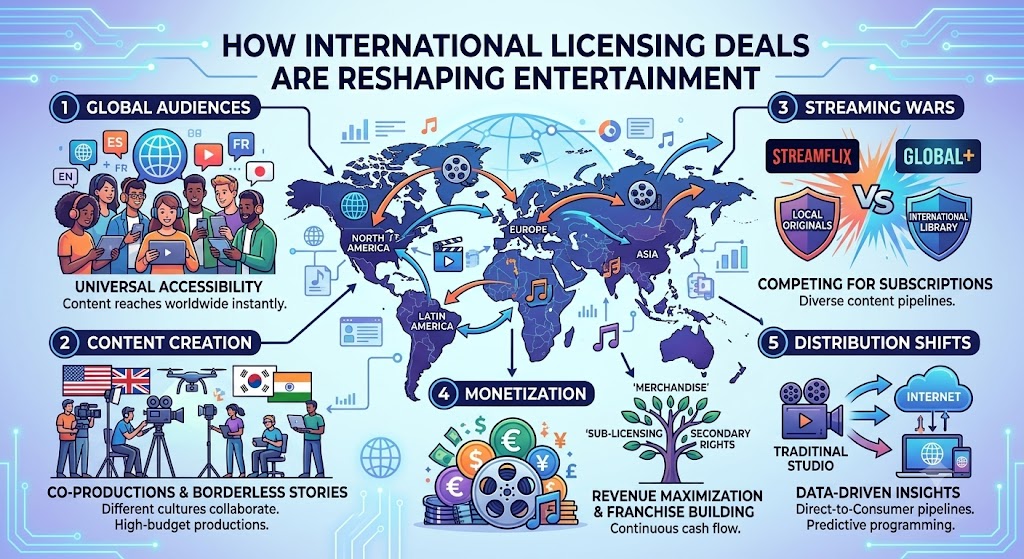
For more on international content strategy, see our guide to international licensing deals reshaping entertainment.
Vitrina’s Role in Entertainment Supply Chain Intelligence
Vitrina’s VIQI platform indexes 159,223 verified media and entertainment companies worldwide, spanning every stage of the entertainment supply chain. That coverage allows executives to map the chain not just conceptually but operationally, identifying which companies operate at which nodes, in which territories, and with what track record. For a studio deciding where to source VFX, which distributor to partner with in Southeast Asia, or which independent producers are active in a target genre, VIQI provides decision-ready intelligence rather than anecdotal research.
The platform’s strength is its cross-stage visibility. Most industry databases are siloed by function: one tool for production contacts, another for distribution, another for post-production vendors. VIQI consolidates all of this into a single verified dataset, enabling buyers and sellers to trace relationships across the full chain. A content acquisition executive, for example, can use VIQI to identify an independent producer, then map that producer’s existing distribution relationships and past co-production partners before opening a conversation. This transforms cold outreach into informed engagement.
Supply chain intelligence also serves a risk management function. When disruptions occur, whether labor actions, geopolitical trade restrictions, or platform strategic pivots, executives who know their supply chain map in advance can identify alternative partners faster. VIQI’s data is structured to support exactly this kind of contingency planning, giving M&E companies a practical tool for building resilience into their content operations. See our related analysis of TV production trends for industry professionals in 2026 for context on how major studios are approaching supply chain resilience.
Discover Every Node of Your Supply Chain
VIQI’s 159,223 verified M&E company profiles give studios, distributors, and streamers a complete operational map of their industry. Start exploring today.
Conclusion
The entertainment supply chain in modern media is not a simple pipeline. It’s a dynamic network of creative, technical, legal, and commercial relationships that spans continents, currencies, and regulatory regimes. Streaming has accelerated velocity at some stages while adding coordination complexity at others. Disruptions from strikes, pandemics, and technological shifts have demonstrated how quickly the whole system can seize when any node fails.
The executives best positioned for the next phase of industry growth are those who treat supply chain intelligence as a strategic asset, not an operational afterthought. Mapping your vendor relationships, understanding your distribution partner landscape, and knowing which companies are active at which stages in your target territories will determine how fast you can move when opportunities or crises arrive.
The tools to build that intelligence now exist at scale. AI, co-production structures, and verified M&E company data are all maturing simultaneously. The question for studios, streamers, distributors, and content buyers is how quickly they can integrate these capabilities into everyday decision-making. The supply chain belongs to those who understand it best.
Get a Personalized Platform Walkthrough
See how leading studios and distributors use VIQI to map their entertainment supply chain, identify new partners, and respond to disruptions faster. Book your walkthrough now.
Frequently Asked Questions
What are the six stages of the entertainment supply chain?
The six stages are development, production, post-production, distribution, exhibition, and streaming/digital delivery. Each stage involves distinct vendors, deal structures, and risk profiles. A single title typically passes through all six stages before its IP is fully exploited across available windows and formats. Streaming platforms have compressed some windows but have not eliminated any of the six fundamental stages.
How have streaming platforms changed entertainment supply chain dynamics?
Streaming platforms restructured the chain in three key ways. First, they shortened theatrical release windows, sometimes to as few as 17 days. Second, they introduced platform-specific technical delivery requirements that require separate asset packages per platform. Third, they shifted to a direct-commission model that bypasses traditional studio gatekeepers, giving independent producers more direct access to commissioning budgets but also shifting more financial risk upstream to them.
What impact did the 2023 WGA and SAG-AFTRA strikes have on the supply chain?
The dual strikes of 2023 caused an estimated USD 6.5 billion in lost economic output across the U.S. entertainment industry, according to Deadline. More than 150 productions halted simultaneously. The disruption extended through the entire upstream supply chain: crew, equipment vendors, location services, and catering all experienced cascading revenue losses. Studios with international production partnerships recovered more quickly by redirecting activity to non-U.S. projects.
What are the most common bottlenecks in the entertainment supply chain?
The most persistent bottlenecks occur at stage handoff points. Rights clearance delays frequently hold up distribution, particularly for content clearing music and archival footage across multiple territories. VFX vendor capacity is chronically oversubscribed at the top tier, forcing cost increases when productions switch vendors. Metadata errors affect an estimated 15-20% of first streaming delivery attempts, adding days or weeks to release timelines and requiring costly remediation work.
How does supply chain intelligence help entertainment executives make better decisions?
Supply chain intelligence platforms like VIQI give executives verified data on which companies operate at which supply chain nodes, in which territories, and with what commercial track record. This allows content buyers to identify vetted partners faster, reduces the risk of engaging unqualified vendors, and supports contingency planning when disruptions occur. Having a mapped supply chain allows executives to redirect activity quickly rather than scrambling to identify alternatives when a key partner fails to deliver.
About the Author
Vitrina Research Team
The Vitrina Research Team produces intelligence-led analysis on media and entertainment industry structure, deal activity, and market trends. Our research draws on VIQI’s proprietary dataset of 400,000+ M&E companies worldwide.
Related Reading
- Production Outlook 2026: What Producers Need to Prepare For
- Film and TV Production Review: Key Takeaways for Industry Leaders
- The State of Global Film Production: Opportunities and Risks in 2026
- Top Content Licensing Trends Shaping the Industry in 2026
- Digital Content Licensing Explained for Media Companies
- How Entertainment Production Data Improves Decision-Making
- Global Content Adaptation Trends Every Producer Should Know in 2026