IHUB
IHUB
 Global Content Pulse (Webinars)


 Global Production Financing
(Webinars)
Global Production Financing
(Webinars)  LeaderSpeak Podcast
  Global Entertainment Digest (Newsletter)
  About Vitrina
 About VIQI
 Our Story
 Our Solutions 🔥
 Film+TV Projects Tracker 🚀
 Case Studies
 Our Profile
By Vitrina Research Team | Published: July 20, 2026 | Updated: July 20, 2026 | 9 min read
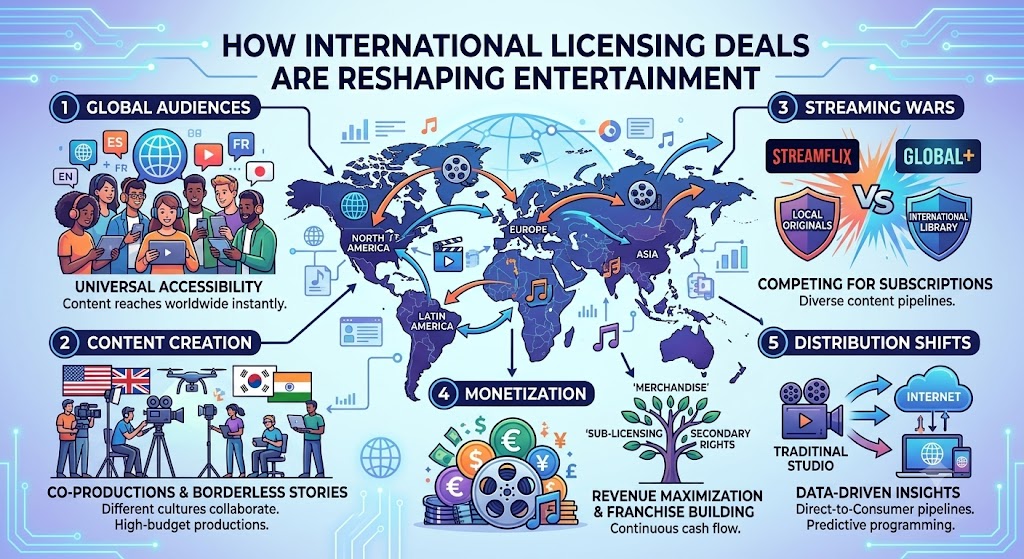
How International Licensing Deals Are Reshaping Entertainment
The global entertainment content market crossed $2.8 trillion in total value in 2025, and a growing share of that value is moving through cross-border licensing deals. International licensing deals in entertainment are no longer just a monetization afterthought. They’ve become primary revenue drivers for studios, streamers, broadcasters, and independent producers everywhere from Los Angeles to Seoul. According to PwC’s Global Entertainment and Media Outlook 2025-2029, international content revenues are projected to grow at a compound annual rate of 6.2% through 2029, outpacing most domestic market growth figures.
What’s changed is the direction of deal flow. For decades, international licensing meant Hollywood selling to the world. Today, K-drama producers negotiate with Netflix, Peacock, and HBO Max simultaneously. Turkish drama studios license finished content to 140+ countries. Indian streamer originals are landing on European platforms before they’ve completed their domestic theatrical runs. The architecture of how content crosses borders has shifted fundamentally, and the companies that understand that shift are capturing the most valuable deals.
This article maps the forces driving international licensing activity in 2025 and 2026, examines what’s working by region and format, and explains how media companies can identify the right partners for licensing opportunities across 190+ territories. For context on the deal-making mechanics, see our guide to how to negotiate content licensing deals and the top content licensing trends shaping the industry in 2026.
Quick Answer
International licensing deals are reshaping entertainment by shifting content power away from a handful of Hollywood studios toward a multi-directional global market where Korean, Turkish, Indian, and Latin American content routinely generates nine-figure licensing revenues. Global content licensing revenues are projected to grow at 6.2% CAGR through 2029 (PwC, 2025), driven by SVOD platform expansion across Asia-Pacific, MENA, and Latin America. Media companies use VIQI by Vitrina to identify the right licensing partners across 190+ territories and track real deal activity in these markets.
Key Takeaways
- International content licensing revenues are growing at 6.2% CAGR through 2029, with Asia-Pacific leading volume growth (PwC Global Entertainment and Media Outlook, 2025).
- Deal flow is now multi-directional: Korean, Turkish, Indian, and Latin American content are reaching global platforms as finished licensed products, not just co-production agreements.
- SVOD and AVOD platforms in MENA and Southeast Asia are among the most active buyers of international licensed content in 2025-2026, creating high-value entry points for rights holders.
- Format licensing (selling the concept and production bible, not finished content) is growing rapidly in Europe and Latin America as local broadcasters seek proven IP with regional production flexibility.
- VIQI by Vitrina enables rights holders and platforms to identify licensing partners across 190+ territories, filter by content type and deal history, and access warm introductions through Vitrina’s concierge service.
Table of Contents
- Why Are International Licensing Deals Growing So Fast?
- How Are SVOD and AVOD Platforms Changing Licensing Dynamics?
- Which Regions Are Driving the Most Licensing Activity?
- What Is Format Licensing and Why Is It Gaining Ground?
- How Are Finished Content Deals Structured Internationally?
- How Vitrina Helps Media Companies Track and Close International Licensing Deals
- Conclusion
- Frequently Asked Questions
Why Are International Licensing Deals Growing So Fast?
The short answer is platform hunger. Global SVOD subscriber counts reached approximately 1.9 billion by end of 2025 according to Digital TV Research, and every one of those platforms needs a constant supply of content to retain subscribers. Domestic production cannot fill that demand alone. International licensing deals fill the gap, and they’ve grown from a secondary monetization channel into a primary acquisition strategy for platforms that operate across multiple territories.
Three forces are compressing the timeline of this shift. First, streaming platforms expanded into 60-plus new markets between 2020 and 2023, creating overnight demand for local-language and local-culture-adjacent content those platforms had no infrastructure to produce. Second, rights holders in markets like Korea, India, and Turkey had built deep content libraries at production costs far below Hollywood equivalents. Third, global audiences proved willing, through COVID-era viewing patterns, to watch subtitled and dubbed international content at scale. Netflix has reported that non-English content now drives a significant portion of its global viewing hours.
Stat citation: Global SVOD subscribers reached approximately 1.9 billion by end of 2025, with platforms in Asia-Pacific, MENA, and Latin America among the fastest-growing segments. The resulting content demand gap is a primary driver of accelerating international licensing deal volumes. (Digital TV Research, Global SVOD Forecasts, 2025)
The growth of international licensing deals is not simply a response to subscriber growth. It’s a structural response to the economics of local production. Producing a premium drama series from scratch in a new market costs $3 million to $8 million per episode for a U.S. studio. Licensing an existing Korean or Turkish hit for the same territory costs a fraction of that and comes with proven audience engagement data. The economics make licensed content the rational first move in a new territory, even for platforms with large production budgets.
What Types of Rights Are Most Commonly Licensed Internationally?
International licensing typically divides into three categories: finished content licenses (the completed show or film), format licenses (the concept, bible, and production format), and ancillary rights (merchandise, gaming, live events). Finished content licensing dominates by volume because it generates immediate subscriber value for acquiring platforms. Format licensing is growing fastest in Europe and Latin America, where broadcasters want proven IP with the flexibility to produce locally relevant versions.
Rights windows add complexity that domestic deals don’t face in the same way. An international licensing deal often needs to specify: which territories are covered, whether the license is exclusive or non-exclusive, which platforms or distribution channels are included, what the duration of the rights window is, and whether subtitling, dubbing, and localization rights are included. Each variable is a negotiation point, and the combinations multiply quickly across a global deal structure.
How Are SVOD and AVOD Platforms Changing Licensing Dynamics?
Streaming platforms have fundamentally altered the power dynamics of international content licensing. The European Audiovisual Observatory reported that streaming-based content spending in Europe grew by 18% year-over-year in 2024, with a significant portion attributed to international acquisition budgets. SVOD platforms are now the primary counterparty in many international licensing conversations, displacing traditional broadcasters as the dominant buyers in territories from Spain to South Korea.
AVOD platforms introduce a different deal structure. Where SVOD deals typically involve upfront licensing fees and exclusivity windows, AVOD deals often use revenue-sharing models tied to advertising inventory. This opens international licensing to rights holders who can’t command large upfront fees but have content that generates steady audience engagement. Tubi, Pluto TV, and regional AVOD services in Southeast Asia and MENA are driving an entirely separate lane of international licensing activity that operates at higher volume and lower per-deal value than SVOD acquisitions.
How Do Platform-Exclusive Deals Affect Rights Holder Strategy?
Exclusive international licensing deals with major streaming platforms offer rights holders a clear financial upside: higher upfront fees, marketing support, and global distribution reach through a single partner relationship. The trade-off is loss of territorial flexibility. A rights holder who signs an exclusive global SVOD license with one platform cannot separately license the same content to free-to-air broadcasters, AVOD services, or competing streamers in any territory covered by the deal.
In our analysis of licensing deal structures across the VIQI database, rights holders who negotiate territory-by-territory non-exclusive deals tend to generate higher total revenue over a three-to-five-year window, even if individual deal values are smaller. The exception is breakout hit content, where a single global exclusive can generate more value than a fragmented territorial strategy would produce. The right structure depends heavily on the content’s genre, existing audience profile, and the rights holder’s operational capacity to manage multiple parallel licensing relationships.
Find International Licensing Partners with VIQI
Access the world’s largest database of M&E companies — filter by territory, content type, and deal activity to identify the right licensing partners.
Which Regions Are Driving the Most Licensing Activity?
Asia-Pacific leads global international licensing activity by deal volume. The Motion Picture Association’s 2025 THEME Report placed Asia-Pacific as the largest region for filmed entertainment revenue, with $23.2 billion in total market value. Within that, licensing deal flows run in multiple directions: U.S. studios license into Japan, South Korea, and Australia; Korean studios license into Southeast Asia and the Americas; Indian content producers are establishing licensing pipelines into the Middle East, Africa, and the diaspora markets of North America and Europe.
MENA: The Fastest-Growing International Licensing Destination
MENA is the region generating the most interest among international rights holders looking for new licensing destinations. PwC projects MENA entertainment revenues growing at 9.1% CAGR through 2028, the highest regional growth rate in their global forecast. Saudi Arabia’s Vision 2030 initiative has catalyzed cinema expansion, streaming investment, and live entertainment infrastructure at a pace that creates licensing entry points across every content category.
Stat citation: MENA entertainment and media revenues are projected to grow at 9.1% CAGR through 2028, the highest regional growth rate globally, driven by streaming expansion in Saudi Arabia, UAE, and Egypt alongside significant cinema and live entertainment infrastructure investment. (PwC Global Entertainment and Media Outlook, 2025)
Shahid (owned by MBC Group), StarzPlay Arabia, and Anghami Plus are the dominant regional streaming platforms, and all three are active international content buyers. Turkish drama content has found a particularly strong audience across the Arab world, with licensing deals for Turkish series generating substantial revenue for Istanbul-based producers. Arabic dubbing quality has improved significantly, removing one of the historical friction points in this licensing corridor.
Latin America: Finished Content and Format Deals Both Thriving
Latin America splits its international licensing activity between finished content acquisition and format licensing. Netflix’s Latin American productions have demonstrated that locally produced content with international licensing potential can be developed at costs far below U.S. production norms, attracting rights holders who see the region as both a buyer and a production hub. According to the International Federation of Television Archives (IFTA), format licensing deal volumes in Latin America grew 22% year-over-year in 2024, as broadcasters sought to produce localized versions of European and U.S. unscripted formats.
Brazil, Mexico, Argentina, and Colombia are the primary licensing markets in the region. Each operates with a distinct mix of free-to-air, pay-TV, and streaming infrastructure, which creates different deal structure requirements. A rights holder licensing content into Brazil needs to evaluate Globo, Band, SBT, and Record as free-to-air counterparties alongside Globoplay, Netflix, and Amazon Prime Video, rather than treating the country as a single licensing window.
Europe: Regulatory Frameworks Are Reshaping Deal Structures
The European Union’s Audiovisual Media Services Directive (AVMSD) mandates that on-demand services make at least 30% of their catalogues European works and ensure that these works are prominently featured. This regulation creates structured demand for European content licensing across platforms operating in EU territory. The European Audiovisual Observatory reported that this quota framework generated an estimated 2.5 billion euros in incremental European content spend in 2024 as non-EU platforms brought their catalogues into compliance.
What Is Format Licensing and Why Is It Gaining Ground?
Format licensing – the sale of a show’s concept, production bible, and underlying creative framework rather than the finished program – represents one of the most commercially durable segments of international licensing deals entertainment has produced. The Wit, a Paris-based format intelligence service, estimated the global format trade was worth approximately $4 billion annually in 2024 and noted that unscripted formats continue to account for roughly 70% of all format licensing transactions globally.
Format licensing succeeds where finished content has cultural friction. A reality competition format can be localized: local hosts, local contestants, local settings, and local cultural references. The underlying competitive structure, the elimination mechanics, the emotional arc, all proven by the original format, can be preserved. Banijay Group, Fremantle, and ITV Studios are the dominant format distributors globally, but independent format creators from the Netherlands, UK, Israel, and South Korea have also built significant licensing businesses on single format hits.
How Does Scripted Format Licensing Differ from Unscripted?
Scripted format licensing is more complex and less common but growing. When a scripted drama or comedy is licensed as a format, the buyer acquires the story concept, character frameworks, and season architecture, then rebuilds the production with local writers, cast, and crew. Successful examples include the Israeli drama “Prisoners of War” (remade as “Homeland”), “In Treatment” (originally Israeli), and the Norwegian drama “Lilyhammer” (partially remade for U.S. audiences). Each required significant creative adaptation while preserving the structural DNA of the original.
The key commercial difference between scripted and unscripted format deals is the royalty structure. Unscripted formats often earn royalties per episode produced, typically 2-5% of the production budget. Scripted format deals involve more negotiated upfront fees because the creative adaptation process is more intensive and the risk of deviation from the source material is higher. Rights holders considering scripted format licensing need strong contractual protections around creative integrity, credit, and quality standards.
How Are Finished Content Deals Structured Internationally?
Finished content licensing deals in international entertainment markets typically involve five core negotiation variables: territory scope, exclusivity terms, rights window duration, localization rights, and payment structure. Understanding how each variable interacts with the others determines whether a deal creates maximum value for the rights holder or simply generates a one-time transaction. The International Federation of Television Archives (IFTA) publishes standardized deal term guidelines that serve as the baseline for most independent international content licensing negotiations.
Stat citation: Format licensing deal volumes in Latin America grew 22% year-over-year in 2024, as broadcasters across Brazil, Mexico, Argentina, and Colombia sought to produce localized versions of proven international formats rather than developing original unscripted concepts from scratch. (International Federation of Television Archives, 2024)
Territory scope is often the first variable settled in international licensing negotiations. A rights holder may license all of Asia-Pacific to a single platform, or break the region into individual country licenses held by different buyers. The multi-territory approach maximizes total revenue potential but requires more deal management. The single-territory-block approach is simpler but often leaves revenue on the table in high-value individual markets where a local buyer might pay more than the blended rate in a block deal.
What Do Localization Rights Include?
Localization rights cover the right to dub, subtitle, and re-edit content for a target territory. Dubbing costs range from $10,000 to $50,000 per hour of content depending on the target language and quality standards. For a 10-episode drama at 45 minutes per episode, that means $75,000 to $375,000 in localization cost before any other production or delivery expense. Rights holders who retain dubbing control can use quality of localization as a brand protection mechanism. Rights holders who grant full localization rights to the buyer lose that control but reduce their own operational burden.
In examining deal terms across the VIQI dataset, international licensing deals for premium drama content show an average exclusivity window of 24 to 36 months for SVOD platforms and 12 to 18 months for free-to-air broadcasters. The gap reflects the subscriber retention logic of streaming platforms: longer exclusivity windows justify higher upfront fees and prevent audience migration to competing services.
How Vitrina Helps Media Companies Track and Close International Licensing Deals
Finding the right international licensing partner is the step that stalls most content deals. Rights holders know their content has international potential, but identifying which platform in South Korea, which broadcaster in Poland, or which streaming service in the UAE is actively acquiring content in their genre and budget range is a research challenge that can take months without the right intelligence infrastructure. VIQI by Vitrina addresses this directly. The platform indexes over 400,000 media and entertainment companies across 190+ territories, with filters for content type, deal activity history, company size, and territory focus. A rights holder can move from “we want to license into Southeast Asia” to a shortlist of qualified buyer candidates in hours rather than weeks.
The intelligence layer in VIQI goes beyond directory search. The platform tracks deal activity signals, including acquisition announcements, content slate updates, and company expansion moves, so users can identify buyers who are actively building catalogues in specific content categories. A drama distributor looking for MENA licensees can filter for streaming platforms in Saudi Arabia and the UAE that have announced documentary or drama acquisitions in the past 12 months, producing an outreach list that’s grounded in current buying intent rather than a static database snapshot.
For companies that need to move faster than cold outreach allows, Vitrina’s concierge service provides warm introductions to decision-makers at target companies. The concierge team draws on established relationships across the global M&E ecosystem to facilitate direct conversations between rights holders and potential licensees, compressing the typical business development timeline. Whether you’re a Korean drama studio looking for European SVOD buyers or a U.S. format owner targeting broadcasters in Latin America, the combination of VIQI’s database intelligence and Vitrina’s concierge service provides a structured path to qualified licensing conversations.
List Your Company on Vitrina
Make your company discoverable to 400,000+ M&E industry buyers, distributors, and licensing partners searching for content companies like yours across 190+ territories.
Conclusion: International Licensing Is the Growth Strategy for 2026 and Beyond
International licensing deals are not a side strategy for entertainment companies any more. They’re the central mechanism through which content value is realized across a global market that no single territory can capture alone. The data is clear: licensing revenues are growing faster than domestic theatrical, faster than linear broadcast, and at rates that make international deal-making one of the highest-return activities available to rights holders at every scale, from studio majors to independent producers with a single breakout title.
The complexity is real. Territory-by-territory deal management, exclusivity window negotiations, localization rights, and format versus finished content decisions all require careful strategy. But the companies that build international licensing capability now, with the right market intelligence and partner networks, will hold a durable competitive advantage as the global content market continues to mature and fragment. The markets are open. The buyers exist. The question is whether you can find them efficiently and reach them with the right offer at the right time.
The structural shift in international content deal flow, from unidirectional Hollywood exports to a genuinely multi-polar global licensing market, is still in its early stages. Asia-Pacific, MENA, and Latin America will generate increasing volumes of content with global licensing potential over the next five years. Rights holders and platforms that build the intelligence infrastructure to track and act on these opportunities now will define the next chapter of global entertainment commerce.
See VIQI in Action
Book a personalized demo and see how VIQI helps content companies find licensing partners, track deal activity, and close international deals faster across 190+ territories.
Frequently Asked Questions
How can I find international content licensing partners?
The most efficient route is using a purpose-built M&E intelligence platform. VIQI by Vitrina indexes 400,000+ media and entertainment companies across 190+ territories, with filters for territory, content type, company size, and deal activity history. Rights holders can build a qualified outreach list for any target region in hours rather than weeks. For warm introductions to specific buyers, Vitrina’s concierge service provides direct access to decision-makers across the global M&E ecosystem.
What is the difference between a licensing deal and a co-production agreement?
A licensing deal transfers rights to use already-existing content (or a format) in a specific territory and window. A co-production agreement involves two or more parties jointly funding and producing content before it exists. Licensing deals are transactional, with the rights holder retaining ownership of the underlying IP. Co-production agreements are collaborative, with ownership typically shared proportionally to each party’s financial contribution. Many international deals combine both: a co-production arrangement that grants one partner territorial licensing rights upon completion.
Which territories offer the highest licensing revenue potential in 2025-2026?
By overall market value, the United States, China, Japan, and the United Kingdom remain the top four territories for content licensing revenue. By growth rate and emerging opportunity, Saudi Arabia, India, Brazil, and South Korea are generating the most active inbound licensing interest from international rights holders in 2025 and 2026. MENA as a regional block is projected to grow at 9.1% CAGR through 2028 (PwC, 2025), making it the fastest-growing destination for international licensing deals entertainment companies are currently targeting.
What is format licensing in the entertainment industry?
Format licensing is the sale of a show’s underlying creative concept, production bible, and structural framework, rather than the finished program itself. The buyer receives the right to produce their own local version of the show using the original format’s rules, structure, and creative DNA. Unscripted formats, including game shows, reality competitions, and talent shows, dominate the global format trade, which The Wit estimated at approximately $4 billion annually in 2024. Scripted format licensing is growing but involves more complex creative and contractual adaptation work.
How long does it typically take to close an international licensing deal?
Timeline varies significantly by deal complexity, buyer type, and territory. Straightforward finished content deals with established broadcasters or streaming platforms can close in 4 to 8 weeks from first offer to signed agreement. Multi-territory deals, format licenses, and deals involving new market entrants or smaller buyers with less deal-making infrastructure can take 3 to 6 months or longer. Rights holders who use market intelligence platforms like VIQI to enter negotiations with pre-qualified leads, clear pricing benchmarks, and well-prepared deal materials consistently close faster than those relying on cold outreach and reactive discovery.
About the Author
Vitrina Research Team
The Vitrina Research Team produces intelligence-led analysis on media and entertainment industry structure, deal activity, and market trends. Our research draws on VIQI’s proprietary dataset of 400,000+ M&E companies worldwide.