IHUB
IHUB
 Global Content Pulse (Webinars)


 Global Production Financing
(Webinars)
Global Production Financing
(Webinars)  LeaderSpeak Podcast
  Global Entertainment Digest (Newsletter)
  About Vitrina
 About VIQI
 Our Story
 Our Solutions 🔥
 Film+TV Projects Tracker 🚀
 Case Studies
 Our Profile
By Vitrina Research Team | Published: July 18, 2026 | 12 min read
Content licensing trends 2026 are rewriting the rules of how entertainment is bought, sold, and distributed across the globe. With global content spending projected to hit $255 billion this year — up from $251 billion in 2025 — the stakes have never been higher for streaming platforms, broadcasters, studios, and independent distributors navigating a rapidly shifting marketplace. Understanding which deals get done, on what terms, and through which windows is now a board-level strategic priority across every corner of the media and entertainment industry.
The year 2025 marked an inflection point: for the first time in modern television history, streaming content spend overtook linear broadcasters, reaching $95 billion. That milestone has fundamentally altered how rights are negotiated, which titles get greenlit, and how licensing windows are structured. From AVOD-first deals to multi-territory co-production arrangements, the licensing playbook that worked in 2022 no longer applies in 2026.
This report, informed by Vitrina’s proprietary dataset of 159,223 M&E companies worldwide, breaks down the eight most consequential content licensing trends reshaping the entertainment industry in 2026 — and the strategic moves executives need to make right now.
Key Takeaways
- Global content spend reaches $255B in 2026, driven by streaming platform expansion.
- Streaming overtook broadcasters in content spend ($95B) for the first time in 2025.
- M&E deal value surged 35% in H2 2025, reaching $151B — consolidation is accelerating.
- OTT video revenue exceeded $340B in 2025, underscoring the primacy of digital rights.
- AI-powered licensing intelligence and data-driven negotiation are emerging as key differentiators.
- International co-production licensing is the fastest-growing deal structure in 2026.
Quick Answer
What are the top content licensing trends in 2026? The defining trends are: streaming-first rights structures displacing linear windows, AI-powered deal sourcing, international co-production licensing growth, FAST channel catalogue monetization, IP bundling in M&A, flexible territory splits, shorter exclusivity windows, and data-driven content valuation. Together, these forces are compressing deal cycles and expanding the global licensing opportunity to $255 billion in total content spend.
1. Content Licensing Trends 2026: Streaming-First Rights Structures Replace Linear Windows
The traditional content licensing waterfall — theatrical, home video, pay-TV, free-to-air — has been fundamentally disrupted. In 2026, the dominant deal structure is streaming-first or streaming-exclusive. Major studios and distributors are negotiating rights with streaming platforms before any other window is even discussed, a reversal of the model that governed Hollywood for four decades.
This structural shift is quantifiable. Streaming platforms now account for $95 billion in annual content spend globally — more than all linear broadcasters combined, according to Ampere Analysis. Netflix, Amazon Prime Video, Apple TV+, Disney+, and a growing roster of regional streamers are all competing for first-window rights, driving up deal values and compressing the timelines for content delivery.
For content distributors, the practical implication is a radical rethinking of window strategy. Theatrical windows — once 90 days — have compressed to 30–45 days for streaming platforms with enough leverage. Premium VOD (PVOD) rights are frequently bundled into streaming deals, collapsing what was once a separate revenue layer. Understanding why content acquisition is critical for streaming success is now a foundational competency for every distributor entering streaming negotiations.
Platform Consolidation Intensifies Streaming Rights Competition
The M&E sector saw deal value surge 35% in H2 2025 to $151 billion, according to PwC and the Hollywood Reporter. Platform mergers and acquisitions — from Paramount’s integration moves to regional streamer consolidations in Southeast Asia and Latin America — are concentrating rights-buying power in fewer hands. This consolidation paradoxically creates both tighter competition for premium content and new sub-licensing opportunities as merged entities rationalize their combined libraries.
Industry Data
“Streaming content spend reached $95 billion in 2025, overtaking linear broadcasters for the first time in modern television history.” — Ampere Analysis, Global Content Spend Report 2025
2. International Co-Production Licensing Explodes
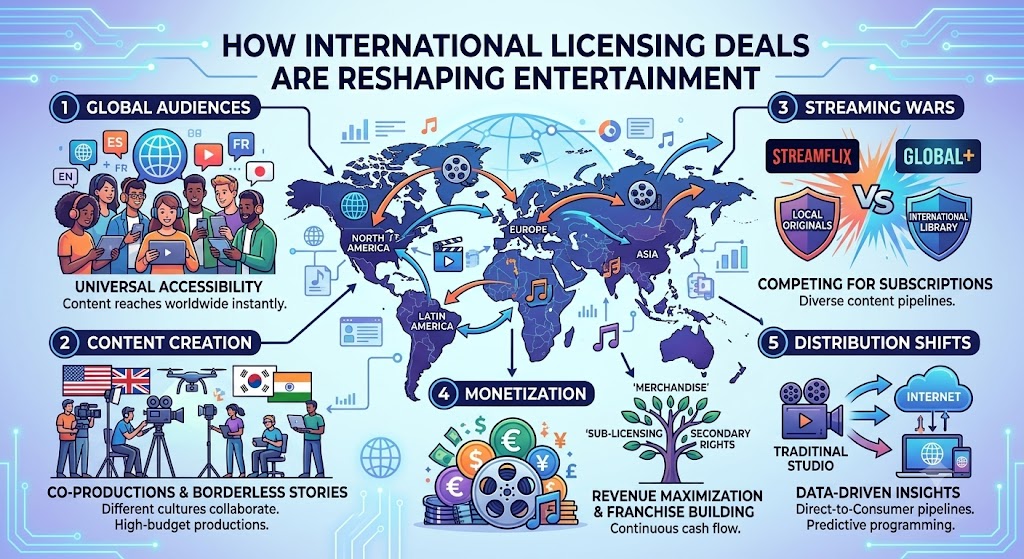
International licensing deals are reshaping the entertainment industry at a pace not seen since the early satellite television era. Co-production agreements — where two or more parties from different territories jointly finance and share rights to content — have emerged as the dominant deal structure for premium drama, documentary, and animation in 2026.
The driving forces are structural: production costs for high-end scripted content now regularly exceed $10–15 million per episode, making single-territory financing increasingly impractical. At the same time, OTT video revenue exceeded $340 billion in 2025 (Statista), creating a deep pool of global platform demand for differentiated local-language content that resonates in both home and international markets. International licensing deals are fundamentally reshaping entertainment as studios and platforms seek to share both cost and upside.
Key Co-Production Licensing Structures in 2026
The most common co-production licensing structures now in play include: Split-rights co-productions, where each party retains rights in their own territory; Lead-platform deals, where a streaming giant funds the majority in exchange for global SVOD rights; and Presales-backed co-productions, where a combination of international pre-sales and tax credits across multiple jurisdictions assembles the financing stack. European broadcasters, in particular, are leveraging the EU’s European Works quota obligations to drive co-production licensing activity with non-EU streamers seeking European content credentials.
Korea, Japan, and India continue to be the most sought-after co-production partners for global streamers, given their combination of premium production infrastructure, local talent, and demonstrated international audience appetite. The anime sector, in particular, represents a fast-growing licensing category where Japanese IP holders are increasingly structuring multi-territory deals that bundle streaming, merchandising, and gaming rights into a single licensing agreement.
3. FAST Channel Deals Drive Catalogue Monetization
Free Ad-Supported Streaming TV (FAST) has emerged from an experimental distribution model into a mainstream licensing category. Platforms like Pluto TV, Tubi, Roku Channel, Peacock Free, and a growing array of regional FAST operators are collectively spending billions annually on catalogue licensing — providing rightsholders with a high-volume, lower-per-title revenue stream that was effectively unavailable five years ago.
For content owners managing large libraries — particularly studios, independent distributors, and public broadcasters — FAST licensing has become a critical secondary monetization layer. Content that may have minimal value in a pay-TV context generates meaningful ad-revenue share through FAST channel deals, particularly for genre content: reality, crime documentary, classic TV, and horror catalogue titles outperform in FAST environments.
FAST Licensing Deal Structures
The dominant FAST licensing deal structure is a revenue-share model, where the content owner receives a percentage of advertising revenue generated by their content on the platform, rather than a flat fee. This aligns incentives between platform and rightholder but introduces revenue variability that rightsholders must model carefully. Increasingly, sophisticated distributors are negotiating hybrid structures: a minimum guaranteed fee plus revenue share above a threshold, providing downside protection while retaining upside exposure to high-performing titles.
Market Intelligence
“OTT video revenue exceeded $340 billion globally in 2025, making digital rights the dominant value driver across all content licensing negotiations.” — Statista, Digital Media Outlook 2025–2026
4. AI-Powered Deal Sourcing and Rights Intelligence
Artificial intelligence is transforming how entertainment licensing professionals identify, evaluate, and close deals. What was once a relationship-driven, conference-dependent business is increasingly augmented by AI tools that can scan thousands of potential licensing partners, map rights availability across global catalogues, and flag deal opportunities that human analysts would take weeks to surface.
For content acquisition teams at streaming platforms, AI-powered intelligence tools are changing the sourcing equation. Instead of relying on agent relationships and industry conference networks, acquisition executives can now systematically scan the available universe of independently-held rights across specific genres, territories, and content types. Entertainment production data is fundamentally improving decision-making at every stage of the licensing process, from initial targeting through deal valuation and negotiation.
AI in Rights Management and Compliance
Beyond deal sourcing, AI is transforming rights management and compliance monitoring. Major studios and distributors are deploying machine learning systems to track how licensed content is being used across platforms, detect unauthorized distribution, and automatically generate rights expiry alerts across multi-territory libraries containing thousands of titles. The efficiency gains from AI-assisted rights management are measurable: EY’s media practice estimates that leading studios are reducing rights clearance administration costs by 25–40% through AI-powered rights management systems.
Access 159,223 M&E Companies for Smarter Licensing Deals
Vitrina’s global intelligence platform gives you direct access to verified company data, deal activity, and rights availability across the entire M&E ecosystem. Stop guessing — start sourcing with precision.
5. IP Bundling Drives M&A-Linked Licensing Activity
The 35% surge in M&E deal value to $151 billion in H2 2025 was not merely a financial phenomenon — it was a licensing event. Every major acquisition in the entertainment space is, at its core, a rights portfolio transaction. When a platform or studio acquires a production company, a library, or a distribution network, the central asset being purchased is a bundle of intellectual property licenses.
This M&A-driven licensing dynamic is creating new complexity for entertainment executives. Post-acquisition, merged entities must rationalize overlapping licensing agreements, renegotiate deals that contain change-of-control provisions, and realign territorial distribution rights across a combined portfolio. Understanding how Disney approaches media and entertainment distribution provides a masterclass in how the most sophisticated studios manage IP bundling across global markets.
Franchise IP as the New Currency of Licensing
In 2026, franchise IP commands a significant premium in both M&A valuations and standalone licensing deals. Acquirers are paying 40–60% premiums for companies that hold recognizable franchise IP — characters, universes, and formats with proven multi-platform monetization potential. The licensing upside from a single franchise property, once developed across film, television, gaming, consumer products, and live experiences, can dwarf the value of any individual content title. This has accelerated the market for IP-first acquisitions, where the acquirer’s primary motivation is not the target’s production capability but its rights portfolio.
6. Shorter Exclusivity Windows and Multi-Platform Rights Splits
One of the most practically consequential content licensing trends in 2026 is the compression of exclusivity windows. Content that was once locked to a single platform for 3–5 years under comprehensive licensing deals is now more frequently available with 12–18 month exclusivity periods, after which rights revert or become available for sub-licensing.
This shift reflects the changing negotiating dynamic between rightsholders and platforms. As content costs have risen and subscriber growth has moderated in mature streaming markets, platforms have become more selective about what they pay for exclusivity. At the same time, rightsholders — including major studios that have learned from early streaming-deal mistakes — are increasingly reluctant to cede long-term control of their best content for a single, front-loaded licensing fee.
Deal Trend
“M&E deal value surged 35% in H2 2025 to $151 billion, as IP bundling and streaming-linked M&A drove the highest transaction activity since pre-pandemic levels.” — PwC Global Entertainment & Media Outlook / Hollywood Reporter, 2025
The Rise of the Territory-by-Territory Licensing Strategy
Multi-platform rights splits are becoming standard practice. Rather than granting global rights to a single buyer, sophisticated rightsholders are now structuring deals that grant different rights to different buyers across dimensions: territory (North America vs. Europe vs. APAC), platform type (SVOD vs. AVOD vs. FAST), language version (original vs. dubbed), and window (first-run vs. library). This approach maximizes total licensing revenue but requires sophisticated rights management infrastructure and deal-tracking capabilities.
7. Data-Driven Content Valuation Reshapes Licensing Negotiation
Perhaps no trend is more transformative to the practice of content licensing than the emergence of data-driven valuation. In 2026, both buyers and sellers are coming to the negotiating table with sophisticated datasets that model content performance across platforms, geographies, and audience demographics. The era of “gut feel” licensing valuations — where a veteran executive’s instinct about a show’s likely performance determined the deal price — is giving way to analytics-driven negotiation.
Companies like Variety, Ampere Analysis, Parrot Analytics, and a growing roster of specialist M&E data providers are supplying the demand-side data that licensing teams use to model content valuations across territories. Netflix’s 2026 growth strategy illustrates how data-driven decision-making extends from content development through the licensing and distribution chain, with performance analytics informing renewal, cancellation, and international licensing decisions in real time.
Greenlight Criteria and Data-Backed Licensing Decisions
Streaming platforms are increasingly applying the same analytical rigor to licensing acquisitions that they apply to original content greenlight decisions. Demand data from third-party analytics platforms — measuring search interest, social engagement, piracy activity (as a proxy for demand), and comparative performance of similar titles — is now routinely cited in licensing negotiations to justify or contest proposed deal terms. For content sellers without access to comparable data, this informational asymmetry can translate directly into lower deal values. Investing in data infrastructure has become a prerequisite for competitive participation in the premium licensing market.
8. Gaming and Immersive Media Rights Enter Content Licensing Bundles
The convergence of film, television, and interactive entertainment has elevated gaming and immersive media rights — VR, AR, and interactive experiences — from an afterthought to a standard component of premium content licensing negotiations. In 2026, any deal involving a franchise IP of significant scale will routinely include discussions about gaming adaptation rights, even when neither party has an immediate game development plan.
The commercial logic is compelling. Video games based on entertainment IP now routinely outperform the source content in revenue terms, as demonstrated by titles like The Last of Us, Arcane, and a growing portfolio of anime-to-game crossovers. For content owners, retaining gaming and interactive rights while licensing film and TV rights to a platform creates a valuable optionality that compounds over time as the IP’s audience grows. Independent producers are increasingly factoring gaming rights into their financing strategies, recognizing that gaming and interactive licensing can provide both upfront value and long-term revenue diversification.
The Metaverse Premium: Emerging Rights Categories
Beyond gaming, entertainment licensing in 2026 is beginning to address a new frontier: immersive experience rights, virtual production, and AI training data licensing. The question of whether an IP holder’s content can be used to train generative AI models has moved from a legal footnote to a major licensing negotiation point, with studios and independent producers seeking explicit protections against unauthorized AI training use and, in some cases, negotiating AI licensing fees as a distinct revenue stream.
Find Your Next Licensing Partner Among 159,223 M&E Companies
Vitrina maps the global entertainment ecosystem — studios, distributors, platforms, and independents — so your licensing team can identify and reach the right partners faster than any conference room allows.
9. How Vitrina Supports Content Licensing Strategy in 2026
Executing a winning content licensing strategy in 2026 requires more than market awareness — it requires access to verified, comprehensive intelligence on the companies, deals, and rights relationships that define the global M&E ecosystem. Vitrina is the only platform built specifically for this purpose, aggregating data on 159,223 M&E companies worldwide to give licensing executives the intelligence advantage they need in a market where information asymmetry is currency.
Vitrina’s platform enables content licensing professionals to:
- Identify potential licensees and licensors across 159,223 verified M&E companies, filtered by genre focus, territory, deal history, and company type.
- Track deal activity across the global M&E sector, monitoring which companies are actively licensing and what deal structures they are using.
- Map the competitive landscape for any content category, territory, or deal type, enabling strategic positioning before negotiations begin.
- Support co-production partner identification, surfacing qualified production partners in target territories with the track record and infrastructure to execute complex multi-territory deals.
As content acquisition becomes ever more critical to streaming success, the platforms and distributors that will win in the next phase of the market are those that can source better deals, faster, with more complete information. Vitrina exists to make that possible for every licensing professional in the M&E ecosystem — from the largest studio to the most focused independent distributor.
10. Conclusion: Navigating Content Licensing Trends in 2026
The content licensing trends shaping the entertainment industry in 2026 reflect a market that is simultaneously expanding in total value and becoming more complex in its deal structures. Global content spend approaching $255 billion, OTT video revenue exceeding $340 billion, and M&E deal activity surging 35% — these are not isolated data points but interconnected signals of a licensing market in fundamental transformation.
For entertainment executives, the strategic imperatives are clear. Streaming-first deal structures require a rethinking of window strategy and rights retention. International co-production licensing demands cross-border relationship infrastructure and deal-making capability. AI-powered sourcing and data-driven valuation are no longer competitive advantages but baseline requirements for any team that wants to participate in premium licensing markets.
Most fundamentally, the companies that will capture disproportionate value from the $255 billion content opportunity in 2026 are those that treat licensing not as a secondary business function but as a core strategic capability — one that requires dedicated intelligence, skilled negotiators, and the right data infrastructure to support every deal from sourcing through execution. The 2026 licensing market rewards preparation, and Vitrina is built to give you that edge.
Ready to Build a Smarter Content Licensing Strategy?
Join thousands of M&E professionals using Vitrina to source deals, track partners, and navigate the global entertainment licensing market with confidence.
11. Frequently Asked Questions: Content Licensing Trends 2026
What are the biggest content licensing trends in 2026?
The biggest content licensing trends in 2026 include the shift to streaming-first rights structures, international co-production licensing growth, FAST channel catalogue deals, AI-powered deal sourcing, IP bundling in M&A transactions, shorter exclusivity windows, data-driven content valuation, and the inclusion of gaming and immersive media rights in standard licensing bundles.
How much is global content spend in 2026?
Global content spend is projected to reach $255 billion in 2026, up from $251 billion in 2025, according to Ampere Analysis. Streaming platforms account for more than $95 billion of this total — the largest share held by any single distribution category, surpassing linear broadcasters for the first time in 2025.
What is a streaming licensing deal?
A streaming licensing deal is a contractual agreement through which a content rightsholder grants a streaming platform the right to distribute their content to subscribers or viewers over a specified period, territory, and set of conditions. These deals can be exclusive or non-exclusive, global or territory-specific, and may cover SVOD (subscription video on demand), AVOD (ad-supported video on demand), or FAST (free ad-supported streaming TV) distribution windows.
How is AI changing content licensing?
AI is transforming content licensing in three primary ways: deal sourcing (identifying potential licensing partners and rights-available titles at scale), content valuation (using demand-side performance data to model expected revenue from licensed content), and rights management (automating compliance monitoring, rights expiry alerts, and contract administration across large multi-territory libraries). AI is also creating a new licensing category — AI training data rights — as studios and IP holders seek to control and monetize how their content is used in generative AI model development.
What is the value of M&E licensing deal activity in 2026?
M&E deal value surged 35% in H2 2025 to reach $151 billion, driven by platform consolidation, IP bundle acquisitions, and streaming-linked M&A. In 2026, deal activity is expected to remain elevated as the market continues to consolidate and as the licensing value of premium franchise IP continues to attract capital from both strategic acquirers and financial investors in the media and entertainment sector.
About the Author
Vitrina Research Team
The Vitrina Research Team produces intelligence-led analysis on media and entertainment industry structure, deal activity, and market trends. Our research draws on Vitrina’s proprietary dataset of 159,223 M&E companies worldwide.