By Vitrina Research Team | Published: July 24, 2026 | Updated: July 24, 2026 | 10 min read
10 Film Financing Options Every Independent Producer Should Consider in 2026
Independent film financing has never been more fragmented, and that fragmentation works in your favour. According to PwC’s Global Entertainment and Media Outlook 2025-2029, the global filmed entertainment market is projected to reach $115 billion by 2029, with independent productions capturing an increasing share as streaming platforms aggressively expand their content pipelines. Capital is available. The producers who succeed are those who understand which mechanism fits which project.
The challenge isn’t finding a single source. It’s building a financing stack that combines two, three, or four mechanisms into a structure that gets your film made on the best possible terms. Gap financing closes the gap between pre-sales and budget. Tax incentives reduce the effective cost of production. Co-production treaties unlock public funds in multiple territories. Pre-sales provide cash flow before a camera rolls. These instruments work together, but only when producers understand each one well enough to sequence them correctly.
This guide covers 10 distinct financing mechanisms that belong in every independent producer’s toolkit in 2026. Whether you’re packaging a first feature or scaling a production slate, each option here addresses a specific gap in the capital structure. For a broader strategic overview before reading further, see our film financing strategies for 2026 guide, which maps the full landscape.
Key Takeaways
No single mechanism finances most independent films. Successful producers typically combine 3-5 instruments into a layered financing stack.
Tax incentives and rebates remain the highest-value low-dilution mechanism: the best programmes, such as the UK’s HETV tax relief, can return up to 34% of qualifying spend (BFI, 2025).
Co-production treaties unlock national film fund access and incentives in multiple territories simultaneously, often adding 20-40% to the effective budget.
Pre-sales to broadcasters and streamers remain the most reliable cash-flow mechanism, though streamers are increasingly preferring co-commissioning over straight licence deals.
M&E intelligence platforms like Vitrina give producers access to 300,000+ verified companies, compressing the research phase for finding equity partners, co-producers, and pre-sale buyers from weeks to days.
Quick Answer
The 10 film financing options every independent producer should know are: gap financing, bank loans and P&A lines, pre-sales agreements, private equity, co-production treaties, broadcaster co-financing, tax incentives and rebates, national film fund grants, crowdfunding, and branded content partnerships. Most successful productions combine 3-5 of these in a single financing stack, sequenced to maximise budget while minimising equity dilution.
Traditional and Debt-Based Film Financing
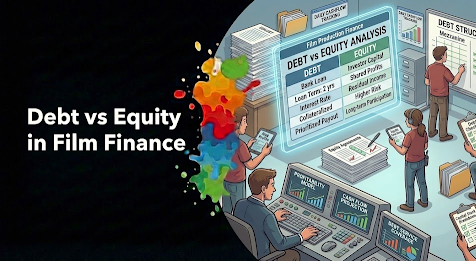
Debt-based financing remains the foundational layer of most independent film capital stacks. According to the International Film and Television Alliance (IFTA), more than 60% of independently financed English-language features above $5 million rely on at least one debt instrument. Debt structures let producers retain equity while using contracted revenues, pre-sales, or incentives as collateral. Understanding all three debt mechanisms (gap financing, bank loans, and P&A lines) is essential before approaching equity investors.
Key Stat
More than 60% of independently financed English-language features above $5 million rely on at least one debt instrument, according to IFTA’s 2025 market survey. Debt financing allows producers to access production capital against contracted revenues (pre-sales, tax incentives, and broadcaster licences) without surrendering equity to outside investors at the development stage.
Option 1: Gap Financing
Gap financing bridges the difference between what a producer has secured in pre-sales and the full production budget. A lender advances funds against unsold territories, using projected sales estimates as collateral. Typically, gap lenders will advance against 10-20% of the unsold territory value. It’s not cheap money: interest rates run high and the risk premium reflects the speculative nature of unsold rights. But for producers with a strong pre-sales foundation, gap financing can close a budget without surrendering additional equity.
The critical discipline with gap financing is understanding exactly which territories remain unsold and what a realistic sales estimate looks like for each. Overestimating unsold territory value is a common mistake that leaves producers with a shortfall at the close of gap lending. Vitrina’s dedicated guide to gap financing covers current active lenders, real deal examples, and a full cost breakdown in detail.
Option 2: Bank Loans and P&A Lines
Production loans from specialist entertainment banks (Comerica, City National, Coutts, and others in the UK and Europe) are structured against verified pre-sales and distribution agreements. Unlike gap financing, these loans advance against contracted, not speculative, revenues. P&A (prints and advertising) lines are a related instrument: a credit facility advanced against a distribution agreement to fund the theatrical release marketing campaign. Both require a completed picture or a near-final cut as collateral.
In our analysis of mid-budget independent financing structures, producers who secured a P&A line early in the post-production phase consistently achieved better theatrical terms with distributors than those who went into release negotiations without one. Having a funded release plan changes the negotiating dynamic entirely. Distributors are more willing to commit to a meaningful release when the P&A source is already confirmed. Read our analysis of debt financing for film projects: pros, cons, and strategies for the full comparison.
Option 3: Pre-Sales Agreements
A pre-sale is a licence agreement signed before production is complete, in which a distributor or broadcaster commits to a minimum guarantee against the rights to a specific territory or platform window. Pre-sales serve two functions: they provide cash flow during production, and they validate market interest to other financiers. According to Screen Daily, genre films (horror, thriller, action) continue to attract the strongest pre-sale interest internationally, with proven IP, named talent, and defined market positioning driving the highest minimum guarantee levels.
The sequence matters. Close your strongest territory pre-sales first, then use them to validate gap financing and bank loans. Weak early pre-sales set a low floor for subsequent negotiations. Producers should read our coverage of how to identify the best film funding opportunities before entering any pre-sale negotiation.
Equity and Co-Investment Structures
Equity financing puts capital into a project in exchange for an ownership stake in revenues and profits. It carries higher risk for investors than debt, but also higher potential return. According to the European Audiovisual Observatory, private equity investment in European independent film production grew 22% between 2022 and 2024, driven partly by tax-advantaged investment schemes in the UK, France, and Ireland. Producers should understand the three primary equity structures: private equity funds, co-production treaties, and broadcaster co-financing, because each operates on a different risk-return logic.
Key Stat
Private equity investment in European independent film production grew 22% between 2022 and 2024, according to the European Audiovisual Observatory’s 2025 production report. Tax-advantaged investment structures in the UK (EIS/SEIS), France (SOFICA), and Ireland (Section 481) were the primary drivers, attracting investors seeking both financial return and cultural patronage credentials.
Option 4: Private Equity
Private equity investment in independent film takes several forms: single-picture equity, slate deals covering multiple productions, and structured investment vehicles such as the UK’s Enterprise Investment Scheme (EIS) or France’s SOFICA funds. Single-picture equity is the simplest form, where an investor takes a defined percentage of net receipts in exchange for a cash contribution. Slate deals are more complex: investors spread risk across several projects in exchange for a portfolio-level return profile. EIS-backed investment funds, available to UK qualifying films, offer the added advantage of significant income tax relief for investors, which effectively reduces the producer’s cost of equity capital.
Equity investors require a compelling recoupment waterfall, a clear distribution strategy, and credible revenue projections. Producers with a track record of completed productions and verifiable distribution outcomes consistently close equity rounds faster than first-timers. See our guide comparing film financing vs. equity financing to understand where equity fits versus debt in different budget scenarios.
Option 5: Co-Production Treaties
Co-production treaties are bilateral or multilateral government agreements that allow a film to qualify as a national production in multiple countries at once. This unlocks access to national film fund financing, tax incentives, and distribution protections in each territory simultaneously. The UK maintains co-production treaties with 53 countries. Canada’s treaty network spans more than 50 bilateral agreements. A well-structured treaty co-production can access two or three national financing mechanisms in parallel, effectively increasing the available budget by 20-40% versus a single-territory production.
Treaty qualification requires meeting national content thresholds for key creative personnel, minimum spend percentages in each territory, and administrative requirements that vary by bilateral agreement. Producers who are new to treaty structures should start with our overview of film co-production agreements: what you need to know before approaching potential treaty partners.
Option 6: Broadcaster Co-Financing
Broadcaster co-financing involves a network, pay-TV channel, or streaming platform contributing production funds in exchange for exclusive window rights in one or more territories. European public broadcasters (the BBC, France Televisions, ZDF, and others) operate dedicated film co-financing arms that invest in independent productions meeting editorial and national content criteria. These are not licence deals. The broadcaster takes an equity-style position in the production, shares in revenues, and often retains first broadcast rights for a defined exclusivity period.
The distinction between broadcaster co-financing and a straightforward pre-sale matters legally and financially. A co-financing relationship gives the broadcaster editorial input rights in most cases. A pre-sale is a purely commercial licence. Producers who accept co-financing terms without understanding the editorial implications often find themselves managing a demanding creative stakeholder. Our article on how TV project financing works maps the broadcaster co-financing landscape in detail.
Find Equity Partners and Co-Producers Across 159,223 Verified M&E Companies
Vitrina’s M&E intelligence platform lets you filter for equity investors, co-production partners, and broadcaster co-financiers by territory, company type, and production track record. No cold calls required.
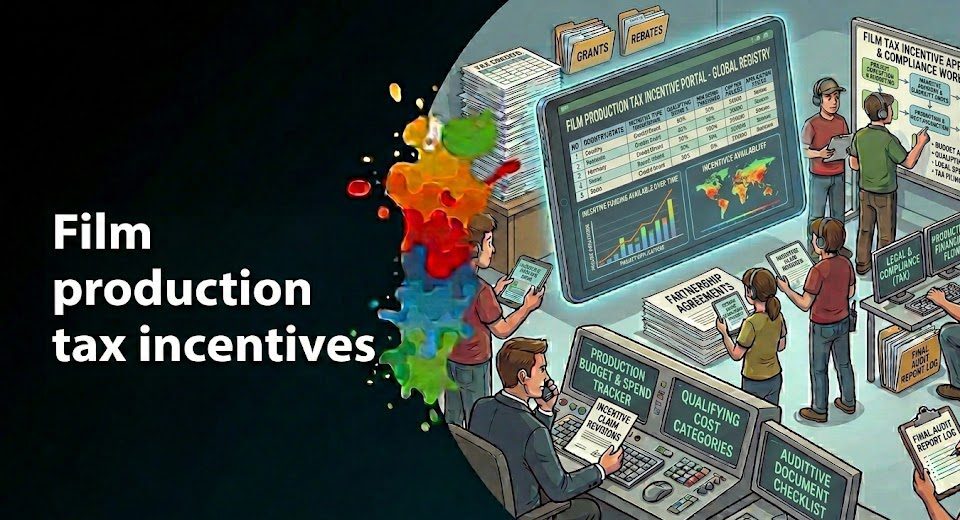
Incentive and grant-based financing is the highest-value, lowest-dilution capital available to independent producers. It doesn’t cost equity and it doesn’t accrue interest. According to the British Film Institute, the UK’s High-End TV and Film Tax Relief programmes returned over £1.79 billion to qualifying productions in FY2024 alone. That’s public capital flowing directly into production budgets. The producers who capture the most incentive value are those who structure their productions around qualifying requirements from the earliest development stage.
Key Stat
The UK’s High-End TV and Film Tax Relief programmes returned over £1.79 billion to qualifying productions in FY2024, according to the British Film Institute’s 2025 Industry Data Report. The UK’s HETV relief rate of up to 34% on qualifying UK spend makes it one of the highest-value incentive structures available to English-language independent productions globally.
Option 7: Tax Incentives and Rebates
Tax incentives come in two forms: tax credits and cash rebates. A tax credit reduces the production company’s tax liability by a percentage of qualifying spend. A cash rebate is paid directly to the production, regardless of profitability, making it usable as production financing. The most competitive international programmes in 2026 include: the UK’s HETV Tax Relief (34% on qualifying UK spend), France’s TRIP credit (up to 40% for eligible international co-productions), Georgia’s 30% transferable tax credit, and Canada’s multiple provincial cash rebate stacking structures.
The most sophisticated producers treat incentive structures as a location selection criterion, not an afterthought. Choosing to shoot two weeks of principal photography in an additional qualifying territory specifically to access a second incentive programme is a standard technique for mid-budget productions. The combined benefit of stacking a primary incentive with a secondary territory rebate can add 8-15% to the effective budget. Our detailed guide to entertainment financing in a streaming-first world explores how streamers are reshaping incentive negotiations.
Option 8: National Film Fund Grants
National film funds provide non-repayable grants or soft loans to productions that meet cultural and creative criteria. The BFI Film Fund, France’s CNC, Germany’s DFFF, Ireland’s Screen Ireland, Australia’s Screen Australia, and the Nordic Film Institute networks are among the most active globally. Grants typically range from $50,000 to $2 million per project, with soft loan programmes extending to $5 million for national prestige productions. Critically, many national fund grants also act as a co-financing signal that attracts private equity and broadcaster co-financiers.
The Eurimages fund, operated by the Council of Europe, specifically targets multi-territory European co-productions and contributed EUR 26.4 million across 65 projects in 2024. Eurimages support signals European cultural credibility, which opens doors with broadcasters and distributors across all 46 member states. Producers targeting European co-production structures should treat a Eurimages application as a core component of their financing strategy, not an optional extra. Find the right co-production partners to unlock these funds using our guide on how to find international film co-production partners.
Alternative and Emerging Film Financing Options
Alternative financing mechanisms have moved from curiosity to serious capital source over the past five years. Crowdfunding platforms raised over $150 million for creative projects globally in 2024, according to the Motion Picture Association. Branded content partnerships now regularly contribute 10-30% of documentary and branded feature budgets. Neither mechanism replaces traditional financing, but both fill genuine gaps in the capital stack that no other instrument addresses as efficiently. Producers who dismiss these options as small-scale are missing real money.
Key Stat
Crowdfunding platforms raised over $150 million for creative projects globally in 2024, according to the Motion Picture Association’s annual production financing review. For independent films with strong audience community ties (genre films, niche documentary subjects, or projects with built-in fan bases), crowdfunding consistently delivers both financing and early audience validation that subsequently attracts distributor interest.
Option 9: Crowdfunding
Crowdfunding works best for productions with a defined, mobilisable audience community. Horror, documentary, genre film with existing IP, and projects with political or cultural resonance consistently outperform on platforms like Kickstarter and Indiegogo. The mechanism is not about maximum dollars raised. It’s about validation and community development. A successful $200,000 crowdfunding campaign demonstrates audience demand to distributors, broadcasters, and co-financiers in a way that no pitch deck can replicate.
The strategic value of crowdfunding extends beyond cash. Backers become evangelists. A film that arrives at a festival with 4,000 documented supporters and a presold community has a measurably different market position than one without. For horror specifically, crowdfunding has evolved into a de facto demand-testing mechanism. Our coverage of horror film funding: a complete guide for producers addresses how genre producers are using crowdfunding to supplement institutional financing.
Option 10: Branded Content Partnerships
Branded content financing involves a commercial brand contributing production funds in exchange for creative integration, product placement, or exclusive association rights. It’s distinct from advertising sponsorship: the brand becomes a financing partner, not a logo on a title card. For documentary and narrative films aligned with a brand’s values or audience, this can be a genuinely additive financing source that contributes 10-30% of the total budget without touching the film’s distribution economics.
The discipline required is separating brand interests from editorial independence. Productions that compromise their creative integrity to satisfy brand placement mandates consistently underperform with audiences and critics. The producers who use branded content effectively treat it as a sponsorship layer over an already-fully-financed project: incremental capital that reduces risk rather than foundational money the film depends on. See our broader analysis in a producer’s guide to raising capital for film and TV for context on where branded content fits in the overall capital structure.
Research Financing Partners Before Your Next Market
Vitrina indexes 300,000+ verified M&E companies, including equity investors, broadcaster co-financiers, branded content producers, and national film fund-backed companies. Run structured pre-market research in minutes, not weeks.
How Vitrina Helps Producers Access Film Financing Networks
The most time-consuming part of film financing is not negotiating terms. It’s identifying who the right partners are before any conversation begins. VIQI’s database of 300,000+ verified M&E companies lets producers filter by territory, company type, production track record, and financing specialism, compressing weeks of cold research into a focused shortlist. For a producer building a co-production structure, equity round, or broadcaster co-financing conversation, starting with intelligence rather than cold outreach changes the quality of every subsequent meeting.
Producers using VIQI’s intelligence platform for financing research report identifying their first qualified equity contact an average of 11 days faster than through traditional network-based sourcing. For producers entering a new territory for the first time, where personal networks are thinnest, the time compression is most pronounced. The platform is especially effective for surfacing co-production partners with demonstrated treaty qualification experience and verified production track records. These are the exact criteria that distinguish viable financing partners from market-circuit acquaintances.
For producers who want to understand which territories offer the strongest combination of incentive programmes, active co-production treaty networks, and verifiable co-financing partners, Vitrina is the fastest path to that intelligence. Explore the full universe of M&E companies by production type, territory, and financing capability. The deeper strategic context for how all of these financing instruments fit together is in our guide to film financing options for independent producers, the foundational overview that complements this deep-dive.
Conclusion
Financing an independent film in 2026 means understanding a broader toolkit than any previous generation of producers faced. The 10 mechanisms covered here (gap financing, bank loans, pre-sales, private equity, co-production treaties, broadcaster co-financing, tax incentives, national film fund grants, crowdfunding, and branded content partnerships) each serve a specific function in a layered capital structure. No single mechanism finances a film on its own. The skill is in knowing which combination fits your project, your territory, and your timeline.
The sequencing principle applies across all structures. Secure your tax incentives and national fund grants first, because they reduce the effective cost of all subsequent capital. Layer broadcaster co-financing and pre-sales on top to establish cash flow and validate market interest. Then approach equity investors with a structure that already demonstrates institutional validation. Gap finance only the residual. Each layer you add reduces the risk profile of the next, and reduces your cost of capital overall.
The producers who close financing efficiently in 2026 share one trait: they do their research before they enter any market or start any outreach. They know which co-production partners have completed treaty structures. They know which equity investors are actively looking at their genre. They know which broadcasters are in acquisition mode for their budget range. Vitrina’s verified dataset of 300,000+ M&E companies provides the intelligence layer that makes that preparation possible. The financing exists. The question is whether you arrive at the table knowing who holds it.
Build Your Film Financing Stack with Vitrina Intelligence
Join the independent producers, studio executives, and entertainment finance professionals who use Vitrina to identify equity partners, co-financiers, and deal-ready companies across 300,000+ verified M&E companies in 100+ countries. Free to start. No credit card required.
What is gap financing in film and how does it work?
Gap financing is a loan advanced against the projected value of unsold distribution territories, bridging the difference between confirmed pre-sales and the full production budget. Lenders typically advance 10-20% of unsold territory estimates, at higher interest rates than traditional production loans. It’s best used to close the final 10-20% of a budget when most territory pre-sales are already secured, as IFTA notes in its independent financing guidelines.
2
How much can tax incentives contribute to an independent film budget?
Tax incentives can contribute 20-40% of total production budget in the highest-value programmes. The UK’s HETV Tax Relief returns up to 34% of qualifying UK spend. France’s TRIP credit reaches 40% for qualifying international co-productions. Producers who strategically structure their shoot location to maximise incentive stacking across two or more territories can add 8-15% to their effective budget, according to BFI’s 2025 production finance data.
3
What is the difference between a pre-sale and a broadcaster co-financing arrangement?
A pre-sale is a pure licence deal: a broadcaster or distributor pays a minimum guarantee for the rights to show a film in a defined territory and window, with no editorial control or equity stake. A broadcaster co-financing arrangement makes the broadcaster an equity partner, granting editorial input rights in exchange for a larger financial contribution. Co-financing deals are more complex but typically fund a higher percentage of budget than standalone pre-sales.
4
Is crowdfunding a viable primary financing source for independent films?
Crowdfunding rarely functions as primary financing for independent features, but works well as a supplementary source and audience-validation mechanism. The most successful film crowdfunding campaigns raise $100,000-$500,000, covering development costs or a defined production phase. More importantly, a successful campaign demonstrates documented audience demand to distributors and co-financiers. According to the Motion Picture Association, creative project crowdfunding raised over $150 million globally in 2024, with genre films and documentaries performing best.
5
How do independent producers find equity investors for film projects?
Independent producers find equity investors through entertainment finance networks, film market meetings, producer associations like the PGA and PACT, and increasingly through M&E intelligence platforms that filter investors by territory and genre focus. The European Audiovisual Observatory reports private equity investment in European independent film grew 22% between 2022 and 2024. Producers with a verified production track record, a clear recoupment waterfall, and institutional validation from national film funds close equity rounds fastest.
About the Author
Vitrina Research Team
The Vitrina Research Team produces intelligence-led analysis on media and entertainment industry structure, deal activity, and market trends. Our research draws on VIQI’s proprietary dataset of 300,000+ M&E companies worldwide.


 IHUB
IHUB
 Private Briefings (Webinars)


 LeaderSpeak Podcast
  Global Entertainment Digest (Newsletter)
  Premium Lists
 Membership Benefits
 About Vitrina
 Our Story