About Innovation Hub
 Global Content Pulse (Webinars)


 Global Production Financing
(Webinars)
Global Production Financing
(Webinars)  LeaderSpeak Podcast
  About Vitrina
 Our Story
 Our Solutions 🔥
 Film+TV Projects Tracker 🚀
 Case Studies
 Our Profile
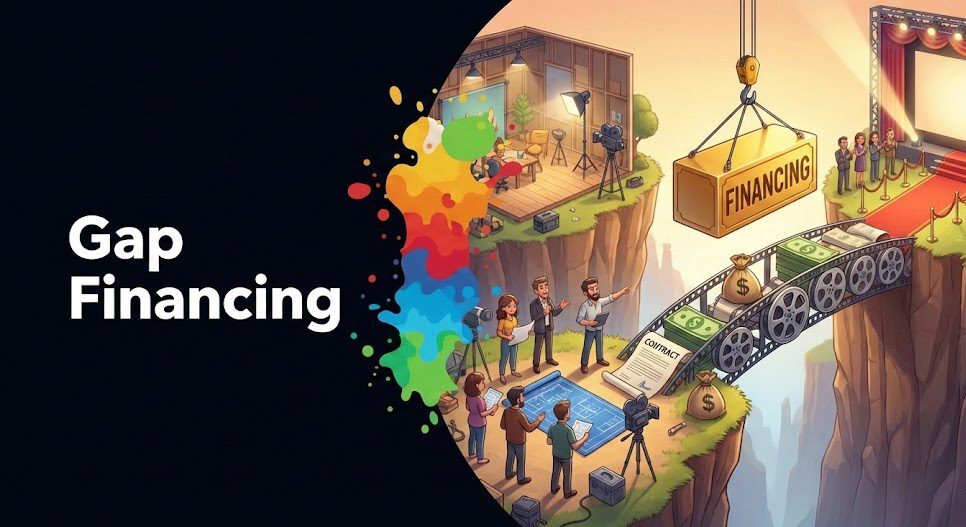
To raise gap financing for an indie feature, you need to secure a debt facility against your project’s unsold territory rights—typically covering the final 10–30% of your production budget.
Successful producers secure this by leveraging high-authority sales estimates, layering regional tax incentives, and selecting lenders who specialize in specific genres. It sits senior to your equity investors, meaning the lender gets paid back first from the “waterfall” of international sales.
Let’s be real: closing the final gap on an indie film is often the most stressful part of the entire development cycle. You’ve got the script, you’ve got some “soft money,” and maybe a piece of equity—but the bank won’t move until the budget is 100% closed. If you’re stuck at the 80% mark, you aren’t just looking for money; you’re looking for a bridge to production. Based on our analysis of 62 expert interviews with lenders like Phil Hunt and Matthew Helderman, here is how you actually bridge that divide in today’s market.
In this guide:
Stop Guessing Who’s Financing. Get Targeted Outreach.
Stop searching and start getting funded. We identify the exact decision-makers currently backing projects like yours, turning raw data into risk-aligned capital partnerships.
Major Studios
Scouting early stage projects, IP, and Regional partners for global studio pipelines.
IP Owners & Leads
Connecting creative leads with qualified financiers and major streaming platforms.
Streamers
Securing high-value pre-buy content and discovering early-stage global IP for platforms.
Indie Producers
Bridging the gap for indie filmmakers to reach executive production partners and capital.
Global Financing Ecosystems
Mapping complex markets and pairing projects with disciplined, risk-aligned capital across global territories worldwide.
What Actually Qualifies as “Gap” in 2025?
Before you try to raise gap financing, you’ve got to understand where it sits in the “capital stack.” Lenders don’t provide gap just because they like your script. They provide it because they believe your “unsold” territories—Japan, Germany, Latin America—are worth more than the loan they’re giving you. It’s an asset-backed loan, where the asset is a future contract that doesn’t exist yet.
In the current environment, “gap” is getting tighter. Streamers are buying fewer worldwide rights, which—ironically—is good for gap lenders because it leaves more territories open for “territorial” sales agents. If you’re exploring how this fits your specific project, you can ask VIQI for a gap feasibility check based on your genre and budget.
The 5 Tactical Paths to Raise Gap Financing
1. The Sales Agent Leverage Model
The most common way to raise gap financing is through the strength of your sales agent’s estimates. But here’s the thing: lenders don’t trust all sales agents equally. If you have a tier-one agent (think FilmNation, WME Independent, or AGC), a lender might advance 60-70% of the “low” estimate. If your agent is unproven? You’ll be lucky to get 30%.
2. The Incentive Collateral Strategy
Smart producers don’t just gap the unsold territories; they gap the “tax credit.” If you’re shooting in a high-rebate region like Saudi Arabia (40%) or the UK (up to 40% for indie films), lenders are much more willing to bridge the gap because they see a guaranteed government payout. This de-risks the entire project and can significantly lower your interest rate. Understanding the production financing landscape in these regions is the first step.
3. The “Genre-First” Risk Mitigation
Lenders love horror, action, and high-concept thrillers. Why? Because they’re “bankable” even without a massive star. If you’re making a $5M horror feature, you can often raise gap financing based on the genre’s floor value alone. Dramas, on the other hand, almost always require “A-list” talent to trigger a gap facility.
4. The Mezzanine-Gap Hybrid
Sometimes the “gap” is too big for a traditional senior lender. In these cases, you might raise “Mezzanine” debt—which is more expensive (often 15-20%) but takes more risk. It sits between the senior debt and the equity. It’s a “weaponized” form of capital that can get a project into production when traditional banks say no.
5. The “Packaged” Lender Approach
Many lenders now offer “one-stop shops.” They’ll provide the bridge loan, the tax credit lending, and the gap financing all in one package. While the fees might be higher, the “execution risk” is lower because you aren’t waiting for three different legal teams to agree on an inter-creditor agreement. You can explore 140+ vetted lenders on Vitrina to find these “one-stop” specialists.
The Vitrina Gap Readiness Scorecard™
Use this to gauge if your project is ready for a professional gap lender. (Score 1-10 per category)
| Sales Agent Authority: Top-tier agents = 10 | __/10 |
| Incentives Layered: >30% rebate = 10 | __/10 |
| Genre Bankability: Action/Horror = 10 | __/10 |
| Completion Bond: Commitment in hand = 10 | __/10 |
| Cast Attachment: Meaningful LOIs = 10 | __/10 |
80-100: Prime Gap Candidate | 50-79: Likely needs Mezzanine | <50: High Execution Risk
Phil Hunt, CEO of Head Gear Films, discusses the current financing reality:

Find the Financiers Backing Your Genre
Stop searching and start getting funded. We identify the exact decision-makers currently backing projects like yours, turning raw data into risk-aligned capital partnerships.
Can You Raise Gap Financing Without an A-Lister?
It’s the question we hear most: “Do I need a movie star?” The honest answer? It depends on your budget. If you’re trying to raise gap financing for a $20M film, yes—you almost certainly need an A-lister. But for the $2M–$5M range? Lenders are more focused on the “package” than a single name.
A strong director, a reputable sales agent, and a “clean” chain of title can often outweigh a B-list cast. Lenders look for “comparables”—other films in your genre with similar specs that performed well. If you can prove the market appetite, you can raise the capital. Also, don’t overlook the importance of post-production quality; lenders want to know the finished product will meet IMF delivery specs for global platforms.
How Vitrina Helps with Gap Financing
Finding the right lender is half the battle. You don’t want to pitch a $3M horror film to a lender that only does $50M studio slates. Vitrina’s platform is designed to compress that search time from weeks to hours.
- Lender Database: Filter 140+ verified gap lenders by territory, budget range, and preferred genres.
- VIQI AI Assistant: Get instant answers on lender requirements and market “norms” for 2025.
- Concierge Service: For active productions, our team provides hands-on matching to qualified financing partners.
Frequently Asked Questions
How much does it cost to raise gap financing?
Expect interest rates between 8% and 15% annually. On top of that, lenders usually charge an “origination fee” of 1-2% and you’ll be responsible for their legal fees (which can run $15k-$25k). It’s not cheap, but it’s often cheaper than giving away another 20% of your equity.
Do I need a completion bond to get gap financing?
Almost always. Gap lenders are senior debt; they won’t take “production risk.” They need a guarantee that the film will actually be finished and delivered so they can collect on their collateral. Without a bond commitment, most institutional gap lenders won’t even open your deck.
What’s the typical timeline to raise gap financing?
Plan for 4 to 8 weeks. The legal “due diligence” on gap deals is intense—lenders have to vet your chain of title, your sales agent’s track record, and your production insurance. Don’t leave it until the week before you start shooting.
The Bottom Line
To raise gap financing, you shouldn’t just look for money; you’re looking for a partner who believes in your project’s international marketability. It requires a balanced capital stack, a trusted sales agent, and a clean package. If you’ve got those in place, the capital is available—you just have to know where to look.
Ready to close your budget? Connect with Vitrina’s Concierge team to get matched with gap lenders who fit your project’s specific profile today.
Find Film+TV Projects, Partners, and Deals – Fast.
VIQI matches you with the right financiers, producers, streamers, and buyers – globally.
Producers Seeking Financing, Co-Pros, or Pre-Buys?
Vitrina Concierge helps producers reach the right financiers, commissioners, distributors, and co-production partners — with precision outreach, not cold pitching.
Join Industry Briefings Trusted by Leaders

Format Adaptations: Global Trends
Where formats are traveling, which adaptations are breaking out, and how streamers are backing remakes in 2025–2026.

Books, Novels & Comics Adaptations: Global Trends
Books, webtoons, and manga driving the next global screen hits. Discover how in this webinar.

Micro-Dramas & Mobile-First Storytelling
Micro-dramas are building real audiences and revenue. Understand the platforms, buyers, and economics behind the growth.

Navigating Global Content Licensing Trends
How global content licensing is shifting beyond flat fees to flexible, deal-driven models.