About Innovation Hub
 Global Content Pulse (Webinars)


 Global Production Financing
(Webinars)
Global Production Financing
(Webinars)  LeaderSpeak Podcast
  Global Entertainment Digest (Newsletter)
  About Vitrina
 About VIQI
 Our Story
 Our Solutions 🔥
 Film+TV Projects Tracker 🚀
 Case Studies
 Our Profile
Author: By Kunal Barai
Kunal Barai leads Global Markets at Vitrina.AI, working with producers and financiers across 100+ countries to facilitate content financing and co-production matchmaking. He recently hosted a roundtable on AI for Film Financing at MIP London 2026. Earlier, he spent 12+ years at Nielsen/Gracenote and completed MIT Sloan’s executive program on AI strategy.
Summary: Music licensing isn’t a post-production afterthought. It’s a deal structure — one that can add unexpected cost, delay distribution, and kill your chain of title if handled wrong. Producers who understand how sync rights, master rights, and performance royalties actually work don’t just save money. They make smarter creative decisions from day one.
Here’s something most first-time producers learn the hard way: the song that perfectly soundtracks your scene in the edit can cost you $80,000 to license — or it can be impossible to clear entirely. The music supervisor you hired didn’t warn you. Your line producer didn’t budget for it. And now you’re in post-production, locked to a track you can’t afford and a distributor who won’t touch the film without it.
This isn’t a rare scenario. It’s a pattern. And it plays out again and again because music licensing in film and TV is genuinely complex — two separate copyrights, multiple rights holders, performance royalties running in the background, and territory-by-territory clearance that can make a global streaming deal fall apart at the worst moment.
The Netflix and Warner Music Group exclusive multi-year deal signed in early 2026 — giving Netflix access to one of the most extensive catalogues in music history — signals exactly where this market is heading. Studio-level licensing relationships are being locked up. For independent producers, that means the cost of access to catalog music is rising. And the window to get deals done cheaply is closing.
What follows is the practical guide that should have been in your development budget from the start.
Table of Contents
- The Two Copyrights You Need to Clear
- What a Music Supervisor Actually Does
- How Music Licensing Deals Get Done
- Studio Catalog Deals and Why They Matter
- Performance Royalties and PROs Explained
- How to Budget for Music Licensing
- Territory Clearance: The Distribution Trap
- How Vitrina Helps Independent Producers
- Conclusion
- Frequently Asked Questions (FAQ)
The Two Copyrights You Need to Clear
Every piece of music carries two separate copyrights. Miss one and you don’t have a license — you have a lawsuit waiting to happen.
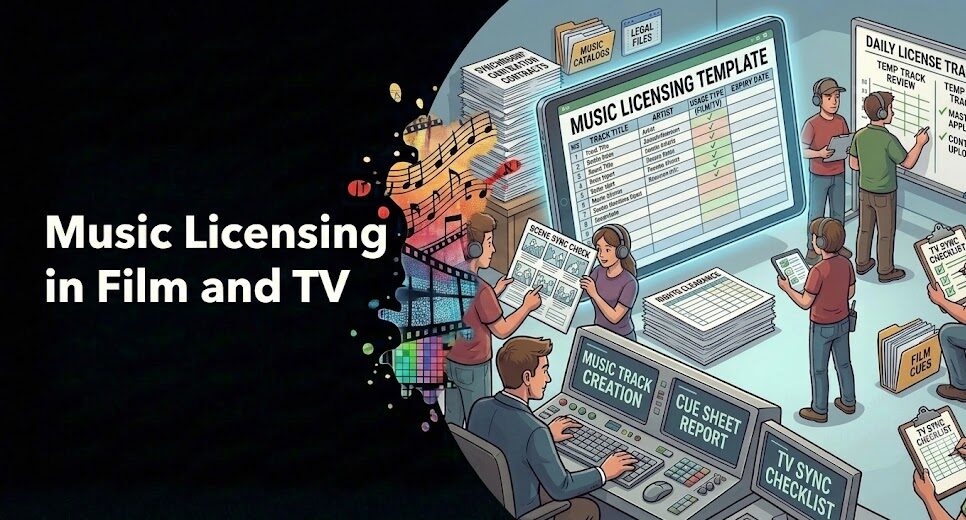
The synchronization license (the “sync license”) covers the musical composition — the melody, lyrics, and arrangement. This is typically owned by the songwriter or their music publisher. You need this to synchronize music with your visuals. The master use license covers the actual sound recording — the specific performance captured on the track. This is usually owned by the record label, or in the case of independent artists, the artist themselves.
Both licenses are required. Every single time. There are no shortcuts.
So what does that mean practically? If you want to use Joni Mitchell’s “Both Sides Now” in your film, you need a sync license from her publisher, and a master use license from whoever owns that specific recording — which could be her original label, a new label if rights have changed hands, or a digital rights administrator. Two separate negotiations. Two separate contracts. Two separate fees.
Here’s where independent producers have a real structural advantage: when a track is owned and controlled by a single artist who holds both master and publishing rights — the “one-stop clearance” — the entire process collapses into one conversation. Music supervisors actively seek these situations because they compress weeks of legal back-and-forth into days. If you’re producing at indie budget levels, building relationships with one-stop artists isn’t just good creative strategy. It’s smart production management.
The trend is notable. Genre and geographic diversity is actively sought by supervisors in 2025-2026 — French indie pop, Latin American singer-songwriter styles, Asian instrumental music. These artists often own their own masters. That’s not a coincidence. Supervisors go where the clearance is easiest when the creative quality is equivalent.
What a Music Supervisor Actually Does
A music supervisor is not your music consultant. They’re your clearance engine — and confusing the two roles is one of the most expensive mistakes an independent producer can make.
The supervisor’s job begins the moment a director says “I want something that feels like early Springsteen but we can actually afford.” They translate that creative brief into a curated selection of tracks that fit the mood, the timing, the budget, and — critically — the clearance reality. A supervisor who can’t deliver clearable tracks isn’t a music supervisor. They’re a playlist generator.
Once a track is approved, the supervisor acts as the liaison between creative decisions and legal execution. They reach out to rights holders, initiate licensing inquiries, request quotes, run negotiations on fee, duration, territory, and prominence, then execute the contract. On larger productions, they often manage this for dozens of tracks simultaneously — each with its own rights holder, agent, publisher, and timeline.
Here’s what most producers don’t budget for: music supervisors typically don’t work on speculative basis on indie projects. You’re paying for their time before a single track is cleared. On studio-scale productions, the supervisor’s fee can be $10,000 to $30,000 for a feature. On an indie, you might find a freelance supervisor willing to work for $3,000 to $8,000 — but don’t expect the same rolodex of relationships, which directly affects what you can clear and at what speed.
The other thing supervisors will tell you quietly: music supervisors rarely accept unsolicited direct submissions from filmmakers. Their preferred pipeline runs through sync agents, libraries, and established publisher relationships. If you’re an indie producer trying to access a specific supervisor, your fastest path is often through a music library they already work with — not a cold email with a brief attached.
How Music Licensing Deals Get Done
The deal starts with a creative brief. The process ends with two contracts, a payment, and a cue sheet. What happens in between is where most independent productions run into trouble.
Once the music supervisor identifies a track, they submit a licensing inquiry to the rights holder — directly to the label, publisher, or artist’s representative. That inquiry specifies how the music will be used: background music or featured placement, duration on screen, the type of scene, the territory of distribution, the media (theatrical, streaming, broadcast), and whether the license is exclusive or non-exclusive.
Rights holders respond with a fee quote. And this is where the variables start stacking up. The same track can cost $500 or $50,000 depending on how it’s used. A background music credit in a single-country streaming release costs a fraction of what a featured placement in a global theatrical release will run. “Prominence” — whether the track is background or the center of the scene’s emotional action — is often the single biggest pricing factor.
Negotiation typically covers four key points: fee, term (how long the license lasts — in perpetuity or for a defined period), territory (which countries the license covers), and scope of use (the specific media and platforms the license covers). Indie producers sometimes try to save money by licensing for limited territory — but if your streaming deal is global, a regional music license creates a gap that your distributor won’t accept. Budget for the distribution reality you’re targeting, not the one that fits today’s cash flow.
Both sync and master licenses are often negotiated together, but they remain technically separate documents with separate rights holders. A “Most Favored Nation” (MFN) clause is commonly used in indie productions — it means both the sync and master licensors receive the same fee, which simplifies negotiations and signals good faith to rights holders who don’t want to feel they negotiated harder than the other party.
Studio Catalog Deals and Why They Matter for Independent Producers
The Netflix-Warner Music Group deal signed in early 2026 wasn’t just a headline. It’s a structural shift in who controls access to premium catalog music — and at what price.
When a streaming platform or studio locks in an exclusive multi-year catalog deal with a major label or music group, what they’re doing is pre-negotiating blanket access to that catalog’s sync and master rights. Warner Music Group represents artists including David Bowie, Cher, Fleetwood Mac, Aretha Franklin, Coldplay, and Bruno Mars. Netflix now has access to that catalog for content produced under its banner. An indie producer trying to license the same tracks works through a completely different channel — and pays spot-market rates, not pre-negotiated platform rates.
The practical effect: as more catalog music moves into exclusive or preferential studio deals, independent producers working without studio backing face a narrowing pool of accessible catalog at affordable rates. Sony Music, Universal Music Group, and Warner Music all operate catalog management divisions specifically for sync licensing — and their priority customer is the platform writing the biggest annual check, not the indie feature with a $2M budget.
But here’s the other side of that equation. The same consolidation driving studio catalog deals is also pushing supervisors toward independent and emerging artists — precisely because they offer one-stop clearance, competitive rates, and flexibility that a label catalog won’t extend on a project-by-project basis. The rise of music libraries like Artlist, Epidemic Sound, and Musicbed is a direct response to this market dynamic. Supervisors can access cleared, high-quality tracks at a fraction of the cost and timeline of a catalog negotiation.
For independent producers, the strategic read is this: budget and schedule as if the catalog music you want will cost more and take longer than expected, then structure your clearance process around music library tracks for everything except your two or three most creatively essential placements. That’s where your clearance budget delivers the highest return on creative investment.
Performance Royalties and PROs: The Revenue Stream Running Behind Your Production
Your sync fee pays the rights holder to use the music. Performance royalties are what happens after your film plays.
Performing Rights Organizations — ASCAP, BMI, and SESAC in the United States; PRS for Music in the UK; SOCAN in Canada — collect royalties every time licensed music is performed publicly. When your film screens in a cinema in Germany, or streams on a platform in South Korea, or broadcasts on television in Brazil, those performances generate royalties paid back to the composer and publisher of every track on your cue sheet.
As an independent producer, you’re not directly responsible for collecting these. Broadcasters, platforms, and venues hold blanket licenses from PROs that cover their public performances. But what you are responsible for is filing an accurate cue sheet — the document that logs every piece of music in your film, its duration, its usage type, and its rights holders. Without a clean, complete cue sheet, composers and publishers can’t collect the royalties they’re legally owed. And if a rights holder discovers their royalties weren’t properly tracked, it becomes your problem in the form of a clearance dispute that can block distribution.
In the United States, films don’t generate theatrical performance royalties — that’s different from most international markets, where theatre screenings do generate PRO income. When your film reaches foreign territories, those royalties kick in and track back to the rights holders via their PROs’ reciprocal agreements. The international performance royalty flow is one reason why rights holders in major markets negotiate harder for international territory coverage — they’re not just protecting one-time sync income, they’re protecting backend performance streams.
ASCAP currently represents over 1.1 million songwriters and composers and licenses a repertory of more than 20 million musical works. BMI represents more than 1.4 million artists. Between them, these two organizations distribute over $1 billion annually in performance royalties. That scale matters to a rights holder when they’re deciding whether to grant a sync license — performance royalties represent a meaningful secondary income stream tied to your film’s success.
How to Budget for Music Licensing Without Blowing Your Post Budget
Most independent productions budget for music as a line item under post-production — and get it badly wrong.
The mistake is budgeting for the music you want at the beginning of the project rather than the music you can actually clear within your distribution window. Those are two very different numbers. Here’s a realistic framework.
For a low-to-mid-budget independent feature targeting streaming distribution, build your music budget around three tiers:
- Music library tracks (background and transitional music): $500 to $3,000 total for unlimited use library licenses via platforms like Artlist or Musicbed. These are pre-cleared, one-stop, and suitable for streaming distribution without additional negotiation.
- Independent artist placements (emerging artists, one-stop clearance): $1,000 to $10,000 per track depending on prominence and territory scope. Budget 2-4 placements here for scenes that need something specific to the project’s voice.
- Catalog music (established artists, label-managed): $5,000 to $80,000+ per placement for global streaming rights. If your creative concept hinges on a specific well-known track, this is your risk item. Budget it specifically, not as part of a general pool.
Add your music supervisor fee on top of that — not inside those numbers. And build a clearance contingency of 15-20% of your total music budget for tracks that don’t clear at the quoted rate and require replacement.
One thing that trips up producers consistently: licensing a song for festival exhibition and then needing to re-license for streaming or broadcast. Festival-only licenses are cheaper, but they don’t extend to commercial distribution. If you’re planning to take the film to a streamer after festivals, structure your licenses for that reality from the start. Re-licensing costs money and time — and some rights holders will use the leverage of your distribution deal to renegotiate upward.
Territory Clearance: The Distribution Trap That Kills Deals
Here’s a scenario that plays out more often than the industry talks about: a small independent film gets a streaming offer — genuine interest, real money. The deal stalls because one of the film’s five music tracks isn’t cleared for the territory the streamer needs.
Territory clearance isn’t an afterthought. It’s a distribution prerequisite. Every streaming platform, broadcaster, and theatrical distributor requires that every piece of music in your film is licensed for the exact territories covered by their deal. If your license says “United States only” and the distribution offer is pan-European, you go back to the rights holder and renegotiate — on their timeline, at their revised rate, while your distribution window sits open.
The smart approach is to negotiate worldwide rights in perpetuity for every piece of music from the first conversation. Yes, that costs more upfront. But it eliminates the renegotiation risk entirely, and it keeps your chain of title clean — which matters significantly when you’re talking to financiers about your next project and your track record with distribution delivery is part of the conversation.
If worldwide rights are cost-prohibitive for certain tracks, the alternative is to be surgical: identify exactly which territories your distribution plan covers in the next 3-5 years and license for those specifically, with a right-of-first-refusal for additional territory expansion. It’s more complex to administer, but it gives you the cost efficiency of a limited license with some protection against expansion.
The Netflix-Warner Bros. acquisition context is relevant here too. As studio consolidation accelerates, the rights landscape for certain catalog music may shift — ownership can change through acquisition, and with it, who you negotiate with and at what terms. Building these clearances under stable rights conditions now is better than navigating a post-acquisition rights landscape where new ownership has reset deal terms across the board.
How Vitrina Helps Independent Producers Navigate Music and Production Partnerships
Music licensing doesn’t happen in isolation. It’s part of a larger production intelligence problem: finding the right people, with the right mandates, at the right moment in your project’s development cycle.
Vitrina’s platform maps 360,000+ companies across the global entertainment supply chain — including production companies, music supervisors, content financiers, and co-production partners across 100+ countries. For an independent producer working through music clearance and production financing simultaneously, that’s not a directory. It’s an intelligence layer.
Through VIQI, Vitrina’s vertical AI assistant, producers can ask specific questions: which music supervisors are actively working on drama productions in my genre? Which production companies in my target territory have a track record with music-driven films? Which financiers have recently backed projects with significant music licensing budgets? VIQI draws on Vitrina’s verified supply-chain dataset — not the internet — to return specific, actionable answers with current roles and deal history attached.
The Vitrina Concierge service takes that intelligence and executes it. If you’re an independent producer seeking co-production partners for a project where music is central to the creative package, Concierge can identify and approach the right executives across multiple territories — matching your project’s profile to the actual mandates and track records of potential partners. Direct engagement, not cold outreach.
Three ways Vitrina supports producers working through music and production decisions:
- Explore the database — search music supervisors, co-producers, and production partners by genre, territory, and deal history
- Ask VIQI — get specific, research-backed answers on who’s active in your space and what they’re looking for
- Contact Concierge — for hands-on partner identification and outreach on your behalf
Conclusion
Music licensing in film and TV isn’t complicated because the rules are obscure. It’s complicated because most producers encounter it at the worst possible moment — deep in post-production, with a distribution window open and a rights holder who knows they have leverage. The sync market hit $650 million in 2024 and is growing. The competition for cleared, affordable catalog music will only intensify as studio-level platform deals lock up the most sought-after tracks.
The producers who navigate this well don’t wait for their music supervisor to surface the problem. They build music clearance into their development budget, structure licenses for their actual distribution ambitions, and build relationships with the kind of one-stop artists and music libraries that can move at production speed.
Studio catalog consolidation is accelerating. Your window to license premium music at independent rates is finite — and the producers who treat music as a production intelligence challenge, not just a creative one, will close faster and distribute cleaner.
Key Takeaways
- Every music placement requires two separate licenses — sync (composition) and master (recording). Both are non-negotiable.
- One-stop clearance — a single artist owning both rights — dramatically compresses timelines and cost. Build relationships with these artists early.
- Studio catalog deals between major platforms and labels are narrowing affordable access for indie producers. Adjust your clearance strategy accordingly.
- License for your actual distribution plan — worldwide rights in perpetuity where possible — not just your immediate production window.
- Performance royalties run behind every public showing of your film. A clean cue sheet isn’t optional; it’s how your rights holders get paid and how you stay clear of post-distribution disputes.
Frequently Asked Questions (FAQ)
What is a sync license in film and TV production?
A sync license (synchronization license) is the legal agreement that grants permission to use a musical composition alongside visual content — in a film, TV show, commercial, or streaming series. It covers the underlying composition: melody, lyrics, arrangement. You need this from the songwriter or their publisher. But a sync license alone isn’t enough. You also need a master use license for the specific recording, which is a separate agreement with whoever owns that recording. Both licenses are required for every music placement.
How much does music licensing cost for an independent film?
It depends on what you’re licensing and how you plan to use it. Music library tracks with pre-cleared sync and master rights can cost $500 to $3,000 for unlimited use. Independent artist placements run $1,000 to $10,000 per track for streaming distribution. Established catalog music — anything from a major label’s roster — can run $5,000 to $80,000+ per placement for global streaming rights. The biggest cost drivers are prominence (background vs. featured), territory scope (regional vs. worldwide), and how recognizable the track is. Budget for clearance contingency of at least 15-20% on top of quoted fees.
What is the difference between a sync license and a master use license?
A sync license covers the composition — the notes, lyrics, and arrangement created by the songwriter. A master use license covers the specific recording — the actual performance captured in the studio. If you want to use a well-known song as performed by the original artist, you need both. If you wanted to commission a new recording of the same composition, you’d only need the sync license plus a deal with whatever artist performs the new version. Independent artists who own both their publishing and masters can grant both licenses in a single negotiation, which is why supervisors often prefer working with them on indie productions.
What do PROs like ASCAP and BMI do in film production?
Performing Rights Organizations — ASCAP, BMI, and SESAC in the US; PRS for Music in the UK; SOCAN in Canada — collect and distribute performance royalties whenever licensed music is performed publicly. For film producers, this means every time your film screens in a theatre, broadcasts on TV, or streams on a platform, PROs are tracking those performances and paying royalties to the composers and publishers of every track on your cue sheet. You’re not directly responsible for making these payments — broadcasters and platforms hold blanket PRO licenses. But you are responsible for filing an accurate cue sheet, which is what enables the PRO to identify and pay the right rights holders.
Do I need to license music differently for streaming versus theatrical distribution?
Yes. The scope of your license must match your distribution plan. A theatrical-only license doesn’t cover streaming. A single-territory streaming license doesn’t cover global platforms. Rights holders price licenses based on use — and if your distribution expands beyond what your license covers, you need to go back and renegotiate, often at rates reflecting your new distribution leverage. The smart move is to license for worldwide rights in perpetuity from the start, even if it costs more upfront. That eliminates re-licensing risk entirely and keeps your chain of title clean for distributors who do proper due diligence.
What is a music cue sheet and why does it matter?
A cue sheet is the complete log of every piece of music in your film — track title, composer, publisher, rights holder, duration, and how it’s used (background, featured, source). You submit this to the distributor and to PROs after the film is complete. Without a clean cue sheet, composers and publishers can’t collect the performance royalties they’re legally owed. A missing or inaccurate cue sheet is also a common cause of distribution delays — streamers and broadcasters require it as part of their delivery requirements. Treat your cue sheet as a production deliverable from day one, not a post-production paperwork afterthought.
How do studio catalog deals affect independent producers trying to license music?
When major streaming platforms lock in exclusive multi-year deals with large music groups — like the Netflix and Warner Music Group partnership announced in 2026 — they’re pre-negotiating blanket access to those catalogs at preferential rates. Independent producers working without studio backing don’t access those deals. They negotiate track-by-track at spot-market rates, which are typically higher and take longer to conclude. The practical effect is that premium catalog music becomes progressively less accessible to indie productions on indie budgets. The counter-strategy is to build your production around music library tracks and one-stop independent artists for the bulk of your score, reserving clearance budget for the two or three placements where catalog music is genuinely irreplaceable to the story.
What is a Most Favored Nation clause in music licensing?
A Most Favored Nation (MFN) clause is a provision that ensures both the sync licensor (publisher/songwriter) and the master licensor (label/artist) receive the same fee. It’s widely used in independent film productions because it simplifies dual negotiations — you’re not managing two different fee structures with two rights holders who might otherwise compare notes and feel the other got a better deal. MFN clauses signal good faith and reduce negotiation time, which matters on productions with tight clearance windows. If you’re licensing three tracks with MFN provisions, all six licenses (sync and master for each) settle at the same rate per track.