About Innovation Hub
 Global Content Pulse (Webinars)


 Global Production Financing
(Webinars)
Global Production Financing
(Webinars)  LeaderSpeak Podcast
  Global Entertainment Digest (Newsletter)
  About Vitrina
 About VIQI
 Our Story
 Our Solutions 🔥
 Film+TV Projects Tracker 🚀
 Case Studies
 Our Profile
Kunal Barai leads Global Markets at Vitrina.AI, working with producers and financiers across 100+ countries to facilitate content financing and co-production matchmaking. He recently hosted a roundtable on AI for Film Financing at MIP London 2026. Earlier, he spent 12+ years at Nielsen/Gracenote and completed MIT Sloan’s executive program on AI strategy.
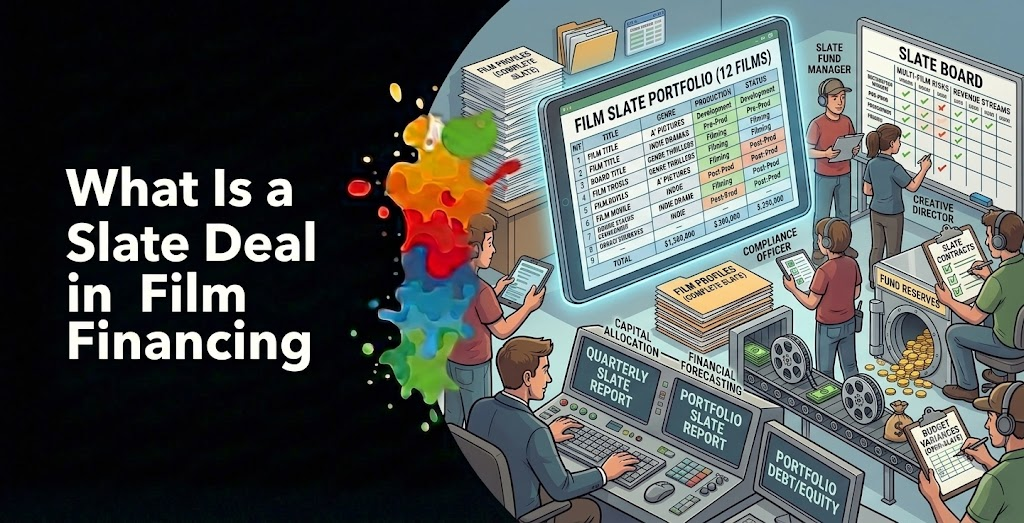
Summary: A slate deal is the mechanism that lets institutional capital enter the film business at portfolio scale — spreading risk across multiple titles rather than betting everything on a single project. Studios use them to offload balance-sheet pressure. Investors use them to access deal flow they couldn’t assemble title by title. For independent producers, understanding how slate deals are structured — and where producers actually sit in the economics — is the difference between entering a deal that builds your business and entering one that funds someone else’s.
Slate financing isn’t new. Studios have been running multi-picture co-financing agreements since the early 2000s, when Relativity Media structured the first major institutional slate deal — a 17-picture joint arrangement with Sony Pictures and Universal Studios backed by roughly $600 million from hedge funds, according to industry accounts reported by Variety. What’s changed is who’s doing it now, and at what scale.
In 2024, Lionsgate signed a multi-year slate co-financing agreement with Media Capital Technologies — a specialty finance company backed by institutional investors including MassMutual — covering titles including Saw X, Ordinary Angels, and The Ministry of Ungentlemanly Warfare, as reported by Variety. In February 2025, Paramount struck a slate financing deal with Domain Capital Group covering at least 30 films, as reported by The Wrap. And in September 2024, European sales company mk2 Films announced a multi-year slate deal with IPR.VC — the Helsinki and London-based fund that has backed A24, XYZ Films, and more than 50 productions — as reported by Deadline.
This isn’t just a studio game anymore. Independent producers, mid-tier production companies, and sales-led outfits are all using slate structures to attract capital that won’t commit to a single film. If you’re building a production company with ambitions beyond one-off projects, the slate deal conversation will come up. Here’s what you need to understand before it does.
Table of Contents
- What Is a Slate Deal in Film Financing?
- How Slate Deals Work: Structure, Capital, and Contractual Mechanics
- The Waterfall Problem: Why Equal Investment Doesn’t Mean Equal Returns
- What Slate Deals Mean for Independent Producers
- Real Slate Deals: What the Market Looks Like in 2025 and 2026
- Slate Financing vs. Single-Picture Financing: Which Works for You?
- How Vitrina Helps Producers Find Slate Financing Partners
- Conclusion
- Frequently Asked Questions
What Is a Slate Deal in Film Financing?
A slate deal — also called slate financing or a co-financing slate agreement — is an arrangement in which a third-party investor commits capital to a defined portfolio of films rather than a single project. The investor and the production company or studio share the costs and revenues across that entire portfolio, with the commercial logic being diversification: a run of underperforming titles is offset, in theory, by the titles that break out.
Think of it this way. A private equity fund that puts $10 million into one film is entirely dependent on that film’s performance — one bad release and the investment is gone. The same $10 million spread across eight films over three years means the fund needs a smaller proportion to succeed commercially to protect the overall position. That’s the investor’s argument for slate financing. It’s portfolio investing applied to content.
For studios and production companies, the logic runs in the opposite direction. They’re offloading balance-sheet pressure. Instead of funding 100% of a slate from their own capital — which ties up cash, increases debt, and concentrates risk in development and production — they bring in a co-financier who covers a defined percentage across all eligible projects. The studio retains distribution rights, controls the creative process, and earns its distribution fee from the top of revenues regardless of whether the individual films turn a profit.
That last part is what makes the waterfall conversation so important. We’ll get to that in a moment.
How Slate Deals Work: Structure, Capital, and Contractual Mechanics
Slate deals vary considerably in their specifics — number of films, percentage of co-financing, duration, which projects are eligible — but their core architecture is consistent across the industry.
The Special Purpose Vehicle
Most institutional slate deals are structured through a Special Purpose Vehicle (SPV) or a co-financing fund. The third-party investor raises capital into that vehicle — either from their own balance sheet, from institutional investors like pension funds or endowments, or through bond issuances. The SPV then satisfies its co-financing obligation with the studio or production company, and in exchange receives a defined share of the revenues generated by the films it funds.
This structure keeps the investment ring-fenced from the broader business of either party. It also makes it easier to bring in multiple institutional investors under a single contractual umbrella, rather than negotiating separate deals for each participant.
The Co-Financing Percentage
Slate deals typically specify what percentage of each film’s budget the co-financier will cover. This can range from 25% to 75% depending on the deal’s risk appetite and the commercial profile of the slate. In the Relativity Media and Universal arrangement reported by Variety, Relativity initially co-financed 75% of Universal’s slate before the structure was revised to 50% under their extended agreement. The percentage matters enormously because it determines your proportional share of both costs and revenues — but that proportion isn’t necessarily equal in both directions, as the waterfall structure ensures.
Title Selection and Holdback Rights
One of the most negotiated elements of any slate deal is which titles the co-financier can participate in. Studios typically retain the right to hold back certain projects — the ones they consider too commercially certain to want to share upside on, or too risky to want to carry a co-financier’s scrutiny. In the Relativity-Universal deal as reported by Variety, Universal retained the right to hold back roughly 25% of its slate. The co-financier, conversely, wants the right to participate in the strongest titles to protect their IRR across the portfolio.
This is where selection matters more than diversification. As Andrea Scarso, Managing Partner at IPR.VC, put it in a Vitrina interview: “If you only put all the focus on the single project, you have to be either extremely lucky or extremely good at just picking that one project.” The portfolio structure gives you more chances — but you still have to pick the right slate partner.
Duration and Commitment
Slate deals are multi-year commitments. The standard duration is three to five years, covering a production pipeline rather than a single production cycle. That duration serves both parties: the studio gets predictable capital availability for planning purposes; the investor gets enough titles to achieve meaningful diversification and begins seeing recoupment from the earliest-releasing films before the full slate is even complete.
The Waterfall Problem: Why Equal Investment Doesn’t Mean Equal Returns
This is the thing most producers and co-financiers learn the hard way. Splitting a film’s budget 50/50 does not mean splitting its revenues 50/50. Not even close.
The waterfall — the order in which revenues flow from gross receipts down to investors and profit participants — is structured to protect the distributor first. Distribution fees typically run 20–35% of gross receipts off the top, according to industry standard analysis by Entertainment Partners. That fee is taken before P&A expenses are recouped, before senior debt is repaid, and certainly before any co-financier or equity investor sees a return. P&A costs — which can run enormous relative to production budgets on wide theatrical releases — come next. Then senior debt and interest. Then gap financing. Then equity recoupment.
The structural consequence is stark. A film that grosses the same amount as it cost to make doesn’t come close to making investors whole once distribution fees and marketing expenses are taken out first. The Columbia Journal of Law and the Arts analyzed the Beverly Fund — the $500 million slate co-financing arrangement Relativity Media established with Sony Pictures in 2007 — and illustrated this precisely: in a hypothetical example using that deal’s structure, Sony spent $32.5 million on a production budget and $35 million on advertising, ultimately receiving $77.5 million. The Beverly Fund, having invested the same $32.5 million, received only $22.5 million — a direct loss on what appeared to be a co-equal investment.
This isn’t fraud. It’s the waterfall working exactly as contracted. The distributor takes their commission first. The studio’s dual role — as both co-financier through the SPV and as distributor — creates an inherent structural advantage. They get paid before the investor regardless of title performance. That’s why title selection, recoupment position negotiation, and the specific waterfall language in the co-financing agreement matter more than the headline percentage of the deal.
The Skydance-Paramount deal, by contrast, is widely considered one of the most successful co-financing pacts in recent history precisely because of how carefully the economics were structured — producing credits include Mission: Impossible — Ghost Protocol, Star Trek Into Darkness, World War Z, and G.I. Joe: Retaliation, a group that performed strongly enough to keep both parties profitable despite the structural disadvantages typical co-financiers face.
What Slate Deals Mean for Independent Producers
Here’s where the conversation shifts. Most of what’s written about slate financing describes it from the investor or studio perspective. But independent producers are increasingly entering slate structures on their own terms — not as partners to a major studio, but as the production entity anchoring a fund’s investment thesis.
What does that look like in practice?
The producer — or production company — presents a pipeline of projects rather than a single film. The pitch to a co-financier isn’t “fund this one thriller I’m developing,” it’s “partner with us across five films over three years, ranging from $3 million to $12 million, with a consistent genre and market focus.” That’s a portfolio argument. It’s a different conversation than single-picture fundraising, and it requires a different kind of investor — one who’s comfortable with content risk across a pipeline rather than one who needs to underwrite each title individually.
The commercial logic for the producer is compelling. Consistent capital availability means you can plan a production pipeline rather than spending a year raising finance for each project sequentially. You build a relationship with a financier who understands your creative sensibility. You reduce the time between greenlight and camera. And once the slate structure is in place, your energy goes toward development and production — not perpetual fundraising.
But there are real risks producers need to understand before entering these structures:
Risk 1: Creative control over title selection. Most institutional co-financiers want participation rights in which projects qualify under the slate. That’s reasonable from their perspective — they’re investing in a portfolio, not writing you a blank cheque. But it means your development slate becomes partly subject to external financial approval, even if creative decisions remain yours. Negotiating clear criteria for what qualifies — and what doesn’t — at the outset is essential.
Risk 2: Recoupment position. If you’re the production entity and the co-financier is providing equity capital, your own recoupment position in the waterfall needs to be explicitly defined. Producer fees, deferments, and backend participation are all negotiated — they don’t default to favourable positions just because you’re the producer. If you deferred your producer fee as part of the financing structure, clarify exactly where in the waterfall that deferment gets paid back. Is it before equity recoupment? After? The difference compounds across five to eight films.
Risk 3: The timeline is long. Slate investors are typically committing to a five-to-eight year horizon — including the production period, festival exposure, distribution deals, and the gradual recoupment from revenue streams that include theatrical, streaming, TV, and ancillary. As one industry practitioner writing for Film Specific noted, the timeline makes sense partly because investors begin seeing recoupment from the first titles that reach distribution before the full slate is complete. But it means your co-financier relationship is a long-term one. Choose carefully.
Real Slate Deals: What the Market Looks Like in 2025 and 2026
The slate financing market has evolved considerably since the hedge-fund-backed studio deals of the mid-2000s. Here’s where the activity is concentrated right now.
Studio-Level: Paramount and Domain Capital
Volume at scale, institutional risk-sharing.
Paramount’s February 2025 slate deal with Domain Capital Group — covering at least 30 films, as reported by The Wrap — is a direct extension of the major studio playbook. Domain Capital, managing director Chiappetta described it as participating in “a slate of films” that would “build on the value of Domain’s film library for our investors.” That language is revealing: this is an institutional investor building a content library asset, not backing individual films. The commercial logic is portfolio exposure to a diversified slate of theatrical titles from an established studio with distribution infrastructure in place.
Independent Studio: Lionsgate and Media Capital Technologies
Franchise IP with institutional co-financing at the indie studio tier.
The Lionsgate and Media Capital Technologies deal announced in June 2024 — reported by Variety as covering a “multi-year period” with a “significant investment” — sits at the independent studio level. MCT CEO Michael Lambert and Chairman Christopher Woodrow described wanting “a long-term investment in Lionsgate’s diversified slate of commercially exciting films, spanning a broad range of genres, budgets and distribution models.” The slate includes franchise titles (Saw, Now You See Me 3, Highlander) alongside more modestly budgeted commercial films — a genre and budget mix that’s clearly designed to appeal to an institutional co-financier looking for diversification without pure arthouse exposure.
Auteur-Driven Independent: mk2 Films and IPR.VC
Equity fund backing for prestige cinema at portfolio scale.
The September 2024 deal between mk2 Films and IPR.VC — reported by both Deadline and Screen International — represents a different model entirely. IPR.VC has raised over $200 million and backed more than 50 productions across film and television, building long-term partnerships with A24, XYZ Films, and animation studio Gigglebug Entertainment. The mk2 slate includes films by Joachim Trier (Sentimental Value), Kleber Mendonça Filho (The Secret Agent), and Dylan Southern (The Thing With Feathers, starring Benedict Cumberbatch). This is institutional equity applied to auteur cinema — the fund’s thesis being that high-quality, internationally resonant films have enduring asset value even at modest commercial scale. As Andrea Scarso of IPR.VC noted in a Vitrina interview, the slate structure allows greenlighting at budget levels that would be too aggressive to justify on a single-title basis.
Slate Financing vs. Single-Picture Financing: Which Works for You?
The honest answer is that it depends on where you are in your production company’s development. Slate financing isn’t appropriate for everyone, and pitching a slate structure to an investor when you only have one project in development is a red flag, not a pitch.
Here’s a practical framework for thinking through the decision:
Slate financing makes sense when: you have a pipeline of three to six projects in active development at similar budget tiers; you have a consistent creative identity or genre focus that makes the portfolio argument coherent; you have at least one produced credit that demonstrates execution capability; and you’re prepared for a multi-year capital relationship with an investor who will have some participation rights in project selection.
Single-picture financing makes sense when: you have one strong project with committed attachments (director, lead cast, pre-sales interest); the project’s commercial profile is specific enough that an investor can underwrite it individually; and you want to maintain full control over your development slate without external financial approval on individual project eligibility.
There’s also a middle path — the hybrid approach that Film Specific documented for indie producers — where an investor spreads risk across three to five films rather than eight to fifteen. That structure keeps the timeline shorter, makes recoupment more predictable, and requires less institutional infrastructure on both sides. It’s increasingly common for production companies with two to three projects ready to enter production simultaneously, particularly in genre film where commercial performance is more predictable and distributor appetite is consistent.
What distinguishes successful slate relationships from problematic ones isn’t the structure itself — it’s how precisely the economics are negotiated at the outset. Recoupment waterfall position, title eligibility criteria, producer fee treatment, and the co-financier’s distribution fee rights (if they’re also taking a distribution role) all have to be explicitly documented before capital flows. The deals that end up in arbitration — like Elliott Management’s dispute with Universal over the Beverly 2 accounting, as reported in industry accounts — typically feature ambiguity in at least one of these areas.
How Vitrina Helps Producers Find Slate Financing Partners
The challenge for most independent producers approaching slate financing isn’t understanding the structure. It’s finding the right investor — one whose fund mandate, risk appetite, budget range, and genre focus actually matches the slate you’re trying to finance.
Vitrina’s platform maps financing companies, production funds, and co-financing entities across 100+ countries, with verified data on their deal history, active mandates, and the types of slates they’ve backed. Rather than cold-calling funds that don’t invest in your budget tier or territory focus, you can surface matched partners based on criteria that actually matter for your specific pipeline.
- Explore VIQI to research active slate financiers by budget range, territory focus, and recent deal activity
- Get 200 free credits and search the platform — no credit card required
- Contact Concierge if you’re actively building a slate financing package and need warm introductions to the right funds
Conclusion
A slate deal is the mechanism that allows film finance to function like portfolio investing — spreading risk across multiple titles so that no single underperformer determines the outcome of the entire relationship. Studios use them to offload balance-sheet pressure; investors use them to access deal flow and diversification. But the waterfall remains the structural reality that governs who actually benefits. Equal investment does not mean equal returns when the distributor takes 20–35% off gross receipts before anyone else sees a dollar.
For independent producers, the slate deal conversation is increasingly relevant — not just as a mechanism for studios and hedge funds, but as a legitimate structure for production companies building sustainable multi-year pipelines. The producers who navigate it well are the ones who understand their recoupment position before signing, negotiate title selection rights carefully, and choose their co-financier based on a genuine alignment of mandate, genre sensibility, and risk appetite rather than whoever commits capital first.
The market is active. Paramount, Lionsgate, mk2 Films, and IPR.VC all closed significant slate deals between late 2024 and early 2025. Capital is looking for content portfolios. The producers who are ready to present one — with a coherent pipeline, a track record, and a clear commercial argument — are the ones who’ll close.
Key Takeaways
- A slate deal is a co-financing arrangement covering a portfolio of films — not a single project — structured to give investors diversification and studios reduced balance-sheet pressure
- Capital typically flows into a Special Purpose Vehicle that co-finances a defined percentage of each eligible film’s budget, with revenues shared according to the waterfall
- The waterfall is the critical variable: distributors take 20–35% of gross receipts off the top before any co-financier or investor sees a return, meaning equal investment does not produce equal returns
- Recent market examples include Paramount/Domain Capital (30+ films, 2025), Lionsgate/Media Capital Technologies (multi-year, 2024), and mk2 Films/IPR.VC (auteur slate, 2024)
- Independent producers can access slate structures — but require a pipeline of multiple active projects, a track record, and explicit waterfall and title-selection negotiation before capital is committed
Frequently Asked Questions
What is a slate deal in film financing?
A slate deal — also called slate financing or a co-financing slate agreement — is an arrangement in which a third-party investor commits capital to a defined portfolio of films rather than a single project. The investor and the production company or studio share costs and revenues across that portfolio. The commercial logic is diversification: underperforming titles are meant to be offset by stronger performers across the same slate. Studios use slate deals to reduce balance-sheet pressure; investors use them to gain portfolio-level exposure to content that would be impractical to assemble title by title.
How does a slate deal work structurally?
Most institutional slate deals are structured through a Special Purpose Vehicle (SPV) or co-financing fund. The investor raises capital into that vehicle — from their own balance sheet or from institutional investors — and uses it to satisfy a co-financing obligation with the studio or production company across eligible titles. The co-financier receives a defined share of revenues, subject to the recoupment waterfall. Key variables include the co-financing percentage per film, which titles qualify, duration of the agreement, and the waterfall structure governing revenue distribution. Slate deals typically run three to five years covering a full production pipeline.
What is the waterfall in a slate financing deal?
The waterfall is the contractual order in which revenues flow from gross receipts to investors and other participants. Distribution fees — typically 20–35% of gross receipts — come first, before any investor or producer sees revenue. P&A costs are recouped next, followed by senior debt, gap financing, and then equity. This structure means a co-financier who splits a budget 50/50 with a studio does not receive 50% of revenues — because the studio’s distribution fee is taken off the top regardless of the film’s performance. Understanding your position in the waterfall is more important than understanding the headline co-financing percentage.
What is the difference between slate financing and single-picture financing?
Single-picture financing is structured around one specific film — typically involving pre-sales, gap loans, equity, and tax incentives assembled for that project alone. Slate financing covers a portfolio of multiple titles, with the investor’s commitment spread across the full pipeline. Single-picture financing is appropriate for producers with one strong project and committed attachments. Slate financing suits production companies with three or more projects in active development across a consistent genre or budget range, who can present a coherent portfolio argument to an institutional investor looking for diversification over a multi-year horizon.
Can independent producers access slate financing?
Yes, increasingly so. While slate financing originated in major studio co-financing arrangements, independent production companies are now entering slate structures with equity funds, specialty finance companies, and content investment vehicles. The typical requirement is a pipeline of at least three to six projects in active development, a demonstrated production track record, and a coherent commercial argument across the slate. The deal structure for independents is similar to studio arrangements — SPV, defined co-financing percentage, waterfall — but tends to cover fewer titles and shorter time horizons, sometimes as few as three to five films over two to three years.
What are the risks of a slate deal for a producer?
The primary risks are creative control over title selection, recoupment position in the waterfall, and the long duration of the commitment. Co-financiers typically want participation rights in which projects qualify under the slate, which introduces external input into development decisions. Your producer fee and deferments need to be explicitly positioned in the waterfall — they don’t automatically sit in favourable positions. And because slate deals run five to eight years from commitment to full recoupment, choosing the right co-financier is a long-term decision, not just a capital transaction.
What slate deals closed recently in the film industry?
Several significant slate deals closed between late 2024 and early 2025. Paramount struck a deal with Domain Capital Group covering at least 30 films, as reported by The Wrap in February 2025. Lionsgate signed a multi-year co-financing agreement with Media Capital Technologies — a specialty finance firm backed by institutional investors including MassMutual — as reported by Variety in June 2024. European sales company mk2 Films announced a multi-year slate deal with IPR.VC in September 2024, as reported by Deadline — the fund has backed A24, XYZ Films, and more than 50 productions across film and television.
How do I find the right slate financing partner for my production company?
The most important filter is mandate alignment — not just whether a fund invests in film, but whether their budget range, genre focus, territory requirements, and risk appetite match your specific slate. A fund that backs major studio franchises won’t be the right partner for a three-film auteur slate at $5 million per title, and vice versa. Research active deal history, look at what the fund has actually backed in the last 18 months rather than what their pitch deck says, and target co-financiers who have demonstrably worked with producers at your stage and scale. Vitrina’s platform surfaces verified financing partners by deal history, mandate, and budget range across 100+ markets.