About Innovation Hub
 Global Content Pulse (Webinars)


 Global Production Financing
(Webinars)
Global Production Financing
(Webinars)  LeaderSpeak Podcast
  Global Entertainment Digest (Newsletter)
  About Vitrina
 About VIQI
 Our Story
 Our Solutions 🔥
 Film+TV Projects Tracker 🚀
 Case Studies
 Our Profile
🗓 Last Updated: April 2026 | ⏱ 8 min read | ✍️ Rutuja Kokate
Choosing the wrong script writing company costs more than money — it costs development time, creative momentum, and sometimes the project itself. With hundreds of script writing firms operating globally across feature films, television, web series, and digital content, selecting the right partner requires a structured evaluation process. This guide walks through every criterion that matters, the red flags to avoid, and the questions you must ask before signing any development agreement.
⚡ Key Takeaways
- Produced credits — not development credits — are the most reliable filter when evaluating any script writing company.
- Always ask specifically who will write your project; many companies pitch senior writers but assign juniors.
- IP ownership terms should be reviewed by a media entertainment lawyer before any development agreement is signed.
- A structured milestone process (treatment → outline → first draft → second draft → polish) protects both parties.
- Red flags: no produced credits, unnamed writers, below-market pricing, vague IP clauses, reluctance to provide references.
- For international co-productions, verify credits in both co-production territories — not just one market.
📋 Table of Contents
- Why This Decision Matters More Than Most Producers Realise
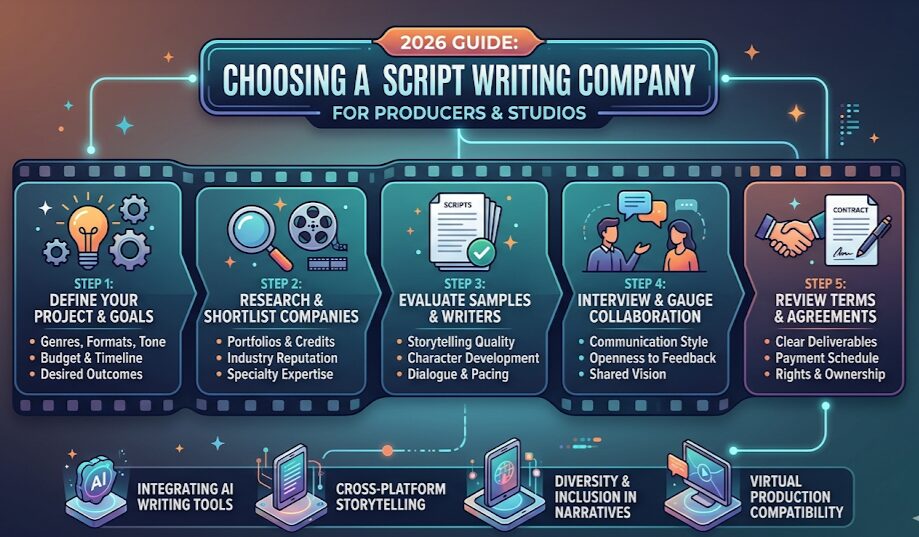
- Step 1 — Define Your Script Development Needs
- Step 2 — Evaluate Track Record (Produced Credits, Not Development Credits)
- Step 3 — Assess Team Structure and Writer Calibre
- Step 4 — Verify Platform and Territory Knowledge
- Step 5 — Scrutinise IP Ownership Terms
- Step 6 — Understand the Milestone and Revision Process
- Red Flags to Watch For
- How to Find Script Writing Companies for International Projects
- Making the Final Decision
- Frequently Asked Questions
- Conclusion
Why This Decision Matters More Than Most Producers Realise
A script is not just a deliverable — it is the foundation every other production decision rests on. Casting, budgeting, scheduling, co-production pitches, platform pitches, and financing packages all depend on script quality. A development partner who misunderstands your genre, target platform, or audience can set a project back by 12–18 months. Conversely, the right script writing company accelerates your path from concept to greenlight.
In 2026, the demand for quality script development has never been higher. Streaming platforms are commissioning local-language originals at scale, and production companies are competing for a limited pool of experienced development partners. Knowing how to evaluate and select the right company is a genuine competitive advantage.
Step 1 — Define Your Script Development Needs
Before approaching any company, clarify exactly what you need:
- Format: Feature film, limited series, ongoing drama, web series, animation, documentary?
- Stage: Do you need concept development from scratch, adaptation of existing IP, a rewrite of an existing draft, or a polish of a near-final script?
- Language and territory: English-language only? Local-language original? Bilingual co-production?
- Platform target: Are you developing for a specific platform (Netflix, Prime, Apple TV+, regional OTT)? Platform commissioning preferences heavily shape script requirements.
- Timeline: What is your greenlight or financing deadline? Script development takes 6–18 months for a full feature, 3–9 months for a TV pilot.
Only with this clarity can you evaluate whether a company’s track record actually matches your needs.
Step 2 — Evaluate Track Record (Produced Credits, Not Development Credits)
12–18 Months
The typical cost of choosing the wrong script writing company — the average time lost when a development partner misunderstands your genre, platform, or audience, forcing a restart.
The most important filter is produced credits — scripts the company delivered that actually went into production. Development credits (scripts that were developed but never produced) are far less meaningful. Any company can develop a script. Far fewer consistently deliver scripts that get greenlit and produced.
When reviewing a company’s portfolio, ask:
- How many of their scripts in the last 3 years were actually produced?
- What platforms or distributors produced those projects?
- Do they have credits in your specific format (feature vs. series)?
- Do they have credits in your target genre?
A company with 50 development credits and 2 produced credits tells a very different story than one with 15 development credits and 12 produced.
Step 3 — Assess Team Structure and Writer Calibre
Understanding who will actually write your script is critical. Many script companies present senior writers in their pitch but assign junior writers to the actual project. Ask directly:
- Who specifically will be the lead writer on this project?
- What are that writer’s individual credits?
- Will a script editor or development executive be assigned? What are their credits?
- Is work subcontracted to external freelancers, or are writers full-time staff?
For television series, also ask about the writers’ room model: how many writers, who manages the room, and how are episode credits allocated.
Step 4 — Verify Platform and Territory Knowledge
Different streaming platforms and distributors have distinct creative preferences, content standards, and commissioning formats. A company that primarily writes for US studio features will not necessarily understand what Netflix India or Canal+ France is looking for in an original series.
If you are targeting a specific platform, ask the company:
- Have you delivered scripts that were commissioned by [platform]?
- Do you have relationships with commissioning executives at that platform?
- Are you familiar with that platform’s current content strategy and genre priorities?
Companies with direct platform relationships can also provide invaluable informal feedback loops during development — knowing what a commissioning executive is likely to respond to before formal submission.
Step 5 — Scrutinise IP Ownership Terms
IP ownership terms in script development agreements have significant long-term commercial consequences. The three main structures are:
- Work-for-hire: You own 100% of the IP upon delivery and full payment. Standard for studio commissions. The writer retains no ongoing rights.
- Co-development: IP is shared between you and the company (or its writers), typically with a back-end participation structure. Common for independent productions where the company takes creative risk in exchange for backend.
- Option-to-purchase: The company writes the script on spec or at reduced fee, with you holding an option to purchase full rights within a defined window. Used in some independent market deals.
Always have a media entertainment lawyer review IP terms before signing. The contract should specify what happens if the project does not proceed — who retains the script rights, and on what terms.
Step 6 — Understand the Milestone and Revision Process
A structured development process protects both parties. Professional script writing companies work to a milestone schedule — typically:
- Treatment / story concept document
- Step outline / beat sheet
- First draft
- Notes and revision period
- Second draft
- Polish / final draft
Each milestone has a payment trigger and a defined number of revision rounds. Be wary of companies offering unlimited revisions — this either indicates inexperience or will result in scope creep that dilutes the development relationship. Defined revision rounds force discipline on both sides.
Red Flags to Watch For
- No produced credits in your format — development credits alone are insufficient evidence
- No named writers in the pitch — generic “our team” language without specific writer CVs
- Unusually low pricing — below-market rates almost always indicate subcontracting to inexperienced writers
- No clear IP ownership clause — ambiguity here creates expensive disputes later
- Reluctance to provide client references — a strong company will have producers willing to vouch for them
- Overpromising timelines — feature development in less than 3 months is almost always a sign of shallow process
How to Find Script Writing Companies for International Projects
For productions requiring local-language script development — Hindi originals, Korean drama, Spanish-language series, Arabic content — identifying qualified script writing companies in specific markets requires access to verified production service directories. Vitrina AI maps production and development service companies across 100+ countries, with filters by territory, genre specialisation, and platform relationship history. This is particularly valuable for streaming platforms and studios commissioning local-language originals in markets where they lack existing development relationships.
Frequently Asked Questions
How do I know if a script writing company is legitimate?
Verify produced credits — scripts they delivered that were actually filmed and released. Request specific project names and cross-reference on IMDb or production databases. Ask for two or three client references from recent projects and contact them directly.
What is the typical timeline for working with a script writing company?
Feature film development (concept to final draft): 6–18 months. TV series bible and pilot: 3–9 months. Script notes and rewrite of an existing draft: 4–12 weeks. Timelines depend on revision rounds, approval processes, and project complexity.
Should I hire a script writing company or a freelance screenwriter?
Hire a company when your project requires a structured development pipeline, multiple simultaneous deliverables, a writers’ room, or format/platform expertise beyond one writer’s capabilities. Hire a freelance writer when your project is in early development, your budget is limited, or you have a strong creative vision that benefits from a single-voice execution.
Can a script writing company help me pitch to Netflix or Amazon?
Companies with direct platform relationships can help shape scripts to match specific platform commissioning preferences and, in some cases, facilitate informal feedback before formal submission. However, formal pitches are always made through an agent, manager, or producer with an existing platform relationship — not directly through a script writing company.
What happens if I am unhappy with the script a company delivers?
The contract’s revision clause governs this. Typically, you are entitled to a specified number of revision rounds. If the final deliverable does not meet the agreed brief, dispute resolution depends on your contract terms. This is why a clearly defined creative brief and milestone approval process — signed off at each stage — is essential protection.
How do I find script writing companies that specialise in my target language or market?
Industry directories, production market databases like those at MIPCOM and AFM, and platforms like Vitrina AI allow you to search script development companies by territory and genre specialisation. For regional language productions (Hindi, Korean, Arabic, Turkish), seek companies with verified credits in that specific language market rather than general international firms.
Making the Final Decision
After evaluating candidates on all criteria above, the final selection should come down to a simple question: does this company understand what a successful version of this project looks like, and do they have evidence of delivering it before? If the answer is yes on both counts, you have your development partner.
For executives managing multiple development projects simultaneously, Vitrina AI’s production service intelligence helps identify and vet script writing companies by territory, track record, and platform relationship — reducing the time from search to shortlist from weeks to hours.
Conclusion
Choosing a script writing company is one of the highest-leverage decisions in the development process. The right partner accelerates your path from concept to greenlight; the wrong one costs you a year or more of development time, budget, and creative momentum.
Apply the six-step framework in this guide: define your needs precisely, insist on produced credits, understand the team structure, verify platform knowledge, scrutinise IP terms, and demand a structured milestone process. These criteria separate professional development partners from companies that look good in a pitch but underdeliver in execution.
Find and vet script writing companies by territory, genre, and platform track record on Vitrina AI.

Rutuja Kokate
Content Writer — Entertainment Supply Chain | Vitrina AI
Rutuja specialises in the global entertainment supply chain, translating complex production-to-distribution workflows into clear, strategic insights for studios, platforms, and service providers navigating the evolving film and TV ecosystem.