IHUB
IHUB
 Private Briefings (Webinars)


 LeaderSpeak Podcast
  Global Entertainment Digest (Newsletter)
  Premium Lists
 Membership Benefits
 About Vitrina
 Our Story
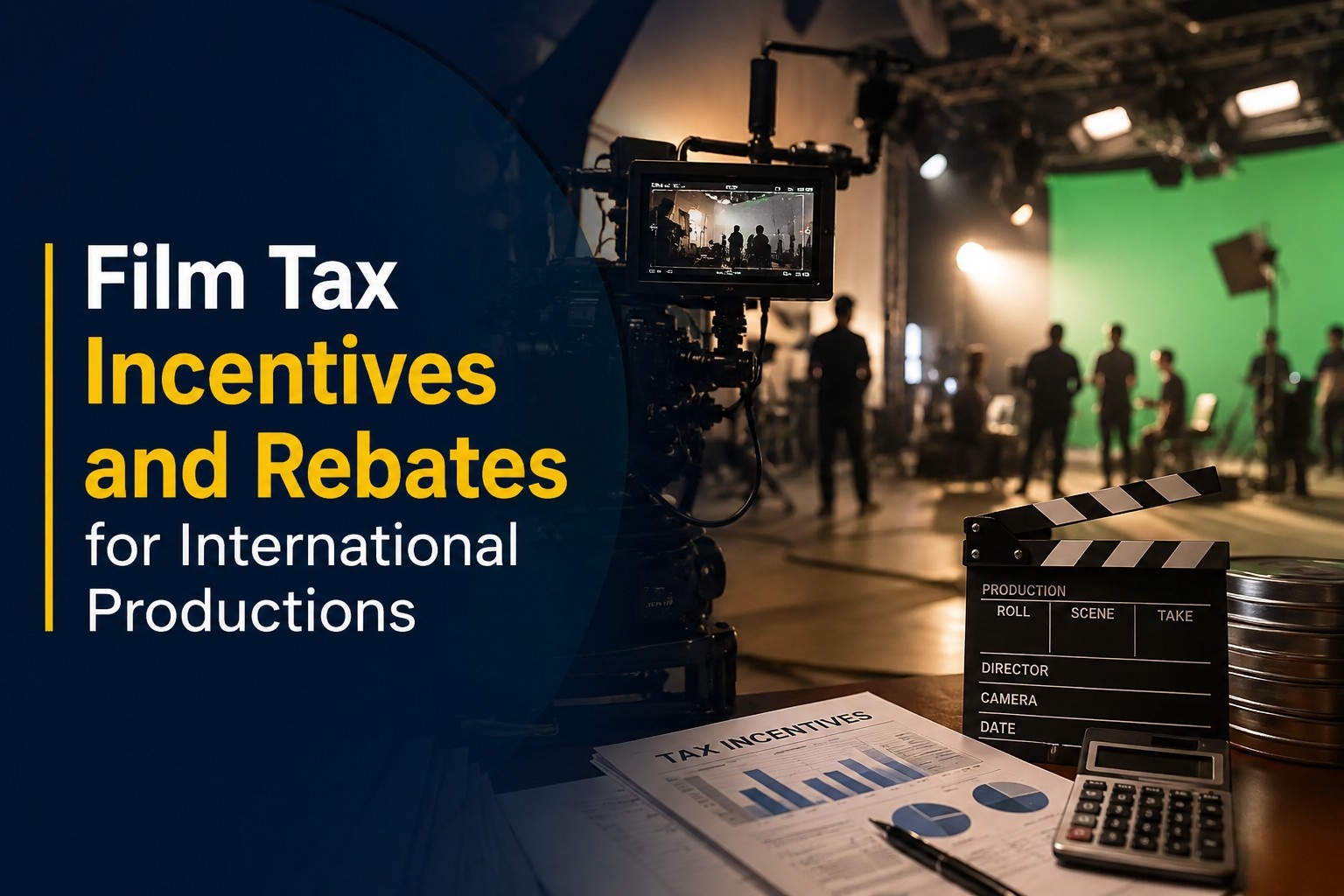
You’re leaving money on the table. Every year, producers walk away from film production tax incentives by country worth 25–50% of their qualified spend—not because the programs don’t exist, but because the information is scattered, out of date, or buried in government websites nobody reads before the greenlight.
Here’s the thing: in 2026, the competition for your production spend has never been more intense. Abu Dhabi is offering 50% cash rebates. The Czech Republic nearly tripled its per-project cap. California just proposed raising its annual fund from $330M to $750M. And Saudi Arabia’s Film Commission is sitting on $1B allocated annually with studios literally being built as you read this.
If your capital stack still treats soft money as an afterthought—something your line producer handles in week three of pre-production—your competitors are already ahead. This guide covers 40+ jurisdictions with current 2026 rates, qualification requirements, and the stacking plays most producers overlook.
IN THIS GUIDE
- The Top 10 Film Tax Incentives, Ranked
- What Tax Incentive Types Actually Mean for Your Budget
- North America: US States + Canada Breakdown
- UK and Europe: The Established Infrastructure
- Middle East: Sovereign Content Hubs Rewriting the Rules
- Asia-Pacific: Japan’s 50% to Australia’s Location Offset
- Latin America and Africa: The Emerging Tier
- How to Stack Incentives Across Jurisdictions
- How to Choose the Right Incentive (NPC Framework)
- Common Pitfalls to Avoid
- What’s Changing in 2027 and Beyond
- FAQ: Everything Producers Ask About Global Tax Incentives
Track Incentive-Eligible Projects Before They Hit the Trades
Vitrina’s 300,000+ company database maps production activity in real-time across every major incentive territory—so you know where the spend is flowing before your competition does. Netflix, Warner Bros, and Paramount use Vitrina to connect with vetted local service providers in qualifying jurisdictions.
200 free credits. No credit card required.
The Top 10 Film Tax Incentives, Ranked
Headline rates alone are a bad way to compare programs. This is Vitrina’s own editorial ranking, scored on five weighted criteria: rebate rate competitiveness (35%), qualification accessibility — minimum spends, cultural tests, application complexity (25%), infrastructure maturity — soundstages, crew depth, vendor ecosystem (20%), payment speed and certainty (15%), and stackability with regional or federal uplifts (5%). A program can have a great headline number and still score poorly if it pays out slowly or has thin local crew depth — the UK’s #1 score of 94, for example, reflects a near-perfect rebate/accessibility combination (25% base rising to 29.25% for VFX, a well-documented Cultural Test) but loses points on stackability relative to Canada’s multi-layer federal-plus-provincial credits.
Honorable mentions just outside the top 10: Quebec, Louisiana, Texas, Ireland, Spain’s regional programs, Qatar, Czech Republic, and Colombia — each covered in full below by region. See our film and TV co-production tax breaks comparison if you’re weighing incentive fit against treaty-based co-production structures instead.
What Tax Incentive Types Actually Mean for Your Capital Stack
Not all incentives are equal—and the difference matters when you’re structuring your financing before a greenlight conversation.
Film Tax Incentive Rates by Territory (2026)
A cash rebate is the cleanest structure: the government sends you a check (or wire) after you’ve spent and audited. No secondary market. No tax liability required. Just spend locally, prove it, collect. This is what the UK, Australia, Saudi Arabia, and most European markets offer—and it’s the most bankable type of incentive for rebate loans.
A refundable tax credit functions almost identically—it offsets your tax liability in the jurisdiction, with any excess refunded as cash. Canada’s federal credit and New York’s credit work this way. These are the “gold standard” for lenders.
A transferable tax credit can be sold to a third party with local tax liability—typically at 80–95 cents on the dollar. Georgia and Louisiana historically ran this model. It adds a monetization step, but the underlying value is still real. Just factor in the discount when you’re building your recoupment model.
And non-refundable, non-transferable credits—avoid structuring around these wherever possible. They only offset your own tax liability in the jurisdiction. Unless your entity is already profitable there, they’re worth close to nothing operationally.
One more distinction: ATL (above-the-line) vs BTL (below-the-line) qualifying costs. Some markets, like New Mexico (up to a $40M ATL cap), let your director and cast fees count toward the qualifying spend. Others restrict rebates purely to crew and facilities. This single variable can swing your effective rebate rate by 8–12 percentage points on a mid-budget film.

Your AI Assistant, Agent, and Analyst for the Business of Entertainment
VIQI AI helps you plan content acquisitions, raise production financing, and find and connect with the right partners worldwide.
- List the top commissioners at the BBC
- List the post-production and VFX decision-makers at Netflix
- List the development leaders at Sony Pictures
- List the scripted programming heads at HBO
- Find active co-producers and financiers for scripted projects
- Find equity and gap financing companies in North America
- Find top film financiers in Europe
- Find production houses that can co-produce or finance unscripted series
- Who is backing animation projects in Europe right now
- Who is Netflix’s top production partners for Sports Docs
- Who is Commissioning factual content in the NORDICS
- Who is acquiring unscripted formats for the North American market
- Show me recent drama projects available for pre-buy
- Show me Japanese Anime Distributors
- Show me true-crime buyers from Asia
- Show me documentary pre-buyers
- I am looking for production partners for a YA drama set in Brazil
- I am looking for producers with proven track record in mid-budget features
- I am looking for Turkish distributors with successful international sales
- I am looking for OTT platforms actively acquiring finished series for the LATAM region
- I am seeking localization companies offer subtitling services in multiple Asian languages
- I am seeking partners in animation production for children's content
- I am seeking USA based post-production companies with sound facilities
- I am seeking VFX partners to composite background images and AI generated content
North America: US States and Canada—Where the Infrastructure Is
The US market is fragmented by design—each state runs its own incentive program, and the variation between them is substantial. If you’re choosing between two viable locations, the incentive differential alone can represent $2–5M on a $20M production budget.
The global film and television production incentive market is valued at an estimated $10–15 billion annually, with more than 100 jurisdictions offering qualifying rebates, credits, or grants. European markets account for roughly 40% of total incentive volume by territory count. (PwC Global Entertainment & Media Outlook, 2025)
Key US States in 2026
Georgia remains the dominant US destination—$4.2B in production spend in 2024, no annual cap, and an audit process that’s genuinely improved since January 2025. New Jersey is the sleeper play: a program extended to 2039 (real long-term commitment), and Netflix’s $900M+ production facility currently under development there signals where streaming money flows next. New Mexico stands out for ATL flexibility—Oppenheimer shot there partly for that reason.
California’s proposed cap increase from $330M to $750M hasn’t fully materialized yet—plan around current reality, not proposals. The expanded Program 4.0 is already awarding under the new cap, though: a November 2025 round awarded 17 TV projects an expected $1.2B in economic impact ($902M in qualified in-state spending), and a separate December 2025 round awarded 28 films $562M in total economic activity ($337M in qualified spending). And Louisiana dropped its cap from $150M to $125M post-tax reform, so the pipeline there gets competitive faster than it used to.
Canada: Federal + Provincial Stacking
Canada’s real power isn’t any single credit—it’s the stacking. You get a federal 25% Canadian Film or Video Production Tax Credit (CPTC) on qualifying Canadian content, then layer provincial credits on top. British Columbia hits 33–35% on resident labor. Quebec reaches 36–40% for services to foreign productions. Ontario runs 21.5–40% depending on project type. Stack those correctly and your effective soft money position shifts the whole financing conversation.
Phil Hunt (CEO, Head Gear Films) lays out how the current financing climate makes incentive strategy—not just creative packaging—the difference between a deal that closes and one that stalls. His perspective on why traditional pre-sale structures are losing ground to soft money is essential context for any producer building a 2026 capital stack.
UK and Europe: The Established Incentive Infrastructure
The UK’s 25% cash rebate (Audio-Visual Expenditure Credit) is one of the most bankable structures globally—predictable, audited, and trusted by lenders. But the headline rate understates the 2026 picture. UK VFX now qualifies at 29.25% as of April 2025, with the cap on VFX qualifying expenditure removed entirely. Studio occupiers get 40% business rate relief through 2034. The UK pulled in £4.2B ($5.3B) in production spend from film and TV—and productions like Jurassic World 4, Mission: Impossible, and Fantastic Four made their location decisions partly on that basis. But pass the cultural test. It’s non-negotiable. Independent films under £15M (up to £23.5M core budget with a tapered rate) qualify for an even richer Independent Film Tax Credit at 53% gross (39.75% net), capped at £6.36M per film.
The UK’s Audio-Visual Expenditure Credit (AVEC) delivers a 34% enhanced rate for qualifying UK film productions — the most competitive headline rate for major studio projects in Western Europe. Productions must exceed 10% of total budget on UK qualifying spend. (HMRC, 2025)
Ireland’s Section 481 is the one producers keep rediscovering. The base rate is 32%—but for films under €20M, you’re at 40% total. And 2025 added a new 20% incentive for unscripted TV (80% of costs, €15M cap). Dublin’s infrastructure has caught up with its talent pool. Don’t sleep on this.
France runs a 30% International Production Tax Rebate—rising to 40% if French VFX exceeds €2M. The requirement to use a French production services company adds complexity, but French co-producers know how to navigate it. Importantly, France’s film subsidies survived 2025 budget pressures intact.
Germany’s DFFF/GMPF programs hit 30% in 2024 (up from 25%) and have been extended through 2025 and beyond. The diversity clause that briefly complicated applications has been removed from German film law.
And then there’s Spain’s regional architecture—arguably the most complex incentive structure in Europe. Federal rates run 25–30%, but the Canary Islands sit at 45–50%, the Basque Region at 35–70%, and Navarre at 35%. If your story has flexibility on location—and the Canary Islands can double for a lot—the effective rebate there is among the highest in the world for qualifying spend.
For a deeper regional breakdown of European financing structures beyond tax incentives alone, see our European film financing guide. Other European markets worth tracking: Greece at 40% with €105M allocated for 2025 and application windows reopened January 1; Czech Republic at 25–35% (higher for animation/digital), with a per-project cap nearly tripled to $19M effective January 2025; Italy at 30–40% via transferable tax credits that can be monetized through Italian banks; and Portugal at 30%, with a €6M per-feature cap and a €2.5M minimum budget threshold.
Find Vetted Production Partners in Every Incentive Territory
Vitrina maps 300,000+ active production companies across every major incentive jurisdiction—with verified capabilities, hero projects, and current availability. Netflix, Warner Bros, and Paramount use Vitrina to connect with qualified local service providers in qualifying spend territories.
Get started with 200 free credits. No credit card required.
Middle East: Sovereign Content Hubs Rewriting the Rules
This is where the Fragmentation Paradox hits hardest for international producers—and where the opportunity is most underutilized. Most teams don’t know what’s actually operational in the Gulf until 6 months after it’s live. By then, the production windows are gone.
Canada’s federal and provincial incentive stack enables effective combined rates of 40–60% in Ontario and British Columbia, achieved by stacking the Canadian Film or Video Production Tax Credit with provincial programs — among the highest stacked rates globally. (Canadian Media Producers Association, 2025)
Saudi Arabia’s 40% cash rebate is backed by Vision 2030’s $1B annual film infrastructure allocation. This isn’t an emerging market story—it’s 17 operational studios, Film AlUla’s purpose-built complex, NEOM facilities handling large-scale productions (Antara with director Simon West shot there), and 65+ registered production companies generating $288M+ in incentive-driven local expenditure. Saudi’s box office hit $248.9M in 2024, heading toward $266.6M+ in 2025. The question isn’t whether the infrastructure exists. It’s whether your team knows how to access it before it hits the trades.
Abu Dhabi’s 50% cash rebate is currently among the highest incentive rates anywhere on earth. The program combines the rebate with 0% taxation for 50 years inside free zones for qualifying projects, and a minimum spend threshold of just $70K for features (with at least one shoot day in Abu Dhabi). This is a de-risking tool your CFO will care about—not just a location-scouting decision.
Dubai’s free zone incentives operate on a different structure but stack well with Abu Dhabi programs for multi-city productions. And the regional OTT infrastructure—Muvi, VOX, AMC, and international streaming platforms all actively acquiring—means the distribution conversation has changed alongside the production incentive conversation.
This is what Vitrina calls the Sovereign Content Hub shift: government-backed capital replacing Hollywood as the primary production engine in these regions. Vision 2030’s Quality of Life Program is backed by $71.2 billion allocated to entertainment infrastructure overall, targeting 450,000 entertainment jobs and 4.2% of Saudi GDP from entertainment by 2030. That’s not aspiration—that’s capital deployment at a scale that changes where international productions route their qualified spend. The NEOM rebate access guide breaks down qualification specifics for that territory specifically.
Asia-Pacific: From Japan’s 50% Cap to Australia’s Location Offset
Australia is a three-layer incentive market. The Location Offset—for international productions—jumped from 16.5% to 30% in July 2024. Domestic productions access the Producer Offset at 40% for features. VFX and post-production separately qualify for the PDV Offset at 30%. Stack regional uplifts from New South Wales (10%), Victoria (10%), Queensland (15%), or South Australia (10%) on top of the base federal credits. A production strategically routing its post through Queensland can see effective rates in the high 30s on that spend line.

New Zealand offers 20% for international productions, rising to 25% for productions delivering significant economic benefit—and the Lord of the Rings / Avatar legacy means the crew depth and infrastructure in Wellington and Queenstown is genuinely world-class at scale.
Japan sits at up to 50% cash rebate—but with a $6.7M (¥1B) per-project cap, it’s designed for mid-budget productions rather than $100M+ tentpoles. Tokyo Vice Season 2 and Snake Eyes both routed production through Japan’s incentive program. The cap limits the absolute dollar recovery, but on qualifying spend within that envelope, no market matches the rate.
India’s federal incentive increased from 30% to 40% reimbursement in 2026, with a $3.6M cap and an additional 5% bonus for productions with significant Indian content. With a domestic market of 1.4 billion people and multiple active language markets (Hindi, Tamil, Telugu, and others), India’s incentive story is increasingly about access to local co-production structures as much as the rebate itself.
Thailand—where The White Lotus filmed—has recently increased its rebate rate and remains cost-competitive for productions needing Southeast Asian locations. Singapore focuses on high-end productions and post-production work through government grants, functioning as a regional hub for distribution and business structures even when principal photography is elsewhere.
Latin America and Africa: The Emerging Tier
Colombia is the standout at 35–40% cash rebate, with a geographic range that covers rainforest, colonial cities, coast, and Andean locations that genuinely can’t be matched elsewhere at the price point. It’s the most aggressively competitive incentive market in Latin America right now.
Morocco’s 30% cash rebate backed Gladiator II’s partial production—and its infrastructure for large-scale international shoots is established, with Ouarzazate and Atlas Studios among the most frequently used locations for Middle Eastern and North African period productions. Brazil and Mexico both run active incentive frameworks, though Mexico’s proximity to Hollywood makes it more of a service market than a co-production partner for most international producers.
Mauritius offers 30–40% and is gaining traction as an alternative to South Africa for certain production types. South Africa remains the most developed production infrastructure on the continent, with established crew depth and post-production capabilities that most other African markets can’t match.
Need Territory-Specific Incentive Intelligence for Your Current Project?
Vitrina’s Concierge team connects producers with qualified local production partners, co-production partners, and incentive specialists in every major territory—typically within 48 hours. Netflix used Vitrina to identify qualified UK partners in under 48 hours.
How to Stack Incentives—and Where Most Productions Leave Money Behind
The single biggest error in incentive planning isn’t choosing the wrong territory. It’s treating incentives as a single-jurisdiction decision rather than a capital stack optimization problem.
Here’s what smart producers actually do: they route their VFX spend to the UK’s 29.25% credit, their principal photography to Georgia’s 30% transferable credit, and their post-production music recording to Ireland at 40% (if budget is sub-€20M). That’s three separate incentive streams running simultaneously on one project—legal, documentable, and the kind of structure that gets your equity investor to a yes before the greenlight meeting ends.
Stacking incentives across two or more jurisdictions requires clean documentation from day one: separate spend tracking by territory, co-production treaty alignment where applicable, and a production accountant who’s done this before—not one learning on your budget.
But there’s a trap most producers hit. The Fragmentation Paradox doesn’t just affect vendor discovery—it affects incentive execution. You need local qualified spend to unlock the rebate. And finding the local suppliers (crew, facilities, services) who qualify under each jurisdiction’s rules is itself a research problem. Without real-time supplier intelligence across your target territories, your production team spends 3–6 months manually verifying vendors who may not even meet the local spend thresholds.
That’s margin erosion hiding inside your incentive strategy. Vitrina’s global incentives tracker maps active incentive programs alongside verified local supplier capabilities—so you’re not just knowing what rate is available, but knowing which local vendors actually qualify your spend to earn it.
How to Choose the Right Incentive for Your Project
A 50% rebate doesn’t matter if your gross costs are double another jurisdiction. Here’s the decision framework:
Step 1: Calculate Net Production Cost (NPC). NPC = Gross Budget – (Incentive Value + Currency/Labor Savings). Model total landed cost, not just rebate percentage — base production budget, crew rates, equipment rentals, stage fees, travel and accommodation for imported talent, post-production, currency exchange, and net incentive received after financing costs, audit fees, and broker discounts.
Step 2: Assess creative fit. Does the location serve the story? Can you actually shoot there, or are you doubling (filming Morocco for Jordan, say)? Location believability affects production value — don’t chase an incentive that compromises the creative. Oppenheimer‘s partial shoot in New Mexico is the model case: the state’s above-the-line cap made the NPC math work, but the production also needed real Trinity-test-adjacent desert locations the incentive alone wouldn’t have justified chasing.
Step 3: Evaluate crew availability. Can you staff locally, or are you flying in department heads? Importing 30% of crew means factoring airfare, per diems, and housing into the real cost.
Step 4: Assess infrastructure and vendor ecosystem. Are soundstages available when you need them? Can local equipment houses supply your gear list? Post facilities for dailies and VFX? Thin infrastructure means more spend on logistics.
Step 5: Consider cash flow and risk. When do you actually get paid? Can you finance against the credit? What’s the audit risk? A credit that takes 18 months to monetize has a real cost of capital — factor financing fees into the NPC calculation.
Common Pitfalls to Avoid When Pursuing Tax Incentives
Producers who get burned on incentives rarely get burned by the rate itself—they get burned by process. Five mistakes show up repeatedly:
Pitfall #1: Chasing headline rates without modeling net cost. A 50% rebate with a $70K minimum spend and thin local crew depth can net out worse than a 30% rebate in a market with mature infrastructure and fast payment. Model the net production cost, not the sticker rate.
Pitfall #2: Ignoring qualification criteria until pre-production. Cultural tests, minimum local spend thresholds, and residency requirements for cast and crew need to shape your budget and scheduling from the outset—not get discovered after you’ve already committed to a location.
Pitfall #3: Underestimating audit requirements. Every rebate and credit requires documented, auditable local spend. Productions that treat this as a paperwork afterthought routinely see qualifying spend disqualified after the fact.
Pitfall #4: Not securing pre-approval. Most jurisdictions require provisional approval before principal photography begins. Spend incurred before that approval typically doesn’t qualify, no matter how well-documented it is.
Pitfall #5: Assuming credits equal cash. A non-refundable, non-transferable credit is worth close to nothing unless your production entity already has tax liability in that jurisdiction. Know which type of instrument you’re actually holding before you count it in your capital stack.
What’s Changing in 2027 and Beyond
The incentive landscape doesn’t hold still, and producers modeling multi-year slates need to watch five developments: a potential US federal film tax credit, which would be the first national-level incentive layered on top of existing state programs; a proposed UK P&A tax relief extending support beyond production into prints-and-advertising spend; continued infrastructure maturation in Saudi Arabia and the UAE as studio capacity catches up to rebate generosity; intensifying competition between Australia and Canada for large-scale international productions as both continue raising rates; and expansion of India’s co-production treaty network, which would open India’s incentive stack to a wider set of international partners beyond its current bilateral agreements—see our country-by-country co-production treaties guide for what’s already in force.
FAQ: Film Production Tax Incentives by Country
The Bottom Line: Your Capital Stack Is Only as Strong as Your Incentive Intelligence
The global race to attract production spend is accelerating. Abu Dhabi at 50%, the Czech Republic tripling its cap, California proposing to double its fund, and Saudi Arabia deploying $1B annually—these aren’t isolated policy decisions. They’re a coordinated global competition for your qualified spend. And if your team is still treating incentives as a post-greenlight item handled by the line producer, you’re negotiating blind.
The producers de-risking their capital stacks are doing three things differently: they’re identifying incentive territory fit before location scouts leave, they’re stacking across jurisdictions wherever treaty structures allow, and they’re verifying local qualified spend suppliers before committing to a shoot schedule. Without real-time intelligence on both program availability and local supplier capabilities, you’re working off six-month-old trade reports in markets that change quarterly.
Key Takeaways
- Highest global rates (2026): Abu Dhabi (50%), Japan (50%, capped), Spain Canary Islands (45–50%), Saudi Arabia (40%), Greece (40%), Ireland (40% for sub-€20M films)
- Best US state for volume: Georgia (30–40%, unlimited cap, $4.2B 2024 spend); best for ATL-heavy projects: New Mexico (25–40%, no cap)
- Stacking opportunity: UK VFX (29.25%) + Georgia principal (30%) + Ireland post (40%) on one project is legal, documented, and structural—not a workaround
- Sovereign Hub shift: Saudi Arabia’s $1B annual allocation and 17 operational studios represent capital deployment, not aspiration—plan your 2026–2027 pipeline accordingly
- Apply early: Most markets require provisional approval before principal photography starts—missing that window can invalidate qualifying spend already incurred
Access 300,000+ Verified Companies in Every Incentive Territory—Right Now
Vitrina maps active production companies, co-production partners, and service vendors across every major incentive market globally. Netflix, Warner Bros, and Paramount use Vitrina to connect with qualified local partners in qualifying territories—typically identifying options within 48 hours. Start with 200 free credits. No credit card required.