IHUB
IHUB
 Private Briefings (Webinars)


 LeaderSpeak Podcast
  Global Entertainment Digest (Newsletter)
  Premium Lists
 Premium Reports
 Membership Benefits
 About Vitrina
 Our Story
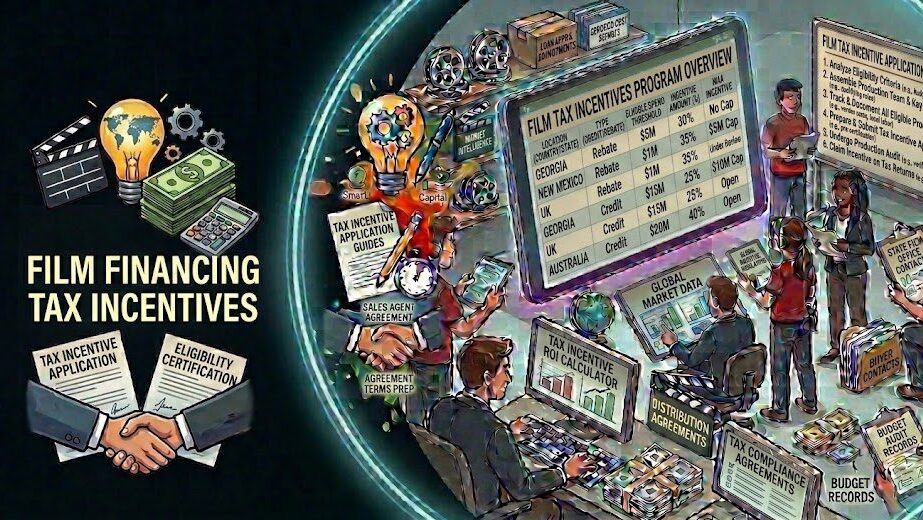
Film financing tax incentives in the United States are state-level programs — not federal — that return a percentage of your qualified production spend as cash, a refundable credit, or a transferable certificate you can sell on the secondary market. Done right, they cover 15–30% of your production budget and sit as the most predictable line item in your entire capital stack. Done wrong, they leave you waiting 6–18 months for a payment you budgeted to arrive in month three.
Quick Answer
US film financing tax incentives include state-level tax credits offering 20–40% rebates on qualifying production expenditure, plus federal bonus depreciation provisions. Key incentive states include Georgia (30%), New Mexico (25–40%), Louisiana (25–40%), and New York (25–35%). Each programme has distinct eligibility criteria, minimum spend thresholds, and qualifying expenditure categories that productions must structure carefully to maximise returns.
Explore Vitrina’s coverage of film financing options.
Here’s what nobody tells you upfront: the headline rate is almost never the number that matters. Georgia’s 30% transferable tax credit sounds like a different instrument than New York’s 25–30% refundable credit — and it is. One requires you to sell a certificate on a secondary market at a discount; the other pays you cash. Your net effective incentive, factoring in how you monetize it, determines how much production capital you actually unlock. That decision — not just which state has the highest percentage — is where sophisticated producers make or lose margin.
Explore Vitrina’s coverage of film finance structures.
This guide cuts through the noise and gives you a CFO-level view of how US film tax incentives actually work, which states dominate in 2025–2026, and how to weaponize incentives as bankable production capital rather than just a backend check. Producers tracking the full incentive landscape across markets use Vitrina’s film and TV financing tax credits overview as a starting reference — but the state-by-state mechanics below are where the real decisions live.
In This Guide
- The 4 Types of US Film Tax Incentives (And Why the Difference Matters)
- The 7 Dominant US States for Film Incentives in 2025–2026
- How the Claiming Process Works (Step by Step)
- How to Monetize Incentives During Production, Not After
- Incentive Stacking: Combining State, Local, and Federal Benefits
- What Costs Actually Qualify — and What Doesn’t
- The Executive Decision Framework: Choosing Your State Strategically
- FAQ
Ask VIQI: Which US States Offer the Best Incentives for Your Budget and Genre?
VIQI is Vitrina’s AI assistant — trained on 1.6 million titles, 300,000+ companies, and 5 million entertainment professionals. Get state-specific incentive intelligence tailored to your project’s budget, genre, and timeline.
✓ Included with 200 free credits | ✓ No credit card needed
The 4 Types of US Film Tax Incentives — And Why the Difference Matters
Before you pick a state, you need to understand what kind of incentive you’re actually getting. In the US, film tax incentives come in four distinct forms — and each one has a different impact on your cash flow, your timeline, and your capital stack.
1. Refundable Tax Credit — The Gold Standard
A refundable tax credit reduces your company’s state tax liability. If the credit exceeds what you owe, you get the balance back as cash. It functions almost identically to a cash rebate — you don’t need to find a buyer, and you don’t take a discount. New York and New Mexico operate this way. It’s the cleanest mechanism for producers and the most straightforward to model into a capital stack.
2. Transferable Tax Credit — The Secondary Market Play
A transferable tax credit can be sold to a third party — typically a corporation with Georgia, Louisiana, or New Jersey state tax liability — at a discount. That discount typically runs 80–95 cents on the dollar, meaning a $1M Georgia credit might net you $850,000–$950,000 after sale. The secondary market for these credits is mature and liquid, especially in Georgia, but you need a tax credit broker and you need to factor the discount into your effective incentive calculation. Don’t model Georgia’s 30% as 30% in your budget — model it as 25–28.5% net after broker fees and discount.
3. Cash Rebate — Simplest Mechanism
A direct cash payment from the state, wired after production completes and a third-party audit confirms your qualifying spend. Texas operates this way. No secondary market, no tax liability required — but the timing is entirely backend. You spend the money, shoot the film, complete the audit, and then wait. The gap between spending and receiving is the cash flow problem you need to plan around.
4. Non-Refundable, Non-Transferable — Avoid If Possible
This type only offsets your company’s own tax liability in that state. You can’t sell it, and you can’t get a refund if it exceeds what you owe. For most independent productions — which don’t generate significant state tax liability — this instrument is essentially worthless. It’s rare in the top US markets, but worth knowing so you don’t accidentally model it as real capital.
Stop Guessing Who’s Financing. Get Targeted Outreach.
Stop searching and start getting funded. We identify the exact decision-makers currently backing projects like yours, turning raw data into risk-aligned capital partnerships.
Major Studios
Scouting early stage projects, IP, and Regional partners for global studio pipelines.
IP Owners & Leads
Connecting creative leads with qualified financiers and major streaming platforms.
Streamers
Securing high-value pre-buy content and discovering early-stage global IP for platforms.
Indie Producers
Bridging the gap for indie filmmakers to reach executive production partners and capital.
Global Financing Ecosystems
Mapping complex markets and pairing projects with disciplined, risk-aligned capital across global territories worldwide.
The 7 Dominant US States for Film Tax Incentives in 2025–2026
There are over 30 US states with some form of production incentive. But the field narrows fast when you apply real criteria: rate, type, cap, infrastructure, and crew depth. These seven states are where the serious capital stack conversations happen.
Georgia — The Volume Leader
Georgia is the most popular US state for film production — and it’s not particularly close. In 2024, Georgia attracted $4.2 billion in production spending. The program offers a 30% transferable tax credit on qualified spend, with an additional 10% bonus for including the Georgia promotional logo in your film. And there’s no annual program cap — a structural advantage that most other states can’t match. Above-the-line costs have no cap either, which is significant for larger productions where ATL represents a material portion of the budget.
The state’s audit process was improved as of January 2025, reducing the uncertainty that previously made some producers hesitant about processing timelines. But: sell that credit on the secondary market and you’re netting 25–28.5% after discount and broker fees. Model accordingly.
New York — Best for Independent Films
New York runs a refundable tax credit at 25–30%, with uplifts for certain areas and production types. The program cap was increased in 2025 to over $700 million annually, with a dedicated $100 million fund specifically for independent films — a meaningful development for producers outside the studio system. Large-budget productions above $100M also got additional funding access. The refundable structure means you’re getting cash back directly rather than navigating a secondary market, which makes New York’s effective rate closer to its stated rate than Georgia’s is.
California — High Rate, Low Odds
California offers a refundable credit of 20–25% with uplifts, and the proposed cap increase to $750 million for 2025–2026 (up from $330M) would make it significantly more competitive. But the allocation is lottery-based — you’re not guaranteed credits even if your project qualifies. And competition is fierce. The “California Jobs Act” criteria must be satisfied. For productions that can’t absorb the uncertainty, California is a difficult program to anchor a capital stack around.
New Mexico — Highest Upside Rate
New Mexico quietly offers one of the most competitive incentive structures in the country: a refundable credit of 25–40%, no annual program cap, and an ATL cost cap of $40 million. The ceiling on above-the-line is the constraint — but below-the-line is uncapped, and the refundable structure means no secondary market haircut. Oppenheimer shot here. For mid-budget productions with manageable above-the-line costs, New Mexico’s effective incentive can beat Georgia’s post-discount number significantly.
New Jersey — The Netflix State
New Jersey has aggressively positioned itself as a production hub, offering a transferable credit of 30–40% (with an uplift for productions with qualifying diversity plans) and an annual cap of $300 million for general productions plus an additional $250 million for studio partners. The program runs through July 1, 2039 — long-term certainty that signals real government commitment. Netflix is developing a $900 million+ production facility in the state. That infrastructure investment is the clearest endorsement a state program can get.
Louisiana — Reformed and Competitive
Louisiana was once the dominant US production destination before cap reductions and regulatory changes shifted the landscape. Post-2024 tax reform, the program offers a transferable credit of 18–25% with an annual cap reduced to $125 million. It still generates roughly $1 billion in annual economic activity and supports approximately 10,000 jobs. Loan-out withholding was reduced to 3%, a meaningful improvement for productions with significant non-resident crew and above-the-line talent. But the reduced cap means allocation is more competitive than it once was.
Texas — Cash Rebate, Growing Fast
Texas operates a cash rebate of 22–25% with additional uplifts, and its biannual cap was increased to $300 million in 2025. The cash rebate structure is clean — but Texas has historically lagged behind Georgia and New York on crew depth and production infrastructure. That gap is closing, particularly in Austin and the Dallas-Fort Worth corridor. For projects that can benefit from the state’s incentive and don’t require the deep crew base of Atlanta or New York City, Texas is an increasingly credible option.
Track Every US State Film Incentive Program — Updated in Real Time
Trusted by Netflix, Warner Bros, and Paramount. Join 140,000+ companies tracking the global entertainment supply chain — including state-by-state production incentive data.
✓ 200 free credits | ✓ No credit card required | ✓ Full platform access
How the Claiming Process Works — Step by Step
The claiming process for US film tax incentives follows a consistent four-stage structure across most states. Understanding the timeline — and where the delays live — is the difference between modeling incentives as real production capital and treating them as a backend bonus you might get eventually.
Stage 1: Pre-Qualification (Before Production)
Apply before cameras roll. Most state programs require pre-qualification — a certification of eligibility that confirms your project meets the program criteria before you start spending. Don’t skip this. If you start production without pre-qualification and your project later doesn’t meet requirements, you’ve spent money against an incentive you won’t receive. The pre-qualification stage also locks in the applicable rate and program terms, which matters in jurisdictions where annual allocation is capped or terms are subject to legislative change.
Stage 2: Production Tracking
Track every qualifying expenditure from day one. Meticulous record-keeping isn’t optional — it’s the foundation of your incentive claim. That means receipts, timecards, contracts, payroll records, vendor invoices. Separate qualifying spend from non-qualifying spend at the transaction level, not at year-end. Your production accountant — who should have direct experience with the specific state program you’re using — is your most important hire for this process. A general entertainment accountant without state incentive expertise will cost you money at audit.
Stage 3: Post-Production Audit
After wrap, you submit a final cost report to the state film commission, supported by a third-party audit. The audit is typically required — and it has to be conducted by a CPA firm with entertainment industry experience and familiarity with the specific state program. The commission reviews the audit, may request additional documentation, and ultimately certifies your qualifying expenditure and the resulting credit or rebate amount. This stage is where most timeline variability lives. Processing times run 2–12 months depending on the state and the current volume of pending claims.
Stage 4: Collection or Sale
For refundable credits and cash rebates, the state issues payment after audit approval. For transferable credits — Georgia, New Jersey, Louisiana — you receive a certificate which you then sell to a buyer on the secondary market through a tax credit broker. Plan for 6–18 months from production wrap to final payment in your cash flow model. That’s not a worst-case scenario; it’s the realistic range for most productions navigating the full cycle.
According to Variety, the competition between states for production spending has actually accelerated audit processing in several markets over the past two years — Georgia’s improved audit process (effective January 2025) being the most notable example — as states recognize that slow payment cycles are a competitive disadvantage in attracting repeat productions.
How to Monetize Incentives During Production — Not After
Here’s the insider move most producers overlook: you don’t have to wait for the audit to access your incentive value. Rebate loans — also called incentive bridge loans — let you borrow against an approved incentive at 80–90% of the incentive’s face value, with interest charged until the state payment arrives and retires the loan.
Joshua Harris, President and Managing Partner of Peachtree Media Partners, describes this as a core component of how his firm structures film lending. Peachtree lends against film IP, pre-sales, distribution agreements, and — critically — tax incentives as a collateral pool. On the incentive side specifically, Harris notes that as long as the qualifying spend has been made, the incentive is earned and has to be paid out — making it one of the lower-risk elements of the collateral stack from a lender’s perspective. The risk, he emphasizes, is timing, not amount.
Joshua Harris discusses Peachtree’s approach to lending against production incentives in this Vitrina LeaderSpeak episode:
Joshua Harris (President & Managing Partner, Peachtree Media Partners) — “Film Finance Lending: Filling the Gap Left by Commercial Banks”
For your capital stack, the rebate loan strategy works like this: you secure pre-qualification, commence production, demonstrate qualifying spend, and use the approved incentive as collateral to borrow against during production — accelerating cash flow and reducing your equity requirement. The interest cost of the bridge loan reduces your net incentive value, so you need to model the effective rate after financing costs. But for productions where cash flow timing is tight, it’s often the cleanest way to de-risk the capital stack without selling more equity.
Not all incentives are equally “bankable” in this way. Refundable credits in states with clean track records — New York, New Mexico — are the easiest to borrow against. Transferable credits require lenders to underwrite the secondary market, which adds a layer of complexity. And some state programs have enough regulatory uncertainty that conservative lenders won’t advance against them at meaningful rates. This is why your choice of state matters not just for the headline percentage, but for how financeable that incentive actually is. For more on how tax incentives slot into a broader capital stack, see our guide to the future of film and TV financing.
Find the Financiers Backing Your Genre
Stop searching and start getting funded. We identify the exact decision-makers currently backing projects like yours, turning raw data into risk-aligned capital partnerships.
Incentive Stacking: How to Combine State, Local, and Federal Benefits
Stacking — combining multiple incentive programs on a single production — is where sophisticated producers extract serious additional value. But it requires careful structuring, because not all programs can be combined, and some specifically prohibit double-dipping on the same dollar of spend.
The most powerful US stack is Georgia state + a local incentive. Savannah, for example, offers its own cash rebate on qualifying local spend, which can be layered on top of Georgia’s state credit. Done correctly, this can push the effective incentive rate toward 40% of qualified spend. That’s a material component of a $10M film budget. On a $10M production, a 30% Georgia state credit generates $3M in transferable certificates — netting approximately $2.55M–$2.85M after discount and broker fees. Add a Savannah local incentive, and you’re meaningfully higher.
On the federal side, there’s currently no direct federal film production incentive at the scale of state programs. But certain productions — particularly those qualifying under Section 181 of the US Tax Code — can allow investors to deduct production costs in the year incurred rather than capitalizing and amortizing them. This isn’t a production rebate; it’s a tax benefit that makes investing in qualifying productions more attractive to certain equity investors, which indirectly helps your capital stack by expanding your investor pool.
The practical stacking rules: always read the fine print on each program before assuming they’re combinable. Some states restrict what local incentives can be layered. Some programs require that a dollar of spend not be counted toward two programs simultaneously. This is where your local production accountant earns their fee — they’ll know exactly which combinations work and which create compliance risk.
What Costs Actually Qualify — And What Doesn’t
This is where most producers leave money on the table — or, worse, where they model incentive values that don’t survive audit. The definition of Qualified Production Expenditure (QPE) varies by state, and the details determine your actual incentive value.
Generally qualifies across most US programs: below-the-line labor for resident crew, in-state vendor spend (equipment rentals, studio fees, catering, transportation), post-production work performed in-state, and payroll for resident cast and crew. Some states — notably Georgia, with no ATL cap — also include above-the-line costs: director fees, producer fees, and actor salaries for qualifying productions.
Generally doesn’t qualify: costs incurred outside the state (even if the production is based there), non-resident labor costs in states with residency requirements, financing costs and interest, acquisition costs for underlying rights, distribution and P&A spend, and costs incurred before the pre-qualification date. Marketing spend — the item most producers try to include — almost never qualifies.
The ATL question is the biggest budget planning variable. If you’re casting a recognizable lead at $1.5M in a state with no ATL qualifying, that’s a $1.5M cost you can’t claim — and your effective incentive rate drops significantly from the headline number. In a state where ATL qualifies — Georgia, New Mexico up to $40M — that same $1.5M generates an additional $450,000 in credits at 30%.
As Deadline has noted, the expansion of ATL cost inclusion — combined with no program cap — is one of the structural reasons Georgia has dominated US production spending. The incentive is genuinely comprehensive in a way that competitors aren’t.
Need Financing Partners Who Understand US Tax Incentive Structures? We’ll Connect You.
Vitrina Concierge is your Virtual Agent. We don’t give you a list — we make warm introductions directly to lenders, financiers, and partners who understand how to structure US production incentives into bankable capital.
- Korean animation studio → Netflix Adult Animation (week one)
- LA producer → Netflix UK, Fifth Season, Fox Entertainment (48 hours)
- Middle Eastern studio → Legendary Pictures (direct access)
The Executive Decision Framework: Choosing Your State Strategically
Don’t just pick the state with the highest rate. That’s the most common and most costly mistake producers make when approaching US incentive selection. The right state is the one that maximizes your net effective incentive after all variables — not just the one with the biggest number on the program brochure.
Here’s the framework that actually works:
Step 1: Calculate Net Effective Rate, Not Headline Rate
For transferable credits, apply the secondary market discount and broker fees. A 30% Georgia credit netting 85 cents on the dollar equals a 25.5% effective incentive. A 27% New York refundable credit that pays at face value is worth more. Run the real numbers before you choose your state based on the headline percentage.
Step 2: Evaluate ATL Treatment Against Your Budget Structure
If your above-the-line costs represent 40% of your budget and the state caps ATL at $40M or excludes it entirely, your effective incentive on the full budget drops proportionally. Map your specific budget structure against each state’s QPE definition before selecting a location.
Step 3: Assess Cap Risk and Allocation Certainty
California’s lottery system is a real risk for productions that need certainty before locking a capital stack. Georgia’s uncapped program is a real advantage. New York’s $700M+ annual cap has historically been large enough that well-qualified productions aren’t fighting for allocation. Match your timeline and certainty requirements to each state’s allocation mechanism.
Step 4: Factor in Infrastructure and Crew Economics
A 30% incentive in a state with thin crew depth might cost you 8% in crew overtime, travel, and productivity losses versus shooting in Atlanta or New York, where you’re pulling from deep local talent pools. The total economics of your production location decision — crew availability, studio access, vendor depth, travel costs — matter as much as the incentive percentage. This is why Georgia, with both a strong incentive and one of the deepest crew bases in the country outside Los Angeles, has become the dominant market it is. For producers exploring production financing outlook data across 2025, the crew availability factor consistently emerges as a top location variable alongside incentive rates.
Step 5: Confirm Bankability with Your Lender Before You Commit
If you’re planning to bridge your incentive with a rebate loan, confirm with your lender — before you’ve committed to a state — that they’ll advance against that specific program. Not all lenders are comfortable with all state programs. Some newer or lower-volume programs don’t have the established track record that gives lenders confidence. Find out what your lender will advance and at what rate before you’ve locked your production location.
Frequently Asked Questions: US Film Tax Incentives
How do film financing tax incentives work in the US?
US film tax incentives are state-level programs that return a percentage of qualified production expenditure as either a refundable tax credit, a transferable certificate, or a direct cash rebate. There is no federal production incentive at comparable scale. The process involves pre-qualifying before production, tracking qualifying spend during production, completing a third-party audit post-production, and then receiving payment — either directly from the state (refundable/cash rebate) or via sale on a secondary market (transferable). Total timelines from production wrap to payment typically run 6–18 months.
Which US state has the best film tax incentive in 2025?
It depends on your project. Georgia is the highest-volume state with an uncapped 30% transferable credit and the deepest non-LA crew base in the country. New Mexico offers a refundable credit of up to 40% with no annual cap — the highest effective rate for productions that can manage the ATL cap. New York is best for independent films, with a dedicated $100 million indie fund and a refundable structure that pays at face value. The “best” state is the one where your specific budget structure, crew requirements, and financing timeline intersect most favorably.
What is the difference between a refundable and transferable film tax credit?
A refundable tax credit is returned as cash directly from the state if the credit exceeds your company’s tax liability — you don’t need to find a buyer. A transferable tax credit is a certificate you sell to a third party with state tax liability, at a discount typically between 80–95 cents on the dollar. Refundable credits are simpler and net a higher effective rate. Transferable credits require a tax credit broker and a secondary market transaction, which adds time and cost. Georgia and New Jersey use transferable credits; New York and New Mexico use refundable credits.
Can I borrow against a film tax incentive before the audit is complete?
Yes — through a rebate loan or incentive bridge loan. Entertainment banks and private lenders like Peachtree Media Partners advance 80–90% of the incentive’s face value against an approved incentive, with interest charged until the state payment retires the loan. This lets you access incentive capital during production rather than waiting 6–18 months post-wrap. Not all state programs are equally bankable — refundable credits in well-established programs are the easiest to advance against. Confirm your lender’s appetite for the specific state program before committing to your production location.
What are above-the-line costs and do they qualify for US film tax incentives?
Above-the-line (ATL) costs include the fees for cast, director, producer, and writer — the creative principals of the production. Whether they qualify for state incentives varies significantly. Georgia includes ATL costs with no cap — a major structural advantage for larger productions with expensive leads. New Mexico includes ATL up to a $40 million cap. Many other states restrict incentives to below-the-line (crew and technical) spend only. If your ATL represents a large share of your budget, Georgia’s inclusive approach can add substantially to your total incentive value.
How long does it take to receive a US state film tax incentive?
Total timeline from production wrap to final payment typically runs 6–18 months. The post-production audit itself takes 2–12 months depending on the state and the current volume of pending claims. Georgia’s improved audit process (as of January 2025) has reduced uncertainty, but variability remains. For transferable credits, add time for the secondary market sale after certification. If you need capital sooner, a rebate loan lets you access 80–90% of incentive value during production rather than waiting for the full cycle.
Can you stack multiple US film tax incentives on one production?
Yes — and this is where significant additional value is extracted. The most powerful US stack is a state incentive combined with a local (city or county) incentive on the same qualifying spend. For example, Georgia’s state credit can be layered with Savannah’s local incentive to push effective rates toward 40%. Always confirm combinability before relying on a stacked model — some programs prohibit counting the same dollar of spend toward two programs simultaneously. Your production accountant and entertainment attorney should map this specifically for your project structure.
Is there a federal film tax incentive in the United States?
Not at the scale of state programs. There is no federal production rebate or refundable credit equivalent to what states like Georgia or New York offer. Section 181 of the US Tax Code allows investors in qualifying film and TV productions to deduct production costs in the year incurred (up to $15 million for most productions, $20 million in certain low-income areas), which can make equity investment in qualifying projects more attractive. But this is an investor-level benefit, not a production-level cash return. All major US production incentives are state-level programs.
Conclusion: Treat Incentives as Capital, Not a Bonus
The producers who get the most out of US film tax incentives are the ones who treat them as a core capital stack element — not a backend benefit they’ll figure out after the film is shot. That means selecting your state before you’ve locked your budget, understanding the net effective rate after discount and fees, pre-qualifying before production begins, and confirming with your lender that the incentive is bankable at a useful advance rate.
Georgia’s uncapped 30% program, New Mexico’s 25–40% refundable credit, and New York’s indie-friendly $100 million fund represent genuine leverage — not just location perks. But they require planning to unlock. The Fragmentation Paradox of US incentive programs — over 30 states with different rates, types, caps, and QPE definitions — is exactly the kind of structural complexity that advantages informed producers over reactive ones.
Key Takeaways:
- Four credit types, one best: Refundable credits pay at face value; transferable credits require a secondary market sale at 80–95 cents on the dollar. Net the discount before comparing states.
- Georgia leads in volume for reason: Uncapped program, ATL costs included, deep crew base. $4.2 billion in 2024 production spend doesn’t lie — but model the effective rate at 25–28.5% net, not 30%.
- Rebate loans unlock incentive capital during production: Borrow at 80–90% of incentive value before the audit is complete. Confirm bankability with your specific lender before committing to a state.
- Stack where you can: State plus local incentives can push effective rates toward 40% in select markets. Always confirm combinability against specific program rules.
- Infrastructure matters as much as rate: A thin crew base in a high-rate state can cost more in productivity loss than the incentive advantage gains. Total production economics beat headline percentages every time.
Discover Which Financing Partners Are Active in Your Target State
Trusted by Netflix, Warner Bros, Paramount, and Google TV. Track 1.6 million+ projects. Access 3 million verified executives. Ask VIQI strategic questions about your market.
✓ 200 free credits | ✓ No credit card required | ✓ Cancel anytime
Or let Vitrina Concierge make direct introductions to lenders and production partners who specialize in US state incentive structures. Explore Concierge Service →