About Innovation Hub
 Global Content Pulse (Webinars)


 Global Production Financing
(Webinars)
Global Production Financing
(Webinars)  LeaderSpeak Podcast
  About Vitrina
 Our Story
 Our Solutions 🔥
 Film+TV Projects Tracker 🚀
 Case Studies
 Our Profile
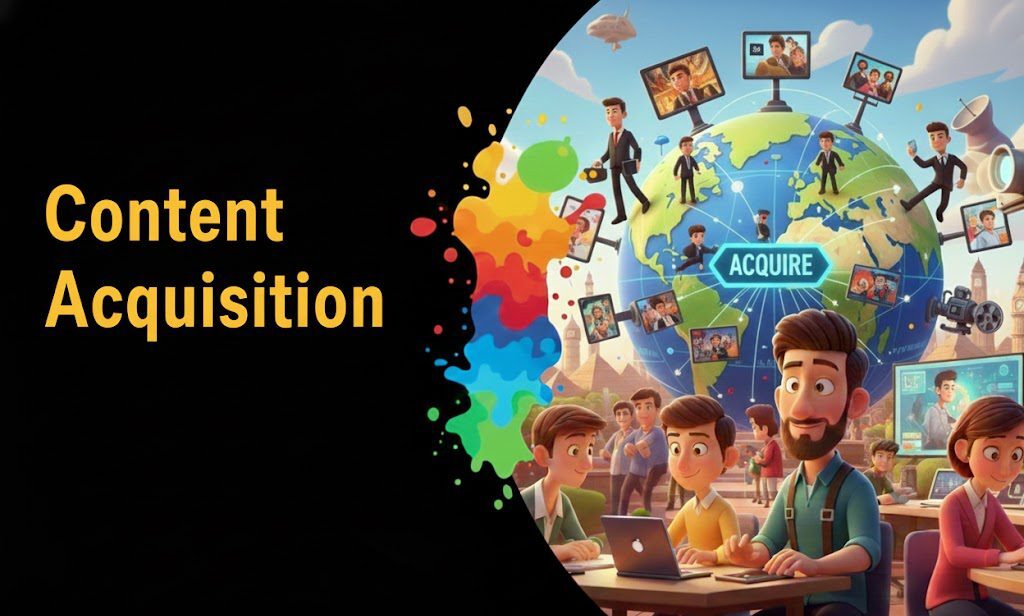
Here’s the uncomfortable truth most acquisition executives won’t say out loud: your content acquisition strategy is probably costing you more than it needs to. Not because your team is making bad decisions — but because the intelligence feeding those decisions is six months old, relationship-filtered, and riddled with gaps that cost real margin. In 2025, with 600,000+ companies operating across the global entertainment supply chain, the volume of opportunity has never been greater. And the opacity has never been worse.
The entertainment industry is in the middle of a structural reset. Streaming platforms are tightening budgets. Independent producers are scrambling for greenlight signals. And meanwhile, buyers at platforms like Netflix, Warner Bros, and Paramount are moving faster than ever — closing acquisition deals in days, not the months it used to take. If your pipeline relies on trade reports and festival hallway conversations, you’re not just slow. You’re invisible to the deals that matter most.
This guide cuts through the noise. We’ll cover the seven content acquisition strategies that top entertainment executives are using right now to de-risk deals, compress timelines, and protect EBITDA — backed by real data, real deals, and the kind of insider analysis you don’t get from the trades.
In This Guide
- Why Content Acquisition Is a CFO-Level Priority
- The Fragmentation Paradox Killing Your Pipeline
- Presales and the Capital Stack Connection
- Sovereign Content Hubs and Regional Acquisition
- Weaponized Distribution: The Netflix/WBD Model
- 5 Frameworks Top Acquisition Executives Use
- How Smart Pairing Accelerates Your Deal Flow
- FAQ: Content Acquisition Strategy
- Key Takeaways
Stop Guessing. Start Acquiring With Intelligence.
Ask VIQI — Vitrina’s AI research engine — to surface acquisition-ready content, map buyer appetite by territory, and identify deal flow across 140,000+ active companies right now. Used by acquisition teams at platforms across MENA, APAC, and Europe.
Ask VIQI Your First Question →
No credit card required · 200 free credits to start
Why Content Acquisition Is a CFO-Level Priority in 2025
Let’s get the framing right. Content acquisition isn’t a programming decision anymore. It’s a capital allocation decision — one that directly impacts EBITDA, recoupment timelines, and the long-term value of your IP portfolio. And the CFOs who don’t treat it that way are the ones watching margin leak out through every badly structured deal.
The math is sobering. According to data tracked across the Vitrina platform, producers and buyers relying on traditional acquisition pipelines — trade reports, festival relationships, static databases — face a 15-20% margin erosion through information asymmetry alone. That’s before you factor in deal delays. The average acquisition cycle in a relationship-dependent pipeline runs 3-6 months from first contact to signed agreement. In a market where the best content gets pre-empted before it hits the trades, that’s catastrophic.
What’s driving this urgency? Three converging pressures:
- Platform consolidation — fewer buyers controlling larger content budgets means each acquisition decision carries more weight and more risk.
- Sovereign fund capital — new money from Saudi Arabia’s Vision 2030, Abu Dhabi’s Twofour54, and similar sovereign hubs is rewriting the geography of where content gets made and who gets first-look rights.
- Audience fragmentation — a single global hit is increasingly hard to engineer; regional content that travels well is the new institutional hedge.
Phil Hunt, Founder and CEO of Head Gear Films, put it plainly in a recent Vitrina LeaderSpeak interview: the market has become “much, much harder in terms of getting movies off the ground and getting movies sold.” Head Gear has financed 550+ movies — running 35-40 films per year, more than most studios — and even they’re seeing the acquisition environment tighten post-COVID. The producers and buyers who survive this crunch are the ones who’ve weaponized their intelligence infrastructure.

Your AI Assistant, Agent, and Analyst for the Business of Entertainment
VIQI AI helps you plan content acquisitions, raise production financing, and find and connect with the right partners worldwide.
- Find active co-producers and financiers for scripted projects
- Find equity and gap financing companies in North America
- Find top film financiers in Europe
- Find production houses that can co-produce or finance unscripted series
- I am looking for production partners for a YA drama set in Brazil
- I am looking for producers with proven track record in mid-budget features
- I am looking for Turkish distributors with successful international sales
- I am looking for OTT platforms actively acquiring finished series for the LATAM region
- I am seeking localization companies offer subtitling services in multiple Asian languages
- I am seeking partners in animation production for children's content
- I am seeking USA based post-production companies with sound facilities
- I am seeking VFX partners to composite background images and AI generated content
- Show me recent drama projects available for pre-buy
- Show me Japanese Anime Distributors
- Show me true-crime buyers from Asia
- Show me documentary pre-buyers
- List the top commissioners at the BBC
- List the post-production and VFX decision-makers at Netflix
- List the development leaders at Sony Pictures
- List the scripted programming heads at HBO
- Who is backing animation projects in Europe right now
- Who is Netflix’s top production partners for Sports Docs
- Who is Commissioning factual content in the NORDICS
- Who is acquiring unscripted formats for the North American market
The Fragmentation Paradox Killing Your Content Acquisition Pipeline
Here’s the paradox no one talks about at market. There are more content suppliers today than at any point in history — 600,000+ companies operating across the global film and TV ecosystem. More sellers should mean better deals for buyers. More options should mean sharper pricing and faster closes. But the opposite is happening.
The Fragmentation Paradox explains why. When supply scales faster than intelligence, you get opacity — not transparency. Of those 600,000 companies, only 140,000 are actively producing content in any given window. The rest are dormant, pivoting, or simply invisible in the databases most acquisition teams rely on. So you’ve got 140,000 potential deal sources and most acquisition teams are working from a known universe of maybe 50-200 relationships.
That’s not a relationship problem. That’s a data infrastructure problem.
The cost is quantifiable. A producer sourcing content for a $10M project who relies on known-network introductions typically pays a 15-20% markup to intermediaries who control access. On a $4M services and content budget, that’s $600,000-$800,000 in recoverable margin — leaving on the table simply because the buyer lacked visibility into what was available at market rate. Across 140,000 active productions annually, the industry bleeds billions this way. Every year.
And the timeline cost is just as brutal. Traditional acquisition research — asking contacts, receiving referrals, flying to festivals, waiting for packages — runs 3-6 months per project. That’s 3-6 months during which the window for a presale, a co-production structure, or a first-look deal can close entirely. The best projects don’t wait.
The answer isn’t “go to more markets.” It’s changing the intelligence layer beneath every acquisition decision. Content acquisition tools built for the entertainment industry now make it possible to compress that 3-6 month research cycle to days — not by skipping due diligence, but by surfacing verified capability data, real-time deal flow, and current project status before you pick up the phone.
Presales and the Capital Stack: The Acquisition-Finance Feedback Loop
Smart acquisition executives don’t just evaluate content — they evaluate capital structure. Because how a project is financed determines what’s available to buy, when, and at what price.
The presales-to-capital-stack feedback loop works like this: a producer who’s secured pre-sale agreements covering 50-70% of budget across major territories is in a fundamentally different risk position than one running on equity alone. Banks lend at 70-90% of minimum guarantee (MG) value against confirmed presale contracts — which means the producer who’s already sold Germany, France, and Scandinavia has a production loan, gap financing capacity, and leverage. The producer without those presales is asking you to be their first-look deal and their financing at the same time.
Why does this matter for your content acquisition strategy? Because the capital stack tells you how much leverage you have in negotiation — and where you sit in the recoupment waterfall.
The waterfall hierarchy matters enormously:
- Senior production loan — lowest risk, lowest return, recoups first
- Gap/supergap financing — mezzanine position, recoups before equity
- Equity investors — highest risk, highest upside, recoups last
- Net profit participation — deferred fees, often the last money in and last money out
Acquisition executives who understand this structure can structure smarter deals. Entering early — before production — gives you MG pricing leverage and potentially a more favorable territorial bundle. Entering post-production means the project is de-risked (you can screen it) but you’re paying a premium and competing with festival buzz. Streaming content acquisition strategies increasingly favor early entry with territory-specific MG structures — exactly the model that top platforms use to maximize their recoupment position without owning the entire capital stack.
Find Your Next Deal Before It Hits the Market
Join 140,000+ entertainment companies using Vitrina to discover content, map capital structures, and close acquisition deals faster. Netflix UK found a qualified partner in 48 hours. Start with 200 free credits.
No credit card required · Trusted by teams at Warner Bros, Paramount, Google TV
Sovereign Content Hubs Are Rewriting the Geography of Acquisition
Here’s what the trades haven’t fully processed yet: the best content acquisition opportunities in 2025 aren’t in Los Angeles or London. They’re in Riyadh, Abu Dhabi, Seoul, and Mumbai — and the sovereign wealth backing those markets makes them structurally different from anything Hollywood has seen before.
Saudi Arabia’s Vision 2030 is deploying capital at scale into film and television infrastructure. Government-backed production investment offers 40-50% incentives versus the 20-30% typical in traditional Western markets. That differential doesn’t just lower production cost — it creates a fundamentally different risk profile for co-production partners and acquisitions entering that capital stack. The completion guarantee is effectively sovereign. The policy stability is long-term committed.
But the more interesting insight for acquisition teams is audience appetite. Regional content from MENA isn’t just finding local audiences — it’s building export pipelines that didn’t exist five years ago. And platforms covering those territories are actively competing for the rights.
Rolla Karam, Senior Vice President of Content Acquisition at OSN (Orbit Showtime Network), shared exactly this strategic dynamic in Vitrina’s LeaderSpeak Episode 69. OSN covers 23 countries across MENA and North Africa — with Saudi Arabia and the GCC as the core market — and Karam leads all content acquisition across that territory. Her team’s strategy is unambiguous: “from the region, for the region.” They’re building Arabic catalog depth while Turkish content, she noted, “does amazingly well” on the platform. The appetite for regionally authentic content is real and growing fast.
Watch Karam explain OSN’s 23-country acquisition strategy and what it means for content sellers entering MENA:

Rolla Karam (SVP, Content Acquisition, OSN) — Vitrina LeaderSpeak Episode 69: “MENA Streaming & Distribution: OSN’s 23-Country Platform Strategy”
For acquisition executives, this represents both competition and opportunity. The Sovereign Hub markets are generating higher-quality originals faster than Western buyers can track them with legacy tools. And the formats traveling out of Turkey, India, and South Korea are proving that non-English language content can command premium MGs in markets that previously treated them as library filler.
The strategic play? Get into these pipelines 6-12 months before the content hits a major festival. By the time something from Riyadh or Istanbul lands at MIPCOM, the smart acquisition teams have already closed their territory deals — quietly, efficiently, and without competing against half the room.
Weaponized Distribution: What the Netflix–WBD Deal Teaches Every Acquisition Exec
In 2024, Warner Bros Discovery and Netflix signed a multi-year licensing deal worth an estimated $72 billion — WBD licensing its HBO content library to what is, technically, its most direct streaming competitor. Industry observers called it unprecedented. But acquisitions insiders recognized it immediately: weaponized distribution in its most sophisticated form.
The concept is straightforward once you see it. Content ownership — not platform control — is the durable strategic asset. WBD owns HBO. Netflix needs premium drama to reduce churn. WBD’s competitors become their best customers. Debt gets paid down faster. Netflix fills a quality gap that original production can’t address on the required timeline. Both sides extract maximum value from an arrangement that looks counterintuitive from the outside.
What’s the acquisition lesson here? Your library has more value than your current recoupment model captures. Every piece of content you’ve acquired but not yet fully monetized represents latent licensing revenue that a weaponized distribution strategy can unlock — specifically by treating competitor platforms as customers, not enemies.
According to reporting in Variety, this co-opetition model is accelerating across the industry. Platforms that once insisted on exclusivity as a brand differentiator are increasingly open to windowed licensing arrangements that protect premium SVOD positioning while generating licensing income from AVOD, FAST channels, and international territories. The recoupment acceleration through this kind of presale optimization and incentive stacking can improve project IRR by 200-300 basis points — a meaningful number when you’re managing a multi-title slate.
But here’s the thing: executing weaponized distribution requires knowing who the real buyers are — which territories are active, which platforms have acquisition budgets, and which deals are closing right now. That’s not intelligence you get from a quarterly Omdia report. It requires real-time content acquisition intelligence built for the OTT industry.
5 Content Acquisition Frameworks the Best Executives Use Right Now
The executives who consistently close better deals aren’t smarter than you. They’re operating from better frameworks. Here are the five that come up again and again in conversations with top-tier acquisition teams across APAC, MENA, and Europe.
1. The 50/30/20 Pipeline Mix
The most resilient acquisition slates are built with a deliberate mix: 50% proven formats (scripted drama, established genres with predictable territory appeal), 30% emerging regional content (Turkish drama, Korean thriller, Indian action — categories with demonstrable crossover), and 20% early-development bets where you’re entering the capital stack early enough to shape the package. This spread protects you when one category underperforms while capturing upside when regional content breaks through.
2. The Intelligence-First Entry Model
Don’t go to market looking for content. Go to market with a shortlist of content you already know is acquisition-ready. This requires monitoring deal flow, project development status, and financing progress in real-time — 6-12 weeks before festival screenings. Acquisition teams using real-time content acquisition platforms consistently close at lower MGs and with better territorial bundles because they’re not competing in the festival scrum.
3. Capital Stack Due Diligence
Before any acquisition conversation, map the capital structure. Who else has MG rights? What territories are locked? Is there a completion bond? What’s the recoupment position of existing investors? A deal that looks attractive on P&A can be structurally compromised if you’re entering behind two layers of equity that need to recoup first. This isn’t optional due diligence — it’s the difference between an asset and a liability.
4. The Territorial Bundle Arbitrage Strategy
Don’t negotiate territories individually when you can negotiate bundles that strengthen your hand. Bundling adjacent markets — GCC + North Africa, Nordic + Baltic, DACH + Benelux — gives you MG leverage that individual territory deals don’t provide. It also simplifies delivery and chain-of-title management. And from the producer’s perspective, closing a bundle beats chasing individual territory deals for 18 months. Use that efficiency as a negotiating chip.
5. The Competitive Intelligence Trigger System
Build alert systems around your most valuable categories. When a competing platform acquires content in your core genre from a specific region, that’s a signal — not just about what they’ve bought, but about what they’re seeing in audience data. The best acquisition executives don’t just track their own deals; they track competitor acquisition patterns to spot category momentum before it becomes obvious. By the time something is “in demand,” the best deals are already closed.
Need a Bespoke Acquisition Intelligence Brief?
The Vitrina Concierge team delivers custom research reports on content pipelines, regional deal flow, and competitive acquisition intelligence — built specifically for your category, your territories, and your timeline. Trusted by acquisition teams at 140,000+ companies worldwide.
Request Your Concierge Brief →
No commitment required · Results delivered in 48 hours
How Vitrina’s Smart Pairing Accelerates Your Acquisition Deal Flow
What if your acquisition pipeline could surface qualified content opportunities — pre-verified, deal-stage-mapped, and matched to your budget, genre, and territorial parameters — before you even attend a single market? That’s not a hypothetical. That’s what Smart Pairing does on the Vitrina platform, and it’s why acquisition teams from Netflix to regional SVOD operators are using it to compress deal cycles from months to days.
Smart Pairing works by cross-referencing 400,000+ active projects across Vitrina’s database against your stated acquisition criteria — genre, budget band, territory availability, production stage, financing status — and surfacing matches ranked by commercial viability and deal-readiness. The result isn’t a longer list of possibilities. It’s a shorter list of probabilities.
And that distinction matters enormously. The Fragmentation Paradox creates noise. Smart Pairing cuts through it by applying verified intelligence — not self-reported capability data, not IMDb credits, not festival catalogs — but real-time operational data on which projects are actively seeking buyers, in which territories, and at what stage of production and financing.
The timeline compression is measurable. Traditional acquisition research: 3-6 months from initial search to shortlist. With Smart Pairing and the Vitrina intelligence layer: days to weeks. That’s an 80-90% reduction in research cycle time — which translates directly to earlier market entry, better MG pricing, and a first-mover advantage on the content that actually moves audience.
But the bigger gain is margin protection. When you can benchmark MG pricing against real market data — not just the asking price your contact at the sales agency quotes — you negotiate from an informed position. Vitrina shows you what comparable projects in the same genre, territory, and budget band have closed at. That intelligence is worth more than the subscription cost on a single deal.
For acquisition executives managing global entertainment supply chain complexity, Vitrina also surfaces co-production structures — identifying which projects have funding gaps that your acquisition MG could close, or where a creative partnership could generate tax incentive benefits that reshape the economics of the deal entirely. It’s not just acquisition intelligence. It’s deal architecture support.
FAQ: Content Acquisition Strategy in the Entertainment Industry
Conclusion: The Acquisition Edge Is an Intelligence Edge
The entertainment industry’s content acquisition landscape has never been more competitive — or more full of opportunity for teams who’ve built the right intelligence infrastructure. The difference between closing the deal and missing it isn’t budget. It isn’t relationships. It’s timing and information.
The executives who’ll dominate the next three years of content acquisition are the ones who’ve stopped treating it as a programming function and started treating it as a capital deployment function — with the CFO rigor, the real-time data infrastructure, and the strategic frameworks to match. That means understanding capital stacks before negotiating MGs, mapping Sovereign Hub pipelines before festival season, and using tools that surface qualified opportunities in days rather than months.
The Fragmentation Paradox is real. But it’s solvable. And the teams solving it are already closing the deals you’ll read about in the trades next quarter.
Key Takeaways
- Intelligence is the asset: The 15-20% margin erosion from information asymmetry is recoverable — but only if you replace static databases with real-time deal-flow intelligence.
- Capital stack first: Understanding a project’s recoupment waterfall before entering MG negotiations determines whether you’re buying an asset or inheriting someone else’s debt problem.
- Sovereign Hubs are producing now: Markets in MENA, South Korea, and India are generating acquisition-ready content at scale — and the acquisition window closes faster than most Western teams realize.
- Enter earlier: The best MG pricing and territorial bundling opportunities exist 6-12 weeks before festival premiere. By the time something is “in demand,” the deal is already done.
- Weaponize what you own: Your existing content library is a licensing asset. Treating competitor platforms as potential licensing customers — as WBD did with Netflix — accelerates recoupment and protects EBITDA on new acquisitions.
Ready to De-Risk Your Next Content Acquisition?
Access real-time deal flow across 400,000+ active projects. Map capital structures. Surface acquisition-ready content before it hits the market. Start with 200 free credits — no credit card required.
Trusted by acquisition teams at Netflix, Warner Bros, Paramount, Google TV · 140,000+ companies on platform
Find Film+TV Projects, Partners, and Deals – Fast.
VIQI matches you with the right financiers, producers, streamers, and buyers – globally.
Producers Seeking Financing, Co-Pros, or Pre-Buys?
Vitrina Concierge helps producers reach the right financiers, commissioners, distributors, and co-production partners — with precision outreach, not cold pitching.
Join Industry Briefings Trusted by Leaders
Streamers – Netflix vs. Amazon – The 2026 Strategy
How Netflix and Amazon’s content and revenue strategies are diverging ahead of 2026.

Format Adaptations: Global Trends
Where formats are traveling, which adaptations are breaking out, and how streamers are backing remakes in 2025–2026.

Books, Novels & Comics Adaptations: Global Trends
Books, webtoons, and manga driving the next global screen hits. Discover how in this webinar.

Micro-Dramas & Mobile-First Storytelling
Micro-dramas are building real audiences and revenue. Understand the platforms, buyers, and economics behind the growth.