About Innovation Hub
 Global Content Pulse (Webinars)


 Global Production Financing
(Webinars)
Global Production Financing
(Webinars)  LeaderSpeak Podcast
  About Vitrina
 Our Story
 Our Solutions 🔥
 Film+TV Projects Tracker 🚀
 Case Studies
 Our Profile
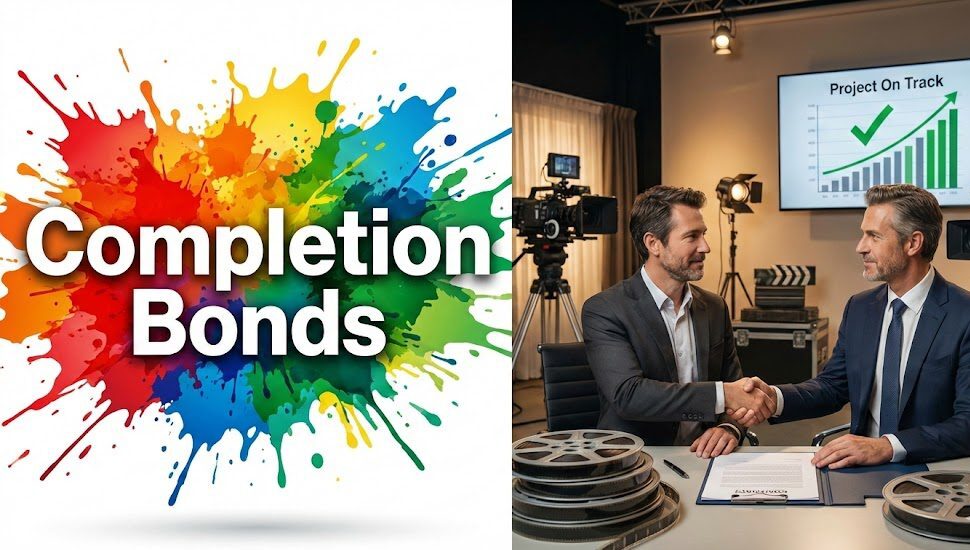
Completion bonds are the financial insurance policies of the global film supply chain. It’s a three-way legal contract between the producer, the financier, and a completion guarantor that ensures a film is delivered on time, on budget, and according to technical specifications. Without one, investors face the “nightmare scenario”—a half-finished project that can’t trigger tax credits or territory pre-sales.
For the sophisticated film investor or CFO, the bond isn’t just a line item; it’s a fiduciary mandate. If you’re putting capital into a slate or a single-picture deal, the bond is what prevents your investment from evaporating in the event of a director’s “creative pivot” or a sudden production shut-down. It’s the gatekeeper of the senior debt.
Table of Contents
Stop Guessing Who’s Financing. Get Targeted Outreach.
Stop searching and start getting funded. We identify the exact decision-makers currently backing projects like yours, turning raw data into risk-aligned capital partnerships.
Major Studios
Scouting early stage projects, IP, and Regional partners for global studio pipelines.
IP Owners & Leads
Connecting creative leads with qualified financiers and major streaming platforms.
Streamers
Securing high-value pre-buy content and discovering early-stage global IP for platforms.
Indie Producers
Bridging the gap for indie filmmakers to reach executive production partners and capital.
Global Financing Ecosystems
Mapping complex markets and pairing projects with disciplined, risk-aligned capital across global territories worldwide.
What is a Completion Bond? (The Investor’s Safety Net)
Let’s be blunt: indie film production is chaotic. A completion bond is the mechanism that tames that chaos for the people writing the checks. At its core, the bond is a guarantee that the film will be completed and delivered—or the guarantor will step in and pay back the investors.
The guarantor doesn’t just write a check and hope for the best. They conduct a rigorous audit of the script, the budget, and the shooting schedule before they ever issue an LOI (Letter of Intent). During production, they monitor daily “rushes” and cost reports. If the project drifts—and it usually does—they have the legal right to take over production. The reality? They rarely have to, but having that “takeover right” is what keeps production on the rails.
Producers can find bond-ready production partners on Vitrina to ensure their projects meet these rigorous standards from day one.
The Vitrina Risk Mitigation Matrix™
Strategic players understand that not all risks are created equal. We’ve mapped out the difference between bonded and unbonded production environments to show exactly where your protection lies.
| Risk Category | Unbonded Production | Bonded (Vitrina Standard) |
|---|---|---|
| Budget Overrun | Investor absorbs 100% of overage. | Guarantor covers overage (Strike Price). |
| Technical Delivery | High risk of rejection by streamers. | Guaranteed to meet Platform Specs. |
| Tax Rebate Trigger | Uncertain. No audit trail. | Verified spend enables easy audit. |
Why Investors and Gap Lenders Demand Bonding
Behind closed doors, the conversation about production financing always circles back to “The Deliverables.” If you are a gap lender, your collateral is the unsold territory rights (e.g., Japan, Latin America). But those rights are worthless if you don’t have a finished IMF (Interoperable Master Format) file to hand to the local distributor.
Insiders recognize that the completion bond is what makes the project “bankable.” Banks like Coutts or JP Morgan won’t cash-flow a tax credit without a bond because if the film isn’t finished, the government won’t pay the credit. The bond “weaponizes” your incentives, turning a future promise into immediate working capital.
Phil Hunt, CEO of Head Gear Films, explains why the capital stack depends on these guarantees:

As Hunt notes, the market has shifted. In a post-streamer-correction world, the margin for error is zero. Investors who bypass completion bonds are essentially gambling, not investing.
Find the Financiers Backing Your Genre
Stop searching and start getting funded. We identify the exact decision-makers currently backing projects like yours, turning raw data into risk-aligned capital partnerships.
How Much Does a Completion Bond Cost? (2025 Market Rates)
What’s the price of sleep? In the film world, it’s about 2% of your budget. Here’s the typical breakdown for completion bonds in 2025:
- The Headline Fee: 1.5% to 2.5% of the “bonded budget” (total budget minus certain exclusions like the bond fee itself and development costs).
- The “No-Claim” Rebate: This is the strategic play. Most guarantors will rebate 50% of their fee if the production finishes without the bond being called. This reduces your effective cost to ~1%.
- The Contingency: Lenders usually require a 10% contingency built into the budget before they’ll even consider bonding it.
If you’re looking to optimize your capital stack, you can ask VIQI for current bonding rates specific to your genre and territory.
The 5-Step Bonding Process: From Script to Delivery
The bonding process isn’t a rubber-stamp exercise; it’s a deep-tissue audit of your project’s viability. If you’re a producer, here’s how you navigate it:
- Submission & Audit: The guarantor reviews script, budget, and schedule. They look for “red flags”—too many night shoots, aggressive VFX timelines, or unconfirmed cast.
- The Letter of Intent (LOI): Once satisfied, they issue an LOI. This is the document you need to close your gap financing.
- The Bond Agreement: This is the execution phase where the three-way contract is signed. The “Strike Price” (total guaranteed budget) is set.
- Production Monitoring: During the shoot, a “production representative” from the guarantor reviews daily wrap reports and cost-to-complete statements.
- Delivery & Close: Once the film is technically delivered to all financiers and the rebate is processed, the bond is retired.
How Vitrina Helps with Completion Bonds
Finding a guarantor who “gets” your genre or your region (like the emerging Sovereign Content Hubs™ in the MENA region) can be a challenge. Vitrina streamlines this by providing a verified database of producers who have successfully bonded projects and the guarantors who back them.
- Explore our database to find bonded-ready production services.
- Ask VIQI for specific bonding requirements in tax-incentive-heavy territories.
- Contact Concierge for hands-on assistance in structuring your bonded capital stack.
Frequently Asked Questions
Who typically pays for the completion bond?
The production pays the fee, but it is almost always budgeted as a line item in the production financing. Essentially, the investors’ capital is used to purchase the protection for that same capital.
What is the “Strike Price” in a completion bond?
The strike price is the total amount the guarantor is willing to guarantee. It includes the production budget, the 10% contingency, the bond fee, and sometimes specific financing costs. If the spend exceeds this, the guarantor is on the hook.
Does the bond cover “creative differences”?
No. Completion bonds guarantee delivery, not quality. If the director makes a “bad” movie that meets the script and technical specs, the bond is satisfied. The guarantor only steps in when delivery is at risk.
Can you get a bond for a VFX-heavy film?
Yes, but the audit will be much stricter. The guarantor will likely require a locked VFX budget and specific post-production benchmarks to be met before releasing tranches of the bond.
The Bottom Line
Completion bonds work when you have a professional, audit-ready package. They are the difference between a high-risk gamble and a de-risked financial asset. If you are exploring financing for a project, remember that the bond is what makes your project real to the capital market.
Ready to de-risk your next project? Vitrina’s Concierge team can connect you with bonded-ready partners in 48 hours.
Find Film+TV Projects, Partners, and Deals – Fast.
VIQI matches you with the right financiers, producers, streamers, and buyers – globally.
Producers Seeking Financing, Co-Pros, or Pre-Buys?
Vitrina Concierge helps producers reach the right financiers, commissioners, distributors, and co-production partners — with precision outreach, not cold pitching.
Join Industry Briefings Trusted by Leaders
Streamers – Netflix vs. Amazon – The 2026 Strategy
How Netflix and Amazon’s content and revenue strategies are diverging ahead of 2026.

Format Adaptations: Global Trends
Where formats are traveling, which adaptations are breaking out, and how streamers are backing remakes in 2025–2026.

Books, Novels & Comics Adaptations: Global Trends
Books, webtoons, and manga driving the next global screen hits. Discover how in this webinar.

Micro-Dramas & Mobile-First Storytelling
Micro-dramas are building real audiences and revenue. Understand the platforms, buyers, and economics behind the growth.