IHUB
IHUB
 Private Briefings (Webinars)


 LeaderSpeak Podcast
  Global Entertainment Digest (Newsletter)
  Premium Lists
 Membership Benefits
 About Vitrina
 Our Story
By Vitrina Research Team | Published: August 1, 2026 | 9 min read
When Netflix paid $587 million to acquire InterPositive Media in early 2026 — a deal structured specifically around the target company’s proprietary AI-assisted post-production infrastructure — it signaled something the industry had been reluctant to say plainly: AI is no longer a tool that film businesses use. It is becoming the asset film businesses are valued on.
This is a guide for executives who need to understand what is actually happening, not what the press release says. We will cover where AI is creating real commercial advantage, where the labor and legal risks sit, and what the data suggests about which companies are ahead of the curve — and which are falling behind.
Key Takeaways
- Netflix’s $587M InterPositive acquisition signals AI infrastructure as a core M&A valuation driver in film
- SAG-AFTRA’s 2026 contract (91.42% ratified) sets binding consent rules for AI likeness use — producers need compliance frameworks now
- McKinsey estimates $10B in addressable value from AI across the M&E value chain — but Deloitte data shows fewer than 3% of M&E companies have meaningful GenAI budget commitments
- AI is creating the largest efficiency gains in post-production (VFX, color, localization) and development (script analysis, greenlight modeling)
- Producers and studios that treat AI as a vendor question — rather than a strategic one — are already behind
Why 2026 Is the Inflection Point for AI in Film
The conversation changed in 2025. Before then, AI in film meant recommendation algorithms at streaming services and a few VFX studios experimenting with machine learning workflows. It was a technology story, not a business strategy story.
Two things shifted it. First, generative AI matured to the point where it could produce commercially usable output — not just rough drafts. Second, the deals started. Acquisitions, equity investments, and technology licensing agreements structured specifically around AI capabilities began appearing on term sheets. The InterPositive acquisition is the clearest example, but it is not the only one.
McKinsey’s media practice has modeled the addressable value from AI across the M&E value chain at approximately $10 billion — accounting for cost reduction in production, improved content targeting accuracy, and reduced time-to-market in post-production workflows. That number is theoretical today. The gap between theoretical and captured value is exactly where competitive advantage will be determined over the next three years.
AI in Development: Script Analysis and Greenlight Modeling
The development phase has historically been the most opaque and expensive in terms of sunk costs per greenlight. A studio might develop thirty projects to produce one. AI tools are attacking that ratio from both directions: improving the quality of what enters development, and accelerating the decision to kill what will not work.
Script analysis platforms like ScriptBook and Cinelytic now provide machine-learning assessments of commercial performance probability based on structural analysis, genre positioning, and market comparables. These tools are not making greenlight decisions — the major studios are clear on that point — but they are used as a filter and a check on instinct.
The more consequential application is in pre-sales and financing modeling. AI-assisted financial modeling tools that incorporate territorial box office data, streaming platform bid histories, and co-production incentive stacking are reducing the time from packaging to term sheet on structured deals. For independent producers, this matters because speed is capital. The faster you can show a credible financial model, the earlier you can lock financing before your attachments move on.
Vitrina’s own intelligence data shows which production companies are actively developing which formats and genres — a resource that is increasingly relevant as producers need to validate whether a project is heading into a crowded market before committing development budget. See how AI is influencing film production and content development across the global supply chain.
AI on Set: Virtual Production and Real-Time Rendering
LED virtual production stages — which use real-time rendered backgrounds in place of location shooting or traditional green screen — are now in active use at facilities across the UK, US, Canada, and India. The underlying technology is Unreal Engine combined with camera tracking, but the reason the economics work has changed.
Early LED volumes required enormous budgets and specialist operators. AI-assisted scene generation and lighting optimization have brought down both the content creation cost and the time required to prepare environments. A production that three years ago would have needed six weeks of background asset preparation for a virtual production stage can now do it in one to two weeks using AI generation tools.
De-aging and digital double technology — which created expensive controversy on some productions — has also matured. The most significant development is predictability: studios can now cost AI-assisted VFX work with greater confidence because the tools are consistent and the workflows are established. That predictability is what turns technology into budget line items.
AI in Post-Production: Where the ROI Is Clearest
Post-production is where the commercial case for AI is most straightforward because the savings are measurable and the workflows are well-understood. Color grading, sound design, localization, and VFX compositing are all seeing AI integration at the pipeline level — not as experimental add-ons, but as standard tooling at tier-one facilities.
The InterPositive acquisition crystallizes why this matters at the M&A level. Netflix did not buy a content library. It bought infrastructure: a pipeline optimized for AI-assisted color and mastering workflows that would reduce the time and cost of processing the volume of content Netflix delivers to 190+ territories. At $587 million, the acquisition was priced on infrastructure value, not content catalog value. That is a new category of valuation in the industry.
For independent studios and post houses, the competitive question is whether to build, buy, or partner with AI post capabilities. Most do not have M&A budgets. But those that establish AI-assisted workflows now — in color, sound, or localization — will win production service contracts over those that do not. This is already visible in RFP criteria from major commissioners. Read more about what buyers expect from production services in 2025-2026.
Track AI-Driven Deals Across the Film Supply Chain
VIQI monitors 300,000+ M&E companies worldwide — see which studios, post houses, and distributors are building AI capabilities before the deals are public.
AI in Distribution and Marketing
Distribution is where AI has been active the longest — recommendation engines at Netflix, Amazon, and Disney+ have been AI-driven for years — but the applications are expanding past algorithm-driven discovery into territory analysis, windowing optimization, and marketing asset creation.
AI-driven trailer and marketing localization allows studios to generate territory-specific promotional materials at scale. What previously required separate creative briefs and production runs per market can now be versioned through AI tooling. For a film releasing in 40 territories, the marketing efficiency gains are material.
On the distribution strategy side, AI modeling of theatrical windows versus streaming release timing has become more sophisticated. The collapse of the 90-day window to 45 days (and in some cases theatrical-day-and-date) was accelerated by streaming economics; AI-powered revenue modeling is now being used to optimize windowing decisions per title and per territory rather than applying a blanket policy. For sales agents, this means the most credible financial models will need to incorporate AI-assisted territory revenue projections. See the latest global content acquisition trends and how streamers approach content licensing decisions in 2026.
The Labor and Legal Landscape: SAG-AFTRA and Beyond
The 2026 SAG-AFTRA contract — ratified at 91.42% — is the most consequential labor agreement for AI use in film production to date. The provisions establish clear consent requirements for AI-generated likenesses: a performer’s digital likeness cannot be created, trained on, or commercially deployed without explicit individual consent agreements. The contract applies to SAG-AFTRA members working on covered productions, which includes virtually all major US studio and streaming productions.
For producers, the practical implications are significant. Productions that plan any AI likeness work — including de-aging, digital doubles, or posthumous performance replication — need consent frameworks built into deal memos before principal photography begins. Retrofitting these agreements after production is expensive and sometimes impossible.
The WGA equivalent provisions, which emerged from the 2023 strike resolution, similarly establish protections around AI-generated script content. Writers working under WGA jurisdiction cannot be required to write from AI-generated material; producers cannot use AI-generated drafts as the basis for compensation calculations. The compliance burden sits with the production company, not the platform.
Beyond US guild agreements, the EU AI Act — which came into force in stages through 2025 and 2026 — introduces transparency obligations for AI-generated content distributed in EU territories. Productions targeting European theatrical or streaming release need to understand the disclosure requirements, particularly for AI-generated visual content.
What Producers Need to Do Now
- Include AI consent riders in performer deal memos for any production that may use AI post-production tools
- Brief legal counsel on EU AI Act disclosure obligations before greenlight on EU-distributed projects
- Establish an AI usage register per production — what tools are used, for what purpose, on what content
- Review errors and omissions insurance terms; some E&O providers now have specific AI liability exclusions
The Adoption Gap: Why Most Studios Are Still Behind
The gap between what AI can do and what most film businesses are actually doing with it is large. Deloitte’s 2025 media industry research found that fewer than 3% of media and entertainment companies have committed meaningful GenAI budgets — where meaningful means budget lines that would produce observable workflow change. The rest are in exploration, pilot, or wait-and-see modes.
There are three reasons for this. The first is organizational: AI adoption requires cross-functional coordination between creative, technical, and legal teams. Most studios have not built the governance structures to manage this. Second, the ROI is opaque at the business unit level. A post-production supervisor knows what AI tools can save. The CFO needs a number. Translating workflow efficiency into P&L impact requires measurement infrastructure most companies do not have.
Third, and perhaps most practically, the vendor landscape is fragmented and immature. There are dozens of AI tools competing for post-production, script analysis, and marketing budgets. Most are early-stage. Evaluating them requires time and specialist knowledge. That evaluation cost is itself a barrier.
The studios that will capture McKinsey’s $10 billion in addressable value are the ones that solve the governance and measurement problem, not just the technology selection problem. This is a management challenge as much as a technology one. See what Netflix’s 2026 strategy reveals about how tier-one streamers are making these investments at scale.
How Vitrina Helps Producers and Studios Navigate the AI Shift
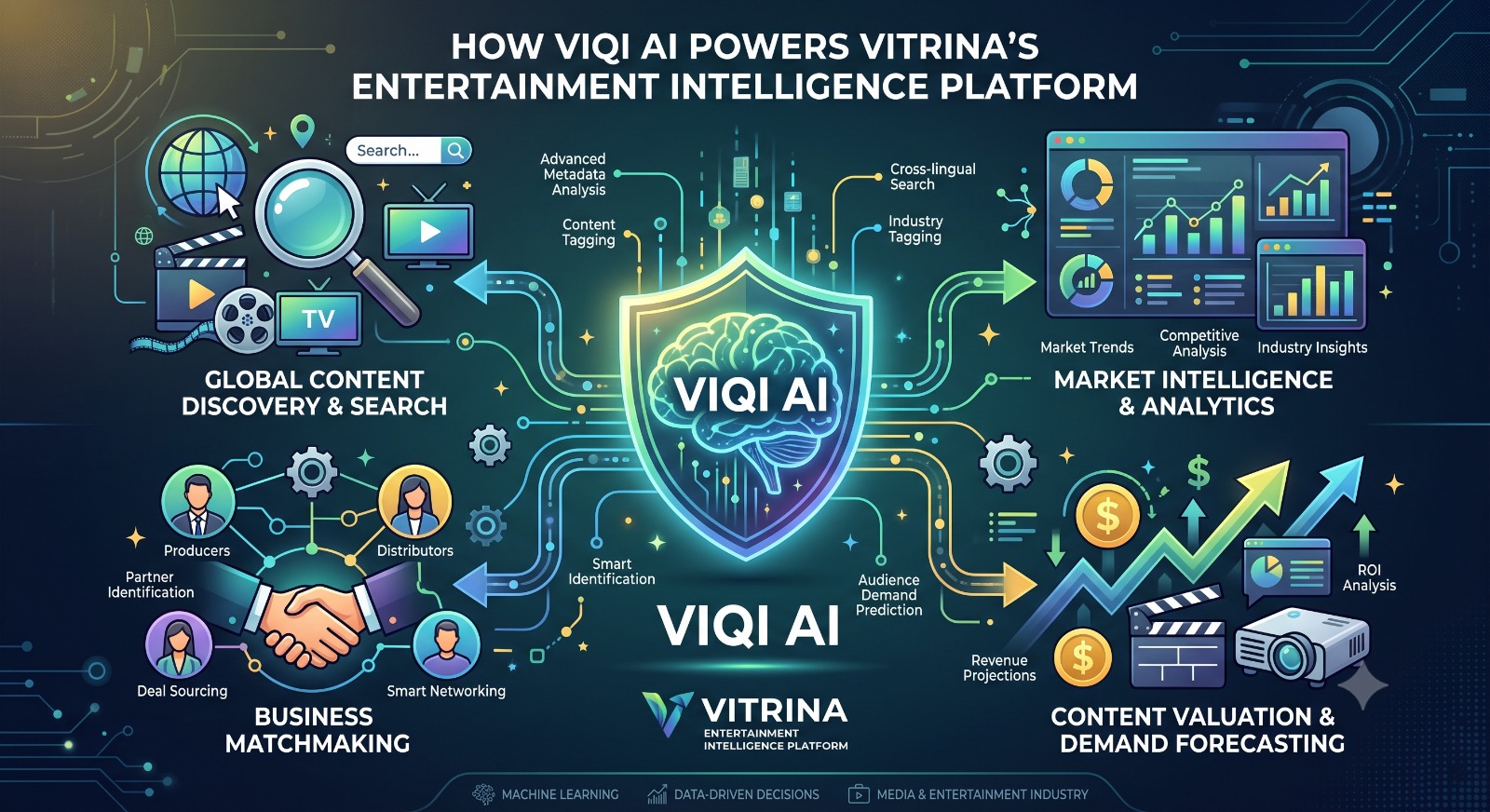
Vitrina’s VIQI platform tracks 300,000+ companies across the global film and TV supply chain — including the emerging tier of AI-native post-production vendors, technology providers, and service companies that are building the infrastructure this transformation requires.
For producers and commissioners evaluating AI post-production partners, VIQI provides verified company profiles with deal history and capability data. For financiers modeling which production companies are building durable competitive advantage, the platform tracks technology investments alongside traditional output data.
The Vitrina Concierge service also provides direct outreach capability — connecting executives who need to identify specific AI-capable vendors or partners with the right companies before the search becomes public. In a market where the best AI infrastructure providers are being acquired, moving early matters.
List Your AI-Capable Studio or Service Company
Producers and studios sourcing AI-enabled production partners are searching VIQI now. Put your company in front of buyers who are actively looking.
Conclusion
AI is transforming the film business in 2026 across every stage of the value chain — but the transformation is not uniform. In post-production, the commercial case is clear and measurable. In development, AI is augmenting decision-making without replacing creative judgment. In labor and legal, the frameworks are being established and compliance costs are real.
The executives who will come out ahead are not necessarily those who adopt AI fastest. They are the ones who build the governance and measurement infrastructure to capture value systematically — and who understand which parts of the supply chain are being restructured by AI at a pace that creates either competitive threat or acquisition opportunity.
The InterPositive deal is the template: AI-optimized infrastructure has real M&A value. The question for every studio, post house, and production company is where they sit on that spectrum right now.
Get a Vitrina Demo for Your Team
See how production companies, financiers, and commissioners use VIQI to track AI capability signals across the global supply chain — before they become public knowledge.
Frequently Asked Questions
What is the biggest commercial AI application in film right now?
Post-production — specifically AI-assisted color grading, VFX compositing, and localization workflows. These applications have measurable cost and time savings at the pipeline level, which is why they are showing up in M&A valuations as Netflix’s InterPositive acquisition demonstrated in 2026.
What do producers need to know about SAG-AFTRA’s 2026 AI provisions?
The 2026 SAG-AFTRA contract (ratified at 91.42%) requires explicit individual consent for any AI-generated or AI-trained use of a performer’s likeness. Consent must be secured before production begins. Productions that plan AI likeness work — including de-aging or digital doubles — need legal frameworks in deal memos from day one.
How much value can AI unlock in the film and entertainment industry?
McKinsey estimates approximately $10 billion in addressable value across the M&E value chain from AI adoption — covering cost reduction in production, improved content targeting, and faster post-production workflows. Deloitte data shows fewer than 3% of companies have committed meaningful budgets to capture this, indicating the competitive window is still open for early movers.
Is AI replacing writers and directors in film production?
No — the commercial applications of AI in film production in 2026 are augmenting workflows, not replacing creative roles. WGA protections explicitly prevent AI-generated scripts from being used as the basis for writer compensation calculations. AI is being used for script analysis, financial modeling, and technical production tasks, with human creative decision-making remaining central.
What should film financiers track regarding AI in their portfolio companies?
Financiers should assess AI capability as part of production company due diligence — specifically: what AI tools are integrated into the post-production pipeline, whether the company has consent frameworks for AI likeness use, and whether they have AI-assisted financial modeling capability for territory analysis. These are increasingly visible in buyer/buyer RFP criteria for production service contracts.
About the Author
Vitrina Research Team
The Vitrina Research Team produces intelligence-led analysis on media and entertainment industry structure, deal activity, and market trends. Our research draws on VIQI’s proprietary dataset of 300,000+ M&E companies worldwide.