About Innovation Hub
 Global Content Pulse (Webinars)


 Global Production Financing
(Webinars)
Global Production Financing
(Webinars)  LeaderSpeak Podcast
  About Vitrina
 Our Story
 Our Solutions 🔥
 Film+TV Projects Tracker 🚀
 Case Studies
 Our Profile
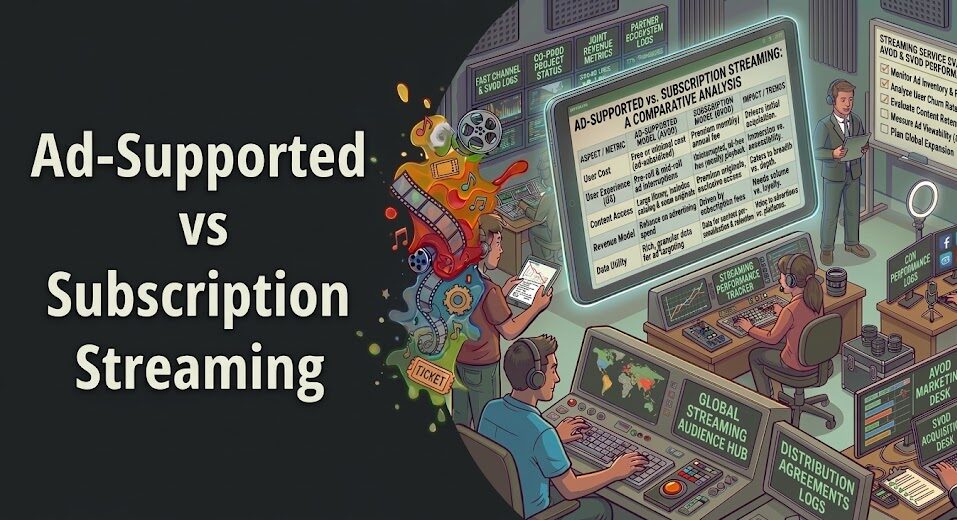
Here’s the uncomfortable truth for anyone still building a pure-subscription streaming strategy: 71% of all net new streaming subscribers over the past nine quarters have signed up for ad-supported plans. Not premium. Not ad-free. Ad-supported—according to Antenna research.
The question isn’t whether ad-supported streaming vs subscription streaming is a debate anymore. It isn’t. The question is how you’re positioning your content, your catalog, and your capital structure for the model that’s actually growing.
The numbers in 2026 tell a story that would’ve seemed impossible in 2019. Back then, Netflix was adamant it would never run ads. Disney+ launched ad-free only. AVOD was considered a second-tier destination—where content went when it couldn’t get a real deal. Five years later, Netflix’s ad-supported tier has surpassed 94 million global monthly active users. That reversal took less than five years. And it’s reshaping every aspect of how content gets commissioned, packaged, and sold.
This isn’t an academic debate about business models. It’s a live, unfolding restructuring of the streaming revenue stack—and where your content sits in that stack determines your recoupment timeline, your production budget ceiling, and your distribution leverage. Let’s break down what’s actually winning, why, and what it means for you.
Table of Contents
- The Numbers Don’t Lie: AVOD Is the Fastest-Growing Revenue Engine
- Why Subscription Still Dominates—For Now
- How Netflix Cracked the Hybrid Code
- FAST Channels: The Third Player Nobody’s Ignoring
- What This Means for Your Content and Production Budgets
- The Capital Stack Logic: Running All Three Models
- Which Streaming Model Fits Your Content Strategy in 2026?
- FAQ
- Conclusion
Ask VIQI: Which Platforms Are Actively Commissioning in Your Genre Right Now?
VIQI is Vitrina’s AI assistant—trained on 1.6 million titles, 360,000 companies, and 5 million entertainment professionals. Get instant intelligence on which AVOD and SVOD platforms are buying, at what deal terms, and in which categories.
✓ Included with 200 free credits | ✓ No credit card needed
The Numbers Don’t Lie: AVOD Is the Fastest-Growing Revenue Engine
Premium AVOD platform revenue grew 39% in 2024—reaching $14.3 billion according to MoffettNathanson research. To put that in context: the entire streaming industry is growing, but ad-supported revenue is growing nearly four times faster than subscription revenue at this stage. And the individual platform data is even more striking when you look closely.
Hulu leads all platforms with $3.1 billion in 2024 ad revenue. Peacock generated $2.1 billion—up 114% year-over-year in Q3 alone. Amazon Prime Video, which only launched ads in January 2024, already hit $2.0 billion. And Netflix—which spent years insisting it would never sell a single ad—generated $1.6 billion in its first full year, with ad revenue growing 116% over 2023.
The global picture confirms this isn’t a U.S.-only story. The worldwide AVOD market was valued at $54.14 billion in 2025, according to SNS Insider research, and is projected to reach $218.31 billion by 2033. That’s a compound annual growth rate exceeding 19%. Compare that to subscription revenue, which still leads in dollar terms but faces a much flatter growth curve as market saturation sets in across major economies.
But here’s the dynamic that matters most for M&E executives: as our analysis of AVOD and FAST platform analytics solutions shows, content owners who negotiate data access alongside revenue share are extracting significantly more value from their catalog deals. The headline revenue split is only part of the story. The audience data that flows from AVOD distribution—viewership patterns, completion rates, demographic breakdowns—has become a negotiating asset in its own right.
Why Subscription Still Dominates—For Now
Don’t mistake AVOD’s growth rate for SVOD’s demise. Subscription video-on-demand still generates more than $120 billion of the global VoD market’s total $182.4 billion in 2025 revenues, according to Global Growth Insights. Netflix alone generates roughly $25 billion annually. HBO Max—with just 67 million subscribers—produces $45 billion in revenue, indicating an extraordinarily high ARPU that ad-supported tiers simply can’t match on a per-user basis at current CPM rates.
There’s a reason your CFO still smiles when a premium SVOD deal lands on the slate. SVOD provides predictable, recurring revenue that you can model against your recoupment schedule. The MG is clean. The term is fixed. The reporting—while imperfect—follows a known structure. Ad-supported revenue, by contrast, fluctuates with CPM rates, advertiser demand cycles, and platform-specific fill rates. That variability changes your capital stack math in ways that aren’t always immediately obvious.
But here’s what the data shows about SVOD’s vulnerability: subscriber acquisition costs are rising, and churn management has become an active operational burden for every major platform. As Deadline has reported extensively, the streaming landscape has entered a phase where the marginal subscriber is harder and more expensive to acquire than at any point since the first wave of cord-cutting. That’s why you’re seeing every major SVOD player—including those that resisted advertising the longest—pivot hard toward hybrid models.
The honest read: SVOD isn’t losing. But the Fragmentation Paradox is real—600,000+ companies operating in opaque silos, with distribution intelligence scattered across deal memos and closed-door conversations. That information asymmetry costs producers 15-20% margin through deals that close slower and on worse terms than they should.
Track Which Platforms Are Buying Before It Hits the Trades
Trusted by Netflix, Warner Bros, and Paramount. Join 140,000+ companies tracking the global entertainment supply chain—platform acquisition strategies, deal terms, and commissioning windows across SVOD, AVOD, and FAST.
✓ 200 free credits | ✓ No credit card required | ✓ Full platform access
How Netflix Cracked the Hybrid Code—And What You Can Learn From It
Netflix launched its ad-supported tier at $6.99/month in November 2022. Disney+ followed. Both now run full dual-model operations—SVOD for premium subscribers, AVOD for everyone else. And as Variety reported, Netflix’s ad-supported membership grew 34% quarter-over-quarter in late 2024, outpacing subscription tier growth across all tracked markets. That’s not a soft launch anymore. That’s a structural pivot.
But the Netflix story isn’t just about adding an ad tier. It’s about what that tier does to their content strategy upstream. When you’re filling an ad-supported tier, your content commissioning logic changes. You need volume. You need catalog depth. You need the kind of mid-budget procedurals, reality formats, and acquired international content that performs consistently with broad audiences—not just the prestige dramas that drive subscription sign-ups. That shift in commissioning priority is already visible in how acquisitions executives at Netflix and its competitors are approaching rights conversations in 2026.
The smartest operators aren’t choosing a single model—they’re running all three simultaneously: SVOD for high-LTV premium subscribers, AVOD for price-sensitive audience segments, and TVOD for event content like new theatrical releases and live sports. Each revenue stream de-risks the others. And the capital stack math starts to look genuinely different when you account for all three.
There’s a practical lesson here for producers and distributors building content strategies in 2026. Your windowing decision—which platform gets what rights, in which territory, in which order—now has an AVOD dimension that didn’t exist five years ago. Structuring your P&A correctly against a hybrid platform deal requires understanding not just the upfront MG, but the CPM economics that underpin the ad-supported layer of that same deal.

Your AI Assistant, Agent, and Analyst for the Business of Entertainment
VIQI AI helps you plan content acquisitions, raise production financing, and find and connect with the right partners worldwide.
- Find active co-producers and financiers for scripted projects
- Find equity and gap financing companies in North America
- Find top film financiers in Europe
- Find production houses that can co-produce or finance unscripted series
- I am looking for production partners for a YA drama set in Brazil
- I am looking for producers with proven track record in mid-budget features
- I am looking for Turkish distributors with successful international sales
- I am looking for OTT platforms actively acquiring finished series for the LATAM region
- I am seeking localization companies offer subtitling services in multiple Asian languages
- I am seeking partners in animation production for children's content
- I am seeking USA based post-production companies with sound facilities
- I am seeking VFX partners to composite background images and AI generated content
- Show me recent drama projects available for pre-buy
- Show me Japanese Anime Distributors
- Show me true-crime buyers from Asia
- Show me documentary pre-buyers
- List the top commissioners at the BBC
- List the post-production and VFX decision-makers at Netflix
- List the development leaders at Sony Pictures
- List the scripted programming heads at HBO
- Who is backing animation projects in Europe right now
- Who is Netflix’s top production partners for Sports Docs
- Who is Commissioning factual content in the NORDICS
- Who is acquiring unscripted formats for the North American market
FAST Channels: The Third Player Nobody’s Ignoring in 2026
And then there’s FAST. Free ad-supported streaming TV—the linear-grid layer sitting inside OTT apps—has quietly become one of the most significant catalog monetization channels in the industry. The global FAST channel count reached roughly 1,850 active channels by mid-2025, up 76% since 2023, according to Ampere Analysis. That growth rate should tell you something about where the smart distribution money is flowing.
Tubi, Pluto TV, The Roku Channel, Peacock Free—these aren’t afterthoughts for back-catalog exploitation anymore. They’re primary distribution pathways for content that can generate CPM revenue from day one, with no subscriber acquisition cost eating into your margin. For independent content owners who aren’t getting a Netflix greenlight, FAST is increasingly the answer to a question that used to have no good options: how do you monetize library titles in a streaming world without a major platform deal?
Fremantle and Pluto TV extended their partnership to launch 25 ad-supported streaming channels globally, covering 13 new markets—featuring titles like Baywatch and Three’s Company. That’s not a small experiment. That’s a deliberate FAST strategy built on catalog IP that generates reliable CPM performance across broad audiences. As our deep dive into navigating FAST channel visibility, consumption, and monetization shows, the operators extracting the most value from FAST are controlling their own distribution infrastructure—not just plugging into revenue-share deals.
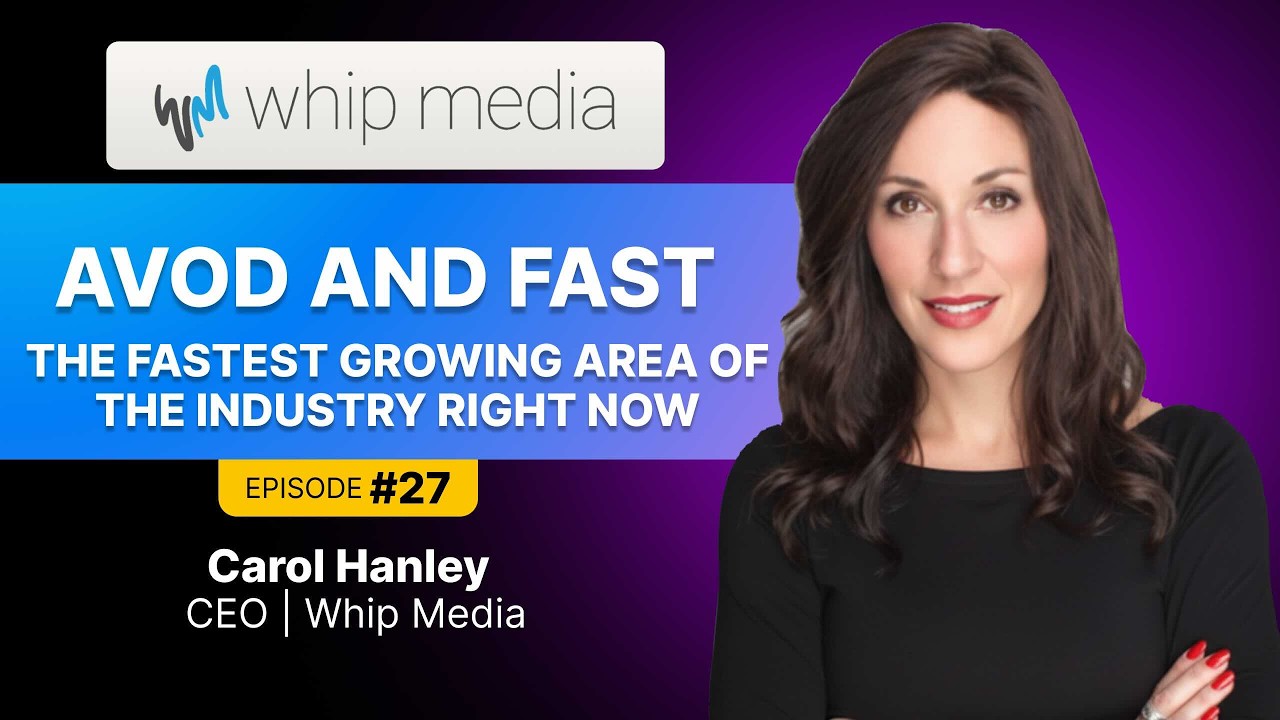
Carol Hanley (CEO, Whip Media) discusses how AVOD, FAST, and streaming analytics are reshaping platform economics—including how royalty tracking and revenue attribution work across SVOD, AVOD, and FAST simultaneously:
Tim Cutting of Gracenote, who leads strategic revenue initiatives across North America, EMEA, LATAM, and APAC, has noted how metadata quality and content IDs have become mission-critical infrastructure for monetizing across FAST environments. Without accurate metadata, your content doesn’t surface in discovery algorithms—and CPM revenue that should be flowing to you flows to someone else instead.
What This Means for Your Content and Production Budgets
The model your content will ultimately live on determines how you should budget it from greenlight. This is a point that doesn’t get nearly enough attention in production finance conversations. AVOD production budgets typically run 20-35% lower than equivalent SVOD commissions—because the revenue ceiling is lower, and the platform’s willingness to absorb production risk is more constrained. You can’t budget a FAST catalog title the way you’d budget an Apple TV+ prestige series. The recoupment math simply doesn’t work.
But here’s the strategic flip side: lower budget ceilings mean lower greenlight thresholds. Content that would never clear the bar for a $6 million per-episode SVOD commission can absolutely work at $1.5 million on an AVOD platform—and with a properly structured multi-platform deal, that content can generate meaningful P&L returns over a 3-5 year catalog lifespan. The economics are different. They’re not worse.
For producers building slates in 2026, the real opportunity is in understanding which content types perform best in which monetization environments. Genre procedurals, reality formats, and international acquired content consistently outperform prestige drama on AVOD metrics—because AVOD audiences are browsing, not committing. True crime, cooking competition, and catalog franchise titles all tend to carry strong CPM profiles. Prestige drama drives subscription sign-ups, but it doesn’t fill ad-supported libraries efficiently.
Our breakdown of how ad-supported streaming affects production budgets goes deeper into the specific budget ranges by genre and platform tier. But the strategic principle is straightforward: Accelerate your content library’s monetization potential by matching budget structure to distribution destination from the first day of development—not as an afterthought once you’ve shot a pilot.
SVOD vs AVOD vs FAST: 2026 Model Comparison
The Capital Stack Logic: Why Smart Operators Run All Three Models
The most important strategic shift in streaming finance in 2026 isn’t the growth of any individual model. It’s the emergence of the hybrid SVOD/AVOD/TVOD capital stack as the default operating model for serious content businesses. Single-model operations are leaving ARPU on the table at every audience segment—and leaving recoupment velocity on the floor.
Here’s how the capital stack logic works in practice. SVOD provides your baseline recurring revenue—predictable, high-LTV, but subscriber acquisition costs are rising and churn management is a real operational overhead. AVOD captures your price-sensitive audience segments—increasingly competitive with SVOD ARPU on a per-user basis when CPMs are properly optimized, which means negotiating hard on exclusivity windows, territory segmentation, and data-sharing rights. And TVOD handles your event content—new theatrical releases, live sports, premium tentpoles—delivering single-transaction revenue with no subscriber commitment and no ongoing churn risk.
But there’s a fourth dimension that most content owners miss: the data layer. The platforms extracting the most value from AVOD aren’t just taking the headline CPM rate. They’re negotiating first-party audience data as part of the deal—viewership attribution at the content level, demographic breakdowns by territory, completion rate analytics that tell you which genres are actually being consumed versus catalogued and forgotten. That data feeds back into your next commissioning decision. It’s the difference between gut instinct and Smart Pairing—matching content to audience in a way that’s defensible to your cap table.
As part of our streaming content acquisition strategies analysis, the operators consistently outperforming on ARPU are the ones treating multi-model distribution as a structured financial instrument—not a scattershot of platform deals. They’re using real-time supply chain intelligence to identify which platforms have open acquisition windows, what their current commissioning priorities are, and whether their content can genuinely compete for the top of a buyer’s list.
Ask VIQI: Which AVOD Platforms Have Open Windows for Your Content Type?
VIQI is trained on 1.6 million titles, 360,000 companies, and 5 million entertainment professionals. A LA producer used Vitrina to connect with Netflix UK, Fifth Season, and Fox Entertainment within 48 hours.
✓ Included with 200 free credits | ✓ No credit card needed
Which Streaming Model Fits Your Content Strategy in 2026?
The answer isn’t AVOD or SVOD. That framing is already obsolete. The real question for every M&E executive in 2026 is: which combination of models, sequenced in which order, across which territories, maximizes your content’s lifetime value? And the answer is different for every project.
But here’s a working framework. If your content is premium, prestige drama with a defined auteur identity and built-in cultural heat—you’re still playing the SVOD game first. You want that MG. You want the territory splits structured to give you secondary window flexibility. The AVOD layer comes later, after your subscription window has extracted maximum brand premium from the title.
If your content is high-volume genre—true crime series, cooking competition, travel format, sports documentary—your AVOD ROI calculation looks genuinely competitive with premium SVOD from the start. You’re not compromising. You’re being strategic about where your content’s strengths align with platform economics. 73% of all TV viewing now occurs on ad-supported platforms, according to Nielsen’s Ad-Supported Gauge from Q1 2025. The audience is already there.
And if your content is back catalog—library titles, completed feature films, legacy IP—FAST is probably your most efficient monetization path right now. No subscriber acquisition cost. CPM revenue from day one. Global distribution through platforms like Tubi and Pluto TV that are actively expanding their catalog footprint. The Roku Channel alone reached households containing nearly 145 million people by end of 2024, with streaming hours up 84% year-over-year through May 2025. That’s a real audience. The question is whether your content is positioned to capture it.
The Weaponized Distribution model that forward-thinking studios are adopting—licensing owned IP across competing platforms to maximize recoupment velocity—starts from exactly this framework. Content ownership beats platform exclusivity when you have the intelligence to identify which platform is the highest-value partner for each specific window. That intelligence used to require a Rolodex and six weeks of phone calls. In 2026, it requires 48 hours and the right data infrastructure.
Frequently Asked Questions
Is ad-supported streaming more profitable than subscription streaming in 2026?
Premium AVOD revenue grew 39% in 2024 to reach $14.3 billion, while subscription growth has plateaued. On a per-user basis, SVOD still leads in ARPU for premium tiers—but AVOD is closing the gap rapidly as CPM rates improve. Hulu’s AVOD service has historically generated more revenue per subscriber than its premium ad-free tier. The answer depends on your specific platform, content type, and CPM optimization—but AVOD is increasingly competitive as a primary revenue model, not just a fallback.
What percentage of streaming viewers use ad-supported platforms in 2026?
According to eMarketer’s 2025 projections, over 50% of the U.S. population will be streaming ad-supported content in 2026. Nielsen’s Ad-Supported Gauge from Q1 2025 shows 73% of all TV viewing already occurs on ad-supported platforms. Globally, AVOD user penetration reached 52.8% in 2025 and is projected to climb to approximately 61% by 2029. That’s no longer an emerging audience—it’s the dominant viewing behavior.
How many monthly active users does Netflix’s ad-supported tier have?
As of late 2024, Netflix’s ad-supported plan exceeded 94 million global monthly active users—a remarkable scale for a tier that didn’t exist before November 2022. Netflix generated $1.6 billion in ad revenue in its first full year, with growth of 116% over 2023. Variety reported that the ad-supported membership grew 34% quarter-over-quarter in late 2024, outpacing subscription tier growth across all tracked markets.
What is the difference between AVOD, SVOD, FAST, and TVOD?
SVOD (subscription video-on-demand) charges a recurring fee for access—Netflix, Disney+, Max. AVOD (advertising video-on-demand) delivers free or low-cost access funded by ads—Tubi, Peacock Free, ad-supported Netflix. FAST (free ad-supported streaming TV) mimics a linear channel grid inside OTT apps—Pluto TV, The Roku Channel. TVOD (transactional) operates pay-per-title—Apple iTunes, Amazon digital rentals. In 2026, most major platforms run multiple models simultaneously, with the ad-supported layer growing fastest across all categories.
How large is the global AVOD market in 2026?
The global AVOD market was valued at $54.14 billion in 2025 according to SNS Insider research, with the U.S. market valued at $18.52 billion. By 2033, the global AVOD market is projected to reach $218.31 billion—a CAGR exceeding 19%. For comparison, the worldwide VoD market total was $182.4 billion in 2025, with SVoD still generating more than $120 billion. But AVOD’s growth rate is running at nearly four times that of subscription revenue in major markets.
Should new productions target AVOD or SVOD platforms?
It depends entirely on genre, budget, and distribution strategy. Prestige drama with cultural heat should still target SVOD first—the MG and brand positioning justify it. High-volume genre content—true crime, reality, documentary, format—is increasingly well-suited to AVOD commissions from greenlight, with production budgets structured accordingly (typically 20-35% lower per episode). Back catalog and completed titles should prioritize FAST channels for immediate CPM revenue. The most effective slate strategies in 2026 are building content specifically for hybrid windowing across all three models.
How fast are FAST channels growing globally?
Globally, FAST channel count reached approximately 1,850 active channels by mid-2025—up 76% since 2023, according to Ampere Analysis, which noted that free ad-supported streaming platforms recorded the fastest catalog growth globally in 2025. Brazil saw FAST viewership increase roughly 4.5 times since 2020. The Roku Channel alone reached households containing nearly 145 million people by end of 2024. FAST is no longer a niche—it’s become a primary distribution category for international catalog content.
What are the biggest challenges with ad-supported streaming revenue?
Three core challenges dominate. First, CPM variability—ad revenue fluctuates with advertiser demand cycles and platform fill rates in ways that subscription revenue doesn’t, complicating recoupment modeling. Second, content curation—200 focused, brand-safe hours in the right genre consistently outperforms 2,000 mixed hours on CPM performance. Volume without curation destroys your average CPM. Third, data access—revenue-share deals that don’t include viewership attribution data leave content owners unable to optimize their AVOD economics. Negotiating data rights alongside revenue share has become as important as the headline percentage.
Conclusion: The Streaming Model Wars Are Over—Hybrid Won
The ad-supported streaming vs subscription streaming debate ended before most people noticed. The industry’s top operators—Netflix, Disney+, Peacock, Amazon—aren’t choosing between models anymore. They’re running all of them simultaneously and using each revenue stream to de-risk the others. Your content strategy in 2026 should do the same.
Key Takeaways:
- AVOD is the growth engine: Premium AVOD revenue grew 39% in 2024 to $14.3 billion—and 71% of all net new streaming subscribers over the past nine quarters came from ad-supported plans.
- SVOD still dominates in dollar volume: SVoD generates $120B+ of the $182.4B global VoD market, with Netflix’s $25B annual revenue proving subscription premium is alive—just not growing at AVOD’s pace.
- FAST is the back-catalog opportunity: With 1,850+ active channels globally (up 76% since 2023), FAST has become the default monetization path for library titles—generating CPM revenue from day one with no subscriber acquisition cost.
- Budget to your destination: AVOD production budgets typically run 20-35% lower than equivalent SVOD commissions—but matching budget structure to distribution destination from greenlight is the difference between profitable and marginal returns.
- Data rights are the hidden negotiation: Content owners negotiating viewership attribution data alongside revenue share consistently extract more long-term value from AVOD deals than those who accept standard revenue-share terms without data access provisions.
The executives who De-risk their slates in 2026 are the ones who Weaponize distribution intelligence—knowing which platform has an open window, what CPM their content will generate in each model, and how to structure the capital stack to maximize recoupment velocity across all three. That intelligence used to require six weeks and a well-connected sales agent. Now it takes 48 hours and the right tools.
Track Every Platform’s Acquisition Strategy—AVOD, SVOD, and FAST
Trusted by Netflix, Warner Bros, Paramount, and Google TV. Track 400,000+ projects. Access 3 million verified executives. Ask VIQI strategic questions about your market.
✓ 200 free credits | ✓ No credit card required | ✓ Cancel anytime
Need direct introductions to platform acquisition teams? Explore Concierge Service →
Find Film+TV Projects, Partners, and Deals – Fast.
VIQI matches you with the right financiers, producers, streamers, and buyers – globally.
Producers Seeking Financing, Co-Pros, or Pre-Buys?
Vitrina Concierge helps producers reach the right financiers, commissioners, distributors, and co-production partners — with precision outreach, not cold pitching.
Join Industry Briefings Trusted by Leaders
Format Adaptations: Global Trends
Where formats are traveling, which adaptations are breaking out, and how streamers are backing remakes in 2025–2026.

Books, Novels & Comics Adaptations: Global Trends
Books, webtoons, and manga driving the next global screen hits. Discover how in this webinar.

Micro-Dramas & Mobile-First Storytelling
Micro-dramas are building real audiences and revenue. Understand the platforms, buyers, and economics behind the growth.

Navigating Global Content Licensing Trends
How global content licensing is shifting beyond flat fees to flexible, deal-driven models.