About Innovation Hub
 Global Content Pulse (Webinars)


 Global Production Financing
(Webinars)
Global Production Financing
(Webinars)  LeaderSpeak Podcast
  Global Entertainment Digest (Newsletter)
  About Vitrina
 About VIQI
 Our Story
 Our Solutions 🔥
 Film+TV Projects Tracker 🚀
 Case Studies
 Our Profile
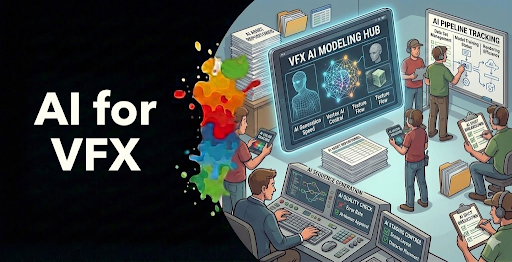
Artificial intelligence has fundamentally graduated from a buzzword into core structural infrastructure across the global visual effects pipeline. In an era where studio budgets face intense compression and margin leakage threatens traditional vendor models, mastering AI-driven tools is no longer a futuristic experiment—it’s an operational mandate to stay competitive.
Let’s be completely honest about the state of post-production. The legacy visual effects pipeline is breaking under its own weight. For years, the industry tolerated a painful reality: thousands of manual artist hours spent on rotoscoping, tedious tracking markers, and brute-force rendering that bled cash from production budgets. It was slow, expensive, and rigid. But the real problem isn’t the creative talent—it is the structural inefficiency of the legacy stack.
Today, the integration of AI for VFX workflows is quietly dismantling those old operational bottlenecks. Machine learning algorithms aren’t replacing the artistry; they are weaponizing it by stripping away the heavy mechanical friction. From predictive rotoscoping and deep-learning-based de-aging to smart plate clean-up, AI models are compressing tasks that once took weeks into single-digit hours. If you’re a service provider or an independent studio, this shift fundamentally changes how you protect your operating margins.
But here’s the catch. As AI tools lower the technical barrier to entry, the global vendor landscape is fracturing. Hundreds of specialized boutique shops are popping up overnight, claim-checking advanced AI capabilities. For buyers and producers, separating actual algorithmic infrastructure from hollow marketing copy has become a high-stakes challenge. To protect your capital stack, you need hard metrics, clear pipeline visibility, and verified vendor track records.
Table of Contents
- Pipeline Transformation: Overcoming Legacy Friction Point Leakage
- Resolving the Fragmentation Paradox in Global Tech Vendor Matchmaking
- VFX Innovation Profiles: Active Studios and Technical Providers
- Industry Implications: Three Structural Conclusions for M&E Operations
- How Vitrina AI Helps with AI for VFX Sourcing
- Conclusion
- Frequently Asked Questions (FAQ)
Pipeline Transformation: Overcoming Legacy Friction Point Leakage
Behind closed doors, studio heads aren’t asking if neural networks are creative—they’re calculating how machine learning can compress the post-production schedule by weeks. When a massive episodic pipeline gets bogged down in frame-by-frame cleaning chores, your capital efficiency plummets. The integration of artificial intelligence across the visual effects ecosystem addresses exactly this vulnerability by automating heavy rote mechanics.
Consider the process of rotoscoping and plate preparation. Historically, pixel-level isolation required armies of junior artists manually drawing splines across thousands of sequential frames. It was an operational bottleneck that frequently leaked 15-20% of a line item’s margin to simple schedule overruns. By deploying deep-learning segmentation models, contemporary facilities are executing baseline matte generation at 80% less time, freeing creative directors to focus strictly on complex composite adjustments and aesthetic edge detailing.
This structural acceleration trickles straight down through your capital stack. When you compress the delivery window of complex sequences, you eliminate carrying costs and reduce the risk of missed delivery dates with major streaming buyers. For operators handling high-volume slates, adopting machine learning frameworks is no longer about chasing a technological edge—it is a direct strategy for protecting your operational margins against legacy infrastructure bloat.
Resolving the Fragmentation Paradox in Global Tech Vendor Matchmaking
The visual effects ecosystem is experiencing what insiders recognize as a classic fragmentation paradox. On one hand, cloud architecture and open-source models have enabled elite technical capabilities to emerge in non-traditional sovereign hubs across regions like LATAM, APAC, and Eastern Europe. On the other hand, this rapid decentralization creates massive information asymmetry. There are over 600,000 suppliers operating in opaque silos globally, making manual capability verification nearly impossible.
When a production team manually filters through vendor options using basic trade directories or relationship networks, they run into a major data deficit. A studio name on a spreadsheet doesn’t tell you their current compute capacity, their familiarity with studio security specifications, or whether their machine learning algorithms are trained on authorized IP. This lack of transparency leads to safe, expensive, and often suboptimal partner choices that drag down project-level economics.
Vitrina AI resolves this friction by mapping the global supply chain in real time. By linking deep operational track records, actual tool deployment histories, and active project timelines, the platform replaces anecdotal guessing with precision matchmaking. This strategy ensures that when you source an advanced technological partner, you’re aligning your budget with verified infrastructural capability, entirely bypassing the legacy markup fees of traditional middleman networks.
VFX Innovation Profiles: Active Studios and Technical Providers
To navigate this evolving market, you must understand the operational footprint of active organizations scaling technological workflows globally. Below are profiles of key entities redefining execution standards:
01. Platige Image
Advanced 3D environment modeling and real-time algorithmic compositing infrastructure.
Operating out of Warsaw, Poland, this powerhouse studio has established deep technical integration on major international streaming assets. By weaving machine learning layers directly into their asset generation frameworks, they drastically cut the traditional turnaround curves required for high-concept sci-fi and fantasy worldbuilding, establishing a benchmark for European technical execution.
- Core Geographies: Europe, North America
- Pipeline Specialization: AI-augmented environments, cinematic episodic animation
- Verified Track Record: Delivered premium complex sequences for global streaming platforms
- Infrastructural Advantage: Real-time rendering tools paired with custom deep-learning pipelines
02. Magic Lab
Automated temporal plate clean-up and deep-learning episodic visual tracking systems.
Based in Prague, Czech Republic, this specialized facility focuses heavily on resolving post-production bottlenecks through custom algorithmic models. Their primary pipeline advantage lies in automating complex rotoscoping, wire-removal, and facial-tracking tasks on highly dynamic plates, minimizing the need for manual, frame-by-frame artist interventions.
- Core Geographies: Central and Eastern Europe
- Pipeline Specialization: Automated tracking, rapid sequence plate preparation
- Verified Track Record: Multi-season episodic post-production delivery schedules
- Infrastructural Advantage: Proprietary neural models designed for artifact elimination
03. Digic Pictures
High-fidelity synthetic asset engineering and neural character performance capture.
Based in Budapest, Hungary, this studio is globally recognized for its hyper-realistic 3D animation and virtual production workflows. By deploying custom machine learning tools to optimize facial mechanics, crowd behavior simulation, and lighting calculations, they compress heavy asset-generation phases that traditionally cause extended budget overruns.
- Core Geographies: Global supply chain integration
- Pipeline Specialization: Synthetic human generation, physics-based neural simulations
- Verified Track Record: Leading gaming cinematics and premium feature elements
- Infrastructural Advantage: Advanced cyber-scanning tech paired with automated pipeline layers
Industry Implications: Three Structural Conclusions for M&E Operations
The evolution of automated post-production tech isn’t just changing how frames look—it is completely reshaping the commercial dynamics of the service business. Here are three major structural shifts unfolding across global markets:
1. The End of Arbitrary Labor-Hour Vendor Pricing
Historically, post-production vendors scaled their pricing based on headcount and desk hours. Machine learning breaks this dynamic. When a specialized studio utilizing custom training models can execute complex plate preparations at 80% fewer artist hours, standard linear bidding models fall apart. Creative buyers will increasingly demand value-based and outcome-driven pricing structures, forcing vendors to either adapt their tech stack or watch their operating margins completely vanish.
2. The Critical Mandate for Authorized AI Pipelines
As studios face stricter copyright scrutiny, completion bond companies and legal teams are imposing rigid compliance rules on post-production software. Utilizing open-source models trained on unauthorized databases creates a massive liability risk that can block wide international distribution deals. The industry is rapidly shifting toward verified frameworks where every dataset, texture pack, and synthetic actor is completely transparent and insurable. If a studio can’t verify its data lineage, it risks getting locked out of top-tier streaming contracts.
3. Capital Redirection into Upfront Virtual Prototyping
With machine learning tools shortening the backend post-production cycle, smart operators are shifting their capital layout forward into development and pre-production. By leveraging real-time visualization and synthetic asset engineering before principal photography starts, producers can de-risk their physical production days. This upfront optimization ensures that when physical shooting begins, asset requirements are tightly scoped, eliminating the frantic “fix it in post” mentality that routinely decimates independent film budgets.
How Vitrina AI Helps with AI for VFX Sourcing
Finding the sweet spot between technical capability and cost efficiency requires deep supply-chain data. Vitrina AI strips away the guesswork by mapping the global post-production ecosystem into a clean, searchable network. Whether you are tracking elite shops utilizing custom neural networks or structuring cross-border co-productions that utilize regional incentives, the platform matches you based on actual track records, not marketing pitches.
- Data-Driven Discovery: Filter through 140,000+ mapped entities based on specific technical services, budget ranges, and location.
- Automated Research: Leverage VIQI to answer critical workflow questions, identify active commissioners, and pinpoint regional content gaps.
- Precision Outreach: Use Vitrina’s Concierge service to handoff your brief to an executive team that connects you directly to matched decision-makers.
Conclusion
The modernization of the post-production pipeline through AI for VFX applications is no longer an optional luxury—it’s a critical commercial necessity. When manual labor-hour overhead can be systematically cut by over 80%, traditional cost structures become obsolete. The producers, studios, and technical vendors who master these machine learning frameworks are protecting their capital stacks, while those sticking to legacy workflows continue to bleed operating margin.
Ultimately, navigating a decentralized and rapidly evolving supply chain requires moving past relationship-dependent sourcing. Relying on outdated directories or anecdotal networking leaves independent creators exposed to massive schedule delays and suboptimal partner deals. Transitioning to real-time supply chain intelligence is the definitive route to secure your delivery windows, de-risk your technology choices, and maximize your project returns.
Frequently Asked Questions (FAQ)
How does AI for VFX save money in independent film budgeting?
AI-driven tools save money by completely cutting down on labor-intensive post-production tasks. Automated tracking and rotoscoping models slash baseline plate prep timelines by 80%. This speed directly reduces artist hour outlays, prevents schedule overruns, and keeps your project’s overhead tightly controlled.
What is the difference between open-source AI and an authorized AI framework?
An authorized framework ensures that all training datasets are legally cleared and clear of copyright risks. Open-source models often rely on scraped internet data, creating massive legal liabilities that can cause completion bond companies to pull coverage and stall major studio licensing deals.
Can small boutique VFX shops compete with legacy facilities using AI?
Yes. Machine learning models democratize high-end post-production workflows by removing the need for massive rendering infrastructure. A nimble, tech-forward boutique shop using optimized algorithms can match the output speed of massive traditional facilities, offering highly competitive project terms.
How long does it take to integrate machine learning tools into a post-production pipeline?
Standard software integration takes roughly 2 to 4 weeks for off-the-shelf tools, while developing proprietary, custom-trained neural setups requires 3 to 6 months of asset collection. Planning this timeline early is essential to protect your project’s delivery calendar.