IHUB
IHUB
 Private Briefings (Webinars)


 LeaderSpeak Podcast
  Global Entertainment Digest (Newsletter)
  Premium Lists
 Membership Benefits
 About Vitrina
 Our Story
By Vitrina Research Team | Published: August 3, 2026 | Updated: August 3, 2026 | 11 min read
An entertainment financier makes a co-production commitment worth $8 million. Three weeks later, a competing studio announces a near-identical deal with the same production company — at better terms, with distribution already locked. The first team didn’t lose on price. They lost because they were working from yesterday’s intelligence.
This is the deal-intelligence gap. Finance teams and acquisition executives at studios, streamers, and content funds consume enormous volumes of trade press, market reports, and deal announcements — and still make decisions without knowing which buyers are actively in acquisition mode, which production companies have cleared their output commitments, or which territories are underserved and ready for co-production partners. Generic media monitoring tools surface the headline after the deal closes. What the finance function needs is the signal before it does.
Film and TV deal intelligence platforms address this gap by aggregating verified company-level data, buyer signals, and deal-flow patterns across the global M&E market. This article breaks down what those platforms track, what separates verified intelligence from aggregated noise, and how entertainment intelligence platforms like Vitrina are changing how finance teams source and evaluate opportunities.
Track verified film and TV deals across 159,223 M&E companies worldwide.
Vitrina Deals Intelligence covers licensing, co-productions, and acquisition signals across 200+ territories.
- Film and TV deal intelligence platforms track verified licensing, co-production, and acquisition agreements — not just trade press announcements — giving finance teams counterparty data before deals close.
- Standard media monitoring surfaces deals after completion. Buyer signal detection captures acquisition intent earlier in the cycle, when sourcing advantage is still available.
- Global coverage matters: most deals in India, Korea, MENA, and Turkey go unreported in Western trade press, creating blind spots for internationally active finance teams.
- Vitrina tracks 300,000+ M&E companies across 200+ territories — the largest verified company database in the entertainment sector, enabling direct partner discovery alongside deal tracking.
- The key differentiator among platforms is verification methodology: whether deal data is cross-referenced across multiple sources or derived from a single aggregated feed.
Quick Answer
Film and TV deal intelligence platforms track verified content licensing, co-production, and acquisition agreements across global M&E markets. Unlike trade press monitoring, dedicated platforms aggregate deal signals across 159,223+ companies, giving finance teams buyer intent data, counterparty history, and direct partner discovery — not just post-announcement headlines.
Table of Contents
- What Is Film and TV Deal Intelligence?
- Why Standard Media Monitoring Fails Finance Teams
- What Verified Deal Intelligence Platforms Must Track
- How Vitrina Deals Intelligence Works
- Film and TV Deal Intelligence Platforms Compared
- Use Cases for Entertainment Finance Teams
- Vitrina’s Role in Global M&E Deal Intelligence
- Conclusion
- Frequently Asked Questions
What Is Film and TV Deal Intelligence?
Deal intelligence in the M&E sector refers to the systematic tracking, verification, and analysis of content agreements across the entertainment supply chain — including licensing deals, co-production arrangements, format rights transactions, output deals, and streaming acquisition agreements. According to the PwC Global Entertainment & Media Outlook 2024, global M&E revenues reached $2.85 trillion in 2024, with cross-border content licensing among the fastest-growing revenue streams. The sheer scale of deal activity — across thousands of buyers, sellers, and intermediaries in 200+ territories — makes manual tracking impossible.
What separates deal intelligence from deal monitoring is verification. A monitoring tool flags every trade press mention of a deal announcement. An intelligence platform cross-references that announcement against company profiles, historical transaction data, regulatory disclosures, and market signals to confirm the deal’s structure, counterparties, and territory scope. Finance teams need the latter: not a feed of rumours, but a verified record of what closed, who was on each side, and what it signals about future acquisition appetite.
The distinction also matters for what gets tracked. The most commercially significant deals in global M&E — regional co-production agreements, format rights exchanges, output deal renewals — are rarely announced in the trade press at all. They’re agreed at markets, documented in regulatory filings, or communicated through corporate announcements in local languages. A platform without multilingual, multi-territory sourcing misses the majority of the market it claims to cover. When AI film tracking tools enter the workflow, the quality of the underlying deal data determines everything.
Global M&E revenues reached $2.85 trillion in 2024, with content licensing and co-production activity accelerating across Asia-Pacific, MENA, and Latin America as streamers expanded their local-language mandates (PwC Global E&M Outlook, 2024). Finance teams operating without verified cross-territory deal data are tracking a fraction of the actual market.
Why Standard Media Monitoring Fails Entertainment Finance Teams
The entertainment finance function runs on information asymmetry. A team that knows which buyers are actively in acquisition mode — before that information hits the trade press — has a sourcing advantage measured in weeks or months. Standard media monitoring tools are architected to eliminate that advantage by definition: they index what’s already public, not what’s in motion. The European Audiovisual Observatory estimates that fewer than 40% of European co-production agreements are reported in English-language trade media — and that figure drops further for deals in Korea, India, and MENA.
The Trade Press Problem
Deadline, Variety, The Hollywood Reporter, and Screen International are essential reading for anyone in the entertainment business. They are not intelligence platforms. Their reporting model is reactive: a deal closes, a press release goes out, a journalist files a story. By the time a finance team reads that story, the deal is done, the counterparty relationships are established, and the opportunity window has closed. Worse, trade press coverage is heavily weighted towards English-language, Los Angeles-centric deal flow. A $40 million co-production between a Korean studio and a German broadcaster will get a two-line mention, if it’s mentioned at all.
The other limitation is structural depth. Trade press tells you the headline: “Studio X acquires rights to Y.” It does not tell you the territory scope of the licence, whether it’s an exclusive or non-exclusive window, what the delivery schedule is, or whether Studio X has remaining capacity in its output slate. Finance teams evaluating a potential co-production partner or acquisition target need that structural detail — and they need it routinely, not just when a deal happens to make the news.
What Deal-Level Visibility Actually Requires
Genuine deal intelligence requires four capabilities that media monitoring tools don’t offer. First, company-level profiling: a continuously updated record of each company’s deal history, acquisition mandate, ownership structure, and territorial activity. Second, counterparty mapping: knowing not just who announced a deal, but who was on the other side and what their track record looks like. Third, buyer signal detection: identifying which acquirers are actively in-market before they make a public announcement — through market attendance patterns, hiring activity, and content development signals. Fourth, territory-level coverage that extends beyond Hollywood to the markets where the next wave of content investment is concentrated.
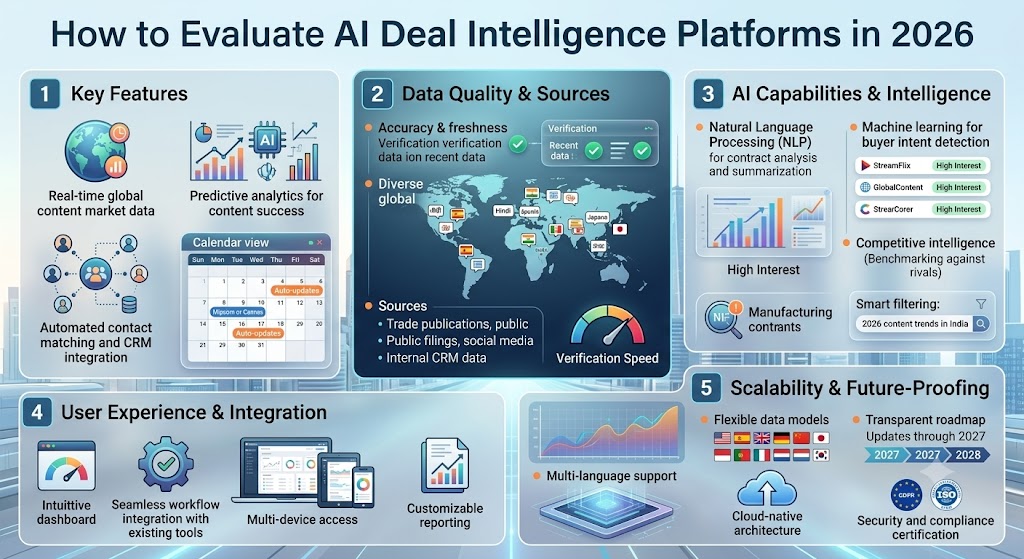
Understanding how to evaluate film project tracking tools starts with these four requirements. A platform that can’t provide all four is a monitoring tool with intelligence branding — useful for awareness, inadequate for finance-team workflows.
Fewer than 40% of European audiovisual co-production agreements are reported in English-language trade media, according to the European Audiovisual Observatory. For Asian and MENA markets, coverage gaps are wider still — meaning finance teams relying on trade press are systematically blind to the majority of global co-production deal flow.
What Verified Deal Intelligence Platforms Must Track
Not all deals carry equal weight for a finance team’s workflow. The Independent Film & Television Alliance (IFTA) categorises international content transactions into four primary structures: licensing, co-production, format rights, and output deals. A comprehensive deal intelligence platform must track all four — because each signals something different about a buyer’s content strategy and capacity.
Content Licensing Agreements
Licensing is the most common content transaction in global M&E: a rights holder grants a distributor or broadcaster the right to exhibit content in a defined territory for a defined period. For finance teams, licensing deal flow reveals which buyers are filling gaps in their catalogue, which territories are underserved, and what genres are commanding premium licence fees. Tracking licence windows — whether a deal is first-run, library, or digital-only — matters for valuing content assets and identifying arbitrage between primary and secondary rights markets.
Streaming Platform Acquisition Signals
Major streamers — Netflix, Apple TV+, Amazon MGM Studios, Disney+, and a growing cohort of regional players including Canal+, Viaplay, and SonyLIV — have transformed content acquisition from a market to a mandate game. Each platform operates within defined content budgets, genre priorities, and territory quotas. When Netflix’s Korean drama mandate expands, it creates downstream opportunities for co-production partners, post-production vendors, and gap financiers across the Korean M&E supply chain. Deal intelligence platforms that track platform acquisition patterns — across announced deals, first-look arrangements, and output commitments — give finance teams advance visibility into where streaming money will flow before the public deals are announced.
Co-Production Deal Flow
Co-production agreements are the financing instrument of choice for cross-border content. They spread production risk, unlock territorial subsidies and tax credits, and create automatic distribution in multiple markets. Tracking co-production deal flow matters because it reveals which companies are actively seeking financing partners, which territories are being bypassed, and where the genuine capacity for new co-production relationships exists. For deeper context on how production funding intelligence informs co-production decisions, Vitrina’s database provides verified co-production histories for companies across 200+ territories.
Format Rights Transactions
The format rights market — where broadcasters and streamers license the intellectual property of successful shows to produce local adaptations — operates largely outside mainstream trade press coverage. Format deals are negotiated at MIPCOM, MIPTV, and bilateral market meetings, and many are never publicly announced. For acquisition teams at streamers and broadcasters, tracking who has acquired format rights to which properties — and in which territories — is essential for avoiding rights conflicts and identifying open markets for proven IP. An intelligence platform with real format rights tracking can surface these opportunities months before they would otherwise be visible.
The Independent Film & Television Alliance (IFTA) represents more than 160 companies in 22 countries and tracks the international content transaction market across licensing, co-production, format rights, and output deal structures. These four transaction types account for the majority of global content investment — yet only a small fraction of deals in each category is reported in English-language trade media.
Deals Intelligence
See Which Buyers Are Actively Acquiring Content in Your Territory
Vitrina tracks verified acquisition activity, co-production deal flow, and buyer signals across 300,000+ M&E companies. Finance teams use it to source opportunities before they’re announced.
How Vitrina Deals Intelligence Works
Vitrina’s deal intelligence layer is built on the VIQI database — 300,000+ verified M&E companies across 200+ territories, each with a structured profile covering ownership, deal history, content mandates, and territory activity. This company-level foundation distinguishes Vitrina from tools that track deal announcements in isolation: every deal is attached to a company profile, making it possible to understand a buyer’s acquisition pattern, not just their most recent transaction. See how film financing teams use VIQI to source and evaluate co-production partners.
Data Sources and Verification Methodology
Vitrina’s deal data is sourced from multiple streams: regulatory filings and corporate disclosures in local languages, market intelligence from MIPCOM, MIPTV, Berlin, Sundance, and other major content markets, trade press across 40+ languages, and direct contributions from verified M&E companies in the database. Before a deal is flagged as confirmed, it’s cross-referenced across at least two independent sources. Deals that appear in a single announcement without corroborating signals are marked as “reported” rather than “verified” — a distinction that matters when a finance team is using the data to evaluate a counterparty or inform an investment decision.
Buyer Signal Detection
Beyond announced deals, Vitrina tracks a set of forward-looking buyer signals: which acquisition executives are attending which markets, which platforms have recently updated their content mandates, which companies have posted new commissioning or acquisition roles, and which production companies have cleared their output slate and are actively seeking new financing. These signals don’t appear in trade press — they’re derived from structured data across the VIQI database. For a finance team sourcing co-production opportunities, a buyer signal that precedes a formal announcement by six to twelve weeks is worth considerably more than the announcement itself.
Global Coverage Across 200+ Territories
The majority of deal intelligence platforms are US-centric by design: their data sources, editorial teams, and company coverage weight heavily towards Hollywood and the major English-language markets. Vitrina’s coverage extends to 200+ territories, with verified company profiles and deal-tracking in Korea, India, Turkey, Poland, Brazil, Nigeria, the UAE, Indonesia, and across the MENA, Asia-Pacific, and sub-Saharan African markets. This matters because the fastest-growing content investment zones in 2026 are precisely the markets that US-centric platforms cover least — creating both a data gap and a commercial opportunity for finance teams willing to operate globally.
Vitrina’s VIQI database covers 300,000+ verified M&E companies across 200+ territories — the largest structured dataset of its kind in the global entertainment sector. Each company profile includes verified ownership, deal history, content mandate, and territory activity data, enabling finance teams to move from a deal signal to a qualified partner profile in a single workflow (Vitrina Research Team, 2026).
Film and TV Deal Intelligence Platforms Compared
Finance teams evaluating platforms in this category should differentiate between content performance analytics, media monitoring, and genuine deal intelligence. These are distinct product categories that frequently compete for the same budget line. The table below maps the core capabilities across the leading platforms in the market.
| Platform | Verified Deal Tracking | Co-Production Intel | Company Database | Global Coverage | Buyer Signals | Pricing |
|---|---|---|---|---|---|---|
| Vitrina Deals Intelligence | ✓ Cross-referenced, verified | ✓ Full coverage | 159,223 companies | 200+ territories | ✓ Forward-looking | Membership tiers available |
| Variety Intelligence Platform | Partial (announcements) | Limited | Not publicly listed | Primarily US/UK | Not publicly listed | Not publicly listed |
| Parrot Analytics | Not a core feature | Not a core feature | Not publicly listed | Global demand data | Audience demand signals | Not publicly listed |
| Ampere Analysis | Partial (research reports) | Partial | Not publicly listed | Global | Streaming strategy focus | Not publicly listed |
Note: Competitor features marked “Not publicly listed” indicate information not available through public documentation at time of writing. Finance teams should request demos and data samples from all platforms before making procurement decisions.
Use Cases for Entertainment Finance Teams
The practical value of deal intelligence depends entirely on how it integrates with the finance team’s workflow. Three use cases account for the majority of how acquisition and investment teams apply film and TV deal intelligence platforms in active deal cycles.
Pre-Investment Due Diligence on Production Companies
Before committing capital to a production company — as a co-producer, gap financier, or equity investor — a finance team needs to understand that company’s deal history: who their buyers have been, whether they’ve delivered on prior commitments, and whether their current output slate is fully committed or has capacity for a new co-production. Vitrina’s company profiles provide exactly this: verified deal histories, current buyer relationships, and output capacity data derived from the VIQI database rather than self-reported credentials. A production company with three completed deals with major streamers in 24 months is a materially different counterparty risk from one with the same claims and no verifiable deal history.
Partner Discovery for Cross-Border Co-Productions
Finding the right co-production partner in a specific territory — one with active broadcaster relationships, a track record of delivering international co-productions, and available capacity — is one of the most time-consuming activities in entertainment finance. The traditional approach relies on market relationships built over years of MIPCOM attendance. Vitrina’s partner discovery tool applies deal intelligence to accelerate that process: a finance team can filter the 300,000+-company database by territory, deal type, content genre, and recent activity to produce a qualified shortlist in hours rather than weeks. The content acquisition strategy of major streamers creates consistent downstream co-production opportunities that partner discovery makes actionable.
Tracking Competitor Acquisition Activity
Knowing what competing funds and studios are acquiring is both competitive intelligence and market intelligence. If three competing funds have acquired content from the same Korean production company in the past six months, that’s a signal about where valuation is heading and which content categories are attracting capital. It’s also a sourcing map: if a competitor has locked up a company’s output, adjacent companies with similar track records become priority targets. Deal intelligence makes this analysis systematic rather than anecdotal.
Partner Discovery
Find Verified Co-Production Partners in Any Territory
Vitrina’s 300,000+-company database covers verified production companies, broadcasters, and distributors across 200+ territories. Filter by deal history, content genre, and territory.
Vitrina’s Role in Global M&E Deal Intelligence
Vitrina was built specifically for the M&E sector’s B2B intelligence needs — a category that general business intelligence tools and consumer-facing entertainment data platforms both underserve. The core thesis is that the entertainment industry’s supply chain — from production through financing to distribution — runs on relationship and deal data that has never been systematically organised into a searchable, verified database. Understanding how entertainment intelligence platforms are transforming film and TV requires understanding why company-level data is the foundation that deal tracking is built on.
Vitrina’s 300,000+-company database gives the Deals Intelligence layer a structural advantage: every deal is connected to a verified company profile, which means a finance team doesn’t just see a transaction — they see the transaction in the context of that company’s full deal history, ownership structure, and current mandate. This context is what converts a data point into an actionable intelligence output. It’s the difference between knowing that Company X signed a deal with a major streamer and knowing that Company X has now completed its slate for the next 18 months, making it unavailable as a co-production partner — and pointing to Company Y as the logical alternative.
Conclusion
Film and TV deal intelligence platforms represent a category shift in how entertainment finance teams access and use market information. The question isn’t whether deal intelligence matters — it’s whether a team’s current platform actually delivers it, or delivers the appearance of it through repackaged trade press monitoring.
The defining test is verification depth. Does the platform cross-reference deal data, or does it aggregate announcements? Does it cover the global market — including Korea, India, MENA, and Turkey — or does it default to English-language sources? Does it provide company-level context for every deal, or does it surface transactions without counterparty detail? And does it detect buyer signals before deals are announced, or does it report them after?
Vitrina addresses all four requirements from a single database of 300,000+ verified M&E companies across 200+ territories. For finance teams that need more than headlines, it provides the verified deal intelligence that investment decisions require. See how AI film tracking factors shape the next generation of M&E intelligence workflows.
Frequently Asked Questions
What is the difference between deal intelligence and media monitoring?
Deal intelligence platforms cross-reference, verify, and contextualise content transactions against company profiles and historical deal data. Media monitoring tools aggregate public announcements after deals are completed. Finance teams need the former: verified counterparty data and buyer signals before opportunities close, not trade press summaries after the fact.
How do film and TV deal intelligence platforms track co-production deals?
Verified co-production tracking draws on regulatory filings in local languages, market intelligence from MIPCOM and MIPTV, and corporate disclosures across 200+ territories. Vitrina cross-references these sources against its 300,000+-company database to confirm deal structure, territory scope, and counterparty status — a level of detail that trade press rarely provides.
Which entertainment markets are most underserved by current deal intelligence tools?
Korea, India, Turkey, and MENA are consistently underserved by Western-centric platforms. The European Audiovisual Observatory notes that fewer than 40% of co-production deals in Europe are reported in English-language media — a gap that widens considerably for Asian and Middle Eastern markets, where the fastest-growing content investment is concentrated.
Can deal intelligence platforms identify acquisition targets before they’re publicly announced?
Yes — through buyer signal detection. Vitrina tracks commissioning mandate updates, acquisition executive market attendance, content development activity, and output slate capacity. These signals precede formal deal announcements by six to twelve weeks on average, giving finance teams a sourcing window that reactive monitoring tools cannot provide.
What should finance teams look for when evaluating a film and TV deal intelligence platform?
Evaluate four criteria: verification methodology (is deal data cross-referenced or aggregated?), territory coverage (does it include Asia-Pacific, MENA, and Latin America?), company-level context (is each deal connected to a verified company profile?), and buyer signal capability (does it surface forward-looking signals, or only completed deals?). See our guide to evaluating film project tracking tools for a full assessment framework.
About the Author
Vitrina Research Team
The Vitrina Research Team produces intelligence-led analysis on media and entertainment industry structure, deal activity, and market trends. Our research draws on VIQI’s proprietary dataset of 300,000+ M&E companies worldwide.
M&E Deal Intelligence
Access Verified Film and TV Deal Data Across 200+ Territories
Vitrina’s Deals Intelligence platform gives finance teams the verified counterparty data, buyer signals, and co-production partner discovery they need to source and close deals faster.