IHUB
IHUB
 Private Briefings (Webinars)


 LeaderSpeak Podcast
  Global Entertainment Digest (Newsletter)
  Premium Lists
 Membership Benefits
 About Vitrina
 Our Story

By Vitrina Research Team | Published: July 25, 2026 | 10 min read
The conversation around AI in film production has always been louder than the reality. For every breathless prediction about machines replacing writers and directors, there has been a corresponding wave of dismissal from people who have seen too many technology cycles come and go. In 2026, neither side is right. AI is not upending the creative industry overnight, and it is not a passing fad, either. What it actually is, is a collection of specific tools doing specific jobs better than they were done before — and that distinction matters enormously for anyone trying to make practical decisions about their slate, their budget, or their team.
The clearest signal is where adoption is actually happening. Studios are not replacing directors with algorithms. They are using AI to read 10,000 scripts a week, flag scheduling conflicts before pre-production begins, and reduce visual effects rendering times by a measurable percentage. These are back-office and workflow gains, not creative replacements. Understanding exactly where the line sits — and where it is likely to move in the next 24 months — is the real competitive edge for producers and executives right now.
This article maps the current state of AI film production in 2026: what is deployed, what remains experimental, and what the data actually shows. It is written for working professionals — producers, development executives, distributors, and financiers — who need a clear-eyed picture rather than a marketing brochure.
Key Takeaways
- AI is actively deployed in script coverage, scheduling, VFX, and content acquisition — not as a replacement for creative talent, but as a workflow accelerator.
- Goldman Sachs estimates AI could automate 26% of tasks in media and entertainment by 2030 — the shift is real but gradual.
- Post-production (VFX, sound design, editing) is seeing the highest immediate ROI from AI tools, with some studios reporting 30-40% reductions in VFX rendering time.
- Independent producers who treat AI as a budget tool — not a creative shortcut — are gaining real advantages in scheduling precision and market research.
- Human judgment remains irreplaceable in greenlight decisions, performance direction, and the creative risk-taking that defines commercially and culturally significant films.
Quick Answer
In 2026, AI is actively influencing film production through script analysis, scheduling, VFX rendering, and audience targeting tools. Goldman Sachs projects 26% of media tasks could be automated by 2030. AI saves time and reduces costs in specific workflows, but creative direction, casting instinct, and greenlight judgment remain distinctly human decisions.
Where AI Is Actually Being Used in Film Production Today
Adoption of AI in entertainment is concentrated in the phases of production that involve the highest volume of repetitive, data-heavy tasks. According to PwC’s Global Entertainment and Media Outlook 2025-2029, 67% of major studios now use some form of AI tool in their production workflow, up from 38% in 2023. The gains are clearest in development, scheduling, and post-production.
The tool categories seeing real deployment break into four groups. Script and story analysis tools parse narrative structure, genre conventions, and comparative performance. Production scheduling software uses machine learning to optimize call sheets and flag conflicts. Visual effects pipelines now include AI-assisted rendering and rotoscoping. Distribution teams use audience-behavior models to guide acquisition and release timing decisions.
What is notably absent from this list is anything approaching autonomous creative decision-making. No studio greenlit a film based on an AI recommendation alone in 2025. No director was replaced by a generative system on a major production. The tools in active use are assistive — they reduce workload, flag issues, and surface data. Final authority stays with the humans who carry creative and financial accountability.
For producers researching how the global entertainment production landscape is changing, the state of global film production in 2026 provides essential context on where the industry is investing and why.
Track AI Adoption Across 159,223 M&E Companies
AI in Development: Script Analysis, Coverage, and Greenlighting
Development is the phase where AI has made the most consistent, measurable impact on studio workflow. A major studio receives thousands of script submissions each quarter. Human readers can realistically cover dozens per week. AI-assisted coverage tools, such as those from companies like Cinelytic and ScriptBook, can analyze a script’s structural components, dialogue pace, genre markers, and comparable title performance in minutes. Variety reported in 2025 that at least four major Hollywood studios now use AI as a first-pass filter before human readers engage.
Key Stat
According to Variety (2025), at least four major Hollywood studios now use AI script analysis tools as a first-pass filter in their development pipeline. Studios using these tools report processing 3-5 times more submissions per quarter without increasing reader headcount, compressing the window from submission to coverage response.
What AI script tools do well is pattern recognition. They can flag whether a three-act structure is intact, whether pacing in the second act is consistent with comparable hits, and whether dialogue length per scene aligns with genre expectations. These are legitimate signals that save human readers time on scripts that have fundamental structural problems.
What they cannot do is evaluate originality, cultural resonance, or the kind of idiosyncratic voice that makes a script genuinely compelling. Several development executives have noted publicly that some of the best scripts they have acquired in recent years would have scored poorly on structural AI metrics precisely because they were unconventional. AI is useful for filtering out the bottom tier. It should not be the final arbiter of what reaches the top.
On greenlight decisions, AI is beginning to play an advisory role. Studios use predictive models that factor in genre trends, comparable title performance, talent attachment, and release timing to project a title’s likely performance range. These models are inputs, not verdicts. Understanding how entertainment financing has evolved in a streaming-first world is essential context for how these AI-assisted greenlight processes interact with investor appetite.
AI in Pre-Production: Scheduling, Budgeting, and Casting
Pre-production is where AI delivers some of its most concrete cost and time savings. Scheduling a film shoot involves hundreds of interdependent variables: actor availability, location access, weather windows, equipment logistics, and union rules. Traditional scheduling is iterative and time-consuming. AI scheduling tools can model thousands of permutations simultaneously and surface optimal shoot orders that minimize company moves and idle time. According to a 2025 McKinsey analysis of technology adoption in entertainment, productions that implemented AI-assisted scheduling reported an average 12-18% reduction in pre-production planning time.
Key Stat
McKinsey & Company (2025) found that film productions using AI-assisted scheduling tools reported a 12-18% reduction in pre-production planning time on average. This translates directly to lower overhead costs and earlier production start dates — a material advantage when talent and equipment hold fees are calculated by the week.
Budgeting is a related area of genuine utility. AI tools can cross-reference a project’s script breakdown — number of speaking roles, locations, stunts, VFX sequences, night shoots — against historical cost data from comparable productions to generate a more precise preliminary budget range. This does not replace a qualified line producer, but it gives development executives a more reliable early read before they commit to detailed pre-production spend.
Casting is more contested territory. Tools exist that analyze audience data to suggest talent combinations likely to maximize performance in specific markets. Some producers have used these tools to identify emerging international talent with strong performance trajectories in target demographics. But casting directors and directors themselves have been consistently resistant to treating audience data as a primary casting criterion, and rightly so. Chemistry, instinct, and the specific creative vision of the project cannot be reduced to box office history.
In our experience tracking production activity across 300,000+ M&E companies in the Vitrina database, companies that are actively building AI capabilities into their pre-production workflow tend to be mid-tier studios and independent production companies with 20-100 employees — not just the largest players. These firms see AI scheduling and budgeting tools as a way to compete with larger operations that have more human resources in development and physical production.
AI in Production: On-Set Tools and Real-Time Assistance
On-set AI deployment remains the least mature phase of the pipeline, but meaningful tools have reached practical use. Real-time script supervision software can flag continuity errors as footage is captured, cross-referencing the current setup against previously approved shots. On larger productions, AI-powered dailies review tools can identify focus issues, exposure problems, and coverage gaps within hours of the day’s shoot ending — faster than a traditional overnight review cycle.
Virtual production environments — large-scale LED volume stages — increasingly use AI to render and adjust background environments in real time as the camera moves. This has reduced on-location shooting days for some productions by allowing multiple environments to be simulated within the same studio footprint. The technology, pioneered on productions like The Mandalorian, is now available at price points accessible to productions outside the top-tier studio system.
Safety monitoring is an emerging application. AI systems trained on set safety protocols can flag potential hazards in camera feeds during stunt and pyrotechnic sequences, providing an additional layer of oversight. This is not replacing trained safety supervisors, but it is beginning to serve as a real-time alert system in high-risk shooting environments.
AI in Post-Production: VFX, Editing, and Sound
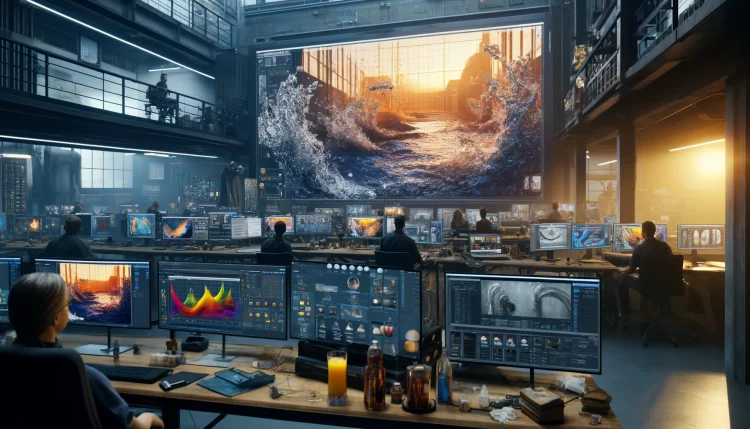
Post-production is where AI has delivered the clearest, most immediate return on investment in the entertainment industry. VFX rendering is computationally intensive and historically one of the largest variable cost line items in a production budget. AI-assisted rendering tools — including NVIDIA’s Omniverse and cloud-based solutions from major VFX houses — have compressed rendering times significantly. Multiple studios reported 30-40% reductions in rendering time for comparable VFX sequences between 2023 and 2025, according to the Visual Effects Society member survey 2025.
Key Stat
The Visual Effects Society member survey (2025) found that studios using AI-assisted rendering tools reported 30-40% reductions in rendering time compared to 2023 benchmarks for comparable VFX sequences. For a mid-budget film with $15-20M in VFX spend, this compression represents a potential saving of $4-6M in labor and compute costs.
Rotoscoping — the painstaking process of isolating elements within a frame for compositing — has been partially automated by AI tools with high accuracy on clean, well-lit footage. Tasks that previously required hours of frame-by-frame work can now be completed in a fraction of the time, freeing human artists to focus on complex edge cases and creative decisions rather than mechanical isolation work.
In editing, AI tools now assist with assembly cuts by analyzing script coverage notes and camera metadata to pre-sort footage by scene, take quality ratings, and director’s preferences. This does not create a finished cut, but it reduces the time an editor spends on organizational tasks at the start of post, allowing creative editorial work to begin sooner.
Sound design and dialogue replacement (ADR) are additional areas. AI voice tools are being used in localization workflows to match lip-sync timing for dubbed versions with greater accuracy than traditional methods. Dialogue restoration tools can clean up problematic location sound with less manual work. These are efficiency gains, not creative replacements — the sound designer’s judgment on texture, emotion, and spatial design remains entirely human.
For a closer look at how VFX production is shifting globally, the current state of global film production covers the geographic redistribution of VFX work that AI tools are both enabling and accelerating.
AI in Distribution and Content Acquisition
Distribution is the phase of the entertainment business where AI tools have the longest track record, given that streaming platforms have been running recommendation and audience-segmentation algorithms for over a decade. What has changed in 2025-2026 is that these tools have moved upstream into content acquisition decisions, and have become accessible to companies well below the Netflix and Disney scale.
Streamers now use audience behavior data — what subscribers watch, rewatch, abandon, and search for — to inform acquisition priorities in specific markets. A regional streamer entering Southeast Asia might use this data to identify which genre combinations and narrative structures are performing best in adjacent markets as a guide for what to license. This is smarter market research, not automated acquisition.
A pattern we’ve found in the Vitrina data is that mid-tier SVOD platforms — those with 5-50 million subscribers globally — are investing in AI acquisition tools at a faster rate relative to their size than the largest platforms. This makes sense: Netflix and Disney have enormous internal data advantages already. Smaller platforms are using AI tools to close the analytical gap and make smarter bets on content that the large players are overlooking or passing on.
Release timing models are another active application. AI tools can analyze theatrical release calendars, competitive title performance, and macroeconomic indicators to recommend optimal release windows. These recommendations are increasingly informing — though not dictating — the decisions made by studio distribution teams. Understanding the future of global content acquisition requires understanding how these analytical tools are changing the pace and logic of buying decisions worldwide.
What AI Cannot Replace: The Human Elements That Still Matter
Clarity about what AI cannot do is as important as understanding what it can. The entertainment industry runs on a particular kind of human judgment that does not yet have a machine equivalent. Goldman Sachs research from 2024 identified creative arts and entertainment as among the occupational categories with the lowest percentage of tasks automatable by current AI systems, estimating that only 26% of specific tasks in media production are candidates for automation by 2030. The majority of what makes a film or television project work — the other 74% — remains stubbornly human.
Creative risk-taking is the clearest example. Every meaningful film that changed the industry required someone to believe in something audiences had not yet seen. AI systems trained on historical performance data are, by definition, backward-looking. They can tell you what has worked. They cannot tell you what will work if it has never been tried. The films that matter most — the ones that shift culture rather than reflect it — will remain human decisions made under uncertainty.
Performance direction is another firm boundary. The relationship between a director and an actor — the specific conversation that leads a performer to a particular emotional truth in a specific moment — is irreducibly human. AI tools can analyze facial expression data and suggest that a scene reads as flat. They cannot replace the director who knows exactly what to say to the actor to unlock something genuine.
Cultural and political judgment — knowing why a story matters now, for this audience, in this moment — is similarly outside the reach of current AI systems. These are the most valuable skills in the entertainment industry, and they are the ones least threatened by the tools currently being deployed.
How Independent Producers Should Think About AI in 2026
For independent producers, the strategic question is not whether to use AI, but which tools actually improve your specific workflow at your specific budget level. The hype around generative AI has created a crowded marketplace of tools with wildly variable real-world utility. Producers who treat AI as a budget tool — focused on reducing concrete, measurable costs in scheduling, VFX, and market research — are seeing genuine returns. Those who adopt tools for their novelty, or because a competitor mentioned them in a trade interview, frequently see limited benefit.
Across the 300,000+ companies tracked in the Vitrina intelligence platform, production companies with documented AI tool investments are concentrated in the United States (42%), United Kingdom (14%), India (11%), and Canada (9%) as of mid-2026. These markets have the combination of technical talent, production infrastructure, and investor appetite required to integrate AI tools into active production pipelines rather than pilots.
The most practical starting points for independent producers are AI-assisted script coverage (reduces reader workload without replacing creative judgment), scheduling optimization tools (delivers measurable pre-production time savings), and AI-enhanced VFX pipelines through partnerships with mid-tier facilities that have already made the technology investment. These are proven ROI areas, not experiments.
For producers building relationships with international co-production partners or technology companies, finding international film co-production partners and how production data improves decision-making are directly relevant companion resources.
How Vitrina Uses AI-Powered Intelligence for the M&E Industry
Vitrina’s VIQI platform applies AI-powered analysis to the problem that matters most to producers, distributors, and financiers in 2026: finding the right partners, clients, and opportunities across a global industry that is too large and too fragmented to navigate manually. With 300,000+ M&E companies tracked across production, distribution, streaming, VFX, licensing, and adjacent sectors, the platform gives entertainment professionals the intelligence infrastructure that was previously available only to the largest studios and agencies.
The AI matching layer within VIQI goes beyond simple directory search. It analyzes company profiles, deal histories, content specializations, geographic footprints, and recent activity signals to surface recommendations that match a user’s specific mandate. A producer looking for a VFX co-production partner in Eastern Europe with genre-specific credentials can receive targeted results in minutes rather than weeks of manual research. This is practical AI film production intelligence, not a chatbot layer on top of a database.
As the media and entertainment industry integrates AI tools at every stage of the production pipeline, the companies that will move fastest are those with the best intelligence on where opportunity and capability sit across the global market. Vitrina provides that foundation — a continuously updated, AI-organized picture of 300,000+ M&E companies that allows professionals to act on data rather than rumor or reputation alone.
Find AI-Ready Production Partners Across 159,223 Companies
Conclusion
AI film production in 2026 is a story of practical tools solving practical problems — not the revolution some predicted, and not the non-event skeptics hoped for. The technology is working in development coverage, pre-production scheduling, VFX rendering, and distribution analytics. It is saving real money and real time in these specific domains. The fundamental creative and strategic work of making films remains human, and the most informed industry professionals understand the distinction clearly.
The competitive advantage in the near term will not go to the companies that have adopted the most AI tools. It will go to the companies that have adopted the right tools for their specific workflow, integrated them thoughtfully, and maintained the human creative judgment that no algorithm can replicate. That balance — between what machines do well and what humans do best — is what the most successful productions in 2026 are getting right.
The next 24 months will bring more capable AI systems to more phases of production. The questions that matter now are not whether to use these tools, but how to use them in ways that genuinely improve creative output and financial performance. For entertainment professionals who want to make those decisions from a position of knowledge rather than speculation, tracking what the best companies in the industry are actually doing — not what they are claiming — is the essential starting point.
Stay Ahead of AI Adoption in Entertainment
Frequently Asked Questions
Is AI currently being used in major Hollywood film productions?
Yes. As of 2025-2026, at least four major Hollywood studios use AI tools in their development pipeline for script analysis and coverage. AI-assisted VFX rendering is standard at leading facilities. Pre-production scheduling tools using machine learning are deployed on both studio and large independent productions. PwC data shows 67% of major studios now use some form of AI in their workflow.
Will AI replace film directors, writers, or actors?
Not in any foreseeable near-term scenario. Goldman Sachs estimates only 26% of media production tasks are candidates for automation by 2030 — and these are largely administrative and technical tasks, not creative ones. Directors, writers, and actors perform work that requires cultural judgment, emotional intelligence, and originality. These are precisely the human capabilities that current AI systems cannot replicate.
What is the actual ROI of AI tools in film post-production?
The Visual Effects Society member survey (2025) reported that studios using AI-assisted rendering tools achieved 30-40% reductions in rendering time compared to 2023 benchmarks. For a mid-budget production with $15-20 million in VFX spend, this compression can represent $4-6 million in reduced labor and compute costs. Rotoscoping automation and AI-assisted sound cleanup deliver additional measurable efficiency gains.
How are streaming platforms using AI in content acquisition?
Streaming platforms use AI-driven audience behavior analysis to inform acquisition priorities, particularly in new geographic markets. These tools surface patterns in what subscribers watch, rewatch, abandon, and search for, and translate these signals into genre and format preferences. The data informs — but does not automate — acquisition decisions. Human acquisitions executives retain final authority over deal terms and creative fit assessments.
Should independent producers invest in AI tools in 2026?
Independent producers should focus investment on AI tools with proven ROI in their specific workflow: script coverage assistance (reduces reader workload without replacing judgment), scheduling optimization (12-18% pre-production time savings per McKinsey 2025), and VFX pipeline access through facility partnerships. Avoid adopting tools for their novelty. The strongest returns come from applying AI to concrete, measurable cost and time challenges rather than aspirational creative applications.
About the Author
Vitrina Research Team
The Vitrina Research Team produces intelligence-led analysis on media and entertainment industry structure, deal activity, and market trends. Our research draws on VIQI’s proprietary dataset of 300,000+ M&E companies worldwide.