IHUB
IHUB
 Private Briefings (Webinars)


 LeaderSpeak Podcast
  Global Entertainment Digest (Newsletter)
  Premium Lists
 Membership Benefits
 About Vitrina
 Our Story
Author:
By Kunal Barai
Kunal Barai leads Global Markets at Vitrina.AI, working with producers and financiers across 100+ countries to facilitate content financing and co-production matchmaking. He recently hosted a roundtable on AI for Film Financing at MIP London 2026, bringing over 12 years of executive experience from Nielsen/Gracenote and advanced strategy frameworks from MIT Sloan.
Summary: The visual effects pipeline of Dune: Part Two proves that blending massive practical sandscapes with specialized vendor infrastructure is the ultimate framework for de-risking high-budget sci-fi slates. For film financiers and sales agents, analyzing how Legendary Pictures and Warner Bros. structured this workflow provides a critical blueprint for protecting equity positions, accelerating production turnaround, and mitigating margin erosion across premium IP portfolios.
Managing capital risk on a $190M tentpole isn’t about hoping the director hits their shoot schedule. It’s about engineering predictability into your asset delivery pipeline long before cameras arrive on set. What the trades don’t report is that the real battle for Dune: Part Two wasn’t fought in the remote dunes of Jordan or Abu Dhabi—it was won inside the data infrastructure of specialized global visual effects vendors. By establishing an asset-reuse architecture and locking in tier-one partnerships months before principal photography, the production de-risked its entire capital stack against unpredictable post-production overages.
Financiers and sales agents recognize that visual effects are frequently the single largest source of margin leakage on speculative slates. Late-stage creative shifts, unoptimized asset pipelines, and siloed vendor networks can cause 15-20% margin erosion overnight. That’s the fragmentation paradox in full effect: a massive, unmapped supply chain of suppliers operating in opaque silos, forcing financiers to make critical allocation choices based on relationship guesswork rather than verified capacity metrics.
But look at the operational efficiency achieved on this production. Under the direction of production VFX supervisor Paul Lambert, the slate deployed a hybrid methodology that fused extensive on-set practical staging with highly integrated digital asset creation. In our analysis of film supply chain optimization, we’ve found that treating digital assets as hard corporate property—rather than temporary post-production deliverables—fundamentally alters project-level economics. It compresses delivery timelines, stabilizes cash flow requirements, and protects the ultimate internal rate of return for your equity investors.
Table of Contents
- How De-Risking the Capital Stack Starts in Pre-Production
- The Global Vendor Infrastructure: Structuring the Allocation Model
- Asset Reuse Mechanics: Protecting Your IRR from Scope Creep
- Industry Implications: Three Structural Takeaways for Capital Allocators
- Conclusion
- Frequently Asked Questions (FAQ)
How De-Risking the Capital Stack Starts in Pre-Production
Behind closed doors, film financiers often treat post-production as a variable contingency line item. That’s a fundamental misunderstanding of modern production economics. Legendary Pictures didn’t treat visual effects as a patch-up job for the third act. Instead, they weaponized their pre-production phase by introducing VFX workflows straight into principal photography prep. Lenders advance funds against territory pre-sales because they expect a predictable delivery timeline. If your asset delivery slips by even two weeks, your theatrical windowing collapses, and your carrying costs skyrocket.
The solution deployed on this sequel was the extensive implementation of what insiders call a “practical-first digital pipeline.” Paul Lambert didn’t let the cameras shoot raw plates against standard, flat green screens. They engineered giant, sand-colored backdrops and highly reflective physical environments. Why does this matter to a sales agent or completion guarantor? It instantly de-risks your grading and compositing overheads. When the background matches the natural illumination of the scene, your rendering hours drop significantly, preventing unexpected post-production invoice expansion.
As industry veterans recognize, navigating volatile funding environments requires a rigid approach to post-production budgeting. Phil Hunt, CEO of Head Gear Films, breaks down the current realities of creative debt and slate stabilization:
By locking in these architectural parameters early, the production ensured that creative decisions were tightly bound to the approved capital structure. It’s an approach that directly counters the legacy inefficiencies where directors “fix it in post,” a phrase that usually translates to equity holders absorbing a 20% loss on their tail-end distribution margins.
The Global Vendor Infrastructure: Structuring the Allocation Model
Let’s look at how the production structured its vendor ecosystem. Opaque supplier capabilities frequently force financiers into single-vendor reliance, concentrated risks, and premium markups. To circumvent this, the production split its visual effects slate across a global network of premier suppliers, anchoring its main pipeline with DNEG while distributing highly specialized sequences to localized boutiques. This is how strategic players structure a supply chain: matching discrete creative needs to verified technical specialization and regional tax incentives.
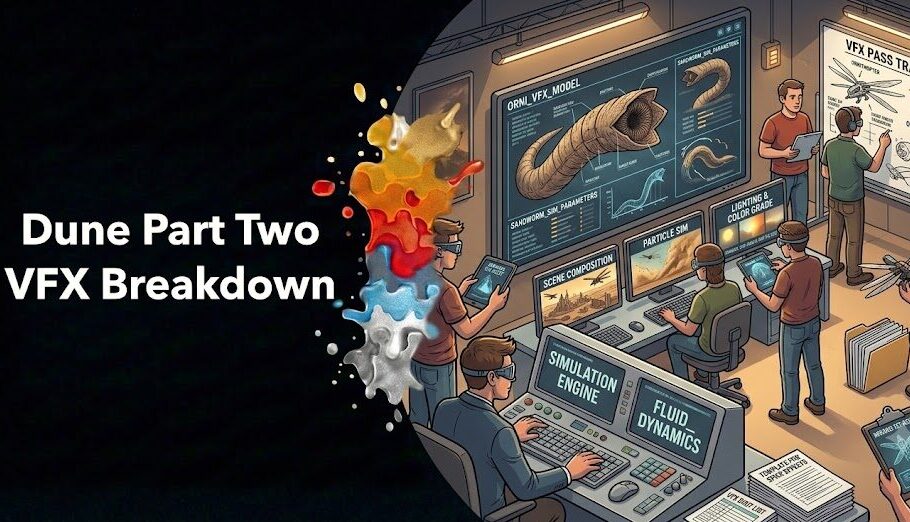
Our analysis of global production networks shows that multi-vendor structures provide vital EBITDA protection by creating competitive procurement conditions. For example, DNEG handled the monumental tasks of environments and creature animation, including the intricate design of the sandworms. Meanwhile, vendors like Rodeo FX and Wētā FX were deployed to scale up massive battles and distinct simulation sets. This isn’t just an artistic decision—it’s an asset-allocation strategy that de-risks the capital stack against vendor capacity constraints.
Furthermore, distributing the pipeline across multiple sovereign content hubs—leveraging incentives across the UK, Canada, and Western Europe—effectively reduced the net cost per deliverable. When you distribute 4,000+ complex shots across diverse fiscal boundaries, your underlying cash flow requirement compresses. Sales agents can weaponize these regional rebates to secure secondary lines of debt financing, enhancing the overall liquidity profile of the project before a single pre-sale agreement is monetized.
Asset Reuse Mechanics: Protecting Your IRR from Scope Creep
What is the ultimate vector for margin erosion on a franchise film? Building identical models from scratch twice. The real economic masterstroke of this production was the systematic reuse and evolution of digital asset architecture inherited from the first installment. The primary environmental models of Arrakis, the structural physics of the Ornithopters, and the core simulation math for sand dynamics were preserved as proprietary corporate assets. This strategic retention allowed the producers to compress their development cycles and allocate their primary capital toward new, high-value spectacle sequences.
Consider the capital efficiency of this framework: by treating digital environment assets as long-term corporate property rather than throwaway line-item deliverables, the production avoided the traditional 15-20% legacy markup discovery costs associated with restarting pipeline R&D. Lenders who advance capital against distribution slates require assurance that every dollar hits the screen. When your vendor can deploy an established, insurable asset library on day one, your production acceleration is immediate.
And that’s where most financiers get it wrong—they overlook the equity value stored within a franchise’s digital asset vault. If your sales agent is structuring a multi-picture financing model, locking down the chain-of-title and cross-collateralizing your digital asset libraries across the entire slate can protect your downstream IRR by hundreds of basis points. It transforms an ongoing production expense into a reusable capital advantage, ensuring your waterfall remains intact when the project moves to secondary monetization windows.
Industry Implications: Three Structural Takeaways for Capital Allocators
The operational framework demonstrated on this production provides essential lessons for anyone structuring production financing or balancing risk across premium entertainment slates.
1. Hybrid Staging Protects Post-Production Margins
Relying on entirely digital environments introduces unmitigated variable cost risk into your capital stack. Fusing physical sand elements and custom color-matched backdrops directly on set anchors your lighting math, compressing rendering cycles and preventing unexpected vendor overages before delivery.
2. Multi-Vendor Networks De-Risk Completion Turnaround
Concentrating your entire delivery pipeline inside a single visual effects supplier creates a critical point of failure for your completion bond. Distributing specialized sequences across an open, verified network of boutiques provides vital EBITDA protection and ensures timeline compliance.
3. Digital Asset Reuse Resets Franchise Economics
Digital architecture must be treated as hard corporate equity across your entire slate. Preserving and cross-collateralizing complex simulation data from past installments reduces upfront post-production expenses, accelerates your recoupment cycle, and de-risks downstream financing lines.
Conclusion
The visual effects architecture of this sci-fi sequel proves that production scale is no longer an excuse for financial volatility. Managing a $190M capital stack without margin leakage requires moving away from reactive post-production spending and embracing tightly integrated, pre-production sourcing models. When your digital assets are treated as hard corporate property and distributed across an optimized network of specialized vendors, your delivery timeline remains completely predictable.
For film financiers and sales agents, the lesson is absolute: the data deficit across the entertainment supply chain is a choice, not an industry reality. Allocating capital based on relationship guesswork rather than real-time capacity and track record tracking routinely causes a 15-20% loss on tail-end distribution margins. Platforms like Vitrina resolve this opacity by providing instant visibility into the global supply chain, allowing you to walk into greenlight meetings with the confidence of an insider.
Key Takeaways for Capital Allocators:
- Fusing physical elements with digital workflows prevents unexpected rendering costs.
- Distributing sequences across localized boutiques protects your completion bond insurability.
- Cross-collateralizing digital asset libraries can protect your franchise IRR by hundreds of basis points.
- Multi-vendor structures establish competitive procurement environments that safeguard operating margins.
Questions film financiers and sales agents are asking
- If we’re underwriting a multi-picture slate, how do we legally structure the digital asset ownership to ensure cross-collateralization across sequels?
- What specific technical verification or capacity tracking should we require from a visual effects vendor before clearing a major capital draw?
- How early do regional tax incentive applications need to be locked down across multi-vendor networks to protect our cash flow schedule?
- When a production shifts from flat-fee licensing to flexible delivery templates, how does that impact our waterfall positioning?
Frequently Asked Questions (FAQ)
What was the total production budget for Dune: Part Two?
The estimated production budget for the film was approximately $190M. Managing a capital stack of this scale required meticulous coordination between Legendary Pictures and Warner Bros., ensuring that visual effects expenditures were carefully monitored through pre-visualization pipelines to eliminate late-stage scope creep and post-production overages.
Which main visual effects vendor anchored the Dune: Part Two pipeline?
The primary visual effects partner for the production was DNEG. Under the direction of production VFX supervisor Paul Lambert, DNEG took the lead on expansive world-building, creature design—specifically the sandworms—and major environment extensions, utilizing an asset-allocation strategy that kept massive asset creation consolidated inside a single secure pipeline.
How did Dune: Part Two control visual effects costs during shooting?
The production utilized a practical-first hybrid pipeline, replacing traditional flat blue or green screens with giant, sand-colored backdrops directly on location. This methodology ensured that the natural lighting of the desert was captured accurately on the actors’ plates, which significantly reduced subsequent rendering hours and protected the financier’s operating margins from late-stage compositing overruns.
What other boutique visual effects companies worked on the production?
To avoid single-vendor bottlenecks and maintain tight pipeline schedules, the production distributed specialized sequences to localized visual effects boutiques, including Rodeo FX and Wētā FX. This structured allocation strategy created highly competitive procurement conditions across different sovereign hubs, protecting the overall capital stack from capacity constraints.
Why is digital asset reuse critical for film financing slates?
Systematically reusing core digital assets—such as environmental layouts and physics simulation models inherited from the first film—saves productions from costly pipeline R&D. This workflow acceleration eliminates the traditional 15-20% legacy markup discovery costs, allowing financiers to allocate capital toward fresh spectacle while protecting tail-end internal rates of return.
How do global visual effects networks utilize regional tax incentives?
Distributing a massive digital pipeline across multiple geographic territories allows production companies to stack localized cash rebates and tax credits. By allocating specific shot slates to vendors across the UK, Canada, and Europe, sales agents can weaponize these regional incentives to stabilize cash flow requirements months before theatrical windows open.