IHUB
IHUB
 Private Briefings (Webinars)


 LeaderSpeak Podcast
  Global Entertainment Digest (Newsletter)
  Premium Lists
 Membership Benefits
 About Vitrina
 Our Story
Kunal Barai leads Global Markets at Vitrina.AI, working with producers and financiers across 100+ countries to facilitate content financing and co-production matchmaking. He recently hosted a roundtable on AI for Film Financing at MIP London 2026. Earlier, he spent 12+ years at Nielsen/Gracenote and completed MIT Sloan’s executive program on AI strategy.
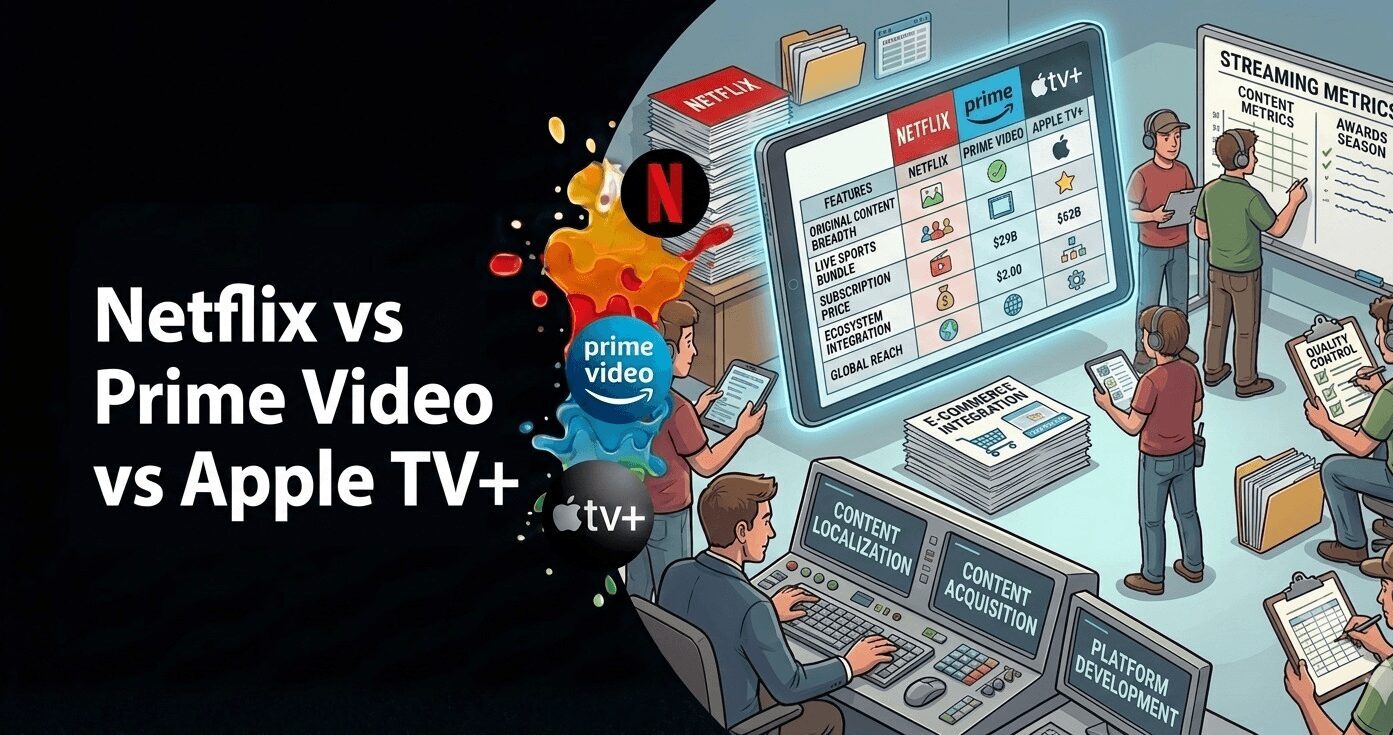
Summary: Netflix, Prime Video, and Apple TV+ are no longer competing for the same content. Netflix is commissioning at global scale with a local-language engine producing originals across 50+ countries. Amazon is becoming the world’s largest streaming spender on sports rights — $3.8 billion in 2026 alone — while building franchise IP that serves a retail and advertising ecosystem, not just a content platform. Apple TV+ is running a prestige-curator model with approximately 45 million subscribers, no ad tier, and a deliberate refusal to compete on volume. For acquisitions executives and development teams pitching into this market, the question is no longer which platform pays the most. It’s which door your project was actually built to open.
The commissioning divergence between these three platforms is now structural, not cyclical. It isn’t a phase in the streaming wars that will rebalance as the market matures. It reflects genuinely different theories of what a streaming service is for — and those theories produce genuinely different content mandates, greenlight criteria, and acquisition cultures.
Netflix believes streaming is a subscriber and revenue growth engine that requires continuous global content volume to reduce churn across every territory simultaneously. Amazon believes Prime Video is an ecosystem play — content that justifies Prime membership, scales an advertising tier, and benefits from the flywheel of Thursday Night Football, NBA live rights, and franchise IP working together. Apple believes TV+ is a brand asset — a prestige signal that enhances the value of the broader Apple services ecosystem, measured in award recognition and customer satisfaction rather than raw subscriber count.
Those three theories produce three fundamentally different commissioning strategies. And an acquisitions or development executive who treats them interchangeably is leaving deals on the table — or worse, burning relationships by pitching the wrong project to the wrong room.
Table of Contents
- Netflix: Volume, Velocity, and the Local-Global Engine
- Prime Video: Franchise IP, Live Sports, and the Ecosystem Bet
- Apple TV+: Prestige Curation and the Brand-Asset Model
- Where the Strategies Diverge Most: Risk Tolerance and Greenlight Criteria
- The Pitch Calculus: What Each Platform Actually Wants to Hear
- How Vitrina Maps Commissioning Intelligence Across All Three Platforms
- Conclusion
- Frequently Asked Questions
Netflix: Volume, Velocity, and the Local-Global Engine
Netflix’s commissioning strategy in 2026 is built on a single insight: a show that feels authentically local can travel globally — and that dynamic is now the primary driver of subscriber acquisition and churn reduction outside North America. Non-English content now accounts for 55% of Netflix’s catalog, with Asian-language titles representing 21% of recent releases and Indian-language content running at 8% of the full catalog. This isn’t a cultural gesture. It’s a subscriber growth mechanism tied directly to engagement data in each territory.
Vitrina’s live tracking confirms 4,460 original commissions and 27,385 total content relationships on record, with 1,211 commissioning and development deals executed in the last 18 months alone. The breadth of that pipeline is deliberate. Reality formats localised by territory — Physical 100: Sweden, Love Is Blind: Denmark — sit alongside scripted drama renewals, literary adaptations, and podcast-to-screen conversions within the same active slate. Netflix is producing originals in 50+ countries, with top-tier commissioning hubs in the US, UK, South Korea, Spain, Japan, France, and India.
Spencer Neumann, CFO of Netflix, addressed the commissioning discipline directly on Vitrina’s LeaderSpeak series: “Credit to Bela and the team for delivering more and more entertainment value per dollar. It’s always continuous improvement — how do we best allocate our content dollars for highest impact… we get smarter at that every year.” That framing matters for anyone pitching into the Netflix system. Volume is not the same as indiscriminate spending. Every commission is being measured against return per dollar — and local-language content that demonstrates global travel potential is consistently winning that test.
Netflix’s $18 billion 2025 content budget — an 11% increase from 2024 — reflects this strategic commitment. By 2026, the platform is targeting 90% of its US catalog to consist of original or exclusive content, according to analysis from ainvest, reducing dependency on licensed library while reinforcing retention through proprietary IP. The global subscriber base stood at 312.5 million as of Q2 2025, with growth concentrated in emerging markets where local-language originals are driving new account creation.
What does this mean for an acquisitions executive at a studio or streamer evaluating co-production or content-sale opportunities with Netflix? The commissioning appetite is real and broad — but the greenlight criteria are increasingly data-driven. Netflix tracks engagement metrics, watch-through rates, drop-off points, and title discovery pathways before content is even commissioned. Proposals that can demonstrate audience validation in a specific territory — and articulate why a title will travel beyond that territory — are structurally better positioned than those making purely creative arguments.
Prime Video: Franchise IP, Live Sports, and the Ecosystem Bet
Amazon’s commissioning logic is structurally different from Netflix’s — and understanding why requires understanding what Prime Video actually is inside Amazon’s P&L. It isn’t a standalone streaming business optimised for content ROI in isolation. It’s a component of the Prime ecosystem, designed to justify Prime membership value, scale an advertising tier, and retain subscribers who are also Amazon’s most valuable e-commerce customers. That context shapes every commissioning decision.
The clearest signal is the sports rights portfolio. In 2026, Amazon Prime Video becomes the world’s largest streaming spender on sports rights globally — an estimated $3.8 billion, representing 27% of total streaming sports investment, according to Ampere Analysis. That figure is driven by the first full year of Amazon’s 11-year NBA deal, valued at $1.8 billion per season, combined with its existing NFL Thursday Night Football rights in the US and UEFA Champions League packages in Germany, Italy, and the UK. These give Amazon a year-round live sports portfolio in the two most popular domestic US leagues simultaneously — a subscriber acquisition and retention mechanism with no equivalent in the scripted or unscripted commissioning world.
The scripted strategy sits alongside this, not instead of it. The Boys, Reacher, Citadel, Lord of the Rings: The Rings of Power — Prime Video’s commissioned drama slate is anchored by franchise IP with multi-format potential: film, TV, podcast, and merchandise. The $8.5 billion MGM acquisition wasn’t just a library deal; it restructured how Amazon thinks about content, layering IP-driven franchise strategy on top of an already complex mix of originals, licensed titles, live sports, and international co-productions.
As Amazon CEO Andy Jassy stated on the Q3 2024 earnings call: “We have increasing conviction that Prime Video can be a large and profitable business on its own. This confidence is buoyed by the continued development of compelling, exclusive content.” That language — “profitable business on its own” — represents a shift in how Amazon is framing Prime Video internally. The platform spent approximately $7 billion on content in 2025. Budget discipline is real. Vitrina’s production trend data reveals Prime Video’s production volumes have moved in the opposite direction to Netflix’s in the most recent two quarters — deliberate rationalisation rather than expansion, focused on fewer, larger bets.
The consequence for development and acquisitions executives: Prime Video is not a broad-aperture buyer in the way Netflix is. It’s looking for IP with franchise architecture — stories that can extend across multiple seasons, generate ancillary revenue, and serve the broader Amazon ecosystem. A standalone limited series with no sequel or franchise potential is a harder sell at this door than it was four years ago.
Apple TV+: Prestige Curation and the Brand-Asset Model
Apple TV+ operates on a theory that is genuinely unusual in the streaming market: that a service with approximately 45 million subscribers — roughly one-seventh of Netflix’s global base — can be strategically valuable to a trillion-dollar company without ever competing on volume, advertising revenue, or catalog breadth.
The awards record validates that theory, at least on its own terms. At the 77th Primetime Emmy Awards, Apple TV+ won 22 Emmys across 81 nominations spanning 14 original titles — a platform record. The Studio became the most-winning freshman comedy in Emmy history with 13 wins. Severance Season 2 won eight, including Outstanding Lead Actress and Outstanding Supporting Actor. Slow Horses won for Outstanding Directing for a Drama. That level of awards recognition, from a platform spending approximately $4.5 billion annually on content — a fraction of Netflix’s budget — is the commercial argument Apple makes internally for the model.
The subscriber response to prestige content is demonstrable. When Severance Season 2 premiered, Apple TV+ saw a 126% surge in new subscribers, according to EMARKETER analysis. That’s a conversion pattern more consistent with HBO’s historical model — one signature show creating a subscription moment — than with Netflix’s continuous-engagement-across-a-broad-slate approach. Apple’s executives have been explicit about the comparison. Eddy Cue, Apple’s SVP of Services, reaffirmed in late 2025 that Apple plans to “build and continue building” its content lineup organically — no plans for a major studio acquisition, no ad tier, no pivot toward volume.
Zack Van Amburg, Apple TV+’s co-head of video programming, told Screen International in November 2025 that the platform would have “a new original nearly every single week” in 2026 — a cadence signal that represents a meaningful step up from prior years, even if the absolute volume remains far below Netflix. Returning seasons of Ted Lasso and For All Mankind anchor the 2026 slate. The theatrical ambition is also escalating: F1: The Movie generated $144 million globally in its opening weekend, becoming Apple’s first genuine box office success and validating a strategy of using theatrical releases for prestige and cultural conversation that drives streaming subscriptions downstream.
What the Apple model doesn’t offer — and won’t for the foreseeable future — is breadth. No reality. No unscripted formats. No format adaptations localised by territory. No volume-driven commissioning across emerging markets. The platform’s commissioning culture is closer to a premium cable network from the prestige television era than to any of its streaming competitors. That’s not a criticism. It’s a commissioning brief — and understanding it precisely determines whether your project has a chance at that door.
Where the Strategies Diverge Most: Risk Tolerance and Greenlight Criteria
The sharpest fault line between the three platforms isn’t budget or subscriber count. It’s risk architecture — how each platform distributes and absorbs content risk, and what that means for the projects it greenlights.
Netflix distributes risk across a vast, diversified slate. If ten shows underperform in any given quarter, fifty others carry the revenue and engagement numbers. That structure allows Netflix to greenlight more experimental formats, emerging talent, and local-language projects in growth territories where individual title performance is genuinely uncertain. The portfolio absorbs misses. The individual title doesn’t have to be right every time — just often enough across enough markets simultaneously.
Prime Video concentrates risk in fewer, larger bets. A single franchise failure carries outsized consequences when your commissioning strategy is built around multi-season IP anchors. The Rings of Power‘s mixed critical and audience reception on Season 1 — despite reportedly being the most expensive TV series ever produced at that point — illustrated this precisely. Amazon renewed it regardless, because the franchise architecture demands continuation. But the commercial pressure on Season 2 to perform was directly proportional to how much of Prime Video’s brand and budget was concentrated in that single IP. For an acquisitions executive evaluating content for Prime Video, that concentration means the bar for franchise potential is genuinely high. A show that might comfortably commission at Netflix — interesting, local, uncertain upside — doesn’t clear the Prime Video threshold if it can’t demonstrate multi-season architecture and ecosystem value.
Apple TV+ absorbs risk through restraint. It commissions so selectively that no single miss can be catastrophic — but it also cannot generate the subscriber momentum that a breakout unscripted hit or a local-language phenomenon would deliver. Severance‘s three-year gap between seasons didn’t kill the platform. It arguably built anticipation. But that only works when the prestige brand is strong enough to hold subscribers through the gap — and when the subscriber base is small enough that you’re not trying to serve the content needs of 300 million people simultaneously.
The greenlight criteria flowing from these risk architectures are equally distinct. Netflix wants evidence of audience validation and global travel potential — ideally demonstrated through engagement data in a comparable territory. Prime Video wants franchise architecture: does this IP have legs across multiple seasons, formats, and revenue streams? Apple TV+ wants the best version of the story — not the most commercial version, not the most scalable version, but the most creatively realised version, with talent attachments and production ambition that justify its prestige positioning.
The Pitch Calculus: What Each Platform Actually Wants to Hear
This is the practical consequence of everything above. The commissioning philosophies translate directly into what each platform’s development and acquisitions teams are listening for when a project arrives at their desk.
At Netflix, the question is: does this travel, and can it be localised? A scripted drama set in a specific territory needs to demonstrate why it will resonate with audiences in five other territories — not just its home market. A reality format needs to show it can be adapted by local production companies across multiple territory versions without losing its core engagement mechanic. The data-driven greenlight process means creative arguments alone won’t clear the bar. Netflix will want to understand what comparable titles performed like in the target territory, what the audience gap is, and how this project fills it. Local production partnerships matter — Netflix’s commissioning in growth markets often runs through established local production companies rather than directly with international studios.
At Prime Video, the question is: is there a franchise here, and does it serve the ecosystem? A limited series with a clean ending and no sequel architecture is a harder sell than it used to be. The platform’s acquisitions teams are increasingly aligned around IP with multi-format potential — books, games, podcasts, merchandise — that can extend across Amazon’s broader commercial ecosystem beyond Prime Video itself. The unscripted category, handled primarily through MGM Alternative (which President Barry Poznick described on Vitrina’s LeaderSpeak as “the number one unscripted studio in the world”), operates with its own distinct commissioning logic around reality competition and factual entertainment — but even there, format longevity and multi-season potential are criteria.
At Apple TV+, the question is: is this the best version of this story, and will it be remembered? That’s not a vague creative standard — it’s a specific filter. Apple doesn’t commission for market gaps or format adaptations. It commissions for cultural conversation and awards recognition. Talent attachments matter enormously: the platform’s reputation was built on relationships with writer-directors who had creative control, and its commissioning culture reflects that. A project with a world-class writer-director attachment, a specific and ambitious creative vision, and production values that justify the Apple brand has a genuine path. A commercially proven format with demonstrated audience data in comparable territories — the Netflix pitch — doesn’t necessarily translate at this door.
How Vitrina Maps Commissioning Intelligence Across All Three Platforms
Understanding that these three commissioning philosophies are distinct is one thing. Knowing which specific executives at each platform are actively developing in your genre, at your budget tier, in your territory — and what they’ve actually greenlit in the last eighteen months — is another. That’s the intelligence gap that determines whether a development or acquisitions team is operating with real market knowledge or working from outdated assumptions.
Vitrina’s platform tracks commissioning and development executives across Netflix, Prime Video, Apple TV+, and 360,000+ other entertainment companies globally — with verified deal history, active project data, and current role information. Vitrina’s live data confirms 1,211 commissioning and development deals at Netflix alone in the last 18 months. The commissioning executives behind those deals, the genres they’re actively developing, and the production companies they’re partnering with are all surfaced through VIQI and the Projects Tracker.
- Explore VIQI to research active commissioning mandates at Netflix, Prime Video, and Apple TV+ by genre, territory, and format
- Get 200 free credits and search the platform — no credit card required
- Contact Concierge if you’re actively developing a project and need warm introductions to the right commissioning contacts at any of the three platforms
Conclusion
Netflix is the volume-and-velocity player, Prime Video is the franchise-and-ecosystem builder, and Apple TV+ is the prestige curator. All three are profitable or moving toward profitability — but through entirely different commissioning philosophies, different risk architectures, and different definitions of what content is actually for. The gap between Netflix’s 312.5 million subscribers and Apple TV+’s approximately 45 million isn’t primarily a content quality gap. It’s a mandate gap — and it exists by design on both sides.
For development and acquisitions executives, this has a direct implication: the most expensive mistake in the current commissioning landscape isn’t producing a show that doesn’t perform. It’s pitching the wrong project to the wrong platform — because the opportunity cost of misaligned pitches compounds across every relationship you burn in the process. Netflix, Prime Video, and Apple TV+ are not interchangeable buyers at different price points. They’re different businesses with different content needs, different greenlight criteria, and different definitions of success. Understanding which door your project was built to open is now foundational commissioning intelligence, not optional context.
As Vitrina’s intelligence on 2026 commissioning confirms, the gap between Netflix and Prime Video’s production volumes is widening, not narrowing — and Apple TV+ shows no signals of pivoting toward scale. These strategies are hardening. The market clarity that creates is an opportunity for development and acquisitions teams who understand it precisely.
Key Takeaways
- Netflix’s $18 billion 2025 content budget allocates 55% to non-English originals — the commissioning engine runs on local-language content that demonstrates global travel potential, not on English-language volume
- Amazon Prime Video becomes the world’s largest streaming spender on sports rights in 2026 at an estimated $3.8 billion — its scripted commissioning strategy is anchored by franchise IP with multi-format ecosystem value, not standalone titles
- Apple TV+ won 22 Emmys from 81 nominations across 14 titles in 2025 — the prestige model is working on its own terms, with a 126% subscriber surge when Severance Season 2 premiered, and no plans for an ad tier or volume pivot
- The three platforms have structurally different risk architectures: Netflix distributes risk across a broad slate; Prime Video concentrates it in fewer franchise bets; Apple TV+ absorbs it through commissioning restraint
- The pitch calculus is different at each door — Netflix wants proof of global travel, Prime Video wants franchise architecture, Apple TV+ wants the best version of the story with talent to match
Frequently Asked Questions
What is Netflix’s commissioning strategy in 2026?
Netflix’s commissioning strategy centres on global-local scale: originals produced in 50+ countries, with non-English content representing 55% of the catalog and a $18 billion 2025 content budget weighted toward local-language programming that travels globally. The strategy is deliberately diversified across scripted drama, reality formats localised by territory, documentary, animation, and unscripted — with data-driven greenlight criteria assessing engagement potential before commissioning. Vitrina’s tracking confirms 1,211 commissioning and development deals executed in the last 18 months, across 4,460 total original commissions on record.
What is Amazon Prime Video’s commissioning strategy?
Prime Video’s commissioning strategy is anchored by franchise IP and live sports rights. In 2026, Amazon becomes the world’s largest streaming spender on sports rights at an estimated $3.8 billion, including its 11-year NBA deal worth $1.8 billion per season and existing NFL Thursday Night Football and UEFA Champions League packages. Scripted commissioning prioritises IP with multi-format franchise potential. The $8.5 billion MGM acquisition added a library and unscripted production capability through MGM Alternative. Budget discipline has led to deliberate production rationalisation — fewer, larger bets rather than broad-aperture commissioning.
What is Apple TV+’s commissioning strategy in 2026?
Apple TV+ commissions for prestige, awards recognition, and brand equity — not subscriber volume or catalog breadth. The platform spends approximately $4.5 billion annually on content, operates with around 45 million subscribers, and has no plans for an ad tier. In 2025, it achieved a platform record of 81 Emmy nominations across 14 original titles. Apple TV+ executive Zack Van Amburg indicated the platform would release a new original nearly every week in 2026 — a cadence increase — while retaining the prestige-curation model. There’s no reality, no format adaptation strategy, and no volume-driven commissioning across emerging markets.
How do Netflix, Prime Video, and Apple TV+ differ in what content they commission?
Netflix commissions broadly across formats and territories, with a specific emphasis on local-language originals that demonstrate global travel potential. Prime Video commissions around franchise IP with multi-season and multi-format potential, prioritising content that serves the broader Amazon ecosystem. Apple TV+ commissions selectively for prestige and awards — prioritising creative vision, talent attachments, and production quality over commercial scalability. The practical consequence is that the same project will not fit all three doors: a local-language drama that clears Netflix’s greenlight criteria may have no natural home at Prime Video or Apple TV+.
How much does Netflix spend on content versus Prime Video and Apple TV+?
Netflix spent $18 billion on content in 2025, making it the largest single spender among the three platforms. Amazon Prime Video spent approximately $7 billion on content in 2025, amplified by the MGM library and $3.8 billion in sports rights in 2026. Apple TV+ spends approximately $4.5 billion annually on original programming, down from a peak of over $5 billion. Netflix’s content spend is also the highest as a proportion specifically of SVOD original spending worldwide, accounting for over 30% of global SVOD originals investment.
Which streaming platform is best for independent producers pitching original content?
The answer depends entirely on the project’s format, territory, and creative profile. Netflix offers the broadest commissioning aperture, particularly for local-language originals in its priority territories — UK, South Korea, Spain, Japan, India, France — and for format adaptations with multi-territory potential. Prime Video is the strongest home for franchise IP with multi-season architecture and ecosystem value beyond pure streaming. Apple TV+ is the right destination for prestige scripted originals with strong talent attachments, ambitious creative vision, and awards potential — provided the project fits the platform’s narrow commissioning lane. Pitching the wrong project to the wrong platform costs more than a rejection. It costs the relationship.
Is Apple TV+ growing its subscriber base?
Apple TV+ has grown from approximately 20 million subscribers in early 2021 to around 45 million by end of 2024, according to independent analysis. The platform saw a 126% surge in new subscribers when Severance Season 2 premiered, demonstrating the model’s subscriber conversion capacity around major title launches. Apple does not publicly report subscriber numbers separately from its broader Services division revenue. The growth trajectory is positive but significantly slower than Netflix or Amazon, reflecting the deliberate choice to compete on prestige rather than volume or price-point accessibility.
How does Amazon’s NBA deal affect its commissioning strategy?
Amazon’s 11-year NBA deal, valued at $1.8 billion per season, gives Prime Video a year-round live sports portfolio in the US alongside NFL Thursday Night Football — the two most popular domestic leagues simultaneously. According to Ampere Analysis, Amazon’s total 2026 streaming sports rights spend reaches $3.8 billion, making it the largest single streaming spender globally. This sports infrastructure drives subscriber acquisition and retention, scales the ad tier, and creates a documentary and access-content commissioning flywheel: behind-the-scenes series, player profiles, and franchise documentaries become part of the sports rights exploitation strategy rather than separate content investments — at a fraction of the live rights capital cost.