About Innovation Hub
 Global Content Pulse (Webinars)


 Global Production Financing
(Webinars)
Global Production Financing
(Webinars)  LeaderSpeak Podcast
  Global Entertainment Digest (Newsletter)
  About Vitrina
 About VIQI
 Our Story
 Our Solutions 🔥
 Film+TV Projects Tracker 🚀
 Case Studies
 Our Profile
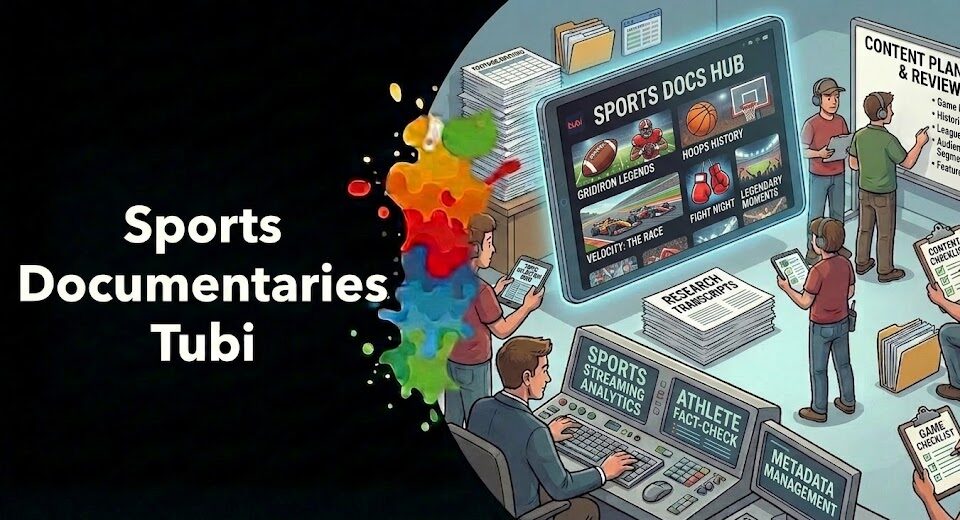
The best sports documentaries streaming free on Tubi for die-hard fans don’t settle for highlight reels and career stats. The ones worth your time get inside the weight rooms, the locker room arguments, the contract disputes, and the 3 a.m. decisions that determine whether a career becomes legendary or cautionary. That’s the access gap between a great sports documentary and an authorized promotional film dressed up to look like one.
Tubi—Fox Corporation’s free ad-supported streaming platform with over 78 million monthly active users—carries a rotating library of sports documentary content that punches well above what you’d expect from a free platform. Academy Award winners. ESPN Films classics. Sundance premieres that fundamentally redefined what sports documentary could accomplish as a genre. And all of it without a subscription fee.
Standard caveat that actually matters: Tubi’s catalog cycles as licensing agreements expire and renew. Every title in this guide has been documented on Tubi across recent catalog periods—but always verify current availability on the platform before you sit down to watch. With that said, here are the six sports documentaries that justify a Tubi account all by themselves.
Professionals tracking sports documentary acquisition will recognize most of these as case studies in long-tail AVOD licensing value—titles that keep generating licensing revenue years after their theatrical windows closed, precisely because die-hard fans keep finding them.
In This Guide
Track Sports Documentary Deals Across Every Major Platform
Trusted by Netflix, Warner Bros, and Paramount. Join 140,000+ companies on Vitrina tracking documentary acquisition activity, AVOD licensing deals, and distribution partner intelligence across the global entertainment supply chain.
✔ 200 free credits | ✔ No credit card required | ✔ Full platform access
What Separates a Great Sports Documentary From a Glorified Career Retrospective
Be honest with yourself about how many sports documentaries you’ve watched that were actually just extended tribute videos. Flattering archival footage. Former teammates saying generous things. The athlete narrating their own legend with full editorial control. That’s not a documentary. That’s a premium press release with better cinematography.
The six films on this list earn their ranking against three criteria that die-hard fans actually care about:
- Behind-the-scenes access that wasn’t stage-managed — Real access means cameras rolling when things go wrong, not just when the athlete wants you to see them. The difference between embedded documentary filmmaking and an authorized bio is visible in the first ten minutes of watching.
- Emotional impact beyond fandom — The best sports documentaries work on people who have no prior investment in the sport or the athlete. That universal reach is the quality marker. Niche appeal means a strong fan film. Cross-genre appeal means a genuinely great documentary.
- Athlete storytelling that doesn’t sanitize — Failure, contradiction, moral complexity, bad decisions made under pressure. The documentaries that last aren’t the ones that make athletes look saintly. They’re the ones that make athletes look human—in the specific, irreducible way that only happens when the camera keeps rolling past the rehearsed parts.
Every film on this list passes all three. Some of them pass so decisively they’ve influenced how sports documentary gets made—and licensed—across the entire industry. Understanding how sports documentary content moves through acquisition cycles explains why these titles keep appearing on free platforms long after their initial release windows—and why AVOD platforms like Tubi compete for them specifically.
Hoop Dreams (1994) — Five Years, Two Kids, One American Myth
Director Steve James spent five years following two teenage basketball players—Arthur Agee and William Gates—from inner-city Chicago as they chased dreams of reaching the NBA. What he captured across 171 minutes is not a basketball film. It’s a structural examination of how American institutions—high school athletics, college recruitment, suburban talent scouting—extract economic and physical value from young Black athletes while distributing almost none of that value back to the families who produce them.
The access is staggering. James embedded with both families for half a decade, which means you’re watching real financial crises, real family arguments, and real moments of institutional betrayal—not reconstructions or talking-head recollections delivered at a comfortable remove from events. St. Joseph High School in Westchester, Illinois, the recruiting powerhouse at the film’s center, becomes one of the most quietly damning institutional portraits in documentary history. And it got there without a single dishonest interview.
The Sundance Film Festival audience awarded it the Audience Award in 1994. It was shockingly snubbed by the Academy for a Best Documentary Feature nomination—an omission that prompted the Academy to change its nomination rules. That institutional consequence alone puts Hoop Dreams in a category most sports documentaries never approach. At 2h 51min, it’s long. Watch it anyway. You won’t be checking the runtime after the first 20 minutes.

Your AI Assistant, Agent, and Analyst for the Business of Entertainment
VIQI AI helps you plan content acquisitions, raise production financing, and find and connect with the right partners worldwide.
- Find active co-producers and financiers for scripted projects
- Find equity and gap financing companies in North America
- Find top film financiers in Europe
- Find production houses that can co-produce or finance unscripted series
- I am looking for production partners for a YA drama set in Brazil
- I am looking for producers with proven track record in mid-budget features
- I am looking for Turkish distributors with successful international sales
- I am looking for OTT platforms actively acquiring finished series for the LATAM region
- I am seeking localization companies offer subtitling services in multiple Asian languages
- I am seeking partners in animation production for children's content
- I am seeking USA based post-production companies with sound facilities
- I am seeking VFX partners to composite background images and AI generated content
- Show me recent drama projects available for pre-buy
- Show me Japanese Anime Distributors
- Show me true-crime buyers from Asia
- Show me documentary pre-buyers
- List the top commissioners at the BBC
- List the post-production and VFX decision-makers at Netflix
- List the development leaders at Sony Pictures
- List the scripted programming heads at HBO
- Who is backing animation projects in Europe right now
- Who is Netflix’s top production partners for Sports Docs
- Who is Commissioning factual content in the NORDICS
- Who is acquiring unscripted formats for the North American market
When We Were Kings (1996) — The Rumble in the Jungle, Forty Years Later
Director Leon Gast had archival footage of the 1974 “Rumble in the Jungle” heavyweight championship fight between Muhammad Ali and George Foreman in Kinshasa, Zaire sitting in storage for 22 years before the documentary was finally completed and released. The two-decade gap is itself a story—rights disputes, funding collapses, the sheer logistical difficulty of assembling a feature from footage shot across multiple formats in the pre-digital era.
But what Gast had was irreplaceable. He’d been on the ground during the three-week delay that preceded the fight—after Foreman suffered a training cut—and that extended access produced footage of Ali in Kinshasa that exists nowhere else. Ali moving through crowds of Congolese citizens who recognized him as something beyond an athlete. Ali shadowboxing in the street at 4 a.m. Ali holding press conferences with the specific combination of political intelligence and performance charisma that no prepared interview could ever recreate.
It won the Academy Award for Best Documentary Feature in 1997. Commentary comes from writers Norman Mailer and George Plimpton, both of whom were present in Kinshasa. Not reconstructed. Not archival. Present—which is why their observations carry a weight that contemporary retrospective commentary simply cannot replicate. If you’ve never seen it, you’re missing the standard against which all boxing documentaries get measured.
Senna (2010) — The Formula One Film That Works Even If You’ve Never Watched a Race
Director Asif Kapadia built Senna entirely from archival footage and audio—no talking-head interviews, no present-day retrospective commentary. Every word you hear from Ayrton Senna, from his rivals, from FIA President Jean-Marie Balestre, from team principal Ron Dennis, was captured at the time it was said. That formal constraint produces something unusual: a documentary about a man who died in 1994 that feels like it was filmed in real time.
Senna’s rivalry with Alain Prost provides the film’s dramatic spine—but the institutional villain is the FIA and the political manipulation of race rules that Senna spent years fighting publicly, on camera, at press conferences where the footage Kapadia later used was already rolling. The 1989 Japanese Grand Prix disqualification sequence is one of the most effectively constructed passages of sports documentary filmmaking in the genre’s history. Not because of the racing. Because of what the footage proves about institutional power over athletic outcome.
It grossed over $3 million at the UK box office—extraordinary for a sports documentary without American distribution infrastructure behind it. The BAFTA for Best Documentary in 2011. And a second-life streaming performance that’s kept it in continuous distribution on free platforms across multiple catalog cycles, which is the industry’s way of confirming that a title has genuine cross-demographic appeal rather than just niche motorsport fandom.
Discover Sports Documentary Distribution Partners in 48 Hours
Vitrina tracks 400,000+ projects and 140,000+ companies across sports content acquisition, AVOD distribution, and documentary licensing. Start exploring with 200 free credits—no credit card required.
O.J.: Made in America (2016) — The 7.5-Hour Sports Documentary That Won the Oscar
Director Ezra Edelman‘s O.J.: Made in America runs 467 minutes across five parts—which is either the most intimidating or most clarifying thing you can know about it before pressing play. This isn’t a murder trial documentary that happens to involve a football player. It’s a documentary about Los Angeles, about race in American public life, about how institutional celebrity functions as a legal defense mechanism—and it uses O.J. Simpson‘s entire arc, from his USC Heisman campaign through his 1995 acquittal to his 2007 Nevada armed robbery conviction, as the structural frame for that argument.
The sourcing is unlike anything else in sports documentary. Former LAPD officers. Ron Shipp, Simpson’s former friend and trial witness. Jurors from both the criminal and civil trials. Marcia Clark. Former USC teammates. Los Angeles Times journalists who covered both the Watts riots and the Simpson verdict. Edelman builds an argument that could only be constructed with that breadth of on-record testimony—and nobody he approached declined to go on camera, which itself says something about where those sources were standing when he came calling in 2015.
It won the Academy Award for Best Documentary Feature in 2017. Produced by ESPN Films as part of the 30 for 30 series—the most important branded documentary franchise in sports television history. The runtime is real but irrelevant once you’re in it. The five-part structure means you can watch it across multiple sessions without losing narrative thread. And it’s the only film on this list where every hour spent watching is an hour that genuinely couldn’t have been shorter.
Icarus (2017) — The Amateur Cyclist Who Accidentally Exposed Russia’s Olympic Doping Program
Director Bryan Fogel started making a film about performance-enhancing drugs in amateur cycling. He wanted to test whether an amateur rider could use doping protocols to improve his performance in the Haute Route—a grueling amateur cycling race through the Alps—without detection. He needed a scientist to design the protocol. He found Dr. Grigory Rodchenkov, then the director of Russia’s national anti-doping laboratory.
What happened next was not in the original film plan. Rodchenkov, having established a relationship with Fogel, decided to defect from Russia and go on record with the full operational details of the state-sponsored doping program he’d run for the Russian Olympic Committee—a program that had systematically cheated at the 2014 Sochi Winter Olympics by passing contaminated urine samples through a hole in the wall of a supposedly secure anti-doping facility. On camera. With documentation.
Fogel’s film became something he hadn’t set out to make: a real-time whistleblower document with geopolitical consequences. The McLaren Report—the independent investigation that confirmed Rodchenkov’s account—was published before the film’s release. Netflix acquired it at the 2017 Sundance Film Festival. It won the Academy Award for Best Documentary Feature in 2018. And Rodchenkov’s testimony ultimately led to Russia’s partial ban from the 2018 and 2020 Olympic Games—a real-world consequence with few parallels in sports documentary history.
The Two Escobars (2010) — Colombian Football, the Cartel, and the Goal That Killed a Man
Directed by Jeff Zimbalist and Michael Zimbalist, The Two Escobars is the story of two men who share a surname and nothing else: Pablo Escobar, the Medellín Cartel leader, and Andrés Escobar, the Colombian national football team defender whose accidental own goal at the 1994 FIFA World Cup contributed to Colombia’s elimination—and who was shot dead in Medellín ten days later by men connected to cartel gambling interests.
The film’s achievement isn’t investigative—the basic facts of Andrés Escobar’s murder were known. It’s contextual. The Zimbalists spent years gaining access to former cartel members, Colombian football officials, surviving teammates, and family members who had never gone on record in any prior documentary. What they assembled is a portrait of how Pablo Escobar’s money laundering entered Colombian football infrastructure throughout the 1980s—building stadiums, funding clubs, placing cartel soldiers as security in locker rooms—and what that structural contamination meant for players who had no choice but to operate inside it.
Produced as part of ESPN’s 30 for 30 series—the franchise that fundamentally changed what sports documentary could accomplish at broadcast scale—The Two Escobars represents 30 for 30 at its most consequential. As Variety noted in its assessment of the 30 for 30 series, titles like The Two Escobars demonstrated that sports documentary could operate as serious investigative journalism rather than premium fan service. That positioning is exactly why ESPN Films content commands AVOD licensing premiums long after its television broadcast windows expire.
Why Sports Documentaries Are Some of the Most Valuable Content on Free Streaming Platforms
Sports documentary performs exceptionally well on AVOD platforms for reasons that are worth understanding—especially if you’re a professional tracking where content licensing value actually sits in the sports vertical.
Rewatch behavior is unusually high. Die-hard fans don’t just watch sports documentaries once. They rewatch them before big games, during offseasons, and as part of introducing younger fans to the sport’s history. That repeat viewing behavior inflates watch-time metrics relative to single-engagement documentary content—which directly affects advertising revenue calculations on AVOD platforms.
Multi-sport cross-pollination works. A boxing fan who watches When We Were Kings discovers Senna. A motorsport fan who watches Senna ends up watching Hoop Dreams. The genre creates genuine cross-sport discovery chains that extend total platform session time far beyond what any single title’s audience would produce independently. Tubi’s content strategy teams know this. It’s part of why sports documentary receives preferential licensing consideration relative to its raw production cost.
Licensing costs are favorable at maturity. Every title on this list is past its primary theatrical and premium SVOD window. Rights holders are actively motivated to license them at AVOD rates that generate consistent revenue against minimal ongoing costs. That’s the Fragmentation Paradox working exactly as it should—premium sports content fragmenting across dozens of platforms simultaneously, generating licensing value at every stage. Content professionals tracking which sports titles are actively moving through these windows can see the full picture through Vitrina’s sports and adventure documentary market intelligence.
Accelerate Your Sports Documentary Distribution Strategy
Vitrina’s concierge team helps sports documentary producers and distributors find the right AVOD acquisition partners, track competitive licensing deals, and connect with content teams at platforms including Tubi, ESPN+, and Peacock. Trusted by documentary professionals at Netflix, Warner Bros, and leading independent sports content distributors worldwide.
Frequently Asked Questions
Are all these sports documentaries currently free on Tubi?
Every title in this guide has documented availability history on Tubi, but AVOD catalogs cycle as licensing agreements expire and renew. Before planning a viewing session, always verify directly on Tubi that the specific title is currently available. If something’s not there right now, Pluto TV, Plex, and The Roku Channel all carry overlapping sports documentary catalogs worth checking.
What is the greatest sports documentary ever made?
Hoop Dreams (1994) holds the broadest critical consensus as the greatest sports documentary ever made—and for reasons that go beyond sports. Roger Ebert called it one of the best films of any kind of the 1990s. Its combination of multi-year embedded access, structural social commentary, and genuine emotional unpredictability (the story does not resolve the way an authorized film would allow) sets a standard that almost nothing in the genre has matched. O.J.: Made in America is the strongest competitor, but its subject matter puts it in a hybrid category between sports doc and social history film.
How long is O.J.: Made in America and is it worth watching the full thing?
O.J.: Made in America is 467 minutes across five parts. Yes—watch all of it. The runtime is a feature, not a bug. Edelman’s argument requires the historical depth that a 90-minute version couldn’t build. The five-part structure means you can watch it across multiple sessions, and the late parts—covering the civil trial and the 2007 Nevada conviction—carry weight that’s only possible because of the three prior parts’ foundation. The Academy doesn’t give Oscars to films that didn’t earn them.
Do you need to follow Formula One to appreciate Senna?
No—and the film’s theatrical and streaming performance confirms it. Senna grossed over $3 million at the UK box office on the strength of non-motorsport audiences who found the film’s political and personal drama compelling independent of any interest in F1. If you know nothing about Formula One, you’ll understand everything that matters within the first twenty minutes. Asif Kapadia constructs the film so the technical aspects of racing serve the human drama, not the other way around.
What actually happened to Andrés Escobar after the 1994 World Cup?
Andrés Escobar scored an own goal against the United States in Colombia’s 1994 World Cup group stage match on June 22, 1994—a result that contributed to Colombia’s elimination from the tournament. Ten days later, on July 2, 1994, he was shot dead outside a nightclub in Medellín. Three gunmen were convicted of the murder. The prosecution established connections between the killers and cartel gambling interests that had bet heavily on Colombia to advance. Humberto Muñoz Castro, a bodyguard for cartel associate Santiago Gallon Henao, was convicted and sentenced to 43 years, later reduced. The Two Escobars covers the full context in depth.
What is ESPN’s 30 for 30 series and why does it matter for sports documentary?
ESPN’s 30 for 30 series launched in 2009 as a collection of 30 films by 30 different filmmakers commemorating ESPN’s 30th anniversary. It became the most important branded documentary franchise in sports television—and the production model that demonstrated sports documentary could operate as serious filmmaking rather than promotional content. Films like O.J.: Made in America, The Two Escobars, and Benji (also worth watching) set quality standards that changed how broadcasters and streamers evaluated sports documentary as a licensing category. The franchise’s AVOD distribution lifecycle is one of the cleaner case studies in how premium sports content generates sustained multi-platform licensing value.
What did Icarus prove about sports documentary’s real-world impact?
Icarus produced real-world consequences that most documentaries don’t approach. Grigory Rodchenkov’s on-camera testimony corroborated the McLaren Report’s findings and contributed directly to Russia receiving a partial Olympic ban for the 2018 Pyeongchang Winter Games and further sanctions at the 2020 Tokyo Games. The Rodchenkov Anti-Doping Act, signed into US law in 2020, was named in part after the whistleblower whose disclosure the film documented. Not many sports documentaries produce named federal legislation as a downstream consequence.
What are the best sports documentaries on free platforms besides Tubi?
Pluto TV, Peacock’s free tier, Plex, and The Roku Channel all carry rotating sports documentary libraries that overlap with Tubi’s catalog. ESPN’s 30 for 30 titles specifically cycle across multiple AVOD platforms simultaneously. YouTube’s free tier hosts sports documentary content through channel partnerships including some ESPN Films material. If a specific title from this guide isn’t currently on Tubi, those four platforms plus YouTube are the most reliable alternatives to check in order of catalog breadth.
Conclusion: Six Sports Documentaries Worth Every Minute of Your Evening
The best sports documentaries streaming free on Tubi for die-hard fans share one quality that separates them from the thousands of sports films that don’t make any list worth reading: they’re better than the sports they document. Not despite the sports. Because of what the sports revealed about something bigger—institutional power, race in America, geopolitical corruption, the economics of athletic ambition in a country where athletic ambition is one of very few accessible mobility paths.
Check Tubi directly for current availability. Catalogs cycle. What’s free today may be behind a paywall next month—that’s how AVOD licensing works, and it’s a reason to watch these now rather than add them to a list you revisit in six months.
And if you’re tracking sports documentary professionally—figuring out which titles are being acquired, which AVOD platforms are licensing sports content, and where distribution deals are landing across the entire vertical—that market intelligence is what Vitrina’s sports entertainment company intelligence was built to surface, across 140,000+ companies and 400,000+ projects in the global entertainment supply chain.
Key Takeaways
- Hoop Dreams and O.J.: Made in America are the two strongest overall entries—both work as social history documents that transcend sports fandom entirely, and both are worth the extended runtime.
- Icarus is the most consequential in terms of real-world impact—named federal legislation and multi-cycle Olympic sanctions are consequences that no other title on this list produced.
- ESPN’s 30 for 30 series transformed sports documentary as a licensing category—O.J.: Made in America and The Two Escobars represent the franchise at its most ambitious and are essential viewing for anyone who wants to understand where the genre’s quality ceiling actually sits.
- Always verify catalog availability on Tubi directly—AVOD licensing cycles mean titles come and go, and what’s available now may not be there next month.
- For industry professionals, sports documentary rewatch behavior and cross-sport discovery chains make it one of the highest-performing AVOD content verticals per licensing dollar—worth tracking closely if you’re active in the documentary distribution space.
Track What Sports Documentary Content Is Being Acquired Right Now
Vitrina tracks sports documentary deals, AVOD licensing activity, and distribution partner intelligence across 140,000+ companies and 400,000+ projects. Trusted by teams at Netflix, Warner Bros, and Paramount. Start with 200 free credits—no credit card required.
✔ 200 free credits | ✔ No credit card required | ✔ Full platform access
Find Film+TV Projects, Partners, and Deals – Fast.
VIQI matches you with the right financiers, producers, streamers, and buyers – globally.
Producers Seeking Financing & Partnerships?
Book Your Free Concierge Outreach Consultation
(To know more about Vitrina Concierge Outreach Solutions click here)
Join Industry Briefings Trusted by Leaders
The Mid-Budget Comeback: Why Mid-Budget Films Is the Smartest Bet in the Room
Mid-budget films are attracting new capital. See why this segment is becoming one of the strongest bets in Film today.
Franchise Fatigue vs. IP Dependency: What Studios Should Be Betting On Now
s franchise performance softens, where will the next generation of valuable IP come from? Join the briefing.
Unscripted Is Eating the World: The Multi-Billion Reality and Format Boom
Unscripted is the new prestige — inside the $19.8B global format boom reshaping how streaming platforms compete.
How Co-Productions and Regional IP Are Reshaping Global Drama
As global drama evolves, which stories travel, which stay local, and how are they getting financed?