About Innovation Hub
 Global Content Pulse (Webinars)


 Global Production Financing
(Webinars)
Global Production Financing
(Webinars)  LeaderSpeak Podcast
  Global Entertainment Digest (Newsletter)
  About Vitrina
 About VIQI
 Our Story
 Our Solutions 🔥
 Film+TV Projects Tracker 🚀
 Case Studies
 Our Profile
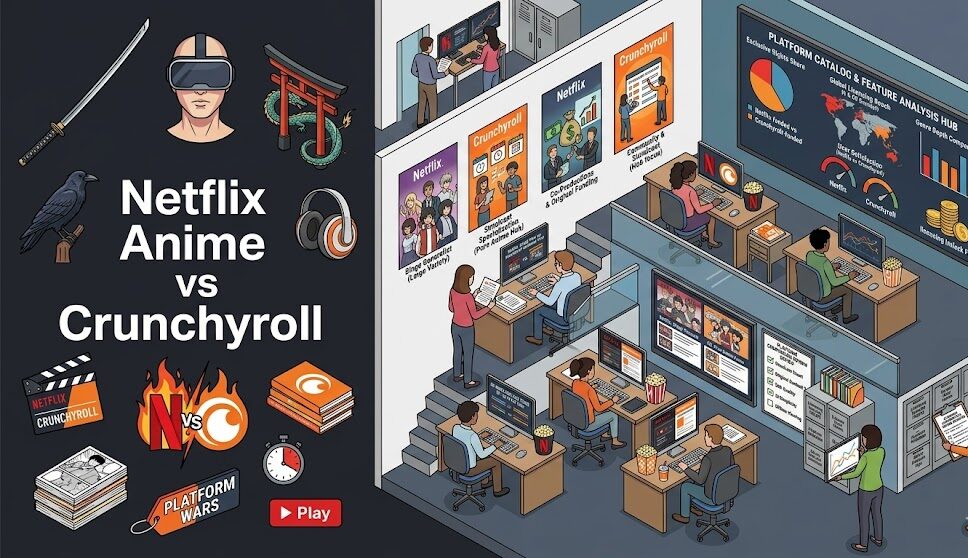
The question sounds simple: Netflix or Crunchyroll for anime? But the honest answer depends on what kind of anime viewer you are—and the right choice for a casual watcher is genuinely different from the right choice for someone who’s tracked seasonal simulcasts for a decade.
This isn’t a piece that ends with “both are great, subscribe to both.” That’s a dodge. This is a direct comparison of Netflix anime vs Crunchyroll on every dimension that matters—catalog depth, simulcast availability, original content, dub and subtitle quality, pricing, and interface—with a clear verdict at the end. If you’re paying for one subscription and wondering whether to switch, or deciding which to add, you’ll have a concrete answer by the time you finish reading.
In This Comparison
Track Which Anime Titles Netflix and Crunchyroll Are Acquiring Before Announcements
Vitrina’s AI intelligence layer monitors licensing deals, streaming commissions, and acquisition activity across Netflix, Warner Bros, Paramount, and 140,000+ companies globally—giving industry professionals a head start before titles trend. 200 free credits. No credit card required.
Catalog Size and Depth: Crunchyroll Is Not Even Close
Let’s start with the number that matters most. Crunchyroll carries approximately 1,000+ anime series and films globally—the largest dedicated anime catalog on any streaming platform. Netflix carries somewhere between 100 and 150 anime titles depending on territory, with significant variation by region. This isn’t a close comparison.
But raw volume isn’t the whole picture. What Netflix lacks in breadth it partially compensates with curation—its anime titles tend to be either high-profile franchise entries or carefully selected originals, and its catalog skews heavily toward titles that perform well globally. You’re unlikely to find deep-cut gems from the 1990s or niche seasonal series on Netflix. But you will find most of the anime that mainstream audiences actually want to watch.
Crunchyroll’s catalog, by contrast, is an actual archive. It carries classic series dating back to the early 2000s, regional content that Netflix doesn’t touch, and a depth of genre coverage—sports anime, mecha, shoujo—that Netflix simply doesn’t replicate. As covered in our comparison of the 2025 anime streaming platform landscape, Crunchyroll’s position as a catalog depth leader has only strengthened since its merger with Funimation consolidated two of the largest English-language anime libraries into one platform.
Winner: Crunchyroll—decisively. For serious fans who want access to the full range of anime history and seasonality, there’s no contest on catalog.
Simulcast and New Season Access: Crunchyroll Wins Again
If you follow seasonal anime—watching new episodes as they air in Japan—Crunchyroll is essentially the only answer. It has simulcast agreements with the majority of Japanese studios and licensors, delivering new episodes to international subscribers within 1 hour of Japanese broadcast. During peak seasons, Crunchyroll simulcasts upward of 50+ titles simultaneously.
Netflix doesn’t do simulcasting in the traditional sense. The platform typically acquires anime in batches, releasing full seasons or blocks of episodes rather than episode-by-episode following Japanese broadcast. For some originals it does release episodes on the same day as Japanese broadcast—but that’s a fraction of its catalog and doesn’t extend to licensed third-party series the way Crunchyroll’s model does.
The practical consequence: if Attack on Titan’s final episodes, Jujutsu Kaisen’s latest season, or a new Studio MAPPA commission starts airing in Japan, Crunchyroll subscribers watch it the same night. Netflix subscribers might wait months for a batch release—if the title comes to Netflix at all. For dedicated seasonal viewers, this is a decisive disadvantage.
Winner: Crunchyroll—not even a question. If seasonal access is your priority, Netflix can’t compete with this model.

Your AI Assistant, Agent, and Analyst for the Business of Entertainment
VIQI AI helps you plan content acquisitions, raise production financing, and find and connect with the right partners worldwide.
- Find active co-producers and financiers for scripted projects
- Find equity and gap financing companies in North America
- Find top film financiers in Europe
- Find production houses that can co-produce or finance unscripted series
- I am looking for production partners for a YA drama set in Brazil
- I am looking for producers with proven track record in mid-budget features
- I am looking for Turkish distributors with successful international sales
- I am looking for OTT platforms actively acquiring finished series for the LATAM region
- I am seeking localization companies offer subtitling services in multiple Asian languages
- I am seeking partners in animation production for children's content
- I am seeking USA based post-production companies with sound facilities
- I am seeking VFX partners to composite background images and AI generated content
- Show me recent drama projects available for pre-buy
- Show me Japanese Anime Distributors
- Show me true-crime buyers from Asia
- Show me documentary pre-buyers
- List the top commissioners at the BBC
- List the post-production and VFX decision-makers at Netflix
- List the development leaders at Sony Pictures
- List the scripted programming heads at HBO
- Who is backing animation projects in Europe right now
- Who is Netflix’s top production partners for Sports Docs
- Who is Commissioning factual content in the NORDICS
- Who is acquiring unscripted formats for the North American market
Original Content Quality: Netflix Takes This Round
This is where Netflix pulls ahead—and it’s a meaningful lead. Netflix’s anime originals include Devilman Crybaby (directed by Masaaki Yuasa, produced by Science SARU), Beastars (Studio Orange), Yasuke (MAPPA), Great Pretender (Wit Studio), Aggretsuko (Fanworks), Kotaro Lives Alone, and Blue Eye Samurai—the Emmy-winning adult animated series that has become one of the platform’s most-discussed commissions globally.
As reported by Variety, Netflix has committed to making anime one of its key content verticals, with dedicated original commissions from top Japanese studios running alongside international co-productions. The platform’s willingness to fund series that wouldn’t get produced through the traditional Japanese broadcast model—darker, shorter, more experimental—has produced some genuinely exceptional work.
Crunchyroll does produce originals, but its output is thinner and generally less ambitious. The platform’s strength has always been licensing and distribution rather than production. Its originals are competent but rarely the kind of cultural conversation starters Netflix’s best commissions become. This isn’t a criticism of Crunchyroll’s core model—it was built to curate and deliver Japanese content, not to compete with a $17 billion annual content budget.
Winner: Netflix—clearly. For original anime content, Netflix’s investment level and creative ambition are in a different tier entirely.
See Which Anime Studios Are Getting Commissioned on Both Platforms
Vitrina tracks production deals and streaming commissions across Netflix, Warner Bros, Paramount, and 140,000+ companies globally. Start with 200 free credits—no credit card required.
Dubs, Subtitles, and Localization: Different Strengths
Both platforms have invested significantly in localization—but they’ve done it differently, and those differences matter depending on how you watch.
Crunchyroll, through its merged Funimation library, now holds the largest English dub catalog in existence. Series that Funimation dubbed over two decades—Dragon Ball Z, Fullmetal Alchemist: Brotherhood, My Hero Academia, the entire Toei Animation back catalog—are available on Crunchyroll with English audio. And its simulcast subtitles are delivered fast, with quality that’s improved significantly in recent years.
Netflix dubs a higher percentage of its catalog than you’d expect—almost everything it produces or acquires gets dubbed in multiple languages, not just English. And its dub quality for originals is often exceptional: the Blue Eye Samurai English cast and the Beastars dub both earned positive critical notice. But Netflix’s dub library is shallower by volume—it covers its specific titles well, but can’t match the breadth of decades of Funimation dub production that Crunchyroll now carries.
For sub-watchers, Crunchyroll’s simulcast subtitles are typically faster and cover more titles. Netflix’s subtitles are polished but limited to its own catalog. Neither platform falls short on quality—they just cover different ground.
Winner: Split. Crunchyroll wins on dub volume and simulcast subtitles. Netflix wins on per-title dub quality for its originals. Where you land depends on whether you prioritize breadth or depth.
Pricing and Value in 2026
Crunchyroll’s pricing structure in 2026 runs roughly $7.99/month for the Fan tier (ad-supported, no dubs) up to $14.99/month for the Mega Fan tier (offline viewing, multiple streams, dubs included). There’s no completely free tier, though a limited ad-supported option exists. For dedicated anime viewers, the Mega Fan tier is what you actually need—dubs on everything plus offline downloads.
Netflix pricing in 2026 sits at approximately $7.99/month for the Standard with Ads plan up to $22.99/month for the Premium 4K plan. But Netflix carries significantly more content beyond anime—its subscription cost covers live-action series, films, documentaries, reality TV, and international content across every genre. On a pure value-per-dollar calculation for anime-only viewing, Crunchyroll delivers more for less. But if you’re already subscribed to Netflix for non-anime content, its anime library is essentially free from a marginal cost perspective.
Winner: Crunchyroll for anime-only value. Netflix wins if you already subscribe for other content.
The Verdict: Who Should Subscribe to What
Here’s the direct answer this article promised.
Subscribe to Crunchyroll if you: follow seasonal anime, want the deepest possible catalog, care about simulcast access, watch a broad range of genres including sports anime, mecha, and shoujo, or prioritize volume of dub content from the Funimation back catalog.
Subscribe to Netflix if you: primarily want to watch acclaimed originals like Blue Eye Samurai, Beastars, Devilman Crybaby, or Violet Evergarden; prefer a more curated, smaller catalog with high production quality; already use Netflix for other content; or are newer to anime and want a digestible entry point without a thousand-series archive to navigate.
Subscribe to both if you: are a dedicated anime viewer who watches both seasonal releases and platform originals, and can justify roughly $22/month total for both services. For hardcore fans, this is the real answer. Crunchyroll covers the seasonal and catalog depth. Netflix covers the originals and prestige productions. Neither completely replaces the other. As explored in our analysis of the best anime streaming platforms in 2025, the most engaged anime viewers in every major market now maintain subscriptions to multiple services—because no single platform holds everything worth watching.
But if you can only pick one? For serious anime fans—people who watch consistently, care about seasonal access, and want the full range of the medium—Crunchyroll is the default answer. Netflix is an excellent complement. It’s not a replacement. As reported by The Hollywood Reporter, Crunchyroll crossed 13 million paying subscribers globally—a base built almost entirely on anime-specific demand, not general streaming bundling. That subscriber profile tells you exactly what the platform was designed for.
Track Anime Acquisitions Across Netflix, Crunchyroll & Every Major Platform
Vitrina monitors deal activity across 400,000+ projects and 140,000+ companies globally—used by professionals at Netflix, Warner Bros, and Paramount to track what’s being licensed and commissioned. Start free with 200 credits. No commitment needed.
Frequently Asked Questions
Is Netflix or Crunchyroll better for anime in 2026?
For serious anime fans, Crunchyroll is the stronger dedicated platform — it carries 1,000+ titles versus Netflix’s 100-150, simulcasts new episodes within 1 hour of Japanese broadcast, and holds the largest English dub library through its Funimation merger. Netflix leads on original content quality and prestige productions. If you can only choose one, Crunchyroll is the default answer for dedicated viewers. Netflix is an excellent complement for its originals.
Does Netflix have more anime than Crunchyroll?
No. Crunchyroll carries approximately 1,000+ anime titles globally — significantly more than Netflix’s 100-150 titles. Crunchyroll was purpose-built for anime and holds one of the largest anime archives in existence, including classic series, seasonal simulcasts, and the former Funimation library. Netflix’s catalog is curated and smaller, but focuses on high-profile titles and original productions.
Does Crunchyroll have Netflix anime originals?
No. Netflix anime originals — including Devilman Crybaby, Beastars, Blue Eye Samurai, Great Pretender, Yasuke, and Aggretsuko — are exclusive to Netflix and not available on Crunchyroll. Similarly, Crunchyroll’s simulcast content and its Funimation-library titles are not available on Netflix. The two platforms hold separate, non-overlapping exclusive catalogs.
Is Crunchyroll cheaper than Netflix?
For anime-only viewing, yes. Crunchyroll’s Mega Fan tier (which includes dubs and offline downloads) runs approximately $14.99/month. Netflix’s equivalent plans are $15.49/month for Standard or $22.99/month for Premium 4K. But Netflix covers far more content categories beyond anime — so the value comparison depends on whether you use Netflix for its full catalog or specifically for anime.
Can you watch new anime episodes on Netflix the same day as Japan?
For some Netflix originals, yes — the platform has released select titles simultaneously with Japanese broadcast. But Netflix does not simulcast third-party anime the way Crunchyroll does. Most Netflix anime titles arrive in batch releases rather than weekly episode drops. For consistent same-day access to new anime from Japanese broadcast, Crunchyroll’s simulcast model is far more comprehensive.
Which is better for anime dubs — Netflix or Crunchyroll?
Crunchyroll has the larger English dub library — it inherited decades of Funimation dub production, covering thousands of episodes across hundreds of series. Netflix dubs a high percentage of its own catalog and its dub quality for originals is frequently excellent. But by sheer volume, Crunchyroll’s merged Funimation library makes it the dominant dub platform. Netflix wins on quality per title for its originals; Crunchyroll wins on breadth.
Should I subscribe to both Netflix and Crunchyroll for anime?
If you’re a dedicated anime viewer, both subscriptions together cost approximately $22-$30/month depending on plan tier — and they serve genuinely different needs. Crunchyroll covers seasonal simulcasts, catalog depth, and the Funimation back library. Netflix covers prestige originals and high-production-value commissions that don’t exist elsewhere. Most serious anime fans who’ve tried both find the combination covers the full spectrum of what they want to watch.
Is Crunchyroll worth it if I already have Netflix?
Yes, if you watch anime regularly. Netflix’s anime catalog — while excellent for its specific titles — doesn’t include simulcasts, most seasonal anime, sports anime, mecha, or the depth of classic series that Crunchyroll carries. If you’re watching more than 2-3 anime series at a time or following seasonal releases, Crunchyroll fills gaps that Netflix simply can’t. The Fan tier at around $7.99/month is a low-friction way to test whether the additional catalog depth is worth it for your viewing habits.
The Bottom Line on Netflix vs Crunchyroll for Anime
Crunchyroll wins the anime platform comparison for serious fans. Catalog depth, simulcast access, dub volume—it’s the purpose-built option for viewers who watch anime consistently and want the full range of the medium. Netflix wins on original content quality and prestige productions—and those originals are genuinely excellent, not consolation prizes.
But they’re not really competing for the same viewer. Crunchyroll is for anime fans. Netflix is for everyone—anime fans included, but not exclusively. And for the anime community specifically, that distinction matters.
Key Takeaways
- Catalog depth: Crunchyroll wins decisively — 1,000+ titles vs Netflix’s 100-150, with the full Funimation back library included after the merger.
- Simulcast access: Crunchyroll is the only serious option for seasonal viewers — new episodes within 1 hour of Japanese broadcast, 50+ titles per season.
- Original content: Netflix leads clearly — Blue Eye Samurai, Beastars, Devilman Crybaby, and Yasuke are among the most acclaimed anime originals produced for Western streaming audiences.
- Pricing: Crunchyroll delivers better anime-specific value at ~$14.99/month for Mega Fan; Netflix makes more sense if you already subscribe for non-anime content.
- Verdict: For serious fans — Crunchyroll first, Netflix second. Crunchyroll crossed 13 million paying subscribers globally precisely because dedicated anime viewers chose it as their primary platform. Netflix is the essential complement, not the replacement.
Stay Ahead of Anime Platform Moves Before They Become News
Vitrina tracks anime licensing deals, studio commissions, and streaming rights across Netflix, Warner Bros, Paramount, and 140,000+ companies globally. 200 free credits. No credit card required.
Need Custom Anime Acquisition Intelligence?
Our concierge team works directly with buyers and distributors across every major streaming platform globally.
Find Film+TV Projects, Partners, and Deals – Fast.
VIQI matches you with the right financiers, producers, streamers, and buyers – globally.
Producers Seeking Financing & Partnerships?
Book Your Free Concierge Outreach Consultation
(To know more about Vitrina Concierge Outreach Solutions click here)
Join Industry Briefings Trusted by Leaders
The Mid-Budget Comeback: Why Mid-Budget Films Is the Smartest Bet in the Room
Mid-budget films are attracting new capital. See why this segment is becoming one of the strongest bets in Film today.
Franchise Fatigue vs. IP Dependency: What Studios Should Be Betting On Now
s franchise performance softens, where will the next generation of valuable IP come from? Join the briefing.

Unscripted Is Eating the World: The Multi-Billion Reality and Format Boom
Unscripted is the new prestige — inside the $19.8B global format boom reshaping how streaming platforms compete.
How Co-Productions and Regional IP Are Reshaping Global Drama
As global drama evolves, which stories travel, which stay local, and how are they getting financed?