About Innovation Hub
 Global Content Pulse (Webinars)


 Global Production Financing
(Webinars)
Global Production Financing
(Webinars)  LeaderSpeak Podcast
  About Vitrina
 Our Story
 Our Solutions 🔥
 Film+TV Projects Tracker 🚀
 Case Studies
 Our Profile
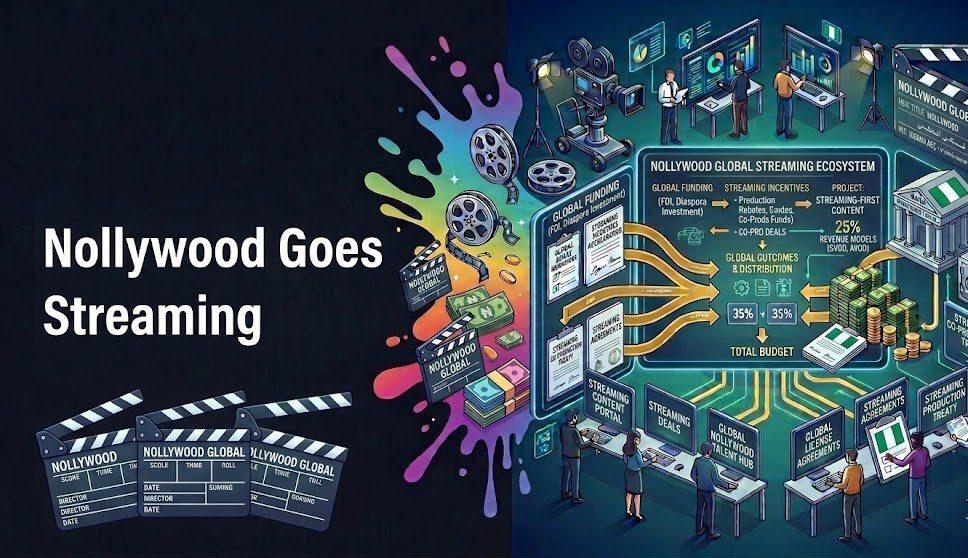
Nigeria produces more films per year than any country in the world except India. Think about that for a moment. Over 2,500 titles annually. Yet until recently, almost none of that output was closing deals with Netflix, Amazon Prime Video, or Apple TV+.
The content existed. The audience existed — a diaspora market spanning the UK, US, Canada, and continental Europe, plus 220 million domestic viewers hungry for stories that look and sound like their lives. The distribution infrastructure to connect them? That was the missing piece.
That’s changing — faster than most Western buyers realize. Nollywood streaming deals with global platforms are no longer aspirational; they’re operational. Netflix has greenlit Nigerian originals. Amazon Prime Video has acquired Nollywood catalog. Canal+ has made Africa a strategic acquisition priority.
And the Nigerian studios that are winning these deals aren’t winning on volume. They’re winning because they’ve made a deliberate pivot on production quality, IP packaging, and deal structure literacy that the global platforms actually respond to.
But here’s what’s still broken: most Nigerian studios are operating with incomplete intelligence about how global platform acquisition actually works — what triggers a greenlight, what delivery requirements look like, how to structure a rights package that doesn’t give away your entire upside on your first deal. And most global buyers, in turn, are working from a Nollywood mental model that’s five years out of date. Both problems are solvable. This guide shows you how.
Find Which Global Platforms Are Actively Acquiring Nollywood Content Right Now
Ask VIQI — Vitrina’s entertainment AI trained on 1.6 million titles, 360,000 companies, and 5 million entertainment professionals. Real-time acquisition intelligence that no trade directory carries.
✓ 200 free credits | ✓ No credit card required
Why Global Platforms Are Finally Taking Nollywood Seriously
The honest reason global platforms ignored Nollywood for so long wasn’t cultural — it was structural. Production quality was inconsistent. Rights were poorly documented, with overlapping territorial claims that made acquisition legally complicated. Delivery specifications — the technical requirements platforms need to publish content — weren’t being met. And the deal terms Nigerian studios were accepting in early streaming negotiations often gave platforms global rights in perpetuity for fees that didn’t reflect the actual market value of the IP.
But the Sovereign Content Hub™ shift has accelerated Nigerian cinema’s evolution. According to Vitrina’s own industry framework, Nigeria sits in Tier 3 — an emerging hub with high output volume, strong diaspora cultural export strength, and growing infrastructure. That Tier 3 designation isn’t a ceiling. It describes where Nollywood was; the trajectory points clearly upward.
The data behind the shift is concrete. Netflix’s Blood Sisters — produced by Nigerian studio EbonyLife — became one of the platform’s most-watched titles in Africa within weeks of its 2022 premiere and generated significant viewership in the UK and US diaspora markets. Amazon Prime Video followed. Canal+ committed to acquiring 500 African films and series over five years, with Nigeria as a primary production partner. The deals aren’t anecdotal anymore. They’re a pattern.
And as Variety has reported, the global platforms’ Africa strategies are being driven by subscriber growth imperatives that make local-language content acquisition commercially essential — not culturally charitable. Sub-Saharan Africa represents one of the last genuinely underpenetrated SVOD markets globally. Nigeria, with its English-language production base and 220 million population, is the most logical entry point.
The FilmOne Model: What a Bankable Nollywood Operation Actually Looks Like
Want to understand how Nollywood studios are positioning for global platform deals? Start with Moses Babatope, co-founder and managing director of FilmOne — the company that’s arguably done more than any other to define what professional Nigerian film distribution and production looks like at scale.
FilmOne operates across both sides of the value chain: distributing international content into Nigeria (making it one of the few companies that understands what Nigerian audiences will pay for) while simultaneously developing and producing Nigerian originals targeting the export market. That dual position is the intelligence advantage. You can’t pitch Nollywood content to a global platform without understanding what that same platform’s competition looks like inside the Nigerian market. FilmOne understands both simultaneously.
Babatope identifies three genres as specifically export-friendly for Nollywood’s international push: epic, drama, and crime. Not coincidentally, these are the same three genre categories that travel best internationally for every other non-English-language cinema — from Korean thriller to Turkish historical epic to Indian period drama. They’re universally accessible, emotionally resonant, and they don’t require deep cultural context to appreciate. Epic Nigerian historical storytelling — the Benin Kingdom, the Yoruba empire, the transatlantic history — lands with international audiences in a way that Nollywood romantic comedy, however technically accomplished, typically doesn’t.
Hear Moses Babatope break down FilmOne’s approach and the 2026 opportunity in Nollywood directly:
How Nollywood Streaming Deals Actually Close in 2026
The mechanics of closing a Nollywood streaming deal with a global platform are genuinely different from how a UK or US independent closes the same type of deal. Understanding the differences isn’t optional — it’s the difference between a deal closing and a deal dying in development limbo for 18 months.
What Netflix, Amazon, and Canal+ Are Actually Buying
The global platforms are buying along three distinct models in Nigeria — and which model they use depends on how well-packaged your project is, not how good your story is.
Commission/Original Model: The platform funds the entire production in exchange for exclusive global rights. This is the EbonyLife/Netflix model. The upside: full funding, guaranteed global distribution. The downside: you give up your IP ownership entirely, and the license fee — however large it looks — is the ceiling of your financial return. No backend. No sequel rights. No format licensing. For first-deal positioning with a major platform, it can make strategic sense. But don’t structure your second and third deals the same way.
Finished Content Acquisition: You produce independently, then license the finished content to the platform for specific territories. The Nigerian studio retains IP ownership and can window across multiple platforms globally. The leverage requirement: your project needs to be production-complete, technically delivered to platform spec, and commercially packaged with recognizable cast. This is harder to achieve, but it protects your long-term asset value. Diaspora markets — UK, US, Canada — are typically where the most meaningful license fees live for this model.
First-Look/Output Deal: A platform pays a development or first-look fee for priority access to your slate before you take it elsewhere. This is the relationship-based deal — typically available to studios that have already demonstrated commercial success in the Nigerian theatrical market and have a track record of delivering at platform spec. FilmOne’s market position makes this type of deal architecture accessible; most Nigerian studios aren’t yet in this conversation.
The Technical Delivery Problem (And How to Solve It)
Here’s the insider candor that most articles on this topic skip over: the single biggest reason Nollywood streaming deals stall or fail post-negotiation isn’t the deal terms. It’s technical delivery failure.
Global platforms have extremely specific delivery requirements — minimum resolution, audio specs, closed caption formats, metadata standards, certification documentation. A project that passes creative review and survives rights verification can still collapse at delivery because the Nigerian post-production facility that completed the project wasn’t working to international delivery specifications. The platform issues a delivery rejection notice. The producer scrambles for remediation. Legal timelines slip. Payment gets delayed. The deal dies in exhaustion rather than disagreement.
The studios closing deals consistently in 2026 have solved this problem upstream — either by partnering with post-production facilities that already hold verified platform delivery credentials, or by investing in their own post pipelines to meet international spec from principal photography onwards. Our guide to top production houses in Nigeria profiles the facilities operating at international technical standards. The distinction matters enormously when you’re heading into a platform acquisition process.
Track Every Active Buyer of African Content Across Global Platforms
Trusted by Netflix, Warner Bros, Paramount, and Google TV. Join 140,000+ companies using Vitrina to surface acquisition-ready platform buyers — including every streamer actively building their African content library.
✓ 200 free credits | ✓ No credit card required | ✓ Cancel anytime
Rights Packaging and the Diaspora Market: Where the Real Revenue Lives
Let’s talk about the number that most Nollywood distribution conversations avoid: the value of the diaspora market. Nigeria has an estimated 17 million diaspora residents across the UK, US, Canada, continental Europe, and the Caribbean — the largest African diaspora in the world by economic output. These audiences consume Nigerian content voraciously, have demonstrated willingness to pay premium subscription fees for exclusive access, and are dramatically underserved by the current legitimate streaming landscape.
The diaspora market is where Nollywood studios should be building the most sophisticated rights packaging — and where most are leaving the most money on the table. Why? Because the default Nigerian distribution approach has been to sell global rights in a single transaction rather than carving the rights geography to maximize per-territory value.
UK diaspora rights — licensed to a premium SVOD with an active Nigerian-British subscriber base — can generate license fees that dwarf what you’d receive for the same content bundled into a broader Africa rights package. US rights sold to a platform with a strong diaspora marketing capability command a different premium than those same rights bundled into a Netflix global deal. The distinction requires deal sophistication that most Nigerian studios haven’t historically needed — but increasingly must have.
The model to study isn’t Hollywood. It’s Nollywood’s relationship with the Nigerian domestic theatrical market — which FilmOne has demonstrated can generate NGN 1B+ (approximately $700K+) box office on a single major title within a weekend, entirely through domestic Nigerian theatrical release. That theatrical leverage — building domestic commercial validation before an international deal — is the same playbook that Korean cinema used before the global streaming era and that Bollywood is increasingly deploying in its international partnership strategy. Domestic proof of demand is your most credible negotiating asset with any global platform. Our in-depth look at the FilmOne and Nigerian cinema ecosystem covers how this domestic validation strategy translates to international negotiating position.

Your AI Assistant, Agent, and Analyst for the Business of Entertainment
VIQI AI helps you plan content acquisitions, raise production financing, and find and connect with the right partners worldwide.
- Find active co-producers and financiers for scripted projects
- Find equity and gap financing companies in North America
- Find top film financiers in Europe
- Find production houses that can co-produce or finance unscripted series
- I am looking for production partners for a YA drama set in Brazil
- I am looking for producers with proven track record in mid-budget features
- I am looking for Turkish distributors with successful international sales
- I am looking for OTT platforms actively acquiring finished series for the LATAM region
- I am seeking localization companies offer subtitling services in multiple Asian languages
- I am seeking partners in animation production for children's content
- I am seeking USA based post-production companies with sound facilities
- I am seeking VFX partners to composite background images and AI generated content
- Show me recent drama projects available for pre-buy
- Show me Japanese Anime Distributors
- Show me true-crime buyers from Asia
- Show me documentary pre-buyers
- List the top commissioners at the BBC
- List the post-production and VFX decision-makers at Netflix
- List the development leaders at Sony Pictures
- List the scripted programming heads at HBO
- Who is backing animation projects in Europe right now
- Who is Netflix’s top production partners for Sports Docs
- Who is Commissioning factual content in the NORDICS
- Who is acquiring unscripted formats for the North American market
Co-Production as a Streaming Shortcut: Why It Works for Nollywood Right Now
There’s a faster route to global platform deals than trying to sell Nigerian-produced, Nigerian-financed content to a skeptical commissioning executive who’s never been to Lagos. It’s co-production — and it’s working.
A Nigerian studio co-producing with a UK, US, or South African partner brings two things to the table that the solo Nigerian producer can’t: first, production quality credibility that satisfies platform technical standards from the outset; second, a recognizable entity on the deal that platform commissioning executives already have a relationship with. The Nigerian partner brings the story, the cultural authenticity, the location, and ideally the cast. The international partner brings the financing access, the technical infrastructure, and the platform relationships. Done right, both sides come out with something they couldn’t have built independently.
Nigeria has bilateral cultural agreements with several countries — though the formal co-production treaty infrastructure is less developed than, say, the UK-India or Canada-Australia frameworks. That means most Nigeria-international co-productions are structured as unofficial production partnerships (Production Service Agreements or co-production MOUs) rather than official bilateral treaty co-productions. You don’t get automatic multi-territory national status, but you get the operational and deal-closing benefits of a structured partnership. For studios exploring this route, our guide on international co-production as a strategic imperative covers both treaty and non-treaty structures in practical terms.
As Deadline has covered, streaming platforms are specifically seeking African co-production partners rather than purely acquired content — because co-productions give them creative input, delivery certainty, and IP participation that pure acquisitions don’t. That platform preference is a structural tailwind for Nigerian studios who can structure a credible co-production proposition.
The Fragmentation Problem: Why Discovery Is Still Nollywood’s Biggest Barrier
Here’s a structural reality that’s rarely spoken plainly in discussions about Nollywood’s global potential: the Fragmentation Paradox™ is particularly severe in the Nigerian market. Over 2,500 titles produced annually by hundreds of studios operating at highly variable quality and professionalization levels, with no centralized tracking of production status, rights ownership, or technical delivery capability. Global buyers trying to identify bankable Nigerian content partners face an information desert.
The 15-20% margin leakage that fragmentation creates in other markets shows up differently in Nollywood — but it’s just as real. It manifests as good projects that never get seen by the right buyers because there’s no verified discovery path. It manifests as platform deals that stall because rights documentation is incomplete. And it manifests as the persistent perception gap between what Nollywood is capable of producing in 2026 and what global buyers believe they’ll find if they start looking.
Vitrina maps 140,000+ active film and TV companies globally — including Nigerian production entities across Nollywood’s Lagos ecosystem and emerging hubs — with verified project histories, deal activity, and technical capability profiles. For global buyers trying to identify which Nigerian studios are actually platform-ready, the difference between informed outreach and uninformed mass inquiry is the difference between closing a deal in 6 weeks and spending 6 months in due diligence. For Nigerian studios seeking to get in front of the right platform buyers — not just the loudest ones — that same intelligence infrastructure maps which platforms are actively in acquisition mode before a market visit. Our resource on African film grants and financing for producers also covers the non-platform capital stack that Nigerian studios can access to strengthen their deal position before they go to a streamer.
Connect Nigerian Studios with Global Platform Buyers — Verified, Matched, Deal-Ready
Trusted by Netflix, Warner Bros, Paramount, and Google TV. Track 400,000+ projects and access 3 million verified executives — including every active buyer commissioning or acquiring African content in 2026.
✓ 200 free credits | ✓ No credit card required | ✓ Full platform access
Need direct introductions to platform commissioning executives for Nollywood content? Explore Concierge Service →
Frequently Asked Questions
Which global platforms are actively acquiring Nollywood content in 2026?
Netflix, Amazon Prime Video, and Canal+ are the three most active global platform acquirers of Nigerian content in 2026. Netflix has greenlighted Nigerian originals (including the breakout Blood Sisters produced by EbonyLife). Canal+ committed to acquiring 500 African films and series over five years, with Nigeria as a priority market. Amazon Prime Video has acquired Nollywood catalog titles. Regional platforms including Showmax and iROKOtv remain active in catalog acquisition for diaspora audiences.
What genres of Nollywood content travel best internationally?
According to Moses Babatope, co-founder and MD of FilmOne — one of Nigeria’s leading production and distribution companies — the most export-friendly Nollywood genres are epic, drama, and crime. These genres carry universal narrative themes that don’t require deep cultural context for international audiences. Nigerian historical epic content — stories rooted in the Benin Kingdom, Yoruba empire, and transatlantic history — has demonstrated particular resonance with both diaspora and non-Nigerian audiences on global platforms.
How many films does Nigeria produce per year?
Nigeria produces over 2,500 films annually — making it the world’s second-largest film industry by output after India. Despite this volume, only a small fraction of Nigerian productions have historically closed deals with global streaming platforms. The gap between production volume and international distribution success is primarily a structural issue around production quality, IP packaging, and technical delivery standards — not a lack of creative output.
What is FilmOne and why is it important for Nollywood’s global expansion?
FilmOne, co-founded and led by Moses Babatope, is one of Nigeria’s most influential film production and distribution companies — operating across both domestic theatrical distribution (including distributing major international titles in Nigeria) and original content development targeting international markets. FilmOne’s dual-market position — understanding both what Nigerian audiences watch and what global platforms want — makes it a benchmark for the professionalized Nollywood studio model that global platform deals require.
Why do Nollywood streaming deals fail after negotiation?
The most common reason is technical delivery failure — not deal terms. Global platforms have strict delivery specifications (minimum resolution, audio standards, closed caption formats, metadata requirements) that many Nigerian post-production facilities haven’t historically met. A project that passes creative review and rights verification can still be rejected at delivery stage, causing timeline slippage, payment delays, and deal collapse. Nigerian studios closing deals consistently in 2026 either partner with post facilities holding verified platform delivery credentials or have invested in their own post pipelines to international specification.
Is co-production the best route for Nigerian studios to access global streaming deals?
Co-production is currently the fastest route for most Nigerian studios — not necessarily the most lucrative long-term. Partnering with a UK, US, or South African production company gives Nigerian studios instant credibility with platform commissioning executives who already have existing relationships with the international partner. The Nigerian studio contributes story, cultural authenticity, locations, and cast; the international partner contributes financing access, technical infrastructure, and platform relationships. For studios without a track record of platform-ready solo productions, co-production is the strategic on-ramp to building that track record.
Conclusion: Nollywood’s Global Moment Is Now — But the Window Has Conditions
The headline story is real: Nollywood streaming deals with global platforms are closing in 2026 at a scale and regularity that wasn’t true three years ago. Netflix, Amazon, Canal+ — all active, all with stated Africa strategies, all looking for Nigerian content that can perform across diaspora and broader global audiences. But the conditions on that window matter. This isn’t a rising tide that lifts all boats. It’s a selective platform demand for specifically packaged, technically delivered, rights-clean Nigerian IP that most of the 2,500 titles produced annually don’t yet meet.
- Genre selection is deal selection: Epic, drama, and crime travel globally. Pitch the right genre to the right platform or you’re starting the conversation with a disadvantage you can’t negotiate away.
- Technical delivery is non-negotiable: The deal that collapses at delivery is worse than no deal. Solve the post-production spec problem before you enter platform negotiations, not after.
- Rights packaging determines your ceiling: Selling global rights in a single transaction is the beginner move. Carving diaspora territories — UK, US, Canada — as separate licensing windows unlocks dramatically higher total value from the same IP.
- Domestic validation is international leverage: A Nigerian theatrical hit is your most credible negotiating asset with a global platform. Build the domestic proof of demand before you walk into a Netflix or Amazon pitch.
- Co-production is the fastest on-ramp: Partnering with an international co-producer solves the credibility and technical gap in a single move — and gives you the platform relationships you don’t yet have on your own.
Map Nollywood’s Platform Opportunity — 140,000+ Companies, Real-Time Intelligence
Trusted by Netflix, Warner Bros, Paramount, and Google TV. Join 140,000+ companies on Vitrina — the only platform with real-time acquisition intelligence across every streaming service building an African content library in 2026.
✓ 200 free credits | ✓ No credit card required | ✓ Full platform access
Find Film+TV Projects, Partners, and Deals – Fast.
VIQI matches you with the right financiers, producers, streamers, and buyers – globally.
Producers Seeking Financing & Partnerships?
Book Your Free Concierge Outreach Consultation
(To know more about Vitrina Concierge Outreach Solutions click here)
Producers Seeking Financing, Co-Pros, or Pre-Buys?
Vitrina Concierge helps producers reach the right financiers, commissioners, distributors, and co-production partners — with precision outreach, not cold pitching.
Join Industry Briefings Trusted by Leaders
Streamers – Netflix vs. Amazon – The 2026 Strategy
How Netflix and Amazon’s content and revenue strategies are diverging ahead of 2026.
Format Adaptations: Global Trends
Where formats are traveling, which adaptations are breaking out, and how streamers are backing remakes in 2025–2026.

Books, Novels & Comics Adaptations: Global Trends
Books, webtoons, and manga driving the next global screen hits. Discover how in this webinar.