About Innovation Hub
 Global Content Pulse (Webinars)


 Global Production Financing
(Webinars)
Global Production Financing
(Webinars)  LeaderSpeak Podcast
  Global Entertainment Digest (Newsletter)
  About Vitrina
 About VIQI
 Our Story
 Our Solutions 🔥
 Film+TV Projects Tracker 🚀
 Case Studies
 Our Profile
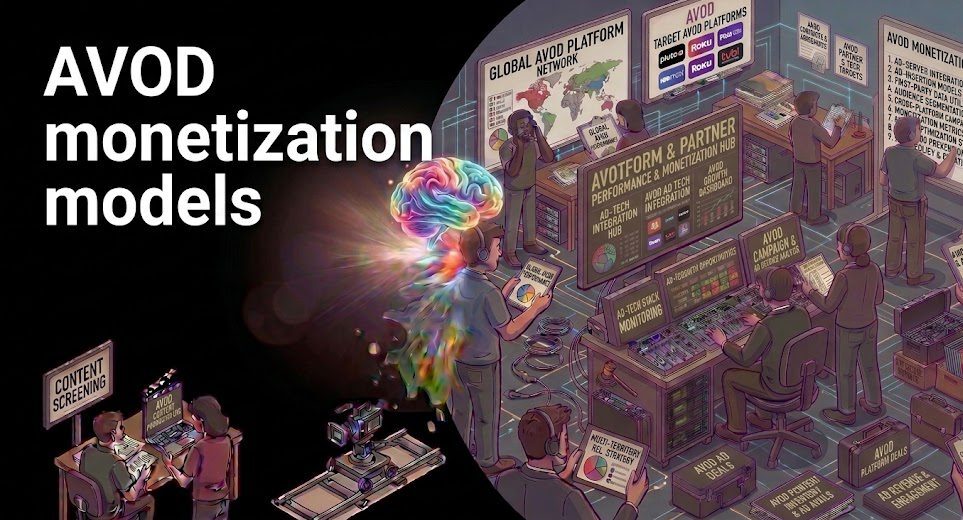
Streaming subscriptions are under pressure. Churn rates are climbing, subscriber growth is flattening—and the platforms that figured out AVOD monetization models first are now collecting revenue from two directions simultaneously. If you’re still treating ad-supported streaming as a fallback window, you’re watching the main event from the wrong seat.
Netflix’s ad-supported tier crossed 40 million monthly active users by mid-2024. Tubi pulls 80M+ registered users without charging a single subscriber. Pluto TV runs 250+ channels—and Paramount collects ad revenue on every one of them. The shift from subscription-first to hybrid monetization isn’t coming. It’s here, it’s operating at scale, and the producers, distributors, and platform operators who haven’t restructured their revenue models are already behind.
What’s actually happening: the subscription market isn’t collapsing—it’s maturing. The marginal subscriber is harder and more expensive to acquire. AVOD monetization solves a real affordability problem for viewers while giving platforms a second (and sometimes primary) revenue stream. In 2026, the question isn’t whether AVOD works. It’s which model works for your content, your catalog, and your capital structure.
In This Article
- Why AVOD Is Reshaping Streaming Revenue in 2026
- The 7 AVOD Monetization Models That Matter
- FAST Channels: The Revenue Machine Most Distributors Underestimate
- How to Structure Your AVOD Catalog for Maximum CPM
- AVOD Analytics: What Whip Media Taught the Industry
- The Hybrid AVOD + SVOD + TVOD Play
- What the AVOD Revenue Split Actually Looks Like
- Frequently Asked Questions
- Key Takeaways
Which AVOD Platforms Are Actively Acquiring Your Content Genre?
The platform commissioning intelligence is scattered across deal memos, trades, and closed-door conversations. VIQI surfaces it in seconds—telling you exactly which FAST and AVOD platforms are buying, in which categories, and at what deal terms. Trusted by teams at Netflix, Warner Bros, and Paramount.
No account required. Ask your first question free.
Why AVOD Is Reshaping Streaming Revenue in 2026
The shift didn’t happen overnight. But by 2025, the pattern was clear: every major SVOD platform either launched an ad-supported tier or found itself increasingly irrelevant to price-conscious audiences. Netflix moved first among premium streamers, launching at $6.99/month in November 2022. Disney+ followed. Now both run dual-model operations—SVOD for premium subscribers, AVOD for everyone else—and the ad tier is growing faster than the paid one. As Variety reported, Netflix’s ad-supported membership grew 34% quarter-over-quarter in late 2024, outpacing subscription tier growth across all tracked markets.
And it’s not just the big players. For FAST channel operators and independent content owners, AVOD is now the primary distribution path for back catalog. You’re not getting a Netflix greenlight for your library titles. But you can get your IP on Tubi, Pluto TV, and 12 other ad-supported platforms—and earn CPM revenue from day one, with no subscriber acquisition cost eating your margin.
But here’s the dynamic that’s reshaping deal structures: as our analysis of AVOD and FAST platform analytics solutions shows, content owners who negotiate data access alongside revenue share are extracting significantly more long-term value than those trading on headline split percentages alone.

Your AI Assistant, Agent, and Analyst for the Business of Entertainment
VIQI AI helps you plan content acquisitions, raise production financing, and find and connect with the right partners worldwide.
- Find active co-producers and financiers for scripted projects
- Find equity and gap financing companies in North America
- Find top film financiers in Europe
- Find production houses that can co-produce or finance unscripted series
- I am looking for production partners for a YA drama set in Brazil
- I am looking for producers with proven track record in mid-budget features
- I am looking for Turkish distributors with successful international sales
- I am looking for OTT platforms actively acquiring finished series for the LATAM region
- I am seeking localization companies offer subtitling services in multiple Asian languages
- I am seeking partners in animation production for children's content
- I am seeking USA based post-production companies with sound facilities
- I am seeking VFX partners to composite background images and AI generated content
- Show me recent drama projects available for pre-buy
- Show me Japanese Anime Distributors
- Show me true-crime buyers from Asia
- Show me documentary pre-buyers
- List the top commissioners at the BBC
- List the post-production and VFX decision-makers at Netflix
- List the development leaders at Sony Pictures
- List the scripted programming heads at HBO
- Who is backing animation projects in Europe right now
- Who is Netflix’s top production partners for Sports Docs
- Who is Commissioning factual content in the NORDICS
- Who is acquiring unscripted formats for the North American market
The 7 AVOD Monetization Models That Matter
Not all AVOD is identical. The structure you choose determines your CPM ceiling, your content acquisition terms, and how much operational overhead you’re absorbing. Strategic players understand the distinction—and pick their model based on catalog depth, territory rights, and internal sales capacity.
1. Platform Revenue Share (FAST/AVOD Licensing)
The most common entry point. You license your content to Tubi, Pluto TV, or a comparable platform—they sell the ads, you take a revenue split. Typical splits run 50/50 to 70/30 in the platform’s favor, depending on exclusivity, catalog volume, and promotional guarantees. It’s low-overhead but low-ceiling.
2. Self-Operated FAST Channel
More complex, more profitable. You operate your own FAST channel through Samsung TV Plus, Plex, or LG Channels, retaining control of your ad inventory. Your CPM ceiling is higher—but so is your sales overhead. This model makes sense when your catalog has 100+ hours of cohesive, genre-specific content and you have the operational resources to run it.
3. Hybrid SVOD/AVOD
Netflix, Disney+, and Peacock all run this now. Premium subscribers pay monthly; ad-tier subscribers get the content at a lower price point in exchange for pre-roll and mid-roll advertising. The EBITDA math works when your content can support both audience segments without cannibalizing premium ARPU.
4. Freemium with Premium Upsell
IMDb TV (now Amazon’s ad-supported Prime tier) uses this effectively. Free AVOD access is the default; ad-free viewing or premium content costs extra. It’s a funnel model—AVOD is customer acquisition, SVOD is monetization upside.
5. Branded Content Integration
Sean Atkins, CEO of Dhar Mann Studios, built branded integration into the studio’s core model. With over 1 billion monthly views and content dubbed in seven languages, Dhar Mann aligns brand partnerships directly with content—making ad integration indistinguishable from editorial. The CPM equivalent exceeds standard pre-roll rates by a meaningful margin, and the content budget recoupment timeline shrinks accordingly.
6. Syndication-to-AVOD Windowing
Classic IP with established audiences gets a second revenue life through AVOD windowing. Fremantle’s partnership with Pluto TV—25 FAST channels across 13 new markets, featuring titles like Baywatch and Three’s Company—is textbook syndication-to-AVOD. Production costs were recouped decades ago. Every ad impression now is pure margin.
7. Dynamic Ad Insertion (DAI) for Live FAST
The most technically demanding model—but standard for sports, news, and live content. DAI serves personalized ads into live streams, driving CPM improvements of 30-60% versus static pre-roll. Gracenote’s content metadata infrastructure underpins most of this at scale. It’s where the highest AVOD CPM rates consistently concentrate.
FAST Channels: The Revenue Machine Most Distributors Underestimate
FAST isn’t a fallback. For catalog-heavy distributors and production companies with established libraries, FAST channels are one of the cleanest monetization structures in the current market—and the overhead is lower than most operators expect.
The operating model: curate a themed channel from existing content (unscripted, true crime, classic drama—whatever your catalog supports), distribute through a FAST aggregator or directly to connected TV platforms, and collect a share of ad revenue based on viewing hours. You’re not producing new content. You’re de-risking revenue from IP you already own.
Track Every AVOD Platform Deal Before It Hits the Trades
Vitrina indexes 140,000+ companies and 400,000+ projects across the global entertainment supply chain—including which FAST and AVOD platforms are acquiring, which genres they’re prioritizing, and which distribution partnerships are being structured right now. Teams at Netflix, Warner Bros, and Paramount use Vitrina to surface deals weeks before public announcement.
Start with 200 free credits. No credit card required.
Tim Cutting of Gracenote—whose metadata infrastructure powers content discovery across major FAST platforms—has been direct about what separates performing FAST channels from underperforming ones: metadata quality. Channels with proper episodic metadata, accurate genre tagging, and clean rights documentation get surfaced and promoted. Channels without it don’t appear in discovery at all. That binary outcome is why FAST channel operations fail at the data layer, not the content layer.
If you want to see how this plays out at scale, our breakdown of FAST channel visibility and monetization dynamics covers the distribution mechanics—and the metadata standards that determine whether your channel earns or disappears.
How to Structure Your AVOD Content Catalog for Maximum CPM
CPM is your core metric in AVOD monetization. And the range is wild. Premium, brand-safe content in high-demand categories—drama, documentary, family—commands $8-15 CPM on average. Less curated content on smaller platforms can sit below $2 CPM. That’s a 7x spread on identical viewing hours. The difference isn’t the platform. It’s the catalog.
Here’s the thing: the content mix you bring to an AVOD partner matters as much as the volume. A tightly curated library of 200 brand-safe hours in a specific genre consistently outperforms 2,000 hours of mixed, uncategorized content. Major advertisers have strict brand safety requirements—and if your catalog includes content that fails their screening, the entire package takes a CPM hit.
What smart AVOD catalog negotiations look like right now:
- Exclusivity windows are shrinking. Platforms want AVOD rights, but producers are protecting windowing flexibility more aggressively. Don’t sign broad exclusivity without a defined term—12 to 18 months maximum.
- Territory segmentation is the real arbitrage. US AVOD CPMs run 3-5x what you’ll see in EMEA markets. Know exactly which territorial rights you’re licensing before you sign anything.
- Data-sharing clauses are becoming standard. If you’re not negotiating access to viewership analytics as part of your AVOD deal, you’re trading future intelligence for a marginal bump in your initial revenue split—and that’s a bad trade.
For producers managing content across multiple distribution channels simultaneously, our breakdown of ad-supported streaming production budgets covers how AVOD revenue feeds back into greenlight decisions—and how to build AVOD recoupment into your production financing from day one.
AVOD Analytics: What Carol Hanley and Whip Media Taught the Industry
Carol Hanley, CEO of Whip Media, has spent years building the analytics infrastructure that streaming platforms and FAST channel operators rely on to track royalties, ad revenue, and audience performance across AVOD and SVOD tiers. Her conversation with Vitrina is one of the clearest breakdowns of how the data actually flows—and where most operators are still running blind.
The core problem she surfaces: most AVOD operators can see impressions but not revenue attribution at the content level. You know how many ads ran against your show. But you don’t know which episodes drove disproportionate advertiser value—or which content is suppressing your platform CPM because of brand safety adjacency issues. Without that granularity, you can’t optimize your catalog, your scheduling, or your deal terms.
Whip Media’s tooling closes that gap. And it’s exactly the kind of operational intelligence that separates AVOD operators generating $4 CPM from those generating $12 CPM on identical viewing hours.
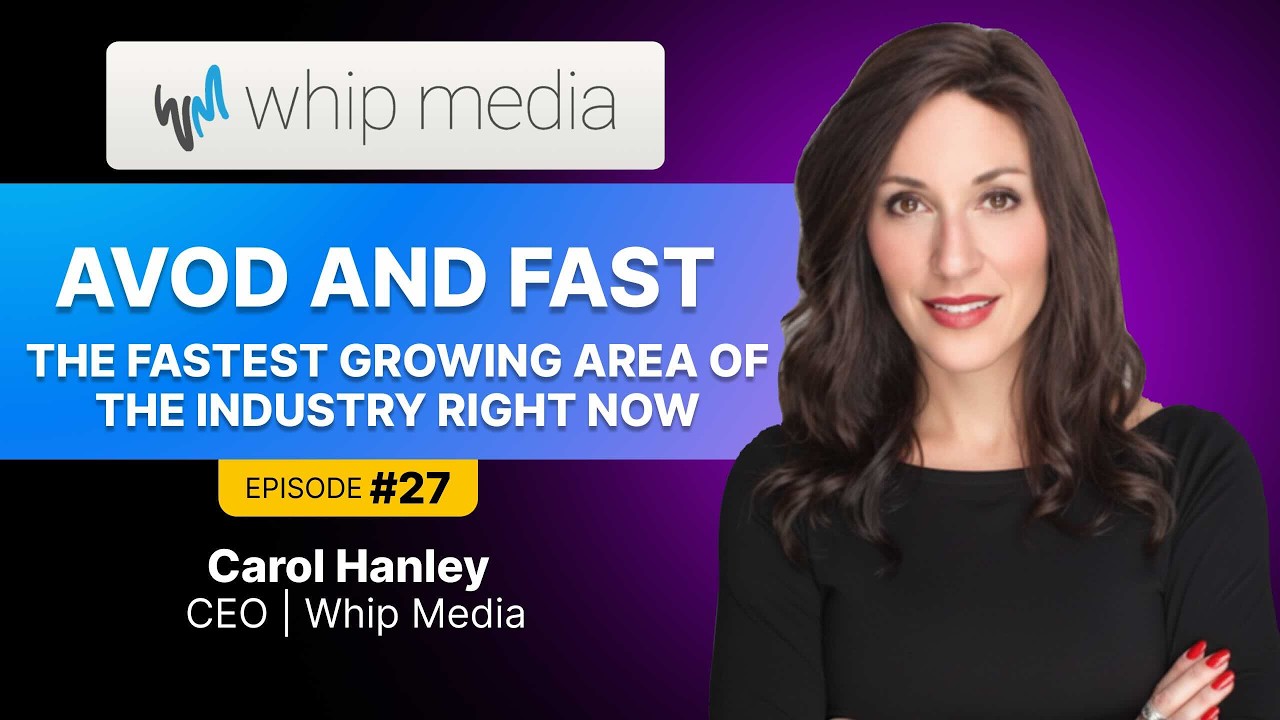
Carol Hanley (CEO, Whip Media) on AVOD, FAST, and the analytics infrastructure behind streaming monetization — via Vitrina Podcast.
The Hybrid AVOD + SVOD + TVOD Play
The smartest operators in 2026 aren’t choosing a single monetization model—they’re running all three simultaneously, with each revenue stream de-risking the others.
Here’s how that capital stack typically structures:
- SVOD provides baseline recurring revenue from premium subscribers. Predictable, high-LTV, but subscriber acquisition costs are rising and churn management is an active operational burden.
- AVOD captures price-sensitive audience segments and generates ad revenue—increasingly competitive with SVOD ARPU on a per-user basis when CPMs are properly optimized.
- TVOD handles event content: new theatrical releases, live sports, premium tentpoles. Single-transaction revenue with no subscriber commitment and no ongoing churn risk.
For regional streamers outside the US—from OSN in MENA to platform operators across APAC—this hybrid model is becoming the operational standard. The windowing discipline that makes it work requires robust internal intelligence infrastructure, which is why data-driven acquisition decisions are replacing gut-feel commissioning at every tier of the market.
If you’re modeling this for a new platform launch or a strategic pivot, our streaming content ROI calculation framework gives you the financial structure to stress-test different monetization mixes—and pressure-check your AVOD assumptions against real CPM data—before you commit capital.
Need a Specialist to Structure Your AVOD Distribution Strategy?
Vitrina’s concierge team works with production companies, distributors, and platform operators to map AVOD partnership options, negotiate catalog deals, and structure hybrid monetization models. The same intelligence that helps teams at Netflix and Warner Bros close faster—available to your team, with no long-term commitment required.
What the AVOD Revenue Split Actually Looks Like
Let’s be direct about the economics—because headline CPM numbers don’t tell the full story, and a lot of content owners are signing AVOD deals based on numbers that look better than they perform.
On a standard revenue-share FAST deal, you’re typically netting 40-50 cents on the dollar after platform splits, rep fees, and programmatic overhead. If your content generates a $10 CPM for the platform, you’re seeing $4-5 CPM equivalent after all the cuts. That’s not a bad number for library content with no additional production cost. But it’s not the $10 CPM that gets quoted in sales decks.
The math changes materially when you own the distribution infrastructure. A company operating its own FAST channel through a CTV aggregator—Samsung TV Plus, LG Channels, Plex—retains 70-80% of ad revenue while the aggregator takes their slice. Your upfront operational overhead is higher (content ops, metadata management, programmatic ad stack coordination), but your EBITDA margin on well-performing channels competes directly with traditional distribution MGs. And you keep the data.
The Bell Media deal with Tubi for Canadian digital ad inventory is a useful case study. As Deadline reported when the partnership was structured, controlling the ad sales relationship—not just the content licensing—is where the real AVOD margin sits. Bell retained local ad sales control while Tubi handled distribution. That split is the structural template more operators are now pursuing. Our breakdown of the Bell Media and Tubi FAST partnership covers the deal mechanics in full.
Frequently Asked Questions: AVOD Monetization Models
What does AVOD mean in streaming?
AVOD stands for Advertising-based Video on Demand. It’s a streaming model where viewers access content for free in exchange for watching ads. Platforms generate revenue by selling ad impressions to brands rather than charging subscriptions. Major AVOD platforms include Tubi, Pluto TV, IMDb TV, Plex, and Peacock’s free tier—plus the ad-supported plans now running on Netflix and Disney+.
How do AVOD platforms generate revenue?
AVOD platforms sell advertising inventory—pre-roll, mid-roll, and display ads—served against their content. Revenue is generated on a CPM (cost per thousand impressions) basis. Premium, brand-safe content in high-engagement categories commands $8-15 CPM. Lower-tier or poorly curated content may see $2-4 CPM. The gap between those two numbers is entirely about catalog curation, metadata quality, and brand safety compliance.
What’s the difference between AVOD and FAST?
AVOD is the broad category—any ad-supported video on demand. FAST (Free Ad-Supported Streaming TV) is a specific delivery format within AVOD characterized by linear-style channels streamed over connected TV devices. Platforms like Pluto TV, Samsung TV Plus, and Plex operate FAST channels alongside on-demand AVOD libraries. Think of FAST as the channel-surfing experience rebuilt for streaming—with programmatic ad insertion at scale.
How much do content owners actually earn from AVOD deals?
Revenue splits vary by platform, exclusivity terms, and catalog size. Standard platform revenue-share deals return 40-60% of ad revenue to content owners after platform fees and programmatic overhead. Operators running their own FAST channels through CTV aggregators retain 70-80% of ad revenue. US CPMs outperform international markets by a factor of 3-5x, which is why territory segmentation in your AVOD licensing agreement matters as much as the headline revenue split.
Which AVOD platforms are most actively acquiring content in 2026?
Tubi (Fox), Pluto TV (Paramount), Peacock (NBCUniversal), Samsung TV Plus, Plex, and LG Channels are among the most active AVOD and FAST acquirers in 2026. International platforms including Rakuten TV and Freeview Play are expanding AVOD operations in EMEA. Acquisition priorities shift quarterly—Vitrina tracks active deal activity across 140,000+ companies to give content owners real-time intelligence on platform buying behavior.
What is CPM and why does it matter for AVOD monetization?
CPM stands for cost per mille—cost per 1,000 ad impressions. It’s the standard unit for pricing AVOD ad inventory. A $10 CPM means an advertiser pays $10 for every 1,000 views of their ad. Your effective CPM as a content owner will be lower after platform revenue splits and fees. Maximizing CPM requires brand-safe content, accurate metadata, strong audience demographics, and—increasingly—programmatic optimization through dynamic ad insertion.
How does Vitrina help with AVOD platform partnerships?
Vitrina indexes 140,000+ companies and 400,000+ projects across the global entertainment supply chain, including AVOD platforms, FAST distributors, and ad-supported streaming services actively acquiring content. You can track which platforms are buying in your genre and territory, monitor new partnership announcements before they hit the trades, and approach acquisition executives with verified market intelligence—not cold outreach.
The Bottom Line on AVOD Monetization in 2026
AVOD monetization models have moved from experiment to primary revenue infrastructure across the global streaming market. But the operators doing it well aren’t just collecting ad impressions—they’re running structured, analytics-driven operations that extract maximum CPM value from every viewing hour while protecting content windowing flexibility and data rights.
The Fragmentation Paradox™ cuts both ways here. There are now dozens of AVOD and FAST platforms actively acquiring content—which sounds like an opportunity, but it’s also an intelligence problem. Without visibility into which platforms are buying, at what deal terms, and in which categories right now, you’re negotiating blind against buyers who know exactly what the market is paying.
Key takeaways for M&E executives navigating AVOD in 2026:
- Revenue splits aren’t fixed. Negotiate hard on exclusivity windows, territory segmentation, and data-sharing rights—not just the headline revenue percentage.
- Catalog curation beats catalog volume. 200 focused, brand-safe hours in the right genre outperforms 2,000 mixed hours on CPM performance, every time.
- Owning ad inventory is the real AVOD margin play. Revenue-share deals are a starting point. The operators extracting 70%+ margins are controlling their own FAST distribution infrastructure.
- Hybrid SVOD/AVOD/TVOD is no longer optional. Single-model operations are leaving ARPU on the table at every audience segment.
- Analytics close the $4-to-$12 CPM gap. If you can’t see revenue attribution at the content level, you can’t optimize—and your AVOD economics stay at floor rates indefinitely.
Find Your Next AVOD Partner in 48 Hours
Track which FAST and AVOD platforms are actively acquiring — by genre, territory, and deal structure — before deals close publicly.
Trusted by Netflix, Warner Bros, and Paramount. 200 free credits. No credit card required.
Find Film+TV Projects, Partners, and Deals – Fast.
VIQI matches you with the right financiers, producers, streamers, and buyers – globally.
Producers Seeking Financing, Co-Pros, or Pre-Buys?
Vitrina Concierge helps producers reach the right financiers, commissioners, distributors, and co-production partners — with precision outreach, not cold pitching.
Join Industry Briefings Trusted by Leaders
Format Adaptations: Global Trends
Where formats are traveling, which adaptations are breaking out, and how streamers are backing remakes in 2025–2026.

Books, Novels & Comics Adaptations: Global Trends
Books, webtoons, and manga driving the next global screen hits. Discover how in this webinar.

Micro-Dramas & Mobile-First Storytelling
Micro-dramas are building real audiences and revenue. Understand the platforms, buyers, and economics behind the growth.

Navigating Global Content Licensing Trends
How global content licensing is shifting beyond flat fees to flexible, deal-driven models.