About Innovation Hub
 Global Content Pulse (Webinars)


 Global Production Financing
(Webinars)
Global Production Financing
(Webinars)  LeaderSpeak Podcast
  Global Entertainment Digest (Newsletter)
  About Vitrina
 About VIQI
 Our Story
 Our Solutions 🔥
 Film+TV Projects Tracker 🚀
 Case Studies
 Our Profile
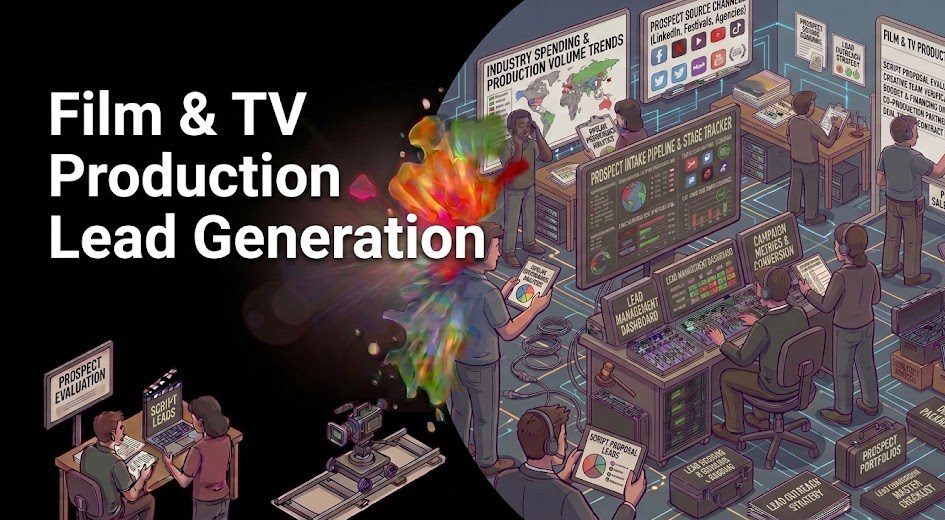
8 Film & TV Production Lead Generation Strategies That Actually Close Deals in 2026
Most entertainment sales teams are still working leads that are six months stale. Here's how the best producers, distributors, and service providers are finding deals before anyone else knows they exist.
Here's the thing nobody says in a pitch meeting: most film and TV production lead generation strategies in use today were designed for a market that no longer exists. Cold email lists built from festival catalogs. IMDb credits scraped six months after the deals closed. LinkedIn searches that surface the same 40 names every producer already knows. It's not that these approaches don't occasionally produce a contact — it's that they produce contacts at exactly the wrong moment in the production lifecycle, when budgets are committed and vendor shortlists are closed.
The producers, distributors, and service companies winning business in 2026 are operating from a fundamentally different intelligence base. They know which projects are in early development before the trades cover them. They reach the right executive when the conversation is still worth having. And they've stopped treating lead generation as a separate activity from market intelligence — because in the modern entertainment supply chain, they're the same thing.
This guide breaks down 8 strategies that are actually generating qualified leads in film and TV production right now. Not hypothetically. Not "according to a whitepaper." In active use by companies with production relationships at Netflix, Warner Bros., Paramount, and across the independent film ecosystem covering 140,000+ active production companies globally.
Track 400,000+ In-Development Projects — Find Leads Before the Trades Do
Vitrina's real-time project tracker monitors film and TV productions across 140,000+ companies globally. See what's in development, who's attached, and which markets are still open — before budgets close.
✓ 200 free credits | ✓ No credit card required | ✓ Trusted by Netflix, Warner Bros., Paramount
Get 200 Free CreditsWhy Traditional Film & TV Lead Generation Fails — and Keeps Failing
The Fragmentation Paradox is the best framework for understanding why traditional entertainment lead generation underperforms so consistently. There are 600,000+ companies operating in the global film and TV supply chain — but they operate in opaque silos. Capabilities are unverified. Deal histories are invisible. Capacity is relationship-dependent. Pricing has no benchmarks.
What this creates is an information asymmetry that systematically advantages insiders and disadvantages everyone else. Your sales team isn't losing deals because their pitch is wrong. They're losing deals because they're arriving at the conversation three months after it was worth having. The project is packaged. The VFX vendor is signed. The co-producer is aboard.
The Fragmentation Paradox: The counterintuitive situation where 600,000+ companies operating globally create scarcity of actionable intelligence — not abundance. More suppliers means more opacity, more information asymmetry, and higher deal costs for producers who lack the tools to navigate it.
Phil Hunt, Founder and CEO of Head Gear Films — one of the UK's most prolific production financiers with 550+ movies financed and 35-40 productions per year — describes the current market bluntly: "The whole industry has become much, much harder in terms of getting movies off the ground and getting movies sold." That's not a cyclical observation. It's a structural one. The companies winning deals in this environment aren't working harder at the old strategies — they've replaced them entirely.
The 8 strategies below are the replacement playbook. But let's be direct: none of them work in isolation from the others. The highest-performing entertainment business development operations use three or more of these simultaneously, feeding intelligence from one into the decision-making of the next.
The 8 Film & TV Production Lead Generation Strategies That Work in 2026
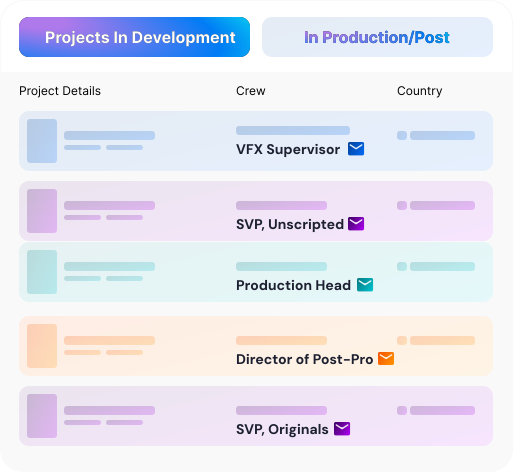
This is the strategy most entertainment service companies talk about wanting but don't actually execute — because they've never had the infrastructure to do it properly. Real-time project tracking means monitoring active and in-development productions globally, and surfacing the ones that match your target client profile, before they've awarded contracts.
The window that matters is pre-production. A production entering pre-production for a $15M scripted series hasn't locked its VFX provider, its post facility, or its local production services company. It's actively evaluating options. That conversation — if you can get in front of it — is worth 10 cold outreach emails sent six months later, after the budget is spent.
Vitrina's project tracker monitors 400,000+ active global productions. You can filter by genre, budget tier, territory, production stage, and greenlight status — then route qualified projects directly into your sales pipeline. The companies that have integrated this tracker into their daily lead generation workflow are reaching decision-makers 6-8 weeks before competitors.
Pre-production and development-stage projects with uncommitted budgets and open vendor shortlists.
Projects already in production or post — budgets are committed, vendors are signed, the conversation is closed.
Here's something worth sitting with: the best entertainment deals don't get made when a project is announced. They get made when the right partner walks in with a term sheet before anyone else is in the room. Pre-development intelligence means monitoring IP acquisitions, option agreements, spec script sales, and greenlight decisions at the earliest possible stage — before the trade press covers them, before the official announcement, and before every competitor in your market is suddenly calling the same producer.
This is what Phil Hunt calls "the center of the carousel" — being positioned at the point where deals form, not where they get publicized. Head Gear Films finances 35-40 films per year not by chasing every project, but by monitoring the market well enough to know which projects are forming before they need financing. That's pre-development intelligence as a business model.
For distributors and pre-sales buyers, the intelligence comes from tracking which production companies are actively developing slates, which IP they've optioned, and what genres and budget tiers they're working in. Rolla Karam, Senior Vice President of Content Acquisition at OSN — the premium streaming and TV platform covering 23 countries across MENA — describes receiving pitches daily and actively shortlisting projects with WBD for original development. If you want to be in that conversation, you need to know it's happening before the pitch deck lands in someone else's inbox.
Distributors, financiers, and broadcasters who need to position ahead of the market rather than react to it.
Production service vendors focused on near-term project wins — real-time tracking (Strategy 1) is the better entry point.
The hardest thing about B2B lead generation in film and TV isn't finding the company — it's finding the right person inside it. A VFX inquiry sent to a development executive goes nowhere. A distribution pitch landing in a VP of production's inbox gets forwarded once, maybe, and then disappears. The entertainment supply chain's decision-making structure is opaque enough that even experienced executives regularly reach the wrong contact on the first approach.
Decision-maker mapping means understanding — precisely — which executive at which company controls the budget category you're selling into, and what their current project responsibilities are. A Head of Production at a studio overseeing three active productions has a completely different purchasing authority than the same title at a company between slates. Metadata that links people to projects, projects to budget stages, and budget stages to procurement timelines is the infrastructure that makes this mapping possible.
Vitrina's 5 million+ entertainment professional profiles are linked directly to active project data — so you can see not just that someone holds a title, but what projects they're currently attached to, what they've recently greenlit, and what markets they're active in. That's the difference between a warm lead and cold outreach with a name on it.
When combined with real-time project tracking — you know the project exists AND who controls the relevant budget.
Using static contact databases without project linkage — you'll reach real people with outdated responsibilities.
Here's the co-production paradox most producers live inside without naming: you know 2-3 potential partners per territory from festival relationships — but 500+ qualified companies in each major market remain invisible. You default to partners you've worked with before, even when the project calls for something different. And because you don't know who else is out there, you can't tell whether your deal terms are fair or whether you're leaving co-financing on the table.
This is the fragmentation paradox operating at the deal level. According to Vitrina's research on co-production lead generation, producers who search the full verified database for co-production partners — rather than relying on festival-network introductions — access 100x more qualified candidates per territory. That's not a marginal improvement. It's a structural competitive advantage.
For MENA executives in particular, the opportunity is acute. OSN's Rolla Karam notes that the platform is "in the middle of the shift" to original content, focusing on Arabic-language scripted series with WBD as a co-investment partner — and is actively open to receiving qualified pitches from international companies. But "open to pitches" isn't the same as "easy to find." Data-driven co-production discovery is what gets you in that room.
Projects requiring tax treaty co-financing, territorial pre-sales, or broadcaster co-investment where verified partner credentials are essential.
Single-territory productions that don't benefit from co-financing — direct project tracking is more efficient.
Vitrina's 140,000+ verified company profiles are linked to active project data — so you reach the right executive at the right stage, every time. Netflix UK used Vitrina to verify a partner in 48 hours.
Smart Pairing is Vitrina's proprietary approach to the fundamental entertainment lead generation problem: too many companies exist to manually evaluate, and the ones worth contacting look identical on the surface to the ones that aren't. Smart Pairing uses verified project data, capabilities metadata, deal history, and territory alignment to surface the specific companies — out of 140,000+ — that represent genuine lead opportunities for your particular offer.
Think about what this replaces. Traditional sales teams spend 60-70% of their outreach time on companies that don't fit their target profile. Wrong budget tier. Wrong genre. Wrong territory. Already in a competing relationship. Smart Pairing eliminates that waste at the top of the funnel, meaning your sales team spends its time on qualified conversations rather than volume cold outreach.
The output isn't just a ranked list — it's a prioritized pipeline with enough context (recent projects, greenlight history, current capacity, executive contacts) to make an intelligent first outreach. That's what converts a lead into a conversation and a conversation into a deal.
Sales and business development teams with defined ICP criteria who currently rely on manual research or generic database searches.
Teams without a clear target client profile — Smart Pairing amplifies a good ICP, but can't substitute for one that doesn't exist.
Market intelligence and lead generation are usually treated as separate functions. They shouldn't be. The most expensive mistake in entertainment business development is investing a quarter of your team's capacity in pursuing leads that look viable on the surface but are disqualified by information you didn't have when you started the conversation.
A production company in "active development" that hasn't closed financing in 18 months isn't a lead — it's a time sink. A broadcaster that's publicly commissioning but has paused acquisitions pending a format rights dispute isn't a buyer right now. Using real-time market intelligence to qualify leads before outreach isn't just efficiency — it's the difference between a pipeline that converts and one that looks full but goes nowhere.
According to Deadline, entertainment production financing tightened significantly following the 2023-2024 industry recalibration, with companies across the supply chain reporting longer deal cycles and more rigorous commissioning requirements. The producers navigating that environment successfully are the ones with enough market intelligence to know which projects are progressing and which are stalling — before they've spent two months in a conversation that was never going to close.
CXOs and senior BizDev leads who need to allocate team capacity to highest-probability opportunities in a tighter market.
High-volume transactional sales teams where deal qualification happens through volume rather than upfront intelligence.
The companies operating at the highest scale in entertainment lead generation aren't running manual searches every morning. They've piped the intelligence directly into their existing CRM and sales workflow through API integration — so that when a new project meeting their target criteria enters development anywhere in the world, the alert lands in a salesperson's pipeline automatically.
Vitrina's entertainment data API enables exactly this — continuous project and company intelligence delivered directly to sales tools, partner portals, or proprietary deal-tracking systems. It doesn't replace human judgment on which opportunities to pursue. But it guarantees that no qualified opportunity escapes notice simply because your team didn't happen to search for it that day.
PRG, one of the world's largest production equipment and services companies, integrated Vitrina's project tracking directly into their business development workflow — surfacing production projects at the pre-shoot stage across their target markets in real time. The commercial ROI is straightforward: fewer missed opportunities, faster response times, more consistent lead quality.
Organizations with established sales infrastructure looking to automate the top-of-funnel intelligence layer and eliminate manual research.
Small teams or individual producers — the platform's direct search tools deliver the same intelligence without API overhead.
Most lead generation thinking focuses on the sell side — finding buyers for your production services or content. But the logic works equally powerfully in reverse. Acquisition executives at streaming platforms, broadcasters, and distribution companies face a version of the same fragmentation problem: there are 140,000+ active productions globally, and they need to know which ones match their acquisition criteria before their competitors do.
Content acquisition intelligence means tracking which productions are approaching completion, which rights markets are open, and which projects carry the metadata signatures of content that travels well internationally — all before the project appears at a market or is formally put into sales. According to Screen International, the most sought-after content deals at European markets are increasingly closed in bilateral conversations before the market opens, not during the market itself.
Rolla Karam at OSN describes reviewing pitches daily for OSN's 23-country MENA platform, with a clear mandate for Arabic-language scripted series and a WBD co-investment structure already in place. That means producers with the right project profile who reach her team before they're scheduled to pitch elsewhere have a structural advantage — but only if they know OSN's current acquisition priorities and project criteria. Real-time content acquisition intelligence is what delivers that knowledge.
Acquisition executives and rights buyers who currently miss deals because they discover available projects after the window has closed.
Production service vendors whose lead gen is project-stage dependent — real-time tracking (Strategy 1) is your higher ROI starting point.

3 Industry Trends Reshaping Film & TV Lead Generation Right Now
These aren't projections. They're operational changes already affecting how the most competitive companies in the entertainment supply chain are generating and qualifying leads in 2026.
According to Variety, the shift to pre-market deal-making has accelerated significantly since 2022, with major streaming platforms and international broadcasters increasingly closing acquisitions and co-production deals before projects appear at traditional markets like MipTV, Berlinale Co-Pro Market, or AFM. This compresses the window for late discovery to near-zero for deals with the highest-profile buyers.
For sales and business development teams, this means the lead generation strategy that worked at a market in 2019 is now structurally inadequate for the highest-value targets. The companies winning those deals are the ones who identified the opportunity 6-8 weeks before anyone booked a hotel in Cannes.
The entertainment industry ran on introductions for decades. But as production volumes increased, deal cycles compressed, and international co-production became the norm rather than the exception, the introduction model's limitations became structural rather than occasional. A warm introduction is still valuable — but it's no longer sufficient verification in an environment where a vendor's claimed capabilities, capacity, and pricing can be checked against their actual project history in minutes.
Verified Company Data: Entertainment company profiles that include confirmed project credits, current capacity status, financial health indicators, and executive contact data — sourced and maintained by a third party rather than self-reported. Vitrina maintains verified profiles for 140,000+ active film and TV companies globally.
For lead generation, this shift matters because verified data reduces the trust cost of a cold approach. If your first outreach to a production company arrives with demonstrated knowledge of their recent projects, their genre focus, and their current development slate, it's not cold anymore — it's intelligence-led.
Most Western entertainment sales teams still treat MENA and APAC as secondary markets — which means they're systematically underserving the two fastest-growing content investment regions on earth. Saudi Arabia's Vision 2030 content investment is funding infrastructure at a scale comparable to China's entertainment buildout in the 2010s. India's JioHotstar platform — formed from Disney's India merger with Reliance — is now one of the world's largest streaming entities by subscriber count, with an active originals mandate across scripted drama and sports.
The lead generation opportunity is acute for any company with content, services, or co-financing capability that fits MENA or APAC buyers' current mandates. Rolla Karam's OSN platform is actively seeking scripted Arabic-language series with a "local to global" ambition — and has WBD as a co-investment partner already in place. That structure will generate multiple commissioning opportunities in 2026 and 2027. The companies that are in those conversations right now got there through proactive intelligence — not festival networking.
Ask VIQI: Which of These 8 Strategies Should Your Team Prioritise Right Now?
VIQI is trained on 1.6 million titles, 360,000 companies, and 5 million entertainment professionals. Tell it your company type, target markets, and deal size — and it'll tell you exactly which lead generation strategies apply to your situation, with specific steps.
✓ 200 free credits | ✓ No credit card needed
Ask VIQI NowFrequently Asked Questions
Here's what the best-performing entertainment sales and business development operations understand that most of their peers don't: lead generation in this industry is not a volume game. It never was. A film production doesn't need 200 VFX vendor pitches — it needs the right three, at the right stage, with verified capabilities that match the project's actual requirements. The company that arrives with the right information at the right moment wins the conversation regardless of how many other vendors are competing.
The 8 strategies in this guide are all expressions of the same underlying principle: intelligence-led outreach closes more deals faster and at lower cost than any volume-based cold outreach approach. That's true whether you're a service vendor trying to get on a shortlist, a distributor trying to discover content before the market, or a financier trying to identify projects at the pre-greenlight stage.
The Fragmentation Paradox isn't going away — there will always be more companies operating in the entertainment supply chain than any individual business can track manually. But the paradox only hurts you if you don't have the tools to cut through it. Key takeaways:
- Real-time project tracking is the single highest-ROI starting point for any entertainment sales or BizDev team
- Decision-maker mapping works best when combined with active project data — not as a standalone contact database
- Co-production partner discovery unlocks 100x more qualified options per territory than festival networking alone
- MENA and APAC markets are generating substantial, underserved lead opportunities for companies with the right intelligence infrastructure
- The window before the trades is now the competitive battleground — companies arriving at markets are increasingly arriving too late
Vitrina gives your team the real-time project intelligence, verified company data, and decision-maker contacts to reach qualified leads before your competitors know they exist.
- Vitrina — Fragmentation Paradox: vitrina.ai
- Phil Hunt, Head Gear Films — Vitrina LeaderSpeak Ep. 62 (October 2025): youtube.com
- Rolla Karam, SVP Content Acquisition, OSN — Vitrina LeaderSpeak Ep. 69: vitrina.ai
- Variety — Pre-market deal-making trends in international co-production: variety.com
- Screen International — European market bilateral deal-making 2024: screendaily.com
- Deadline — Production financing market conditions 2024–2025: deadline.com